A useful way to rethink solar in 2026 is this: the theoretical ceiling for a standard single-layer solar cell is 33.7%, yet the most efficient mass-market panels are still around 24.8%, while lab devices have already reached 47.6% with multi-junction designs and 34.85% with a perovskite-silicon cell announced in 2025, according to Sunsave’s review of improving solar efficiency.
That gap changes the conversation. The latest technology in solar panels isn’t just about “higher efficiency” in the abstract. It’s about separating three very different things that often get mixed together: lab records, early commercial products, and bankable equipment you can confidently put on a roof or into an investment model.
Homeowners usually care about roof space, electricity savings, and warranty confidence. Investors care about energy yield, asset life, and financing risk. Both groups need the same skill: knowing when a breakthrough is real, and when it’s still more science story than buying decision.
The Dawn of a New Solar Era
Solar technology has entered a new phase. For years, most of the improvements came from refining silicon panels that already looked familiar on rooftops. Those gains still matter, but the bigger story now is architectural. Engineers are stacking materials, redesigning electrical contacts, and making panels work harder with the same footprint.
That matters because panel efficiency does one simple thing. It determines how much electricity you can get from a fixed area. If your roof is small, higher efficiency can mean the difference between offsetting part of your consumption and offsetting much more of it. If you’re building a large project, better efficiency can reduce land pressure, balance-of-system complexity, or both.
Why this moment feels different
The latest technology in solar panels stands out because several lines of progress are happening at once:
- Silicon is still improving. Manufacturers continue to squeeze more performance from established cell designs.
- Tandem cells are crossing out of the lab. They’re no longer just headline science.
- Panel design is changing too. Bifacial modules and building-integrated products are expanding where solar can work.
- Buyers are asking harder questions. Efficiency is only one part of value. Reliability over decades matters more.
Practical rule: A record efficiency number is interesting. A proven commercial module with dependable long-term field performance is investable.
That distinction is where many articles fall short. They list exciting technologies but skip the question that decides real purchases: can this panel deliver for years in heat, moisture, and ordinary operating conditions?
In 2026, that’s the lens that matters most.
Understanding the New Solar Technology Landscape
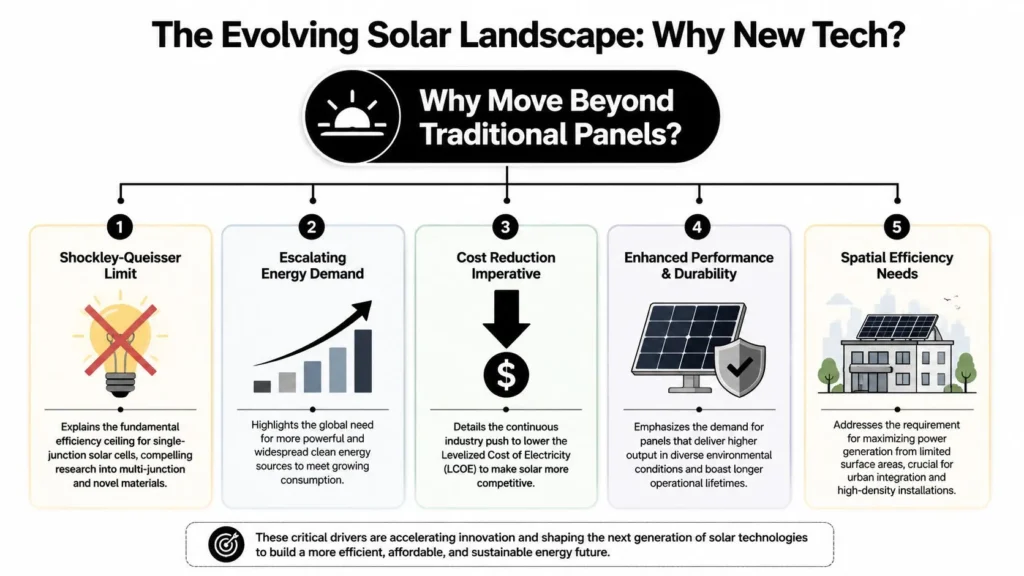
Traditional solar panels haven’t stopped working well. They’ve just approached the point where getting each additional gain becomes harder. The easiest analogy is a bucket.
A standard single-junction silicon solar cell is like a bucket that can only hold so much water. You can improve the bucket shape, seal some leaks, and pour more carefully, but eventually the bucket is close to full. For single-layer solar, that ceiling is the familiar efficiency limit that pushes engineers to look beyond conventional designs.
Some people hear “new solar technology” and assume it means a totally different product. Often it doesn’t. Sometimes the panel still looks almost the same from the outside. The primary change happens inside the cell, where manufacturers try to reduce electrical losses or capture more of the sun’s spectrum.
Two levels of innovation
It helps to split the latest technology in solar panels into two categories.
Cell-level innovation
This is the microscopic side. Engineers change the material stack, the contact structure, or the way light and charge move through the device. Terms like TOPCon, HJT, perovskite, and tandem belong here.
These changes affect the core physics. The goal is to convert more incoming sunlight into usable electricity while losing less to heat or recombination.
Module-level innovation
This is the panel as a product. Engineers decide how cells are packaged, how both sides of a panel can collect light, or how a panel can become part of a roof, facade, or tile.
For many buyers, module-level innovation is easier to see. A bifacial panel, a solar facade, or a solar roof product changes how the system fits the building or site.
Why the industry keeps pushing
The pressure to improve comes from practical constraints, not just scientific curiosity.
- Limited space: Rooftops, carports, and urban buildings don’t offer endless area.
- Project economics: More power from the same footprint can improve system value.
- Real-world conditions: Heat, reflection, shading, and surface design all affect output.
- Broader adoption: Solar needs to fit homes, warehouses, facades, and utility sites, not just ideal roofs.
If you want a broader primer on where solar fits in the bigger energy mix, this guide to renewable energy basics is a helpful companion.
The smartest way to read solar news is to ask one question first: is this a better cell, a better panel, or a better system design? Each solves a different problem.
That question keeps the jargon manageable. It also prevents confusion when one article talks about a lab cell, another talks about a shipping module, and a third talks about an entire solar installation.
Next-Generation Solar Cell Architectures
Most efficiency gains come from one idea: stop wasting sunlight. Some photons pass through a cell without being absorbed well. Others create charges that recombine before they can be collected. New cell architectures try to catch more light and lose less electricity on the way out.
From PERC to better silicon designs
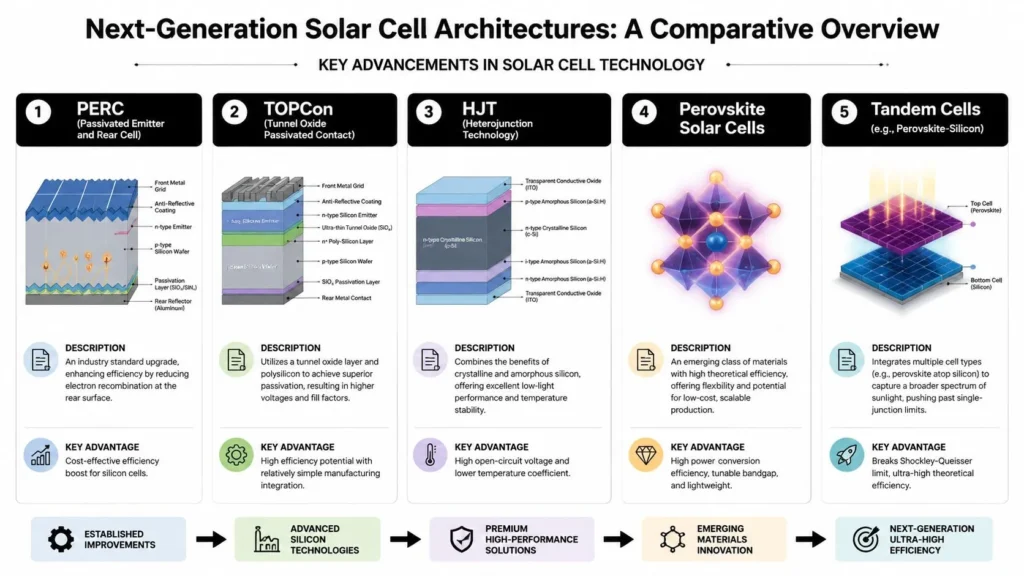
PERC became a major upgrade because it improved how the back side of a silicon cell handled light and charge. In plain terms, it reduced waste at the rear surface and helped the cell make better use of incoming sunlight. Think of it as adding a better reflective lining to the bucket rather than changing the bucket itself.
That mattered because PERC offered a practical step up without requiring the industry to rebuild everything from scratch. It helped push silicon forward using manufacturing methods the market could adopt at scale.
TOPCon goes further. It uses a very thin oxide layer and a refined contact structure to reduce electrical losses. For a buyer, the practical outcome is simple: more of the generated charge is collected instead of lost. TOPCon has become especially important because it raises efficiency while staying close enough to familiar silicon production to be commercially meaningful.
HJT, or heterojunction technology, takes another route. It combines crystalline silicon with thin amorphous silicon layers. That combination is useful because it can improve performance under a wider range of operating conditions and support very high efficiency potential. HJT often comes up in conversations about premium modules because it’s associated with strong electrical performance, though buyers still need to weigh cost and supplier track record.
Why perovskites changed the conversation
Perovskite grabbed attention because it opened a new path rather than just refining silicon again. The material can be tuned to absorb parts of sunlight differently from silicon. That’s why it works so well in a tandem design.
A good analogy is layered window tint. One layer is best at blocking one part of the light spectrum, while another layer handles a different part. Stack them carefully and the system catches more of the total light. That’s what a perovskite-silicon tandem cell does.
The World Economic Forum highlights why this matters. Perovskite-silicon tandem solar cells capture different parts of the solar spectrum, and it points to LONGi’s certified 33.9% efficiency for such a cell, far above the 20% to 23% range of typical commercial silicon panels in the same discussion of solar panel innovations.
The promise and the trade-off
Tandem cells are the most important breakthrough to watch because they address the core bottleneck of single-junction silicon. They offer a credible route to more power from the same roof or land parcel.
But buyers shouldn’t stop at the headline number. A high-efficiency tandem cell still has to answer hard engineering questions:
- Stability: Can the material keep performing over long exposure to weather?
- Manufacturing consistency: Can factories produce it at commercial quality, not just in a lab?
- Module integration: Can the stack survive real installation and operating stress?
- Financeability: Will lenders and asset owners treat it as proven equipment?
Readiness in plain English
Here’s the practical ladder:
| Architecture | What it changes | Main buyer benefit | Readiness |
|---|---|---|---|
| PERC | Better rear-side cell behavior | Mature performance uplift | Established |
| TOPCon | Lower contact losses | Higher efficiency with familiar silicon roots | Commercially strong |
| HJT | Hybrid silicon structure | Premium performance profile | Commercial, but more selective |
| Perovskite | New absorber material | Big efficiency upside | Emerging |
| Tandem | Stacked materials | More output from same area | Early commercial frontier |
New architectures don’t replace due diligence. They raise the quality of questions you need to ask.
For homeowners, that means asking installers which technology they deploy most often, not which one appears most in headlines. For investors, it means separating demonstrator excitement from fleet confidence.
Innovations in Panel Design and Application
Cell architecture is only half the story. A solar panel also has to live somewhere. That’s why some of the most practical innovation is happening in how panels are built, mounted, and integrated into surfaces people already use.
Bifacial panels in the real world
A standard panel mainly works from the front. A bifacial panel also captures reflected light on the back. That sounds minor until you place it in the right setting.
A utility-scale solar farm in a bright, reflective environment gets more than direct sunlight. Light bounces off pale soil, concrete, snow, or a white membrane roof and reaches the rear of the module. With modern TOPCon bifacial modules, rear-side efficiency can be around 91.7% of the front-side efficiency, according to this technical discussion of modern bifacial TOPCon performance. That’s why bifacial designs are especially useful in high-albedo sites.
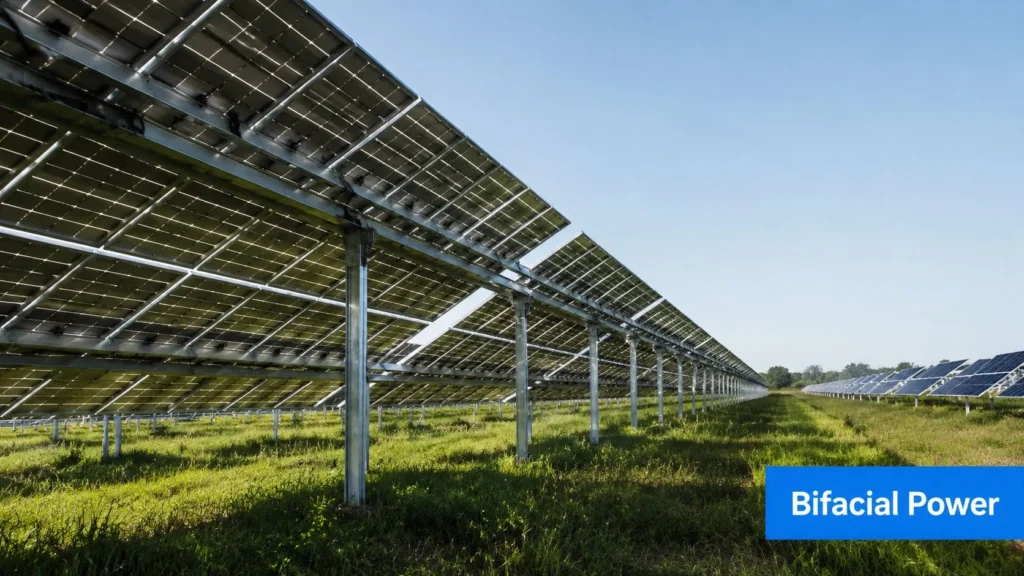
For a homeowner, bifacial often makes the most sense on a ground mount, pergola, or raised structure where the rear side isn’t blocked. For a developer, it can change layout decisions, row spacing, and ground treatment.
Solar that becomes part of the building
Some innovation is less about chasing the last point of efficiency and more about making solar fit the built environment gracefully.
Building-integrated photovoltaics, often shortened to BIPV, turn parts of the building envelope into power-producing surfaces. That can include facades, skylights, or roof elements. Architects like this approach because it treats solar as a design material rather than an add-on.
A related example is solar roofing products. If you’re looking at alternatives to rack-mounted modules, resources on VPP compatible solar power tiles can help clarify how integrated solar surfaces fit into a modern distributed energy strategy.
Thin-film and niche applications
Thin-film solar still matters because not every project has the same priorities. Some sites care more about weight, flexibility, or performance profile than about squeezing maximum wattage from a small rectangle.
That’s why panel innovation now spans several use cases:
- Utility sites: Bifacial modules that benefit from reflective ground and careful layout.
- Commercial buildings: Roof systems where design, weight, or geometry may matter as much as peak output.
- Architectural projects: Facades, glazing elements, and integrated roof surfaces.
- Specialty installations: Surfaces where rigid conventional panels aren’t the cleanest fit.
A better solar panel isn’t always the one with the highest efficiency. Sometimes it’s the one that fits the site with the fewest compromises.
That’s a useful shift in mindset. The latest technology in solar panels is not one product. It’s a toolkit. The right choice depends on where the panel sits, what surrounds it, and how predictable you need its lifetime performance to be.
Performance vs Practicality A 2026 Buyers Guide
A panel can win headlines in a laboratory and still be a poor buying decision for a roof or a financed project. For 2026 buyers, the useful question is narrower. Which solar technologies are efficient enough, proven enough, and available enough to count as reliable purchases rather than interesting experiments?
That distinction matters because solar moves through three very different stages. First comes the lab result, which shows what a cell can do under tightly controlled conditions. Next comes the commercial product, which is what a manufacturer can produce at scale with repeatable quality. Then comes the bankable product, which has enough field history, warranty confidence, supply stability, and insurer or lender acceptance to support a serious long-term investment.
A simple analogy helps. A concept car at an auto show can be impressive, but a family or fleet buyer cares more about service history, parts availability, and how the vehicle performs after years on the road. Solar works the same way.
What bankability really means
Bankability sounds abstract, but the idea is practical. It asks whether the market trusts a panel to keep producing electricity predictably over its expected life.
For homeowners, that trust shows up as lower technology risk and fewer unpleasant surprises after installation. For investors and commercial buyers, it affects financing terms, insurance treatment, yield forecasts, and replacement planning. Analysts at GreenLancer note that perovskite-silicon tandem cells still face questions around degradation and performance under heat and moisture, which is why bankability remains a central question for new high-efficiency panels.
That is the gap many articles skip. New technology can be genuine progress and still be early from a purchasing standpoint.
Solar Technology Comparison 2026
| Technology | Commercial Efficiency | Relative Cost | Market Maturity | Best For |
|---|---|---|---|---|
| PERC | Lower than newer premium silicon options | Lower | Mature | Budget-focused projects where proven supply and price matter most |
| TOPCon | High among mainstream commercial silicon modules | Moderate | Strong commercial maturity | Homeowners and developers who want a current, widely available upgrade |
| HJT | Premium high-efficiency commercial segment | Higher | Commercial, but more specialized | Space-limited roofs and buyers willing to pay for premium performance |
| Tandem | Higher than standard silicon in early commercial offerings | High initially | Early commercial | Projects where area is unusually constrained and the buyer accepts emerging-tech risk |
The practical takeaway is straightforward. TOPCon and HJT are easier to treat as buyable products today. Tandem is more like an early premium category to watch carefully, especially if your project depends on proven warranties, broad installer familiarity, and predictable long-term operation.
A decision filter that works in the field
Start with the site, not the spec sheet. A small roof with high electricity prices may justify paying more for premium efficiency. A large ground-mount project may gain more from proven procurement, easier replacement, and lower module cost than from chasing every last point of efficiency.
Use this filter:
- Choose proven silicon first if you want broad installer experience, easier sourcing, and stronger field confidence.
- Choose TOPCon or HJT if roof area is limited and higher output per square foot improves the economics enough to justify the premium.
- Treat tandem as selective, not default if you are considering 2026 purchases. It may fit innovation-led projects, but many buyers should wait for more operating history and broader market acceptance.
- Price the whole system, not just the panel because inverter choice, shading losses, roof geometry, labor, and monitoring often have as much effect on results as the module label.
Maintenance belongs in that calculation too. A high-efficiency panel only helps if sunlight reaches the cells consistently. If you are comparing long-term upkeep, a guide to professional solar panel cleaning investment can help frame that part of ownership cost.
Don’t judge the panel by module efficiency alone
Two buyers can install panels with similar nameplate ratings and get very different value. One may have a clean, unshaded south-facing roof and a battery that shifts evening usage. The other may have partial shade, limited export compensation, and no storage. The better purchase is the one that fits the operating conditions.
Storage can change that calculation a lot. If your goal is resilience, self-consumption, or better use of midday solar output, panel selection should be paired with a basic understanding of battery behavior. This explainer on how lithium batteries work is useful if you want the storage side explained in plain language.
The best 2026 solar buy is rarely the newest module on paper. It is the product with a credible warranty, a supply chain you can count on, and performance characteristics that match your roof, climate, and risk tolerance. For many buyers, that points to mature premium silicon. For a smaller group, it may justify watching tandem closely without betting on it too early.
The Future of Solar Energy Generation
Solar is now one of the cheapest sources of new electricity in many markets. That headline matters, but it can also hide the more useful question for a buyer in 2026: which solar technologies are bankable, available at scale, and likely to perform as promised for decades?

The answer is more conservative than many trend lists suggest. Tandem solar has clearly moved closer to commercial reality, and early products from firms such as Oxford PV have drawn serious attention. But investors and homeowners should read that progress in context. A lab record is like a concept car at an auto show. A bankable module is the version that can be manufactured consistently, shipped on time, insured, warranted, and financed without unusual risk.
That distinction will shape the next few years of solar more than any single efficiency headline.
The panel becomes one part of an energy system
Future solar growth will come from better coordination between parts of the system, not just better cells. Panels now work more like the engine in a larger machine that includes the inverter, battery, controls, software, and utility connection. If one part is mismatched, the whole system gives up value.
A practical example helps. A roof with slight morning shade and no battery may benefit more from good power electronics and clear monitoring than from paying extra for an ultra-premium module. Another property with tight roof space and high evening power prices may justify a higher-efficiency panel because every square foot matters. The best technology depends on the job you need it to do.
Three long-term shifts are becoming easier to see:
- Modules are getting smarter at the system level. Better optimization and monitoring make it easier to spot underperformance, reduce mismatch losses, and identify maintenance issues early.
- Solar and storage are increasingly designed together. That pairing matters because midday production is often more valuable when it can be shifted into evening demand.
- Buildings will generate power from more surfaces. Rooftops will remain the main site for generation, but facades, carports, and integrated materials will keep expanding where design and economics support them.
Solar also sits inside a wider race to expand low-carbon generation. For a useful contrast with another high-profile energy frontier, see this article on a recent fusion power breakthrough.
A short visual overview helps show how rapidly solar systems are evolving beyond conventional rooftop arrays.
What to expect from the market
For most buyers in 2026, mature silicon products will still be the low-risk choice. That includes premium versions with incremental gains in efficiency, temperature behavior, and degradation warranties. Tandem products are worth watching closely, especially for projects where space is limited, but wide adoption will depend on manufacturing scale, field data, warranty confidence, and financing comfort.
In other words, the future of solar generation is not just about chasing the newest panel. It is about choosing technology that can move from brochure promise to dependable cash flow.
That is the primary direction of travel. Higher output per square foot will matter. Better integration with storage and controls will matter more. And the winners in 2026 will usually be the products that combine innovation with proof, not innovation alone.
If you enjoy clear, practical explanations of science and technology, explore more articles at maxijournal.com. It’s a strong place to keep up with approachable writing on energy, innovation, business, health, education, travel, entertainment, and other everyday topics shaped by change.
Discover more from Maxi Journal
Subscribe to get the latest posts sent to your email.