You’re probably doing what most couples do at this stage. One of you is scrolling through polished ring photos, saving sleek bands and diamond-studded stacks. The other is asking the less glamorous questions: Will this scratch? Can it be resized later? Will it sit next to the engagement ring without that awkward gap?
That tension is normal. A wedding band looks simple, but it’s one of the few wedding purchases you’ll use every day. Flowers fade. Cake gets eaten. A ring has to survive handwashing, workdays, travel, heat, winter dryness, and years of changing taste.
The best wedding band isn’t automatically the boldest, the most expensive, or the most fashionable. It’s the ring that still feels right after the honeymoon glow wears off. It should suit your hand, your routine, your budget, and your idea of what “forever” looks like. If you’re also thinking about your overall personal style, this guide to developing a fashion sense can help you separate passing taste from the pieces that really fit you.
Starting the Search for Your Forever Ring
A couple walks into a jewelry store thinking this will be the easy part. They already chose the engagement ring. Surely the band is just a simpler version of that decision.
Then the tray comes out.
There’s yellow gold, white metals, matte finishes, polished edges, slim bands, wide bands, plain bands, curved bands, and bands covered in stones. Ten minutes in, they realize they aren’t picking an accessory. They’re picking a daily object that has to feel comfortable on tired fingers, look good in ordinary light, and still make sense years from now.
That’s why the phrase best wedding band can be misleading if you treat it like a popularity contest. The best ring for one person may be a plain 14K gold band that can be resized and polished over time. For someone else, it may be a heavier platinum band, or a lightweight titanium ring that barely feels there.
The smartest buyers don’t start with trend boards. They start with how the ring will live on the hand.
A good choice usually comes from asking practical questions first.
- Daily wear: Do you work with your hands, type all day, lift weights, or wear gloves often?
- Comfort preference: Do you like feeling a ring on your finger, or do you want something low-profile and barely noticeable?
- Long-term flexibility: If your finger size changes later, do you want a metal that a jeweler can usually adjust?
- Visual goal: Should the band blend subtly with the engagement ring, or stand on its own?
Some readers get stuck because they think choosing carefully means choosing cautiously. It doesn’t. You can still pick something modern or expressive. The trick is understanding what you’re giving up, and what you’re getting in return.
Understanding Wedding Band Metals
Metal decides how your ring ages, how it feels at the end of a long day, and how easy it will be to maintain years from now. Style still matters, but metal is the part that determines whether a ring stays satisfying to wear once the excitement of shopping wears off.
A helpful way to compare metals is to treat them like different flooring materials in a home. Hardwood, tile, and stone can all look beautiful. They wear differently, feel different underfoot, and ask for different kinds of upkeep. Wedding band metals work the same way.
Gold and what karat actually means
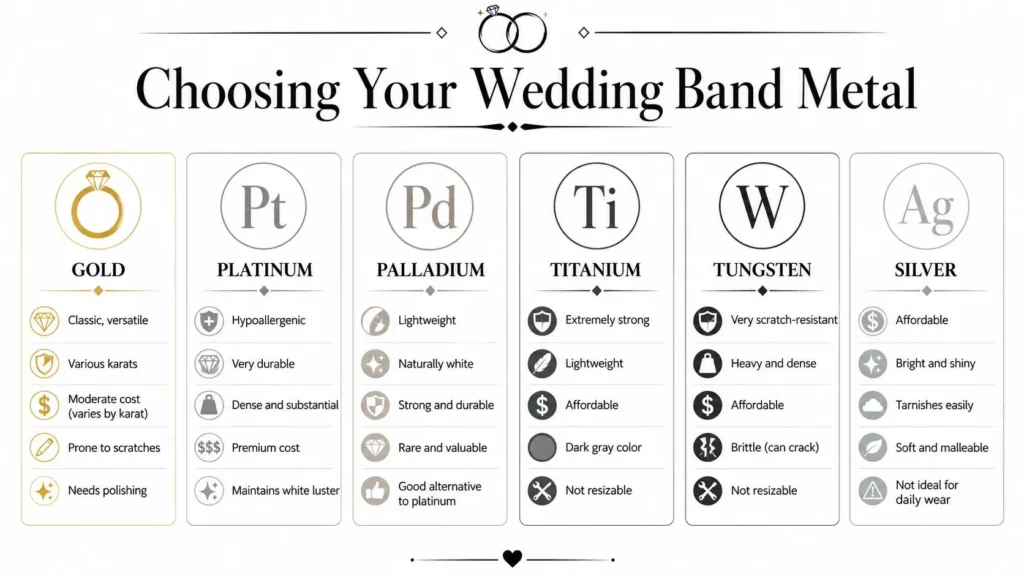
Gold is the familiar starting point for good reason. It is traditional, widely available, and easy for many jewelers to size, polish, and refinish over time. For a ring you plan to wear for decades, that serviceability has real value.
Karat tells you how much pure gold is in the alloy. RockHer explains in its buyer’s guide to men’s wedding bands that 14K gold contains 58.3% gold and 41.7% other metals. Those added metals make it harder than higher-karat options, which is why 14K is often the practical middle ground for everyday wear.
Here is the simple breakdown:
- 10K gold is harder and usually more budget-friendly, but its color is less rich.
- 14K gold balances durability, color, and long-term repair options well.
- 18K gold has a richer gold tone, but it is softer and can show wear sooner in daily life.
That trade-off trips up a lot of first-time buyers. Higher purity sounds better, but daily-wear jewelry does not behave like a display piece. If you want a ring that can handle years of typing, lifting, travel, and occasional knocks, 14K often makes more sense than 18K.
Platinum, titanium, and tungsten
These metals often get grouped together as “durable,” but they solve different problems.
Platinum is a precious metal with a naturally white color and a dense feel. Many people love that weight because it makes the ring feel substantial and permanent. Others try it on and realize they prefer something lighter. Comfort is personal, and hand feel matters more than shoppers expect.
Titanium is almost the opposite experience. It is very light, strong, and easy to forget you are wearing. That can be excellent for someone who dislikes bulky jewelry. The trade-off is future flexibility. Resizing and repair options are often more limited than they are with gold.
Tungsten appeals to buyers who want hardness and strong scratch resistance. It holds its shape well, but RockHer notes that tungsten generally cannot be resized. That is not a small detail. It affects the ring’s cost of ownership, because a future size change may mean replacing the ring rather than adjusting it.
For couples comparing precious and modern metals side by side, this guide to durable wedding band options is a useful companion.
| Metal | What it feels like | Why people choose it | What to watch |
|---|---|---|---|
| Platinum | Dense, weighty | Premium feel, naturally white color | Heavier on the hand, usually higher upfront cost |
| Titanium | Very light | Strong, modern, comfortable for daily wear | Limited resizing and repair flexibility |
| Tungsten | Solid, rigid | Hard surface, scratch-resistant feel | Generally cannot be resized |
Good-looking in the case and practical for real life are not always the same
A polished ring in a showroom is a little like a new car under dealership lights. It shows the best version of itself. What matters more is how it behaves after months of normal use.
Some metals scratch but are easy to refinish. Some resist scratching better but are harder to resize or repair. Some feel luxurious because of their weight. Some feel comfortable because they almost disappear on the hand. None of those qualities is automatically “best.” They only become best if they match your habits and priorities.
This video gives a useful visual overview before you shop in person.
A practical shortlist helps:
- Choose gold if you want classic style, easier long-term servicing, and broad design options.
- Choose platinum if you want a white precious metal and like a heavier ring.
- Choose titanium if low weight matters more than future resizing flexibility.
- Choose tungsten if hardness and scratch resistance matter more than adjustability.
- Approach silver cautiously for an everyday forever ring, because it is softer and can tarnish over time.
- Consider palladium if you want a less common white metal and can confirm local jewelers are comfortable servicing it.
The right metal is the one whose compromises still feel reasonable ten years from now, not just the one that looks strongest on a display card.
Choosing Your Ring Profile and Width
Once the metal is settled, comfort becomes the primary test. Two rings made from the same material can feel completely different because of profile and width. Many shoppers make a fast visual decision, then wonder why the ring feels off after an hour.
Profile changes how the ring sits
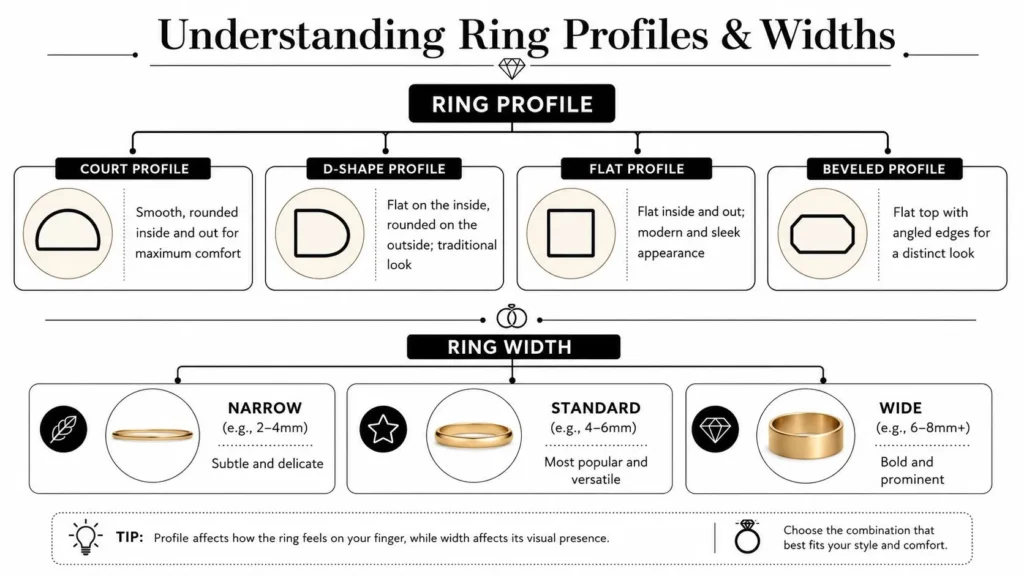
A profile is the ring’s shape when you look at it from the side or in cross-section. That tiny detail changes comfort more than most first-time buyers expect.
Common profiles include:
- Court or comfort-fit: Rounded inside, often easier for daily wear and sliding over the knuckle.
- D-shape: Flat on the inside, rounded on the outside, with a traditional look.
- Flat profile: Crisp and modern, with a cleaner edge.
- Beveled profile: Flat top with angled edges, often a nice middle ground between classic and contemporary.
If you’re unsure, try a flat ring and a comfort-fit ring in the same width. The difference becomes obvious immediately. One may feel sleek and architectural. The other may feel easier to wear for long stretches.
Width changes more than appearance
Width affects presence, comfort, and fit. Reflective Jewelry notes that comfort-fit men’s bands are commonly selected in the 5–8 mm range, and that wider bands usually feel heavier and may require more careful sizing because both width and inner profile affect how the ring sits on the finger, as explained in their article on men’s comfort-fit wedding bands.
That matters even if you aren’t shopping for a men’s ring. The principle is universal. A wider ring covers more finger, feels more substantial, and can fit differently than a narrow one in the same nominal size.
A width that looks elegant in a product photo can feel bulky if you’re not used to wearing jewelry.
How to narrow it down
Try this simple approach in person.
- Start with comfort, not style. Put on a few bands with different interiors. If one slides on and settles naturally, notice that first.
- Then change width only. Don’t compare five variables at once. Test a narrow band, then a standard one, then a wider one in the same general style.
- Look at your whole hand. A very slim band can disappear on larger hands. A wide band can overwhelm shorter fingers.
- Move your hand normally. Grip a bag, hold a phone, make a fist, rest your hand flat.
A quick cheat sheet helps:
| Width feel | Visual effect | Good for |
|---|---|---|
| Narrow | Delicate, subtle | Minimalists, stacking, smaller visual presence |
| Standard | Balanced | Most buyers who want versatility |
| Wide | Bold, more coverage | Statement look, stronger presence |
If you’re torn between two widths, choose the one you forget about faster while wearing it. Admiring the ring is good. Constantly noticing it on your finger usually isn’t.
Getting the Perfect Fit and Pairing
Sizing sounds simple until you remember that fingers change through the day, and two rings that look beautiful separately may not sit well together. A good fit is partly measurement and partly real-world testing.
Getting the size right
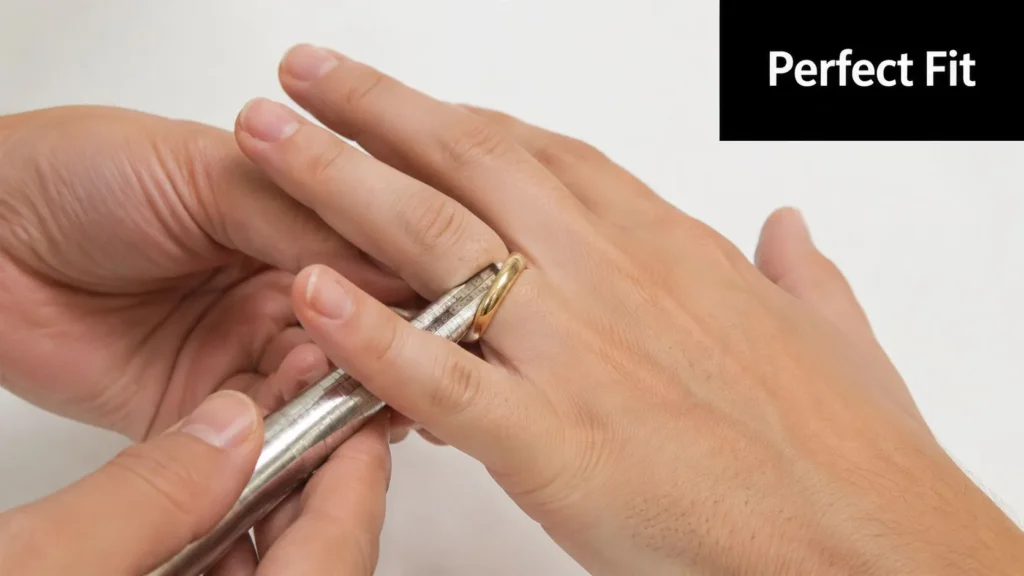
Your ring should go on with a little resistance at the knuckle and settle comfortably once it’s in place. If it spins constantly, it may be too loose. If it feels fine for one minute and unbearable after a short walk, it may be too tight.
A few practical habits help:
- Measure when your body feels normal. Avoid sizing right after exercise, in extreme heat, or when your hands are unusually cold.
- Try the actual width you plan to buy. A wider ring can feel tighter than a narrow one.
- Wear a sample for a bit. Don’t decide in ten seconds at the counter.
- Test both hands if needed. Fingers on your dominant hand may fit differently.
If a jeweler offers only a quick size check with a thin sizer, ask to try on a band closer to your intended width and profile. That extra minute can prevent a frustrating purchase.
Pairing with an engagement ring without a gap
This is one of the biggest real-life issues, especially with unusual engagement rings. The common question isn’t “What’s the prettiest band?” It’s “What will sit next to this ring?”
A documented gap in existing guidance is how to choose for non-standard engagement rings, especially east-west settings, low-set stones, bezel settings, and rings with unusual profiles. Existing advice often mentions contoured, open-cuff, spacer, and curved bands as solutions, but it’s often scattered and not very decision-oriented, as described in this discussion of the flush-fit problem in a fit-first guide gap overview.
Here’s the simplest decision guide:
| Engagement ring shape | Common issue | Band style to try |
|---|---|---|
| Low-set center stone | Straight band bumps against setting | Curved or contoured band |
| Bezel setting | Outer edge blocks flush fit | Open-cuff or shaped band |
| East-west setting | Wider stone changes spacing | Contoured band or spacer |
| Unusual gallery or profile | Band sits unevenly | Custom-shaped or spacer solution |
Bring the engagement ring every time you shop for the wedding band. Never rely on memory.
If pairing feels difficult, don’t assume the band has to match the engagement ring exactly. Sometimes the better choice is a deliberately shaped band that fits cleanly, even if it looks less “standard” on its own. If you’re comparing online and in-store buying options, this roundup of the best places to shop can help you weigh convenience against hands-on fitting.
Considering Gemstones Budget and Ethics
A plain band and a stone-set band can both be beautiful. The hard part is deciding whether the added sparkle is worth the added maintenance, potential repair concerns, and limits on future sizing.
Plain band or gemstone band
A plain band is easier to live with for many people. It’s simple to clean, less likely to catch on things, and usually easier to maintain over time. That doesn’t make it boring. Finish, profile, width, and metal color can give a plain ring a lot of personality.
Stone-set bands bring a different kind of appeal. They can add brilliance, create a matched bridal look, and feel more decorative on their own. But the practical questions matter.
- Half-eternity styles: Often give sparkle across the visible top while leaving some plain metal underneath.
- Full eternity styles: Look luxurious, but can be less forgiving for comfort and later resizing.
- Channel, pavé, and shared-prong styles: Each changes cleaning, security, and repair complexity.
If you love gemstones, ask not just how the ring looks today, but how it will be serviced later. A good jeweler should answer calmly and clearly.
Building a realistic budget
Budget conversations get easier when you have at least one real benchmark. The Knot’s 2023 Jewelry and Engagement Study reported that women’s wedding bands average $1,200, which gives a useful market reference for U.S. buyers, according to The Knot’s article on who pays for the groom’s wedding ring.
That figure doesn’t tell you what you should spend. It tells you that many buyers are shopping in a meaningful price range, not treating the band like an afterthought.
The same source notes that couples still use different buying arrangements in 2026, including the traditional approach where each partner pays for the other’s ring, while many couples now split or otherwise share the cost. That’s helpful because it removes some pressure. You don’t have to follow one etiquette model if another fits your finances better.
A practical budget usually accounts for:
- The metal itself
- Any stones or detailing
- Possible future resizing or maintenance
- Whether you’re buying one ring or a coordinated pair
If you’re trying to balance the band with the rest of the wedding budget, these tips to save money on your wedding can help you decide where to spend for longevity and where to trim.
Ethics and sourcing questions worth asking
Ethics matter to many couples, but this is an area where clear questions work better than vague promises. Ask whether the jeweler can explain metal sourcing, diamond policies, and any recycled-metal options in plain language.
If your values play a big role in what you wear, this introduction to sustainable fashion can help you think through how craftsmanship, sourcing, and long-term use connect.
A ring doesn’t have to be flashy to feel meaningful. Often the most satisfying purchase is the one that respects both your finances and your values.
Ensuring Long-Term Wearability and Value
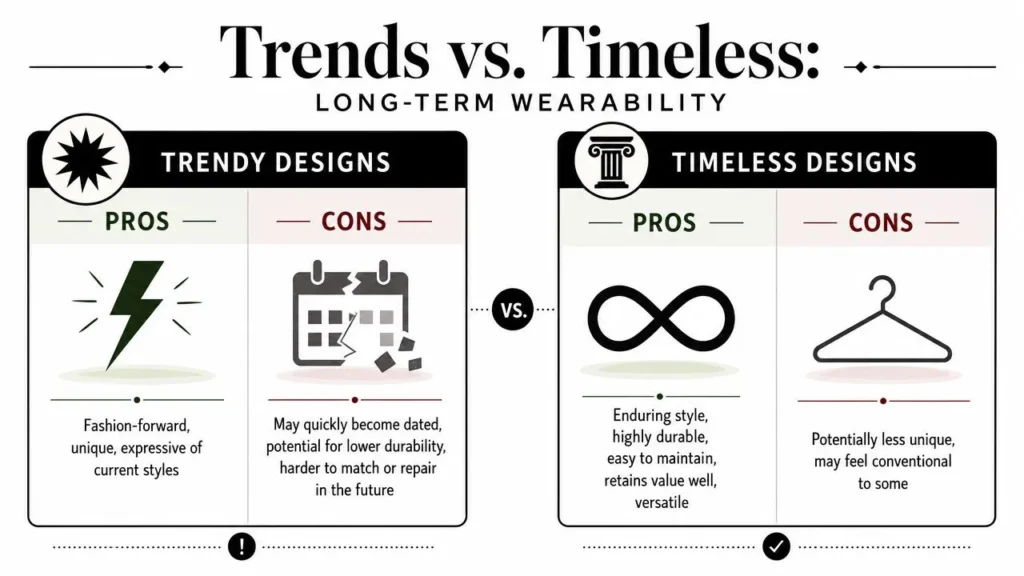
A ring can be trendy and still be a smart purchase. But trend-led designs deserve harder questions than they usually get. Daily wear changes the standard. Once a ring becomes something you cook, travel, commute, and age with, durability stops being a side note.
Why fashionable doesn’t always mean practical
One important gap in many buying guides is the trade-off between visual appeal and long-term wearability. Existing content often highlights diamond-heavy half-eternity bands, geometric designs, and stackable sets without fully addressing comfort, repairability, and maintenance over years of wear, as noted in this discussion of unique wedding bands and longevity gaps.
That doesn’t mean you should avoid modern design. It means you should buy it with open eyes.
A few examples:
- Diamond-heavy bands can look brilliant from the top but may require more careful wear and maintenance.
- Geometric edges can feel crisp at first but may be less forgiving if you want a softer everyday feel.
- Stacked sets create a styled look, but multiple rings can rub against each other and feel busier on the hand.
Think like an owner, not a shopper
When someone falls in love with a ring in the case, they usually ask how it looks. The better questions come next.
Ask these before buying:
- How easy is this ring to resize later?
- If a stone loosens, what does repair usually involve?
- Will the finish need regular refreshing to keep this look?
- Does this design catch easily on clothing or gloves?
- Can a local jeweler service this ring, or does it need specialist work?
A beautiful ring that’s annoying to wear becomes jewelry you leave at home.
This is often why simpler bands age so well. A plain gold or platinum band may not get the most social media attention, but it usually asks less of you over the years. It tends to pair easily, clean easily, and adapt better if your preferences change.
Hidden cost of ownership
The purchase price is only part of value. The rest comes from how well the ring keeps serving you.
Here’s a useful way to compare:
| Design type | Immediate appeal | Long-term considerations |
|---|---|---|
| Plain classic band | Understated, timeless | Usually easier to maintain and wear daily |
| Half-eternity band | Bright and decorative | More maintenance questions, less simplicity |
| Intricate geometric band | Distinctive and modern | Fit and comfort matter more over time |
| Stackable set | Flexible styling | More moving parts, more interaction between rings |
If you want the best wedding band for decades, choose the ring you’ll still want to wear on an ordinary Tuesday. Wedding-day drama fades quickly. Comfort, serviceability, and ease of living with the ring do not.
Frequently Asked Questions About Wedding Bands
Why do people wear the ring on the fourth finger of the left hand
A couple walks into the shop, tries on bands, and then asks the question almost everyone asks at some point: which hand and finger is this supposed to go on?
In many Western traditions, the wedding band is worn on the fourth finger of the left hand. The old explanation comes from the Roman idea of the vena amoris, a symbolic connection between that finger and the heart. The anatomy was never the primary point. The tradition stuck because symbols help people mark commitment in a visible, shared way.
That said, there is no universal rule. Some cultures wear wedding bands on the right hand, and some couples choose based on comfort, work habits, or family custom. If one hand gets more daily impact, the other may be the better long-term choice.
Is it better to buy online or from a local jeweler
The better option depends on how many variables you are trying to get right at once.
Buying online often works well for a plain band in a metal you already understand, especially if you know your size from repeated in-person fittings. It can also make price comparison easier. Local shopping usually helps more when comfort, width, profile, stacking, or pairing are still undecided, because you can feel the difference instead of guessing from photos.
A ring is a bit like a pair of shoes you plan to wear for decades. The picture matters, but the fit matters more after the first week.
If you shop online, confirm the return window, resizing policy, shipping insurance, and whether the finish in the photos is likely to show wear quickly. If you shop locally, ask to try similar widths and inner profiles, not just similar styles. That is often where couples avoid an expensive mistake.
Should you solder the engagement ring and wedding band together
Soldering makes sense for some sets and creates frustration for others.
If two rings spin apart, rub against each other, or never sit straight, joining them can improve comfort and reduce wear where the metals meet. But you give up flexibility. A soldered set is harder to separate if your finger size changes, if you want to wear the band alone, or if your style shifts over time.
The practical question is simple. Do you want one unified piece, or do you want options?
Couples who wear both rings every day in the same arrangement often like soldering. Couples who switch between rings for work, travel, exercise, or personal preference usually prefer to keep them separate.
Is a plain band too simple
A plain band is often the smartest choice in the case. Simple designs tend to feel comfortable longer, cost less to maintain, and pair more easily with changing styles over the years.
Trendy details can be beautiful. They can also come with trade-offs, such as more visible scratching, more cleaning, more repair questions, or a shape that feels less pleasant during daily wear. A plain band avoids many of those ownership costs while still looking intentional and complete.
That is why plain bands remain popular year after year. They do their job well, and they rarely ask much from the person wearing them.
If you enjoy practical, approachable guides like this, visit maxijournal.com for more clear writing on fashion, lifestyle, culture, and everyday decisions that deserve better advice.
Discover more from Maxi Journal
Subscribe to get the latest posts sent to your email.