You’ve probably seen this happen in your own scene file. The concept sketch looks sharp. The pose reads. The attitude is there. Then you block in the fill, hit play, and your elegant black cat turns into a drifting silhouette with eyes.
That’s the main problem with black cat animation. It isn’t coming up with a cool character. It’s making a dark, mostly monochrome subject stay readable while moving through light changes, camera changes, and emotional beats. A black cat has very little margin for sloppy posing, muddy values, or generic motion. If the silhouette collapses, the performance disappears with it.
That challenge is also why black cats remain so compelling in animation. Some of the most recognizable animated felines helped define the trope across decades. Disney’s The Jungle Book premiered in 1967, introducing Bagheera, while Sailor Moon introduced Luna in 1992, showing that black-cat characters were used in major international entertainment properties spanning Western animation and Japanese anime by the late 20th century, as noted in PetMD’s overview of black cat facts.
Famous examples matter, but they don’t solve the production problem. Readability does. The craft comes down to shape design, controlled value separation, selective detail, and motion choices that keep the cat feeling feline instead of turning it into a moving cutout. When a black cat works on screen, it’s usually because the animator and lighting artist made dozens of small decisions that protect the character’s form.
The Allure and Challenge of Animating Black Cats
Black cats are irresistible to animate because they arrive with built-in personality. They can read as elegant, aloof, clever, magical, threatening, or affectionate before they even move. That kind of visual shorthand is powerful. It gives you a lot of character value from a simple design.
The downside is just as strong. A dark character removes many of the shortcuts animators often rely on. Mid-tone fur markings, color blocking, and internal shape contrast all become weaker tools. You can’t depend on surface detail to carry expression. The body line, head angle, ear direction, and eye treatment have to do the heavy work.
Why black fur exposes weak animation
A spotted or striped cat can survive mediocre posing because the pattern creates extra visual information. A black cat doesn’t hide your mistakes. If the spine line is vague, the audience feels it. If the tail overlaps the body in the wrong way, the whole pose tangles into one mass.
That’s why I treat black cat animation less like “animal animation with a cool paint job” and more like shape-first character performance. Every major choice has to answer one question. Will this still read when the fur is nearly one value?
Practical rule: If the pose only works because of internal line detail, it isn’t ready yet.
Why they keep showing up anyway
They keep showing up because the payoff is huge. A black cat can command the frame with very little. A small head turn, a lifted paw, or a tail curl can feel loaded with intention. That economy is gold in both stylized and realistic work.
The trick is respecting the limits of the design. Black cats look best when the animator treats silhouette, timing, and lighting as one system instead of three separate departments.
Designing a Readable Black Cat Character
A black cat design succeeds long before the first in-between. If the model sheet doesn’t read in flat fill, the animation won’t rescue it later.
Start with silhouette, not detail
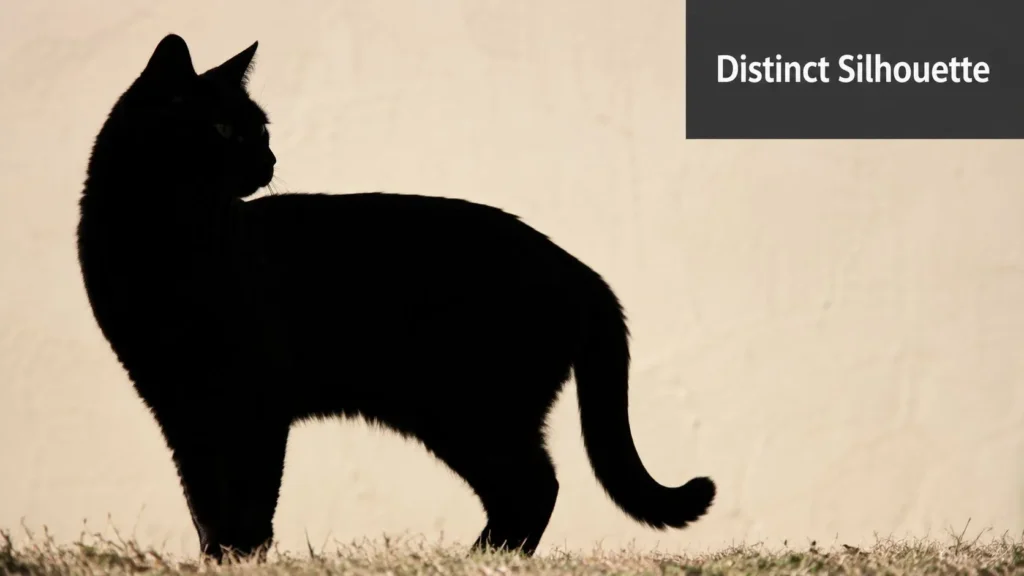
When I rough a black cat, I temporarily ignore fur texture, whisker polish, and small facial markings. I look at the outer shape first. The ears, muzzle break, chest puff, back arch, and tail line need to create an instantly recognizable cat even at thumbnail size.
Weak silhouette design usually has one of these problems:
- Rounded sameness: Head, torso, and hips blend into one soft lump.
- Tail confusion: The tail hugs the body contour so closely that it stops reading as a separate limb.
- Neutral ears: Ears sit in a generic upright position and fail to communicate alertness, suspicion, or comfort.
- No negative space: Front legs merge into the chest, or the tail tangles with the hind leg contour.
Strong design does the opposite. It creates deliberate separations. A chest silhouette can push forward while the foreleg drops cleanly beneath it. The tail can arc away from the body instead of tracing the same line.
Build emotion into the outline
For black cat animation, posture is emotion. You don’t need many lines if the body attitude is clear.
A few reliable choices:
Confident cat
Head level, shoulders high, tail carried with easy lift, long stride.Suspicious cat
Neck slightly retracted, chin forward, ears angling independently, weight held back.Playful cat
Shortened body, lifted forequarters, tail making broader graphic curves.
For facial work, I keep the eyes simple and intentional. On a dark face, eyes become the main anchor. If you over-render them, they float. If you under-design them, the face dies. The sweet spot is a controlled shape that locks to the skull and supports the head turn.
A black cat’s face usually reads better when the eye design is cleaner than the rest of the character, not more complicated.
Use adjacent contrast, not decoration
You don’t need to carve every plane into the fur. Often the better move is staging the cat against a lighter shape, doorway, moonlit floor patch, fog band, or warm wall. The character becomes readable because the environment supports it.
If you’re still refining your eye placement and facial structure skills, portrait practice helps more than many animators admit. A clear breakdown of observation and structure in this step-by-step portrait drawing guide translates directly to black cat faces, especially when you’re trying to imply form with very few marks.
For hybrid pipelines, design discipline matters even more once AI tools enter the process. If you’re exploring character ideation with generative systems, a resource on mastering AI tools for animation is useful because consistency starts with a strong base design, not with hoping a model guesses the same cat every time.
Animating Core Feline Movements
Cat movement falls apart fast when you animate it like a small dog or a generic quadruped. The body mechanics are quieter, sneakier, and more elastic. A cat doesn’t just place feet. It pours weight from one support point to the next.
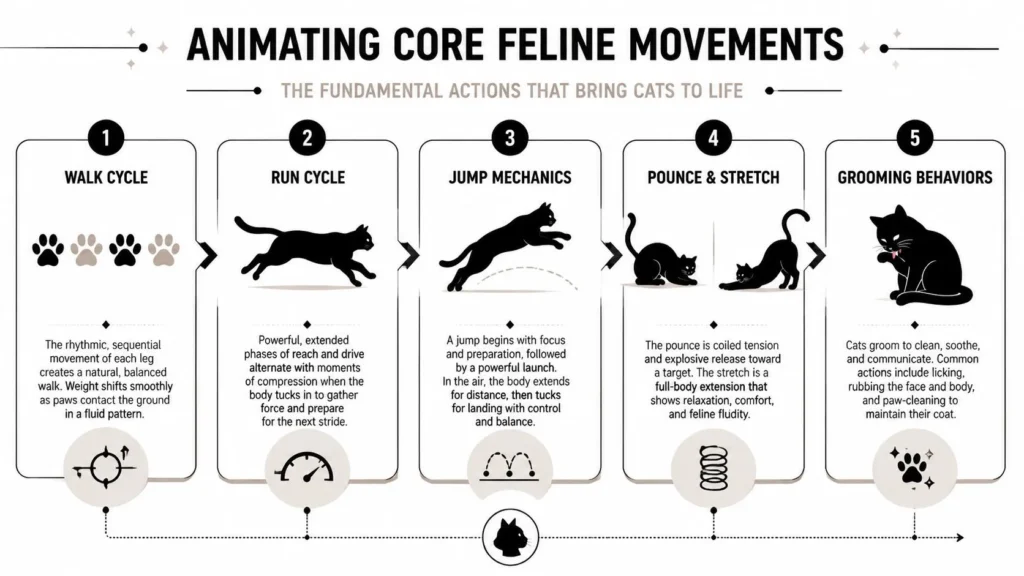
What makes a cat walk read like a cat
The biggest tell is the spine. In a believable feline walk, the torso doesn’t behave like a rigid plank. The shoulders and hips trade emphasis, and the back carries a subtle flowing rhythm instead of a simple up-and-down bob.
I look for these anchors in blocking:
- Shoulder lead: The front body often feels like it’s reaching and testing space.
- Hip response: The pelvis follows with controlled sway, not exaggerated wagging.
- Head stability: The head can stay composed while the body does more of the work.
- Paw placement: Cats place paws with intent. Random spacing makes them feel clumsy.
A tail can support the rhythm, but it shouldn’t become a metronome. If it swings in perfect opposition every time, the cat starts looking designed rather than alive.
For readers studying tail control and how much expressive range it adds to a pose, this article on whether cats control their tails is a useful companion when you’re thinking about intent versus automatic follow-through.
Blocking the cycle before polishing
I usually block a cat walk with clear contact, passing, and reach poses, then spend extra time on the transitions. The transitions matter more than the extremes because cats live in those gliding weight shifts.
A practical order that works:
- Pose the line of action first: Get the spine and neck arc reading before touching paws.
- Place feet second: Grounded contacts matter, but they only make sense after body intent is clear.
- Delay the tail pass: Tail animation too early distracts from fixing the gait.
- Polish the scapula area last: Even in stylized work, slight shoulder articulation helps sell the species.
Here’s a useful visual reference for observing timing and body flow in action:
Running, jumping, and pouncing
Running amplifies compression and extension. The body folds harder, launches more decisively, and lands with spring instead of thud. Many animators overdo airborne poses and underdo preparation. The prep is where the cat loads.
For jumps and pounces, I watch three things:
| Action | What sells it | Common mistake |
|---|---|---|
| Walk | Smooth weight transfer through spine | Legs moving under a stiff torso |
| Run | Strong compression before release | Too much float, not enough drive |
| Pounce | Coiled hold before explosion | Starting the leap too early |
| Landing | Absorption through limbs and back | Hitting like a rigid toy |
If the movement still feels generic, simplify the shot and study one action in isolation. A cat’s grooming pause or cautious step often teaches more than a flashy leap.
Bringing Your Cat to Life with Secondary Motion
A black cat can have a solid walk cycle and still feel dead. That usually means the primary motion is working, but the secondary motion isn’t carrying thought.
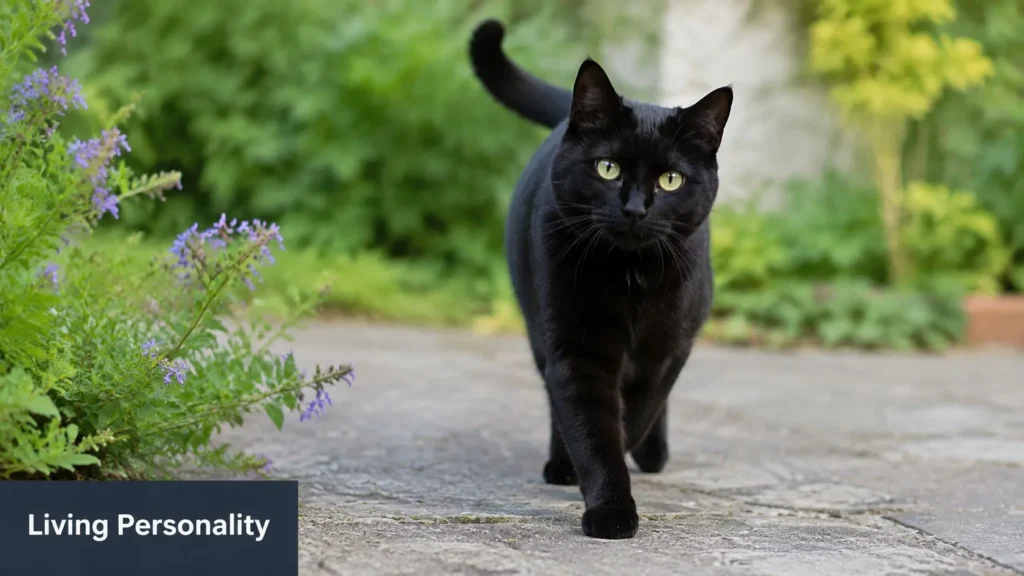
I learned this the hard way on stealthy character shots. The body crossed the screen properly, but the cat didn’t seem aware of anything. The fix wasn’t bigger acting. It was offset motion. The tail lagged a little. One ear reacted before the other. The head settled after the chest. Suddenly the same shot had inner life.
Let each part keep its own rhythm
This principle shows up even in CSS character work. In Álvaro Montoro’s black cat CSS art walkthrough, varying durations and timing functions across moving parts is treated as essential because uniform easing makes motion look artificial. That logic carries over perfectly to character animation. If every part moves on the same cadence, the audience reads a mechanism, not an animal.
What works better is slight disagreement between body parts:
- Tail: Follows the pelvis, then resolves with its own drag and settle.
- Ears: React to sound, attention, and mood. They shouldn’t mirror each other all the time.
- Whiskers: In stylized work, even tiny directional shifts can support muzzle compression.
- Shoulder fur or cheek tufts: These can add subtle delay if the style allows it.
The fastest way to make a cat feel robotic is matching the tail, head, and torso to the exact same timing curve.
Tail animation is mood animation
The tail isn’t just follow-through. It’s editorial control over the performance. A raised tail with relaxed curvature feels social or self-possessed. A low tail with a restrained tip flick changes the whole emotional read. A broad swish can introduce irritation before the face does.
I prefer animating tails in long directional phrases instead of frame-by-frame fidgeting. Think in arcs. Think in pressure changes. A tail that changes direction too often feels noisy.
Small asymmetries make the shot feel observed
Good secondary motion often comes from unequal choices. One ear twitches while the other holds. The whiskers settle later on the downstage side. The head turns, then the tail answers. That asymmetry makes the cat feel like it’s processing the world rather than executing a cycle.
Try this pass order when a shot feels stiff:
- Add tail overlap on the major body beats.
- Offset ear reactions by a small amount.
- Reduce any mirrored behavior in the face.
- Remove half the “cute” extras you added. Keep only what supports intention.
That last step matters. Secondary motion should deepen the action, not decorate it.
Lighting and Rendering a Dark Character
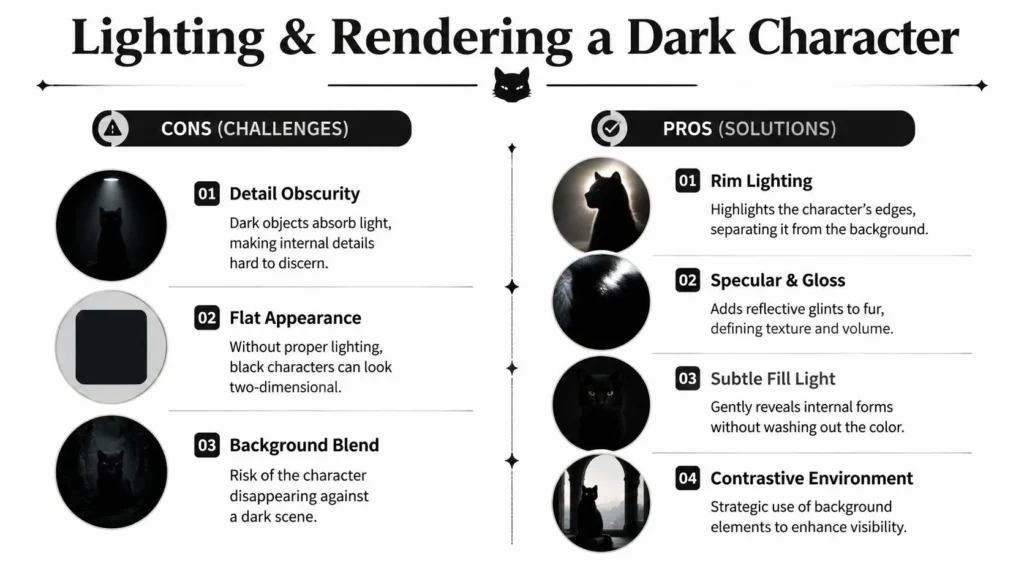
If design gives a black cat structure, lighting gives it permission to exist in the frame. Without controlled lighting, dark fur collapses into one value block and the performance vanishes.
Rim light is shape insurance
For black cat animation, rim light isn’t a stylish extra. It’s often the difference between readable and lost. A controlled edge light lets the audience track the skull shape, back line, ear separation, and tail contour without forcing the whole cat brighter.
The mistake is making that rim too even. Perfect outlining flattens the form and starts to look graphic in the wrong way. I want selective edge information. Catch the top of the shoulder, the outside ear, the bridge of the back, or the tail tip. Leave some sections to disappear.
A useful test is to squint at the frame. If you can still tell what the cat is doing, the lighting is probably carrying its weight.
Don’t fight darkness with blanket fill
A lot of artists respond to black fur by raising fill light until they can see everything. That usually kills mood and still doesn’t solve the form problem. You get a gray cat, not a readable black cat.
Better options:
- Use localized fill: Light the face plane or chest subtly instead of lifting the whole character.
- Control the background: A slightly lighter window, wall, or fog bank can separate the body better than more frontal light.
- Preserve spec hits: Small highlights can imply coat texture and volume without brightening the base value.
- Watch the eyes carefully: Eye highlights should support gaze, not overpower the face.
A black character should stay black. The job is to reveal form, not repaint the model with extra light.
Rendering choices in 2D and 3D
In 2D, I keep value groups limited. Too many internal shades turn the cat muddy. A base dark shape, one controlled lighter plane, and selective highlight accents usually read better than a soft airbrushed treatment.
In 3D, fur and shader response can make or break the shot. You need enough material variation for the coat to catch light naturally, but not so much gloss that the cat starts looking wet or plastic. Test under the actual scene lighting, not only in a flattering preview setup.
A quick review checklist helps:
| Problem | Better fix |
|---|---|
| Crushed black face | Add narrow fill to front planes, not full-scene exposure |
| Body merges with background | Shift staging or add selective rim separation |
| Fur looks flat | Tune spec response and break up broad uniform values |
| Eyes dominate too much | Reduce highlight intensity and anchor them to head form |
The strongest renders usually feel restrained. You’re guiding the eye, not explaining every hair.
Choosing Your Tools and Exporting for the Web
Tool choice matters, but not in the usual “best software” sense. For black cat animation, the right setup is the one that gives you control over silhouette, spine flexibility, tail articulation, and predictable output.
Pick tools by motion needs, not brand loyalty
If the project is graphic, stylized, and shape-driven, Toon Boom Harmony and Adobe Animate are practical choices. Harmony gives you strong cutout and rig options with enough deformation control for feline spines and tails. Adobe Animate works when the motion language is simpler and the delivery is web-focused.
For 3D, Blender is excellent when you want an accessible rigging and rendering workflow. Maya remains a strong choice for animators who want deeper rig integration and established pipeline habits. In either case, the cat rig needs a flexible spine, clean paw controls, and tail controls that support broad arcs and finer offsets.
Here’s a simple comparison to frame the decision:
| Software | Best For | Learning Curve | Cost |
|---|---|---|---|
| Toon Boom Harmony | 2D rigged character animation | Moderate to steep | Paid |
| Adobe Animate | Lightweight 2D and web delivery | Moderate | Paid |
| Blender | 3D character animation and rendering | Moderate to steep | Free |
| Maya | Production-style 3D animation pipelines | Steep | Paid |
AI-assisted workflows can help, but consistency is still a problem
AI tools are useful for ideation, look exploration, and sometimes motion experiments. They’re less reliable when the assignment is “keep this exact cat recognizable across multiple outputs.” That’s where many creators hit friction.
If you’re exploring that route, Nereo’s AI animation tutorial is worth reviewing as a workflow reference. Just keep your expectations grounded. AI can accelerate exploration, but it still needs a strong character bible and manual correction if continuity matters.
Unreal and engine delivery need validation
For game or real-time delivery, engine integration is part of the animation job. In 3D pipelines like those built for Unreal Engine 5.5.4+, a common pitfall is assuming a rigged model will import identically across engine versions. Teams need to validate skeleton deformation, fur readability under game lighting, and animation clip stability, as described in this Unreal black cat character asset overview.
That point matters because a cat that looks great in DCC software can fall apart once engine materials, hair behavior, and retargeting enter the picture.
Exporting for web delivery
Web export is mostly about preserving the read you fought to build.
A short checklist helps:
- Check silhouette at small size: Social feeds shrink your work fast.
- Test compression early: Dark gradients and subtle fur values can break sooner than expected.
- Loop on a neutral action: Breathing, blinking, or tail sway often survives compression better than complex locomotion.
- Edit for pace: Even a strong animation benefits from smart trimming and platform-aware timing. A practical primer on editing videos for YouTube can help if you’re packaging the final piece for online viewing.
The export isn’t just technical cleanup. It’s the final readability pass.
Black Cat Animation FAQs
How do you stop a black cat from looking like a blob?
Start with silhouette separation. Keep the ears, tail, chest, and leg groupings distinct in the pose. Then support that shape with selective lighting or background contrast. If the cat only reads when you zoom in, the design or staging still needs work.
Should black fur have visible texture in every shot?
No. Texture should serve the shot, not announce itself constantly. In wider shots, clean shape usually matters more than fur detail. Save finer rendering for close-ups or moments where the audience needs to feel the coat surface.
What’s the best way to show emotion on a dark face?
Use head angle, ear direction, eye shape, and body posture together. Don’t rely on mouth shapes alone. On a black cat, the emotional read often comes from the full pose before the audience notices any facial nuance.
Why does my tail animation keep feeling fake?
It’s often too synchronized with the body. A tail should react, lead, or comment on the action, but not move like a perfectly timed pendulum. Give it drag, settle, and moments of stillness.
Can AI generate a consistent black cat character across shots?
It can help, but consistency is still unreliable. A notable challenge in the generative space is prompt consistency. Recent examples show that animating the same public-domain black-cat image multiple times with an identical prompt can still produce visually different cats, highlighting a core limitation for creators seeking reliable character continuity in AI-assisted workflows, as shown in this creator example on Instagram.
Is 2D or 3D better for black cat animation?
Neither is automatically better. 2D gives you stricter control over shape design and graphic clarity. 3D gives you richer camera options and lighting control, but it also introduces shader, fur, and rendering complexity. The better choice depends on whether your project is performance-led, style-led, or pipeline-led.
What’s the first thing to fix in a weak shot?
Check the pose in flat fill. If the silhouette doesn’t read, fix that before touching fur detail, whiskers, or render polish. Most black cat problems start earlier than people think.
If you enjoy practical breakdowns like this, Maxi Journal publishes approachable writing across arts, animation, technology, pets, entertainment, and more. It’s also a solid place to explore fresh commentary or find inspiration for your next deep-dive read.
Discover more from Maxi Journal
Subscribe to get the latest posts sent to your email.