For years, the most concrete image attached to the Evangelion live action movie wasn’t a trailer frame or a casting photo. It was a status update: on hold.
That small phrase turned a dream adaptation into one of the entertainment industry’s cleanest examples of how a famous property can stay culturally alive while never becoming an actual movie.
The Decades-Long Saga of a Movie on Hold
A Hollywood adaptation can spend years in uncertainty and still fade from memory. Evangelion did the opposite. It remained one of the most discussed unmade genre films of its era, which is what makes it such a useful case study in development hell rather than a routine example of a project that stalled.
The long pause matters because the underlying property never lost relevance. New viewers kept discovering the anime, the brand kept circulating through home video and later rebuild films, and the idea of a live action version stayed marketable even as the movie itself failed to reach visible production.
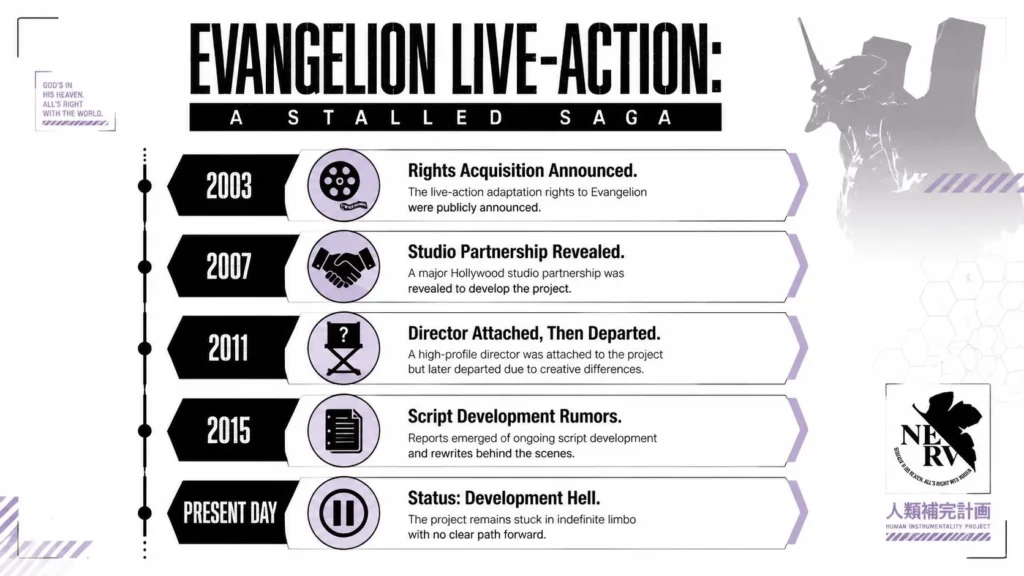
The hype phase
In the early 2000s, that pitch looked powerful. Evangelion offered recognizable iconography, giant battles, apocalyptic stakes, and a fan base large enough to attract both genre producers and companies looking for the next globally exportable franchise. Hollywood has often pursued anime rights on the assumption that visual distinctiveness and existing fandom will reduce market risk. In practice, rights announcements create attention long before anyone solves the adaptation.
That pattern shaped Evangelion almost from the start.
Public discussion treated the film as a matter of timing, as if the main obstacle were scheduling or financing. The more revealing question was whether anyone had translated the property into a producible American feature package. Those are not the same thing. A title can be famous, commercially attractive, and still be far from a movie.
The warning signs
The project became associated with ADV Films and Weta Workshop, a combination that gave the adaptation an unusual amount of early credibility. Weta’s involvement suggested technical seriousness. ADV’s connection to the franchise suggested access and intent. For fans, that looked like momentum.
Industry analysts would read the same signals more cautiously. Effects talent does not solve development. It only answers one narrow question, whether the world can be visualized. The harder questions come earlier: who controls the rights, which version of the story is being adapted, what audience the film is for, and whether the material can survive compression into a studio feature without losing its identity.
Those questions lingered for years because the usual markers of progress never appeared.
As Eva Monkey’s account of the project’s status noted, there was no announced shooting script, director, cast, start date, or release window, while Weta Workshop’s public position was that the film was “on hold.” That is less a pause in active production than evidence that active production never fully formed.
How “on hold” became the real legacy
That phrase did unusual cultural work. In many stalled adaptations, silence ends the conversation. Here, silence sustained it. Fans, journalists, and industry observers kept returning to the project because Evangelion was too prominent to dismiss and too difficult to resolve into a normal studio movie.
A project in that condition stops functioning as a forthcoming release and starts functioning as an industry riddle. The absence of milestones becomes the story. People who follow long-form development coverage on movie review and entertainment analysis websites recognize the pattern. Once reporting consists mostly of historical summaries, rights speculation, and postmortems, the project has crossed from anticipation into legend.
That is what happened to the Evangelion live action movie. It did not become famous for casting, footage, or production design. It became famous for remaining imaginable after every concrete sign of progress had disappeared.
That distinction matters. Many unmade films are forgotten because they were optional. This one endured because it sat at the intersection of Hollywood ambition, anime fandom, and a property whose reputation made abandonment look temporary even when the evidence pointed in the other direction.
Why Adapting Evangelion Is Uniquely Difficult
The hardest part of adapting Evangelion isn’t the robots. It’s deciding what the movie is about once you strip away the shorthand.
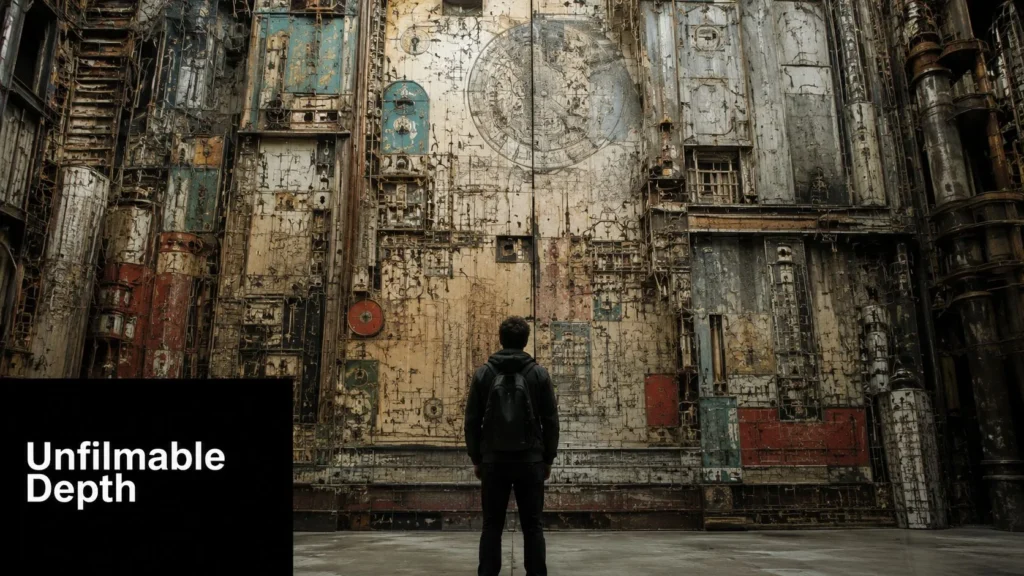
Most franchises can survive simplification. Evangelion resists it. The property is built from three elements that are all difficult to commercialize at once: psychological interiority, heavy visual demands, and a creator’s highly specific voice.
The narrative won’t compress cleanly
At surface level, the pitch sounds straightforward. Young pilots defend humanity from existential threats. That is the sell. It is not the substance.
The franchise’s identity comes from unstable psychology, alienation, symbolism, fractured relationships, and scenes that often prioritize emotional breakdown over plot efficiency. A studio version that turns all of that into a conventional invasion narrative might be easier to market, but it would stop feeling like Evangelion.
That creates a screenwriting trap:
- Too literal to the anime, and the film risks becoming dense, overexplained, and dramatically cramped.
- Too simplified for broad appeal, and the adaptation loses the very unease that made the original matter.
- Too reverent to iconography, and the result becomes a museum exhibit with expensive effects.
- Too revisionist, and long-time fans read it as a misunderstanding rather than an interpretation.
A lot of anime properties bend toward plot. Evangelion bends toward mood, trauma, and philosophical pressure. That’s much harder to fit inside a conventional blockbuster spine.
The production design challenge starts before filming
The project’s technical paralysis was also unusually severe. As Evageeks’ production summary notes), by late 2007 no production work had started, and the project was waiting on a director before moving forward. That’s the kind of detail that sounds procedural until you think about what it means for a VFX-heavy film.
If a studio doesn’t have a locked creative lead, it can’t confidently finalize script revisions, define the visual language, shape a VFX workflow, set schedules, or ask effects vendors to bid against stable assumptions. For a property built around giant biomechanical combat and city-scale destruction, that isn’t a minor delay. It’s a structural stoppage.
A movie like Evangelion can’t improvise its scale. It has to design its scale before cameras roll.
That is why “development hell” is more than a colorful phrase here. It describes a project unable to move from aspiration to engineering.
A quick visual refresher helps show why the adaptation challenge is as much about form as fandom.
Hideaki Anno’s shadow is part of the text
Many anime adaptations face fan resistance. Evangelion faces something more specific. Viewers often treat the franchise as inseparable from Hideaki Anno’s sensibility. His handling of dread, intimacy, abstraction, and collapse doesn’t feel like decorative authorship. It feels like the engine.
That creates an unusual problem for Hollywood development. In most major IP adaptations, studios ask how to preserve brand identity while changing medium. With Evangelion, they also have to answer a harder question: can the brand identity survive if it loses the authorial pressure that gave it shape?
A generic answer isn’t enough. The Evangelion live action movie would need a filmmaker capable of translating tone, not just lore. That’s a much smaller pool of talent than fans usually assume.
Lessons from Other Anime Live Action Adaptations
Hollywood has already run the experiment many times. The results are mixed, and the pattern is clearer than the discourse sometimes admits.
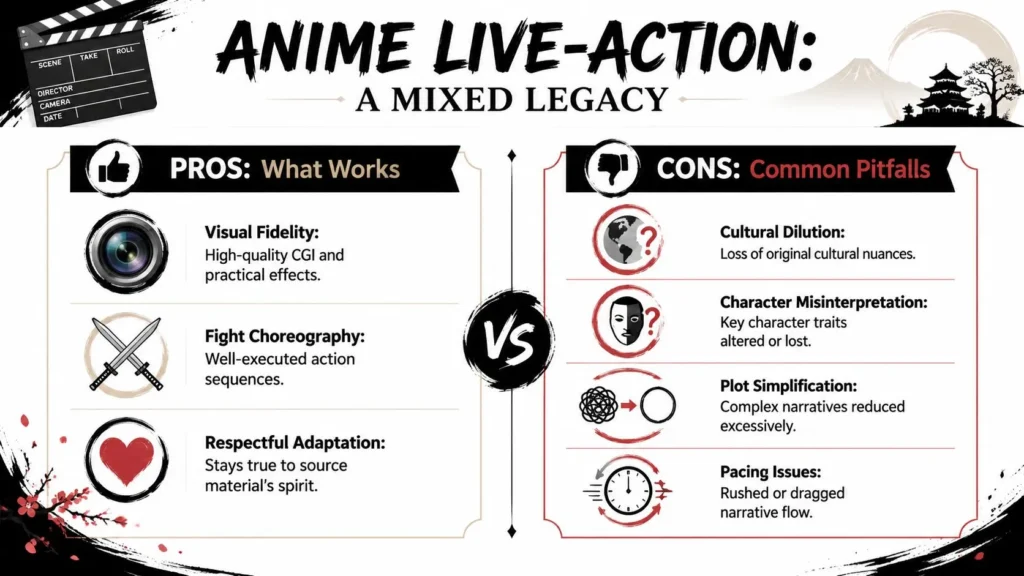
Some adaptations fail because they treat anime as a plot delivery system. Others work better because they recognize that audiences are often responding to tone, rhythm, and character logic, not just costumes and names.
What the weaker adaptations usually get wrong
A title like Dragonball Evolution is still the standard warning sign because it illustrates a common error. It reprocesses the source into generic Western franchise grammar and assumes the familiarity of the brand will do the rest. It usually doesn’t.
Netflix’s Cowboy Bebop hit a related obstacle, though by a different route. It preserved some iconography but struggled with the delicate tonal balance that made the original distinctive. Style without precise tonal calibration can feel oddly farther from the source than a looser adaptation.
The recurring pitfalls are familiar:
| Adaptation problem | What it looks like on screen | Why it matters for Evangelion |
|---|---|---|
| Cultural flattening | Settings and character dynamics lose their original texture | Evangelion relies on mood and context, not just premise |
| Character drift | Motivations are rewritten into simpler hero arcs | Its protagonists aren’t built as clean wish-fulfillment leads |
| Plot reduction | Dense material is compressed into exposition and action beats | The franchise collapses if inner conflict becomes background noise |
A broader comparison with franchise remakes and reinterpretations, including projects outside anime, can be useful in this context. The success and backlash patterns around live-action reworkings of familiar properties show the same central rule: audiences tolerate change when the adaptation understands the original’s emotional contract.
What the better adaptations tend to preserve
The stronger examples don’t necessarily copy scene for scene. They usually preserve intent.
Consider the difference in approach behind titles often discussed more positively, such as One Piece or Alita: Battle Angel. They don’t succeed because live action is automatically the right medium. They succeed when the production treats worldbuilding, character dynamics, and tonal sincerity as the point, rather than as obstacles to be minimized.
Decision test: If a studio can’t say what fans emotionally protect about the source, it probably isn’t ready to adapt it.
For Evangelion, that matters more than for most properties. The safest commercial instinct would be to foreground battles, mythology, and apocalyptic scale. Those are marketable. They are also secondary. The thing audiences protect most fiercely is the instability of the people inside the machines.
That is the lesson other adaptations make clear. The danger isn’t that a live-action Evangelion would look strange. The danger is that it would look correct while feeling conceptually hollow.
The Legal Maze and the Creator’s Shadow
A project can survive bad scripts, changing directors, and years of silence. It rarely survives uncertain ownership combined with an auteur-driven brand.
That combination helps explain why the live-action Evangelion became more than an unmade movie. It became a case study in development hell. The property remained globally recognizable, but recognition alone does not finance production. Studios and investors need a clear chain of authority, especially on an adaptation that would trigger disputes over design, story structure, merchandising, sequel rights, and international distribution.
Background on the long-stalled film, including Weta Workshop concept work and the project’s eventual collapse, is summarized in Collider’s reporting on the adaptation’s collapse. The larger issue was not simple delay. It was that the parties who might push the film ahead were dealing with a franchise whose legal and creative control had become unusually sensitive.
Rights limbo changes the economics
For a standard studio property, rights questions are often messy but manageable. Evangelion was different because control over the brand carried direct consequences for every expensive decision. If ownership, approvals, or exploitation rights are disputed, development spending becomes harder to justify. A producer cannot confidently commission rewrites, attach talent, or promise downstream revenue if another stakeholder can challenge the scope of those rights later.
That uncertainty affects the project at multiple levels at once. Who has final say on script revisions? Which party approves departures from character designs and lore? Can a studio build a franchise plan around spin-offs or streaming rights without creating a later conflict? In a property this famous, each unresolved question becomes a budget problem.
Readers looking for a practical frame for that problem can look at firms that explain intellectual property law services. The legal obstacle was never just abstract ownership. It was whether a production could move from optioning and development to filming and release without hidden veto points or contested approvals.
Anno’s role changed the risk profile
Hideaki Anno’s distance from Gainax also mattered in a way that would not apply to many other franchise adaptations. Evangelion is tightly identified with its creator’s authorship, not just with its iconography. The robots, Angels, and apocalypse imagery are marketable assets, but the property’s identity comes from Anno’s psychological and formal choices. Remove too much of that, and the adaptation may still look expensive while losing the feature that made the brand durable.
That makes legal control and creative legitimacy inseparable. A rights holder might have formal authority yet still face audience distrust if the project appears detached from the creator’s sensibility. Hollywood has adapted anime where fans primarily protect premise, aesthetics, or action grammar. Evangelion adds another layer. Fans protect point of view.
That is why the project’s collapse still attracts attention. It was not merely a failed licensing exercise. It exposed a structural problem in adapting auteur-driven anime for global live action. The more personal the source text, the less useful a generic franchise model becomes.
The same tension appears in nonfiction filmmaking. Strong documentaries often depend on a recognizable authorial perspective, not just access to the subject. Many of the best documentary filmmaking techniques work because style, structure, and interpretation are bound together. Evangelion creates a similar challenge for adaptation. The work’s meaning is tied to how it is expressed, not only to what happens in the plot.
That is what made paralysis so likely. Legal ambiguity discouraged ambitious development. Ambitious development was the only kind that had any chance of justifying a live-action Evangelion in the first place.
Who Could Realistically Make It Happen Today
If someone revived the Evangelion live action movie now, the first serious decision wouldn’t be casting. It would be format.

A single theatrical feature offers scale and cultural event status. A prestige series offers time, tonal elasticity, and room for psychological deterioration. For Evangelion, those aren’t equal options.
Theatrical film versus prestige series
A movie can deliver impact. It can also force destructive compression. Too much of Evangelion depends on cumulative stress, repeated emotional failure, and long stretches where the conflict is internal rather than tactical. Those qualities are easier to sustain in episodic form.
A modern studio would likely weigh the formats this way:
- Theatrical path: Better for spectacle, cleaner for global marketing, riskier for narrative oversimplification.
- Prestige series: Better for character interiority, better for worldbuilding, harder to maintain visual quality across the full run.
- Hybrid model: A limited series followed by event films could fit the material, but only if rights and approvals are unusually stable.
This is one reason contemporary production strategy matters more than fan casting. The medium choice would determine whether the adaptation starts by respecting the material or by squeezing it.
The director pool is smaller than fans think
People often name filmmakers such as Denis Villeneuve or Guillermo del Toro because they can handle scale, science fiction imagery, and serious tonal registers. That’s understandable. But the pertinent question isn’t who can stage giant combat. It’s who can hold together adolescent fragility, apocalyptic iconography, and emotional unpleasantness without smoothing the edges off.
That shortlist is short. The ideal candidate would need to be comfortable with:
- Controlled ambiguity, rather than constant explanation
- Large-format spectacle, without reducing the story to action coverage
- Actor-driven psychological scenes, especially with younger performers
- Design discipline, because the visual world has to feel intentional rather than merely expensive
A director with documentary-like sensitivity to behavior could matter as much as a sci-fi stylist. That’s one reason adjacent reading on documentary filmmaking techniques is unexpectedly relevant here. The challenge isn’t only scale. It’s whether performances feel observed rather than arranged.
The smartest modern approach
The most realistic model isn’t a maximalist blockbuster trying to summarize the franchise in one pass. It’s a carefully controlled, creator-aligned prestige adaptation with enough runway to let the psychological story breathe.
That means fewer fan-service promises and more industrial discipline. Lock the rights. Lock the creative lead. Decide the format before promising spectacle. Then build outward.
Without that sequence, any revival would risk repeating the original mistake. It would become a discussion object before it became a production.
A Realistic Outlook for a Live Action Evangelion
Will the Evangelion live action movie ever happen? Yes, it still could. But the conditions have to change before the announcement means anything.
The project’s long stall exposed three truths. First, Evangelion is hard to adapt because its core value isn’t just its premise. Second, rights instability can drain momentum from even a famous global property. Third, this material probably fits a prestige series better than a conventional feature.
That doesn’t mean a film is impossible. It means a studio would need unusual patience and unusual restraint. The winning strategy wouldn’t be “make the anime bigger.” It would be “protect the psychology, then decide how much spectacle the format can support.”
There’s also a practical modern wrinkle. Development packages now depend heavily on previsualization, proof-of-concept materials, and internal pitch assets. Teams exploring large-scale genre projects increasingly use advanced visualization pipelines, and readers curious about that side of contemporary packaging can explore top AI video generators to understand how studios and creators now mock up tone and sequence ideas earlier in development. Tools can help a pitch. They can’t solve a rights conflict or replace a coherent creative vision.
My own view is simple. If Evangelion returns to live action, it will most likely succeed only if it arrives as a tightly managed series with clear creator alignment and a filmmaker willing to preserve discomfort. Anything less would probably give audiences the surface of Evangelion without its pulse.
If you like film analysis that treats development history, adaptation risk, and entertainment culture as part of the same conversation, MaxiJournal is worth reading. It publishes accessible commentary across movies, arts, technology, business, and more, with the kind of broad editorial range that suits readers who want more than quick takes.
Discover more from Maxi Journal
Subscribe to get the latest posts sent to your email.