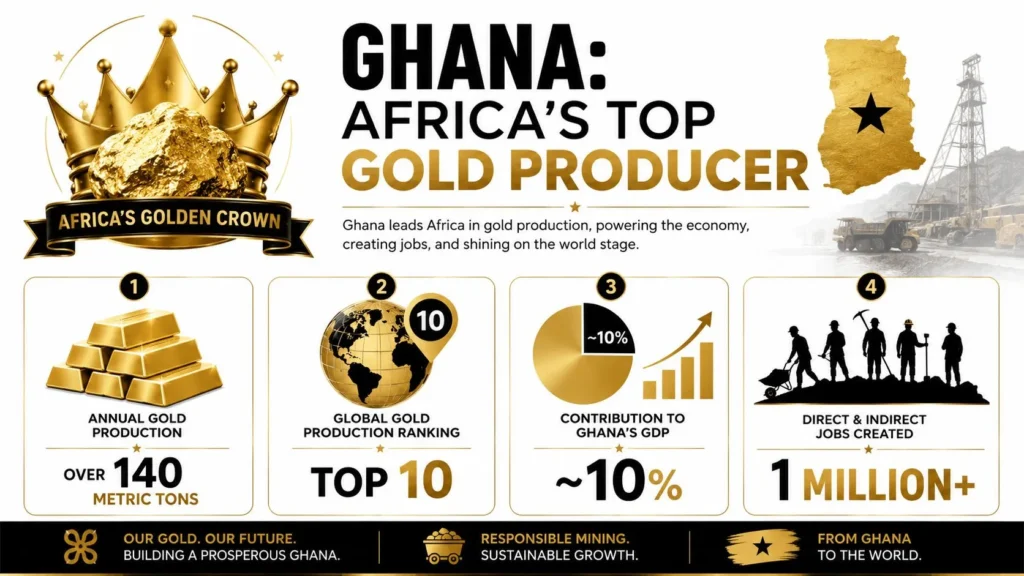
4.9 million ounces. That was Ghana’s estimated gold output in 2024, as noted earlier in this article. The scale helps explain why gold sits at the center of Ghana’s economic story. It does not explain why, in the same country, state-backed mining investment coexists with polluted rivers, contested land, and a persistent illegal trade that successive governments have struggled to contain.
That tension is the key starting point for understanding Ghana gold mining. A narrow argument between growth and damage misses the structure underneath. Gold brings export revenue, tax receipts, foreign exchange, and jobs linked to some of the country’s largest industrial operations. Gold also offers a livelihood to small-scale miners, traders, and households shut out of formal work, even when that activity falls into the murky and often destructive world of galamsey.
The paradox is economic before it is moral. Industrial mining can post record production while nearby communities still question how much value remains locally. Crackdowns on illegal mining can win public support while also cutting off income in places where farming has become less reliable and formal employment is scarce. Officials describe galamsey as a law-enforcement problem. For many miners and traders, it is also a survival system.
That is why the headline numbers matter, but only up to a point.
Ghana’s gold sector is best read as a chain of competing incentives: multinational capital seeking stable output, a state seeking revenue and control, local communities seeking jobs and compensation, and informal miners seeking access to ore wherever regulation is weak or enforcement is inconsistent. Readers who want to assess how such claims are checked against public records can review this guide to source verification methods.
Gold in Ghana is a historical inheritance, a pillar of the present economy, and a recurring test of political authority. The question is not merely whether mining helps or harms the country. The harder question is why, after centuries of extraction and years of record production, Ghana still operates two gold economies at once. One is formal, capital-intensive, and globally connected. The other is improvised, labor-hungry, and often beyond the state’s full reach.
Ghana’s Modern Gold Rush
Nearly five million ounces. That was Ghana’s estimated gold output in 2024, a level that kept the country at the top of African production and among the world’s leading suppliers, as noted earlier. On paper, the story looks straightforward: strong output, strong export relevance, and a metal the world still wants in periods of inflation, currency stress, and geopolitical uncertainty.
On the ground, it is much less tidy.
Ghana’s modern gold rush is not only a surge in extraction. It is a test of whether a state can convert mineral wealth into broad economic gains while parts of the same industry keep operating through informal labor, contested land access, and weak local trust. Record output can coexist with anger in host communities. Tough enforcement can coexist with persistent illegal mining. Those are not contradictions at the edge of the story. They are the story.
Why the headline number can mislead
National production figures compress very different mining realities into a single success metric. Large companies report output through licensed concessions, capital-intensive processing, and formal export channels. In many districts, small-scale and illegal operators work through pits, river dredging, hand-dug shafts, and trading routes that move faster than regulation. Both systems respond to gold prices. They do not answer to the same incentives.
That split helps explain why the debate over Ghana gold mining rarely stays inside the usual argument of growth versus damage. For central government, gold means foreign exchange, tax revenue, and investor attention. For multinational operators, it means reserve life, production targets, and operational stability. For many local residents, the calculation is more immediate. A mine can bring wage work, road upgrades, and business for transporters or food sellers. It can also mean lost farmland, disputed compensation, and polluted streams.
The result is a sector that looks highly productive from Accra and highly unsettled in some mining belts.
Reporting standard: In a sector crowded with official claims, company disclosures, and community allegations, careful source-checking methods for economic reporting matter as much as the production data itself.
More than a commodities story
The persistence of galamsey sits at the center of the modern rush. It is often described as a policing problem, and in many cases it is. Illegal mining has damaged rivers, entered forest reserves, and exposed collusion between operators and public officials. But reducing it to criminality alone misses the economic conditions that keep feeding it. In districts where farming incomes are volatile and formal jobs are scarce, illegal mining can function as a fallback labor market, however dangerous and destructive.
That does not excuse it. It explains why eradication campaigns have repeatedly produced mixed results.
Investors and policymakers tend to focus on geological potential, regulatory certainty, and export earnings. Communities often judge the industry by a different standard: who got hired, who lost land, whether water is still usable, and whether the promised local benefits arrived. Those measures are harder to summarize in a national production chart, but they shape public consent far more than export rankings do.
Ghana’s gold rush therefore reveals a deeper paradox. The country has the institutions, experience, and mineral endowment of a mature mining jurisdiction. It also has a parallel gold economy that remains labor-intensive, politically sensitive, and only partly under state control. As long as those two systems operate side by side, record production will remain an incomplete measure of success.
A Golden Legacy Centuries in the Making
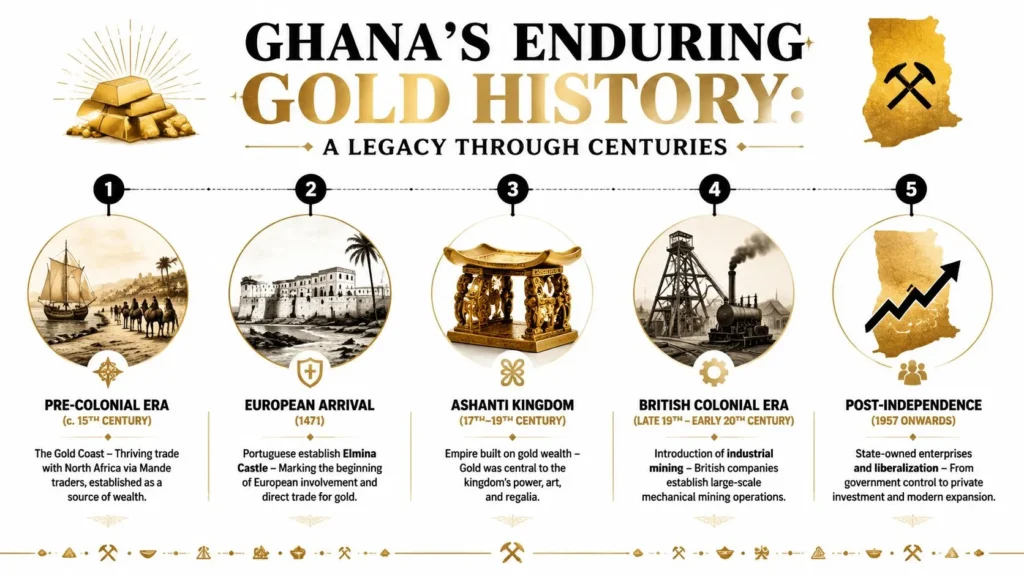
Between 1493 and 1600, the region that is now Ghana accounted for an estimated 36% of global gold output, or about 8,153,426 fine ounces, according to this historical analysis of Ghana’s gold economy. That figure helps explain why gold in Ghana is more than a commodity story. It is tied to how power formed, how trade expanded, and why outside actors were drawn to the region centuries before modern mining companies arrived.
That long view matters.
In many mining countries, the industry can be presented as a modern development project layered onto rural land. Ghana is harder to describe that way. Gold extraction predates the contemporary state, predates formal mining law, and in many places predates the institutions now charged with regulating it. This history does not settle today’s disputes over ownership or legality, but it helps explain why those disputes are so persistent.
Before the first commercial mine
Pre-colonial gold production made the area a major node in regional and international trade. Gold circulated through systems of exchange that were governed by local authority, custom, and commercial networks rather than by the concession model that dominates large-scale mining today. For communities that lived with gold long before company leases and ministerial permits, the idea that only one form of extraction is legitimate can feel historically incomplete.
Gold also carried political and cultural meaning. It signified rank and authority in parts of what is now Ghana, particularly within Akan political traditions, where gold weights, regalia, and ornament were woven into systems of status and governance. That legacy still shapes how people talk about mineral wealth. For some officials and investors, gold is a national asset to be regulated efficiently. For some traditional leaders and local residents, it is also part of inherited territorial rights and communal memory.
That tension sits beneath many modern arguments.
The colonial turn to industrial mining
The shift toward corporate, mechanized mining began in the late nineteenth century, with commercial mining near Obuasi often treated as a turning point, as noted earlier in the article. What changed was not only scale. It was control.
Industrial mining introduced fixed concessions, heavier capital requirements, wage labor, transport infrastructure, and a clearer role for state-backed property claims. Gold that had long moved through dispersed local systems increasingly came under the authority of companies, colonial administrators, and later post-independence institutions. The result was a reordering of who could mine, who could profit, and whose claim counted in law.
Some historians describe this as modernization. Others would call it dispossession alongside industrial growth. Both interpretations capture part of the record.
Why the past still shapes the present
The historical study cited above notes that production rose by roughly 700% in the last two decades of the twentieth century, while output from resident gold mines accounted for about 37% of national output at the time. The point is not confined to mining expansion. It is that Ghana’s gold economy has been repeatedly reorganized under new political and commercial systems.
That helps explain a modern paradox at the center of this industry. Gold mining can look fully established from Accra, London, or Toronto, with listed companies, export earnings, and mature legal institutions. On the ground, especially in mining districts, access to gold can still be understood through older ideas of local entitlement, customary authority, and survival-based extraction. The conflict between licensed mining and informal mining is therefore not only a battle between law and lawbreaking. It is also a clash between different historical understandings of who has the right to benefit from mineral wealth.
Seen this way, the persistence of today’s disputes is less surprising. Ghana’s gold sector is not wrestling with a new resource boom alone. It is carrying centuries of unresolved arguments about land, labor, and legitimacy.
The Engine of an Economy Current Production and Players
The industrial face of Ghana gold mining is built on scale. Mines are not mere holes in the ground. They are integrated systems of blasting, hauling, crushing, processing, waste management, power supply, water handling, and export logistics. When policymakers or investors discuss Ghana as a gold jurisdiction, this is often the side of the sector they have in mind.
A useful case is Tarkwa. Its technical report states that the mine operates on leases of about 20,800 hectares and produced 0.612 million ounces of gold in FY2009 through a combination of heap leach and milling, at a reported cash cost of US$521/oz, according to the Tarkwa technical report from Gold Fields. Even though that production snapshot is historical, it shows the operating logic of a mature large-scale mine in Ghana.
What Tarkwa reveals about industrial mining
Tarkwa is important because it demonstrates how large-tonnage gold deposits can remain commercially viable when the processing route matches the ore. Oxide material can often be treated through heap leach circuits, while other material may require milling to achieve finer liberation. That combination is not a technical footnote. It shapes recovery rates, processing costs, and the pace at which a mine converts rock into saleable gold.
Industrial operations of this kind rely on repeatability. They drill known ore bodies, move immense volumes of material, and process ore through systems designed to manage variability. Their advantage lies in engineering, capital access, and the ability to spread fixed costs across high throughput.
The business logic of the large mines
Large-scale mining in Ghana tends to attract international operators and institutional finance because the basic ingredients are legible to capital markets: geology, permits, infrastructure needs, production schedules, and operating plans. A mine like Tarkwa makes visible what national output figures can hide.
Consider what industrial operators have to coordinate every day:
- Ore handling: Different ore types often require different processing decisions.
- Plant performance: Throughput only matters if recovery remains commercially workable.
- Cost discipline: Cash costs influence how resilient a mine remains during weaker price periods.
- Land control: Large leased areas create operational certainty, but also social friction where land uses overlap.
Why industrial success doesn’t settle the national debate
There is a tendency to treat industrial mining as the clean, formal answer to Ghana’s gold paradox. That overstates the case. Large mines can produce taxes, wages, and infrastructure, but they also transform the terrain and create long negotiations over compensation, resettlement, and community expectations.
A hard truth: Industrial order and social consent are not the same thing. A mine can be technically efficient and still face unresolved local grievances.
The modern industrial sector has one clear advantage over illegal mining. It is visible. It has named operators, formal processes, and documented assets. But visibility doesn’t remove conflict. It only changes the forum in which conflict is argued, from riverbanks and forest clearings to boardrooms, district offices, courts, and public hearings.
That is why the “players” in Ghana’s gold economy extend beyond mine owners. Chiefs, local assemblies, regulators, traders, contractors, security services, and nearby residents all influence whether a mine operates with real stability or only with legal permission.
Two Worlds of Mining Industrial versus Artisanal
Ghana’s gold belt is not evenly spread across the country. A recent GIS-based study found that gold-bearing formations cover 55,723 km², or 23.34% of Ghana’s landmass, and are concentrated mainly in Birimian Volcanics, Birimian Sediments, and Tarkwaian rocks, with especially strong clustering in Bono, Ashanti, Western, and Western North, as shown in this geological mapping study of gold-bearing formations in Ghana. Geology helps explain why mining activity is dense in particular districts and why different forms of extraction often emerge side by side.
Where ore is accessible near surface, artisanal miners can move in quickly with simple tools and improvised systems. Where deposits support long-life operations and large capital outlays, industrial mining dominates. The result is not one sector but two overlapping worlds.
Same metal different systems
Large-scale mining and artisanal or small-scale mining often pursue the same commodity in the same broad regions, but they do so with different time horizons and different rules. One runs on leases, engineering studies, and fixed plants. The other may run on manual labor, mobile equipment, and rapid excavation wherever accessible ore appears.
That difference affects nearly everything: labor needs, environmental controls, safety systems, land access, and conflict risk.
| Attribute | Large-Scale Mining (LSM) | Artisanal & Small-Scale Mining (ASM) |
|---|---|---|
| Typical setup | Long-life concessions, fixed processing systems, formal site planning | Smaller workings, flexible sites, simpler tools or hired equipment |
| Capital intensity | High. Requires major upfront investment in plant, haulage, and infrastructure | Lower entry barrier relative to LSM, though operators may still rely on financiers and equipment owners |
| Regulatory visibility | Generally easier for the state to identify and monitor | Harder to track when activity shifts quickly or operates outside permits |
| Labor profile | Structured workforce with defined roles | Labor-intensive and often tied to household or local survival strategies |
| Geological fit | Best for deposits that justify sustained industrial extraction | Often expands where gold is shallow, scattered, or rapidly accessible |
| Conflict pattern | Disputes often center on land access, compensation, and community consent | Disputes often center on legality, encroachment, water use, and local livelihoods |
Why the two systems keep colliding
The clash is partly legal, but it’s also spatial. Ghana’s gold-rich lithologies are concentrated, not diffuse. That means industrial concessions, farming land, settlements, rivers, and artisanal workings can all converge in the same zones. In those areas, one person may see a regulated mineral lease while another sees inherited land or an urgent income opportunity.
The technical split matters too. Industrial mines optimize ore handling through systems suited to geology and plant design. Anyone interested in the mechanics behind fluid power on heavy mining equipment could look at practical resources on optimizing hydraulic power unit performance, because machinery reliability can directly affect uptime in extraction and material handling. Artisanal mining, by contrast, often depends less on engineered continuity and more on immediate recoverable gold.
The crucial distinction inside ASM
Not all small-scale mining is identical. Some activity is licensed and organized. Some is not. That distinction often disappears in public debate, which can flatten all non-industrial mining into one illegal category. But the legal small-scale segment and illicit galamsey networks don’t operate under the same constraints or incentives.
A fair reading of Ghana gold mining has to hold two thoughts at once:
- ASM provides livelihoods in places where formal employment may be scarce.
- Unlicensed extraction can be destructive when miners move onto riverbanks, forests, farms, or concessions without safeguards.
The most important divide in Ghana’s small-scale sector is not small versus big. It is licensed versus unlicensed, accountable versus unaccountable.
That is why attempts to solve the mining problem through a simple industrial-versus-artisanal binary usually fail. The core issue is how geology, poverty, legality, and land pressure interact in the same terrain.
The Unseen Costs Environmental and Social Impacts
The hardest part of reporting on Ghana gold mining is this: the damage is often easiest to describe after it has already become visible in a river, a farm, or a child’s absence from school. By then, the extraction that caused it may have moved on.
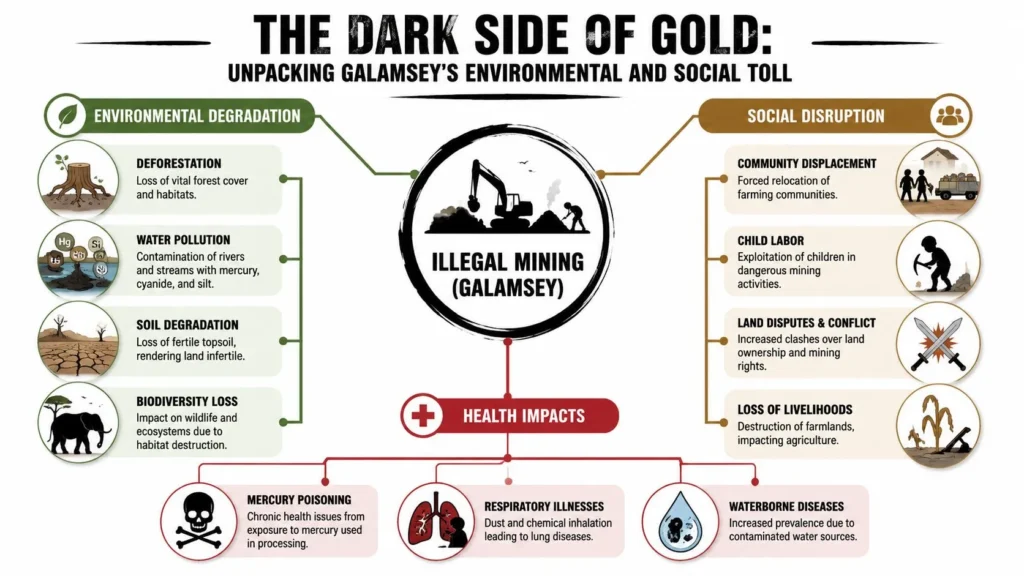
The most acute concern sits around illegal and unlicensed mining. Reporting cited in a DW video on Ghana’s illegal mining crisis says illegal mining has negatively affected 44 communities and that Ghana is losing about 5,520 hectares of land to illegal mining. The same broad body of coverage describes mercury leaching into soil and water, while cocoa farms and other agricultural land are damaged or abandoned.
Water and land are where the costs show up first
For many communities, the argument about gold becomes concrete at the point of use. Can families still drink from local water sources? Can farmers still cultivate land after topsoil has been stripped, trenches have opened, or contaminated runoff has spread through low-lying fields? Those questions don’t read like abstract environmentalism. They read like household economics.
Illegal mining changes the physical environment quickly because it often prioritizes immediate extraction over site rehabilitation. Riverbanks are especially vulnerable. Once water turns turbid or chemically compromised, the cost is distributed outward. Households, farmers, water operators, and downstream settlements all inherit part of the burden.
For readers interested in the wider relationship between extractive pressure, ecosystems, and long-term environmental risk, broader background on how climate change reshapes environmental systems helps place local degradation in a larger context.
Why galamsey persists
The persistence of galamsey is often described as a policing failure. That’s only part of the story. An analysis of child labor and illegal gold mining in Ghana says that by 2024 about 40% of Ghana’s gold output came from small-scale miners, yet an estimated 70–80% of those operations were still unlicensed and operating illegally. The same source says rising gold prices in 2023 and 2024 pulled more youth into unlicensed mining and that thousands of children aged 10–17 work in these mines.
Those numbers expose the paradox. Gold is valuable enough to draw in labor fast, but legality, monitoring, and alternative livelihoods don’t expand at the same speed. In districts where farming incomes are weak or unstable, illegal mining can look less like organized crime from the inside and more like the fastest available cash economy.
Field reality: Enforcement can shut a pit. It can’t, by itself, erase the income logic that sent people there.
A second pressure is social imitation. Once some households earn visible money from unlicensed digging, neighbors and relatives may follow. That doesn’t make the practice safer or more legitimate. It does help explain why repeated crackdowns rarely end it for long.
Here is the documentary embed referenced in coverage of the issue:
The burden falls unevenly
The costs of illegal mining are not shared evenly across the population.
- Children face direct risk: Some work in dangerous extraction and processing environments instead of remaining in school.
- Farmers absorb land loss: Productive soil can become excavated, polluted, or inaccessible.
- Women often shoulder household stress: When water sources fail or food production drops, domestic burdens usually rise.
- Communities lose bargaining power: Illegal sites can multiply faster than local institutions can respond.
The central problem is not that Ghana lacks reasons to mine. It is that the benefits and harms are distributed through different channels. Gold revenue can concentrate. Contamination and lost farmland usually do not.
Navigating the Rules Legal Frameworks and Investment
For all the disorder around illegal extraction, Ghana’s formal mining sector does have a recognizable regulatory architecture. Investors and operators don’t enter a legal vacuum. They move through institutions, permits, reviews, and ongoing compliance obligations. The challenge is that a written framework and lived enforcement are not always the same thing.
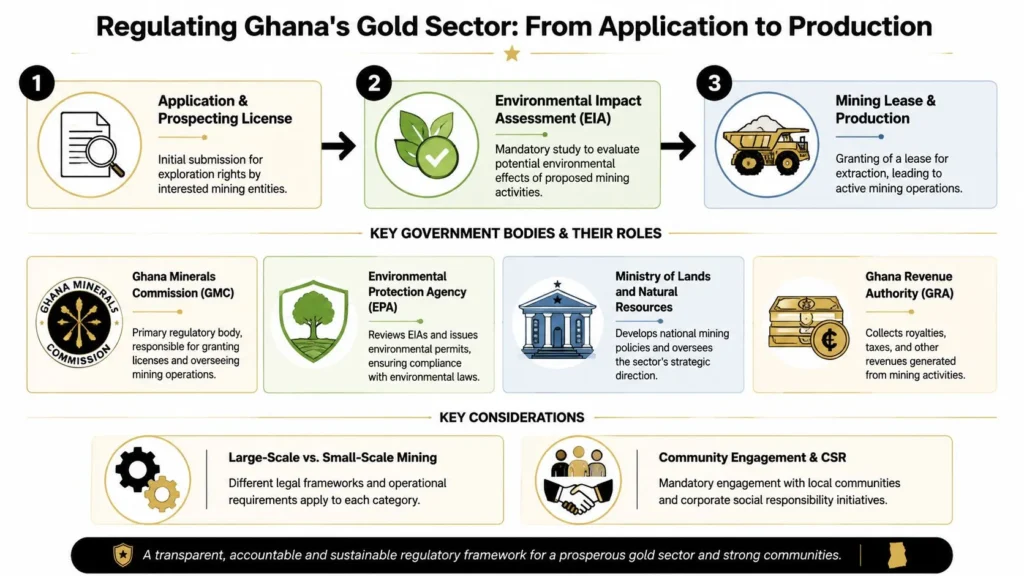
At the center of the formal system are the Minerals Commission, the Environmental Protection Agency, the Ministry of Lands and Natural Resources, and revenue authorities that collect royalties and taxes. Together, they define the legal route from exploration interest to production.
How formal entry usually works
For a legitimate operator, the path is structured rather than improvised.
- Secure exploration or prospecting rights through the relevant state process.
- Undertake environmental review, including impact assessment and permitting.
- Obtain the production lease and operate under continuing oversight, including revenue obligations and community-facing responsibilities.
The details vary by project type and scale, especially between large-scale and small-scale mining, but the principle is straightforward. Legal mining in Ghana is supposed to be licensed, monitored, and fiscally legible.
What investors actually weigh
Investors don’t look only at ore bodies. They also judge whether the jurisdiction can sustain the rules it has written. Ghana offers several attractions. It has a long gold history, established mining zones, and geological continuity that is easier to evaluate than frontier regions with thin records.
But the opportunities come with clear risks:
- Regulatory execution: A permit on paper doesn’t eliminate delays, disputes, or administrative uncertainty.
- Security and encroachment: Illegal mining on or near concessions can disrupt operations and raise protection costs.
- Social license: Community opposition can slow or destabilize projects even when formal approvals are in place.
- Reputation exposure: Investors increasingly care whether a project sits inside broader narratives of water damage or land conflict.
Someone entering the sector for financial reasons should understand the difference between a mineral opportunity and an investable operating environment. Readers new to portfolio basics may find broader primers on how to start investing money useful before looking at resource jurisdictions, because commodity exposure carries a distinct set of political and operating risks.
The gap between legality and confidence
A functioning legal framework matters because it gives serious operators something to plan around. But confidence depends on whether the state can enforce boundaries consistently, especially where legal concessions overlap with local livelihood pressures.
A mining code can attract capital. Only credible enforcement and credible community engagement can keep that capital in place.
That is the unresolved institutional question in Ghana gold mining. The country is attractive precisely because it is a known producer with a long record. Yet that same long record has produced entrenched expectations, competing claims, and a difficult coexistence between formal mining and informal extraction. For investors, that means Ghana offers real opportunity, but not easy certainty.
Beyond the Mine Gold’s Broader Influence
Gold shapes Ghana far beyond the pit edge. It influences where roads are built, how towns grow, what kinds of jobs people pursue, and how land is valued. In places such as Obuasi, where commercial-scale mining began in 1897 according to the source cited earlier, the industry’s footprint is historical as well as economic. Mining towns carry layers of memory, dependency, resentment, and local pride all at once.
That broader influence explains why the public debate remains so unsettled. Gold can finance households and attract global attention to Ghana’s resource potential. It can also crowd out other visions of development if farming land, water systems, or local institutions weaken in the process.
What sustainable mining would actually require
The phrase “sustainable mining” is often used too loosely. In Ghana’s case, it likely means something more concrete.
- Formalization that works: Licensed small-scale mining has to become easier to distinguish from criminal extraction.
- Water and land protection that is enforced: Damage can’t remain an externality pushed onto villages and farmers.
- Community bargaining power: Consent, compensation, and grievance systems have to function before conflict hardens.
- A broader local economy: Mining districts need livelihoods that don’t depend entirely on the next gold rush.
These are not anti-mining demands. They are the conditions under which mining stops behaving like a cycle of emergency.
The policy question that won’t disappear
The central paradox remains unchanged. Ghana has a gold sector strong enough to place it among the world’s leading producers, yet persistent enough informal extraction to undermine governance, public trust, and environmental security. That is why the country’s future debate will likely focus less on whether gold matters and more on what kind of gold economy Ghana wants to tolerate.
The answer won’t come from a simple choice between growth and restraint. It will come from deciding which forms of extraction deserve legal protection, which costs should never be socialized onto communities, and whether the state can align mineral wealth with public order rather than permanent improvisation.
Ghana gold mining is often described as a blessing or a curse. In practice, it is neither by itself. It is a test of institutions, incentives, and political will.
If you want more clear, evidence-aware reporting on business, science, technology, health, culture, and global trends, visit Maxi Journal. The publication curates approachable, well-structured articles for readers who want sharp commentary without the clutter, and it also offers a home for prospective contributors looking to publish thoughtful work.
Discover more from Maxi Journal
Subscribe to get the latest posts sent to your email.