You can smell the grill, hear the patio chairs scraping, and still feel the itch before the first mosquito even lands. That’s usually the moment people start wondering whether the soap they used this morning is doing anything at all, or whether bug repellent soap is mostly a label that sounds smarter than it is.
The confusion makes sense. Soap sounds ordinary and gentle, while bug repellent sounds like something you’d only trust after reading a label twice. In real life, those two ideas get mashed together in DIY videos, garden advice, and travel product claims, even though they don’t all do the same job. If your window screens are torn, a fix there may matter more than any scented bar, and a practical place to start is a reliable resource on DIY bug screen fixes.
What follows is a plain-language way to sort the category out. Some products are real skin repellents backed by field trials and public-health guidance, some are garden insecticidal soaps that only work on contact with pests, and some are just marketing dressed up as chemistry. A clear eye on those differences saves you money, prevents false confidence, and keeps you from treating one product like it can do the job of another.
The Promise and the Confusion Around Bug Repellent Soap
A humid dusk is when the claim sounds most tempting. You’ve already showered, you’re clean, and you still don’t want to stand outside applying a separate spray to every inch of exposed skin. That’s the appeal of bug repellent soap, it suggests you can wash once and carry some protection with you.
The problem is that the word soap pulls people toward the wrong mental model. Many readers assume all bug soaps work the same way, but some products are personal repellents meant for skin, while others are garden soaps that only affect insects on contact. Those are different tools with different evidence, and the confusion online is a big reason people end up disappointed.
Practical rule: if a product claim doesn’t clearly say whether it’s for skin or for plants, treat it with caution.
There’s also a history behind the idea that’s easy to miss. During World War II, military soap was adapted to leave a thin residue of repellent compounds on skin, helping mask human scent and irritate insects’ sensory receptors, which was an early attempt to combine hygiene and bite prevention in one product. That’s a very different thing from assuming any bar that smells herbal or “bug-safe” will protect you all evening.
The rest of the topic gets easier once you sort the categories. Personal repellents, like the kinds backed by CDC and EPA guidance, are one lane. Garden insecticidal soap is another. DIY scent-based bars are a third lane entirely, and they’re the one most likely to overpromise.
How Bug Repellent Soap Actually Works
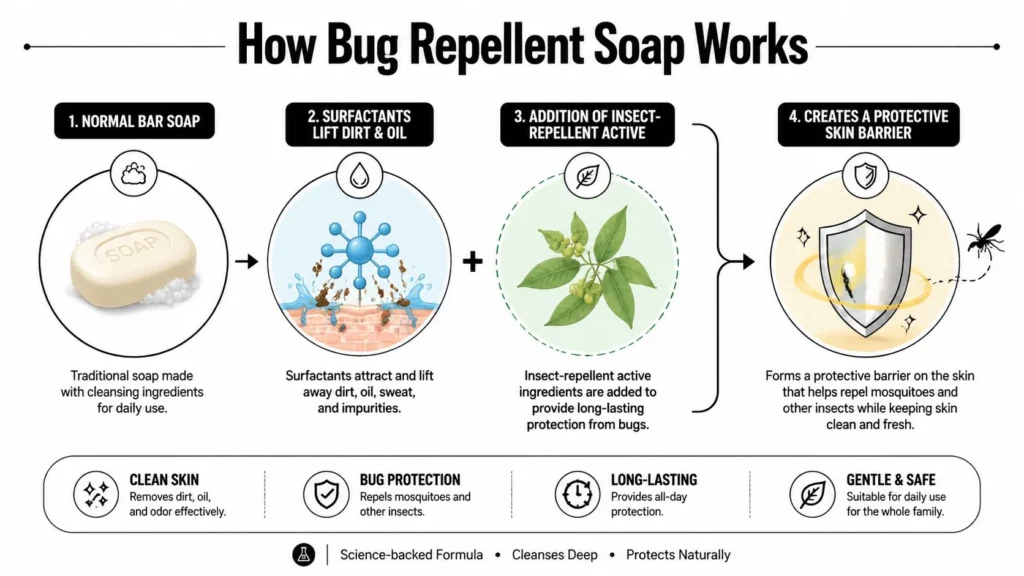
Start with a normal bar
A regular bar of soap is built around surfactants, the cleaning molecules that help lift oil, dirt, and grime so water can rinse them away. On its own, that’s a cleaning system, not a biting-insect defense system. If a bar has no repellent active in it, it may feel fresh and smell strong, but that doesn’t mean mosquitoes are being discouraged in any meaningful way.
Add the repellent active
A true bug repellent soap gets its insect effect from an added active ingredient, not from the foam itself. In controlled field trials of a soap formulation containing DEET, mosquito landing-biting rates were reduced by 83.8% to 100.0%, and the residual effect lasted up to 4 hours against outdoor mosquitoes in Malaysia (PubMed). That points to the active ingredient doing the primary work, not the soap base.
The easiest analogy is this. A repellent soap is closer to a scented candle that changes the local environment, while a garden insect soap is closer to a fly swatter that only works when it hits the target directly.
The base matters for cleansing, but the active ingredient determines whether the product repels.
You can see the same logic in the engineering of the product itself. If the active is weak, the bar may smell pleasant and lather well, but it won’t perform like a genuine repellent. If the active is well chosen and properly concentrated, the soap can function more like a wash-and-protect product than a novelty bar, and that distinction matters much more than the color of the packaging.
For readers who like the skin-care side of the story too, a close cousin topic is glycerin soap and how it supports moisture balance, which helps explain why not every bar has the same feel on skin even before you add a repellent ingredient.
Active Ingredients Compared
The fastest way to judge bug repellent soap is to look at the active ingredient, not the word “soap.” Some actives have a long track record in personal repellents, others do not behave well in a soap matrix, and a few sound plausible but don’t show the same kind of field support.
| Active Ingredient | Typical Soap Concentration | EPA-Registered | Key Limitation |
|---|---|---|---|
| DEET | Varies by product | Yes, in repellent products recommended by CDC and EPA | Higher concentrations can improve repellency, but soap performance still depends on formulation |
| Picaridin | Varies by product | Yes, in repellent products recommended by CDC and EPA | Needs a well-designed product, not just a scented base |
| Permethrin | Varies by product | Yes, in some insect-control products | Did not improve mosquito repellence when added to soap in one comparative study |
| Natural oils | Varies widely | Not the same regulatory footing as EPA-registered repellents | Often smell strong, but that isn’t the same as proven duration |
What the comparison actually shows
The clearest pattern in the evidence is dose and formulation. A comparative chemistry study reported that higher DEET concentrations increased repellency, while permethrin did not improve mosquito repellence when added to soap. The authors concluded that a repellent soap with DEET only at 50% concentration was the most effective formulation they tested, which is a strong sign of a dose-response relationship in the soap context (study PDF).
That doesn’t mean every consumer needs a bar at that concentration. It does mean the active ingredient and its amount are what matter, not the novelty of a homemade blend or the intensity of the fragrance.
Helpful shortcut: if a product can’t tell you what the active is, it’s probably selling a feeling, not a result.
For everyday buyers, the CDC and EPA guidance is still the safest anchor. They recommend EPA-registered repellents such as DEET and picaridin, and the Boy Scouts of America cite 20% concentration as an effective benchmark for those ingredients. That benchmark belongs to dedicated repellents, not to every DIY soap on the shelf, but it’s still a useful reference point when you’re reading a label and trying to tell a real repellent from a cosmetic scent.
Skin Repellent Versus Garden Insecticidal Soap
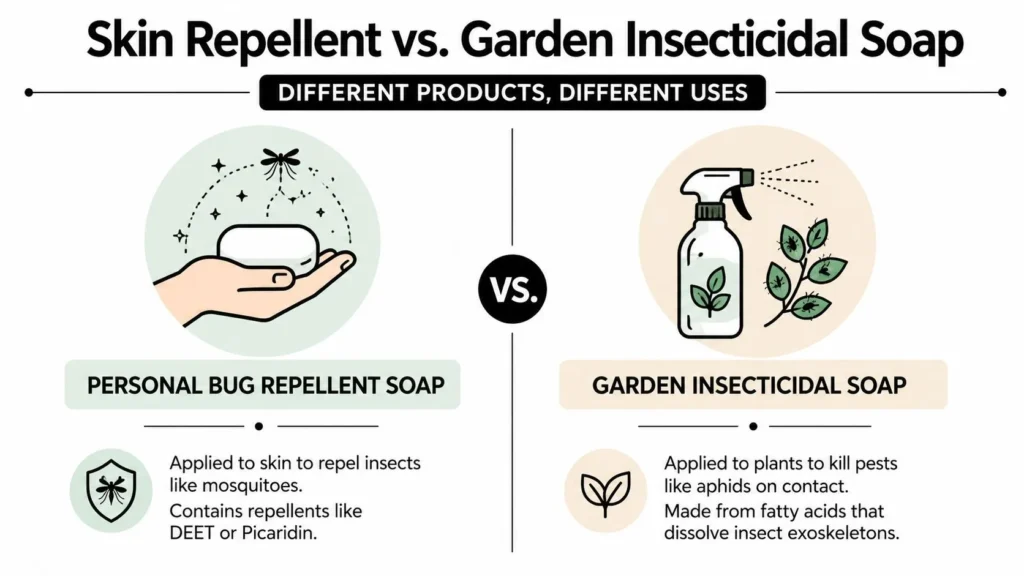
The biggest mistake people make is assuming every “bug soap” is a repellent for skin. It isn’t. Garden insecticidal soap is made to kill soft-bodied pests on plants by direct contact, not to provide long-lasting personal protection for a person standing on a porch.
Clemson’s guidance is blunt about how insecticidal soap behaves. It works only when it directly contacts the insect’s body, spraying dormant leaves is ineffective, the effect is short-lived and may need reapplication every 4–7 days, and soap does not bother insects if they eat it (Clemson HGIC). That means a lot of DIY advice, especially the kind that suggests rubbing soap on doorframes or skin as if it were a substitute for repellents, is mixing up two unrelated uses.
The same confusion shows up in household pest advice. People want one product to solve mosquitoes, flies, aphids, and patio annoyance all at once, but the biology doesn’t cooperate. If the product is intended for plants, it belongs in the garden, not on your arms.
For homeowners trying to reduce mosquito pressure around the house, a focused local resource like the guide to mosquito control for Miami homeowners can be more useful than improvising with the wrong kind of soap. Mosquito management starts with the environment, then moves to personal protection, not the other way around.
Practical Use Across Everyday, Travel, and Family
Backyard evenings and humid patios
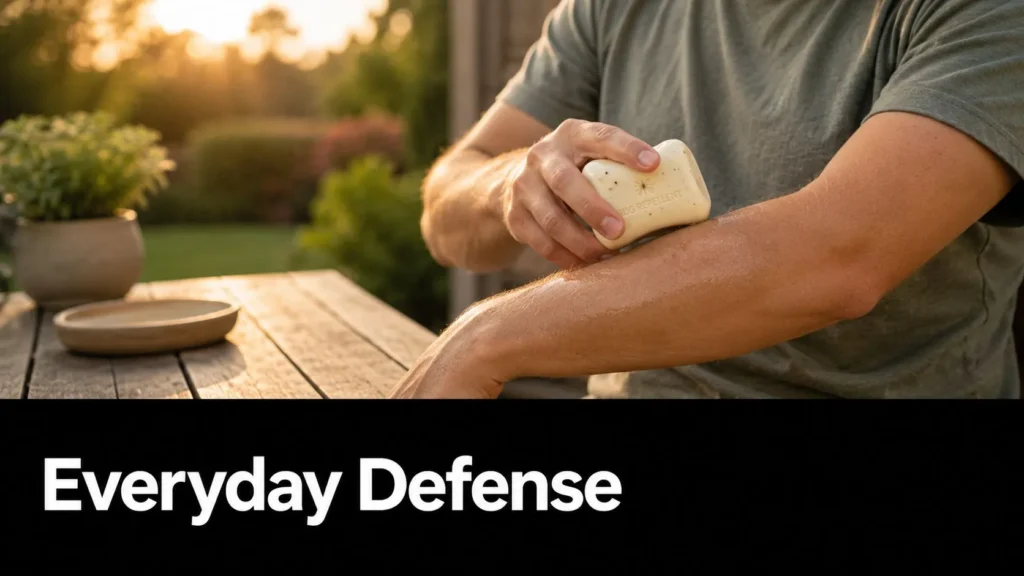
A warm evening outside is the easiest place to misunderstand bug repellent soap. If you are sitting on a patio and mosquitoes are active, a repellent soap may fit into your routine, but it works best as one layer among several. Screens, long sleeves, and getting rid of standing water around the yard still do more of the heavy lifting, because soap on its own is rarely enough for a whole night.
That is especially true in muggy weather, when bites can start quickly and people assume any scented bar is doing the same job as a true skin repellent. It helps to treat the soap the way you would treat a backup flashlight. Useful to have, not the only tool you rely on. For people dealing with swarms outdoors, a practical overview like what to do about swarms of flies around the house can also help separate nuisance control from personal bite protection.
Travel and higher-risk settings
Travel raises the stakes. If you are going somewhere where mosquito-borne illness is a concern, soap alone is a risky choice, because personal protection has to be dependable, not just pleasant-smelling. The Burkina Faso product reported by Reuters was described as a low-cost malaria tool and was said to repel mosquitoes for up to six hours after washing, with runoff that might also reduce breeding in stagnant water (Reuters). That is encouraging, but the reporting still frames it as part of a broader public-health effort, not a stand-alone answer.
For travelers, the practical takeaway is simple. Use soap as part of washing, then rely on a repellent strategy that is meant for skin and backed by field testing or clear regulatory guidance. A bar that smells strong at the sink is not the same thing as a product that has been checked for real-world bite reduction.
Kids and sensitive skin
With children and anyone whose skin reacts easily, the label deserves slow reading. A product can feel mild in the hand and still be too irritating for daily use, especially if it carries a heavy fragrance load or a strong active ingredient. The key questions are basic ones. Is it meant for skin, is it formulated for that use, and does it have the kind of registration or guidance you would expect from a repellent rather than a craft soap?
That is the part parents often skip. They see “natural” and assume safe, or they see a stronger active and assume harsh, but the core issue is whether the full product was designed and tested for the skin that will use it. Sensitive skin does not need guesswork.
Pets
Human bug repellent soap should stay in the human category. Pets groom differently, lick their coats, and have skin that responds differently to many ingredients, so a product made for people should not be borrowed for animals without veterinary guidance. That keeps the line clear and avoids turning a simple wash into a problem for the pet.
DIY Bug Repellent Soap and Formulation Tips
A humid evening is when DIY bug-repellent soap looks most appealing. The sink smells fresh, the mosquitoes are active, and it is easy to assume a stronger scent means stronger protection. That is where the confusion starts, because a soap can be pleasant to use without being a dependable repellent.
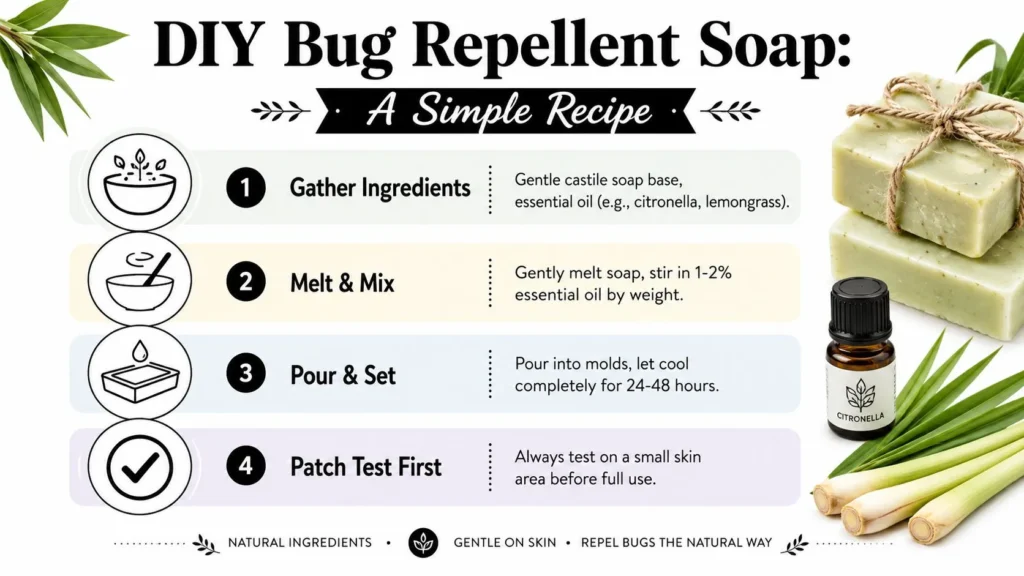
A sensible DIY approach begins with a gentle base and cautious ingredient choices. If your goal is scent plus mild outdoor use, a castile-style soap with a measured additive is the clearest way to frame it. Once you start expecting the bar to work like a true skin repellent, you are no longer mixing craft soap, you are trying to build a formulation.
The 2016 Burkina Faso invention shows how difficult that jump can be. Reuters described a mosquito-repellent soap developed by two former students, with claims that it could repel mosquitoes for up to six hours after washing, and it was presented as part of a low-cost malaria-control effort. The important lesson is not the novelty of the idea. It is that performance claims in a soap are only meaningful when the product has been tested as a repellent, not just praised for its smell (Reuters).
Formulation still matters even for simple home projects. If the active is too weak, you get a bar that feels thoughtful but offers little protection. If it is too strong, skin irritation becomes a real possibility. Essential oils can make a soap smell like summer, but fragrance alone does not tell you anything about bite reduction.
If you make it at home, treat it as a light-use product, not a substitute for a repellent that has been checked in the field.
The basic recipe logic is straightforward, even if the chemistry is not.
- Choose the base carefully. Start with a mild soap base that does not already bother your skin.
- Keep the additive measured. Use a small, controlled amount of any active instead of guessing by scent.
- Patch test first. Skin tolerance matters just as much as smell.
- Do not confuse aroma with protection. A stronger smell does not prove a stronger repellent.
If the soap is meant for household use, keep it in the human category. Do not assume a scent that seems fine on people is fine for animals. For anyone wondering about citrus-based additives in particular, this guide on whether citronella is safe for dogs is a useful reminder that pets process ingredients differently and should not be treated like small humans.
Regulation, Environment, and Travel Considerations
A careful buyer reads the label before the bar ever reaches the shower shelf. If a product claims repellency, the key question is whether the active is EPA-registered and clearly named on the package. That matters because registration moves the product out of casual marketing and into the same regulatory space used for repellents discussed by CDC and EPA guidance.
The research pattern behind repellent soaps also matters for labeling claims. As noted earlier in the comparison of active ingredients, controlled testing favored a stronger repellent effect only when the active ingredient and concentration were doing real work, not just adding scent. That is the same practical lesson regulators care about. A soap that promises protection without a meaningful active is making a weak claim, even if the packaging sounds convincing.
Travel convenience is a separate issue from bite protection. Soap bars are often easier to pack than liquid sprays, and they are less likely to raise spill concerns in a carry-on bag. Single-use wipes also create more packaging waste than a reusable bar. Those are useful features, but they do not prove that the product will stop mosquito bites, so the better travel question is whether the repellent matches the place you are going and the level of exposure you expect.
For dog owners, the boundary needs to stay clear. A human repellent soap is not a pet-care product, and a general discussion of citronella safety belongs in veterinary guidance, not in a bathroom test. If that is your situation, read this citronella and dog safety guide before putting anything on an animal.
Quick Answers Before You Buy or Use
If you are deciding whether bug repellent soap is enough for a trip, the short answer is no. The stronger guidance still favors dedicated EPA-registered repellents and other prevention steps, with soap playing a limited supporting role rather than carrying the whole job.
How long protection lasts depends on the product and the study behind it. The controlled trial discussed earlier found residual protection against outdoor mosquitoes after washing, and the Burkina Faso report described a product that researchers said could continue repelling for a period after use, but those results do not make every repellent soap interchangeable. A bar that smells like citronella is not the same thing as a tested active ingredient held in a specific formula.
Sensitive skin adds another layer of caution. A gentle soap base can help, but the repellent active and fragrance still matter, so a product that feels fine on one person may still irritate another.
Dogs need separate products and separate advice. Human repellent soap belongs in human use, while pet safety needs veterinary guidance and products made for animals.
If you want clearer science, simpler label reading, and more plain-English breakdowns like this, visit maxijournal.com for approachable coverage that cuts through marketing and gets back to what products do.
Discover more from Maxi Journal
Subscribe to get the latest posts sent to your email.