You’re sitting outside on a warm evening. The mosquitoes are out, so you light a citronella candle or clip on a citronella collar because it feels like the natural, simple fix. Your dog is nearby, stretched under the chair or trotting around the yard, and the question usually comes later: is citronella safe for dogs, or does “natural” give a false sense of security?
That question gets confusing fast because citronella shows up in very different forms. A garden plant isn’t the same as a concentrated essential oil. A patio candle isn’t the same as a bark collar. A dog-formulated topical product isn’t the same as a human diffuser blend. The risk changes with the form, dose, route of exposure, and your dog’s sensitivity.
As a veterinary toxicology educator, I want to lower the temperature on this topic. Not everything containing citronella is automatically disastrous. But it also isn’t harmless just because it comes from a plant. Dogs experience scent, skin exposure, and accidental ingestion very differently than we do. Their body language often tells you when something is too intense, which is why learning to read subtle signals matters. If you want a refresher, this guide to understanding dog body language is a helpful companion.
A Pet Owner’s Guide to Citronella Safety
A lot of owners arrive at the same place. They’ve used citronella for years around people without a problem, then they notice their dog sneezing near a candle, scratching after a spray, or licking at a citronella product that spilled.
That’s where the real issue starts. Citronella safety for dogs isn’t one yes-or-no answer. It’s a product-by-product question.
Some dogs only experience mild irritation. Others react more strongly because the exposure is concentrated, prolonged, or close to the face. A collar that releases scent near the nose creates a different situation than a plant at the far edge of a garden. A bath product formulated for dogs is different from undiluted oil from a diffuser bottle.
Practical rule: When you ask “is citronella safe for dogs,” always add four more words: in what form, how much?
That simple shift helps you think like a toxicologist. We don’t just label a substance good or bad. We ask how the dog encountered it, how much reached the body, and which tissues took the hit first. With citronella, those tissues are often the nose, airways, skin, eyes, and digestive tract.
The Truth About Citronella and Its Use Around Pets
Citronella has a clean, bright scent that people associate with fresh air and outdoor comfort. That’s part of why it’s so popular in candles, sprays, oils, and training products. But pet safety gets muddy because “natural” and “safe” get treated as synonyms, and they aren’t.
A jalapeño is natural. So is poison ivy. So is garlic. Nature produces lots of biologically active chemicals. Citronella does too.
Why owners get mixed messages
One of the biggest points of confusion is the contradiction in how citronella gets described. Some sources warn that citronella plants and oils can cause problems in dogs, while dog-specific collars are marketed as safe and humane alternatives to shock collars. As noted in this discussion of the contradiction around citronella products for dogs, that gap often leaves owners uncertain because coverage rarely reconciles the difference between general toxicity warnings and pet-product marketing.
That contradiction doesn’t always mean someone is lying. It often means they’re talking about different products.
A live plant in the yard exposes a dog mainly through chewing. A candle exposes a dog through nearby fumes, heat, and possibly wax. A diffuser may push volatile compounds into enclosed air for a long stretch. A citronella collar uses a controlled burst or release designed for canine use, but it still places scent very close to a dog’s face and skin.
Natural doesn’t mean low-risk
Toxicology works a lot like sun exposure. A little morning light on your skin isn’t the same as hours of midday sun without protection. The category sounds the same, but the intensity and route change the outcome.
That’s why broad statements like “citronella is safe” or “citronella is toxic” don’t help much. Both are too blunt.
Here’s the clearer version:
- Plant material can upset the stomach if chewed.
- Concentrated oils carry more risk because they’re potent and easy to overuse.
- Airborne products can irritate a dog’s nose and airways.
- Topical products can irritate skin, especially in sensitive dogs.
- Dog-specific products may be safer than human products, but “safer” doesn’t mean risk-free.
The question to ask before using any product
Instead of asking whether citronella is good or bad, ask:
- Was it made for dogs
- Is it concentrated
- Will it sit near the face
- Can my dog lick it
- Can it touch skin or eyes
- Can my dog leave the area
That last question matters more than people think. Dogs can’t tell you a smell is overwhelming. They just avoid the room, paw at their face, sneeze, pace, or shut down.
If your dog keeps moving away from a citronella product, take that behavior seriously. Aversion is information.
Analyzing Citronella Risk by Product Form
Not all citronella exposures belong in the same bucket. Many articles lose the plot, talking about “citronella” as if a patio candle, a garden plant, and a pure essential oil bottle are interchangeable. They aren’t.
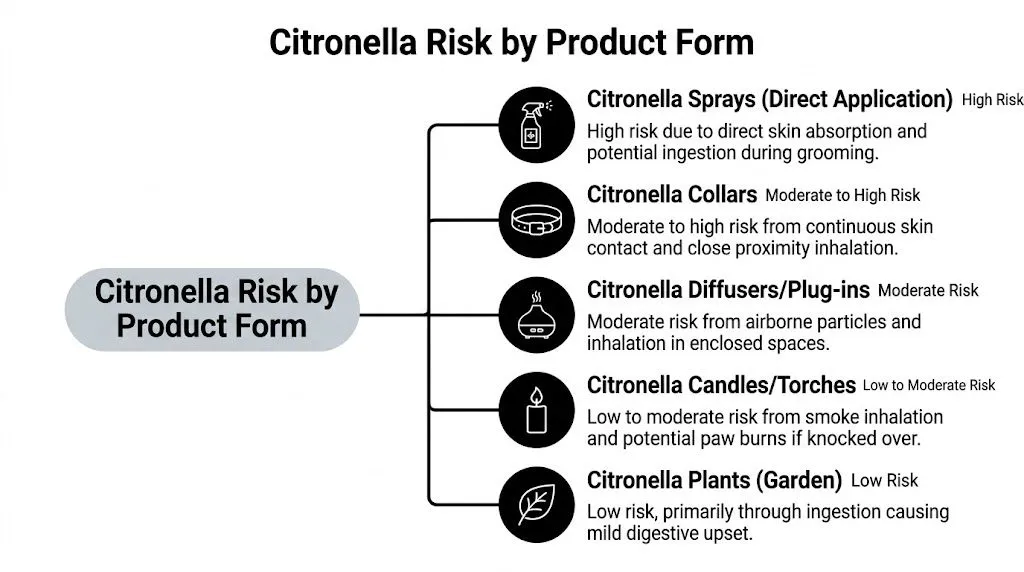
Quick comparison for everyday use
| Product Form | Primary Risk | Risk Level | Safety Precaution |
|---|---|---|---|
| Citronella plant | Chewing and stomach upset | Low to moderate | Keep curious chewers away from the plant |
| Essential oil | Ingestion, inhalation, skin irritation | High | Avoid pure oil around dogs |
| Diffuser or plug-in | Airway irritation from prolonged scent exposure | Moderate to high | Don’t use in enclosed spaces your dog can’t leave |
| Candle or tiki torch | Smoke, heat, melted wax, close-range fumes | Low to moderate | Use outdoors and keep distance from the dog |
| Spray not made for dogs | Direct skin contact and licking after application | High | Don’t apply human citronella sprays to dogs |
| Dog-formulated topical product | Irritation if the formula doesn’t suit the dog | Moderate | Use only as directed and monitor skin |
| Citronella bark collar | Close facial exposure and skin contact | Moderate | Use only dog-specific products and watch for irritation |
Citronella plants in the yard
A citronella plant in a garden usually creates the lowest everyday risk unless your dog likes to chew leaves or dig around roots. The problem here is less about the smell drifting through the yard and more about physical access.
A single sniff while walking past usually isn’t what worries me. Repeated chewing is. Dogs that mouth plants out of boredom, teething, or curiosity are the ones I’d watch most closely.
If you keep citronella in the yard, placement matters. Put it behind a barrier or in a section your dog doesn’t treat like a snack bar.
Essential oils and concentrated bottles
This is the form I worry about most. Pure or concentrated citronella oil is easy to spill, easy to overapply, and easy for a dog to ingest by licking paws, fur, floors, or a tipped diffuser.
Think of concentration like broth versus bouillon paste. They may come from the same flavor family, but one is much denser. Citronella oil in a bottle is the dense version.
For practical home safety, I’d keep concentrated citronella oils out of dog environments unless your veterinarian specifically recommends a dog-safe formulation and use plan.
Diffusers and plug-ins
Diffusers create a problem owners often underestimate. They don’t have to touch the dog to matter. They just keep feeding volatile scent into the same air the dog breathes.
That can be especially uncomfortable for dogs that already have airway sensitivity, anxiety, or a strong aversion to sharp smells. Even if the room seems lightly scented to you, your dog may experience it as an all-day sensory load.
A simple test helps. If your dog leaves the room when the diffuser runs, don’t assume they’re being fussy. They may be telling you the environment is unpleasant.
Candles and tiki torches
Candles are usually seen as the “mild” citronella product because the exposure is less direct than oil on skin. Often that’s true. But the risk isn’t zero.
You have several moving parts:
- Fumes and smoke near the nose
- Open flame if a tail or paw gets too close
- Hot wax if knocked over
- Chewing risk if a dog mouths a cooled candle or container
For most dogs, a citronella candle used outdoors at a distance is less concerning than direct oil exposure. Indoors, or right beside a resting dog, the balance changes.
Sprays and direct application
This category splits in two.
Human citronella sprays and improvised DIY mixes are the version I’d avoid around dogs. They can land on the coat, be absorbed through skin, and then be licked during grooming. That turns one exposure into two.
A properly formulated dog product is different. A 2024 peer-reviewed study on a 6% citronella oil bath bomb used on dogs found 100% repellency at 3 hours, 69.28% at 6 hours, and 65.58% at 8 hours, with no skin irritation observed in treated dogs. That’s useful because it shows the issue isn’t “citronella can never touch a dog.” The issue lies in formulation, concentration, and intended use.
If you want a comparison point with another plant-derived scent product, this piece on is lavender toxic to dogs shows why plant-based ingredients still need product-specific scrutiny.
A dog-safe formulation can be acceptable. A random bottle of essential oil is not the same thing.
Citronella collars
Citronella collars sit in the middle of the debate. They’re often marketed as humane because they use scent rather than electric shock. That makes sense from a behavioral equipment perspective, but it doesn’t answer every toxicology question.
A collar keeps citronella very close to the dog’s nose, eyes, and skin. So even if it avoids one problem, it can still create another. Some dogs tolerate these collars. Others develop redness, scratching, or clear scent aversion.
I’d call this a product that deserves caution, not panic. If an owner chooses one, it should be dog-formulated, introduced carefully, and stopped at the first sign of distress.
The Science of How Citronella Affects Dogs
Dogs don’t experience citronella the way you do. That’s the starting point.

Why the smell hits dogs harder
Dogs have about 300 million olfactory receptors, which is about 40 times more than humans, according to the veterinary toxicology profile summarized in HBNO’s citronella safety overview for dogs. That means a smell you notice as “fresh” or “strong” may land on your dog as intrusive and irritating.
The easiest analogy is sound. A blender in the kitchen may be annoying to you, but if your hearing were far more sensitive, the same noise could feel unbearable. Citronella can work like that through scent.
Three ways exposure causes trouble
Inhalation
When a dog inhales volatile citronella compounds, the nose and upper airways react first. The scent can trigger irritation that leads to sneezing, coughing, or rhinitis.
This is one reason diffusers, sprays near the face, and collars can be a problem. The dog doesn’t need to swallow anything. The air itself becomes the exposure.
Ingestion
Ingestion is the route that usually creates the biggest concern. The same source notes that ingestion of 1 to 5 mL/kg bodyweight can cause significant gastrointestinal upset in dogs, and vomiting occurred in up to 80% of reported canine cases to ASPCA Poison Control.
That doesn’t mean every dog who tastes citronella will become severely ill. It does mean accidental licks of spilled oil or grooming after topical exposure shouldn’t be brushed off.
Once citronella reaches the digestive tract, it can irritate the stomach and intestines. In larger exposures, dogs may also show depression, wobbliness, or weakness.
Dermal exposure
Skin contact often gets dismissed because it doesn’t sound as dramatic as poisoning by mouth. But skin is a major organ, and dogs don’t leave irritated skin alone. They lick it, rub it, and scratch it, which can worsen the problem.
This matters even more in sensitive dogs. A product can be “not severely toxic” in a systemic sense and still be a poor choice because it makes the dog miserable.
Why low-dose safety doesn’t erase irritation risk
The European Food Safety Authority assessed citronella oil in animal feed and, at very low dietary concentrations, considered it of no concern for dogs within specified limits. For dogs, EFSA listed 10 mg/kg in complete feed for short-living animals and 2.0 mg/kg for long-living and reproductive animals, while also flagging citronella oil as an irritant to skin and eyes and a dermal sensitizer in its 2024 scientific opinion on citronella oil as a feed additive.
That sounds contradictory until you separate two ideas:
- Systemic safety at very low oral doses
- Local irritation to skin, eyes, and airways
Both can be true.
Toxicology isn’t just about whether a substance kills. It’s also about whether it inflames, irritates, sensitizes, or distresses.
Recognizing and Responding to Citronella Exposure
If your dog gets into citronella, your job is to stay calm and become an observer. Most owners lose time by guessing. It’s better to gather facts fast.

What signs to look for
Citronella exposure can show up in different ways depending on whether the dog inhaled it, got it on the skin, or swallowed it.
Watch for:
- Mild early signs such as sneezing, pawing at the face, drooling, lip licking, or restlessness
- Digestive signs including vomiting or diarrhea
- Skin signs like redness, scratching, rubbing, or a rash
- More serious signs such as weakness, poor coordination, unusual sleepiness, or feeling cold
If the exposure was topical, don’t ignore “just a little redness.” As covered in the EFSA assessment earlier, citronella is flagged as a skin and eye irritant and a dermal sensitizer, so mild skin reactions deserve follow-up rather than dismissal.
What to do right away
Start with simple first aid.
- Move your dog away from the source. Fresh air matters if the exposure was from a candle, diffuser, spray, or collar.
- Remove the product. Take off the collar, wipe away visible residue, and prevent further licking.
- Wash exposed skin with mild soap and lukewarm water. Rinse well.
- Flush the eyes gently with clean water if eye exposure is suspected.
- Do not induce vomiting unless a veterinarian tells you to.
If you need guidance on what over-the-counter medications are and aren’t appropriate in emergencies, this overview on can you give a dog Benadryl may help you avoid common mistakes. It isn’t a substitute for poison advice.
Bring the package, photo, or label to the phone call. The exact product matters more than the brand story on the front.
When to call for help
Call your veterinarian or a pet poison service promptly if:
- your dog swallowed citronella oil or a citronella product
- vomiting starts or repeats
- your dog seems weak, unsteady, or unusually sleepy
- breathing seems labored
- skin irritation spreads or worsens
- the product was concentrated, unknown, or not made for dogs
A short video can also help you think through urgency and basic next steps if you’re flustered in the moment.
What information to have ready
When you call, keep these details nearby:
- Product form such as oil, candle, collar, diffuser, or spray
- How exposure happened by inhalation, licking, chewing, or skin contact
- When it happened
- What signs you’ve seen
- Your dog’s size and health history
That allows the veterinarian to judge whether this is likely to stay local and irritating, or whether it may become a more significant poisoning event.
Effective and Dog-Safe Pest Control Alternatives
Once owners learn the risks of citronella, they often swing too far in the other direction and feel they have no good mosquito-control options. You do. You just want methods that don’t ask your dog’s nose, skin, or stomach to carry the burden.

Start with the environment
The safest mosquito strategy is often the least glamorous. Make the yard less attractive to bugs.
- Dump standing water. Birdbaths, planters, buckets, and clogged gutters give mosquitoes breeding spots.
- Use outdoor airflow. Fans make it harder for mosquitoes to hover and land.
- Time outdoor activity. If bugs are worst at certain hours, shift walks and yard play when you can.
- Keep resting zones clean and dry. Damp, shaded clutter attracts pests and irritates skin.
These changes don’t depend on scent at all, which makes them easier on dogs.
Choose barriers over fragrance
Screens, covered patios, and physical separation work well because they target the insect rather than your pet. If you can reduce bites without putting aromatic compounds into your dog’s breathing zone, that’s usually the cleaner solution.
For some homes, the most dog-friendly “repellent” is a better screened space plus a fan.
Ask your veterinarian for dog-formulated repellents
If your dog needs direct protection, especially in mosquito-heavy areas, ask for a product specifically formulated and labeled for dogs. That’s the category where you’re most likely to balance effectiveness with a known safety margin.
Avoid improvising with human sprays, DIY essential oil blends, or products marketed with broad “natural” language but no clear canine use directions.
Use garden choices thoughtfully
If you like the plant route, focus on landscaping that doesn’t put a toxicology puzzle in your dog’s path. Fragrant gardens can still be pleasant without relying on citronella itself.
The key idea is simple. Your yard shouldn’t require your dog to constantly tolerate a scent they may find harsh.
Good pest control protects the dog from insects without making the dog the delivery system.
A better decision standard
When comparing any pest product, ask:
- Does it work by changing the environment
- Was it designed for dogs
- Can my dog avoid it
- Will it sit on skin or near the nose
- What happens if it gets licked
That framework will usually guide you toward lower-risk choices faster than reading marketing claims.
Common Questions on Citronella and Dog Health
Is it safe if my dog just walks past a citronella candle
Usually, brief and casual passing exposure outdoors is less concerning than direct contact, prolonged close exposure, or indoor use. The bigger issues are if the candle is right next to your dog, produces enough fumes to make them avoid the area, or can be knocked over.
Are products labeled pet-friendly with citronella always safe
No. “Pet-friendly” is a marketing phrase, not a toxicology conclusion. Check whether the product is specifically intended for dogs, whether directions are clear, and whether the dog can lick or inhale it at close range. If the label is vague, I’d be cautious.
What’s the difference between citronella, lemongrass, and lemon balm for dogs
Owners often lump them together because the scents overlap. But they aren’t interchangeable from a safety perspective. Similar smell does not mean similar risk. The safest approach is to evaluate each plant or oil on its own name and product label, not by scent family.
Can a neighbor’s citronella use affect my dog
Sometimes, yes, but context matters. Outdoor scent drifting from a distance is usually less worrisome than a product used inside your home or near your dog’s resting area. If your dog shows repeated sneezing, avoidance, or distress every time the neighboring product is in use, reduce your dog’s exposure and talk with your veterinarian.
Are citronella collars safe long-term
That’s one of the gray areas. Dog-formulated citronella collars are often presented as humane alternatives to shock collars, but there’s a gap in long-term, collar-specific evidence. I’d treat them as products requiring active monitoring, not passive trust. If the dog scratches, seems stressed, or tries to escape the scent, stop using the collar.
My dog licked a tiny amount once. Is this always an emergency
Not always, but it should never be ignored. Small exposures may only cause mild stomach upset. Larger or more concentrated exposures can be more serious. What matters most is the exact product, the amount, your dog’s size, and whether symptoms start.
Can citronella ever be used safely on dogs
Sometimes, in properly formulated canine products used exactly as directed. The strongest support for that idea comes from specific formulations, not from raw oils or homemade mixtures. That’s the distinction many owners miss.
So, is citronella safe for dogs
The fairest answer is this: citronella is not universally safe or universally dangerous. It becomes more or less risky depending on the form, concentration, route of exposure, and the individual dog.
If you want the shortest practical answer, here it is:
- avoid pure oils and DIY use
- be cautious with diffusers, sprays, and collars
- treat skin and airway irritation seriously
- prefer dog-specific products over human ones
- choose environmental mosquito control whenever possible
If you enjoy practical, evidence-aware pet guides written in plain English, visit maxijournal.com for more approachable articles across pets, health, science, and everyday questions that deserve clearer answers.
Discover more from Maxi Journal
Subscribe to get the latest posts sent to your email.