You open a door or step onto the patio, and there they are. A shifting cloud of tiny bodies hanging in the air, bumping against a sunny window, or gathering over a lawn at dusk. Many refer to all of them as “just flies,” but that’s where the confusion starts.
Swarms of flies can mean very different things. Some are mostly a seasonal nuisance. Some are tied to mating behavior. Some point to a hidden trash problem. And some, surprisingly, can tell you something useful about the health of a nearby pond, stream, or wet patch of land.
If you understand what kind of swarm you’re seeing, the whole situation gets easier to handle. You stop guessing. You start noticing clues like where the insects gather, what time of day they appear, and whether they’re coming from outdoors, drains, trash, or wall voids.
Understanding Different Fly Swarms
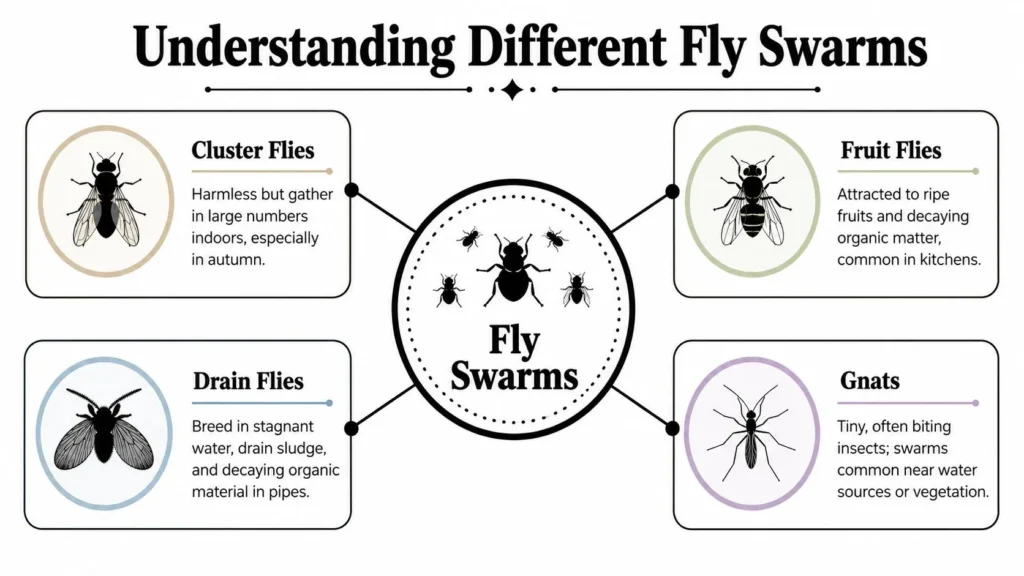
You spot a cluster of flies at a sunny upstairs window in October, then another cloud hovering over the lawn near a damp corner of the yard at dusk. Those two swarms may look similar from across the room or patio, but they usually point to very different stories about the space around your home.
That is why identification comes first. A fly swarm is not just a nuisance to remove. It is also a clue. In the same way a fever hints at one set of causes and a cough hints at another, the kind of fly you see can tell you whether the issue is wall voids, ripe produce, organic buildup in drains, or nearby standing water. In some cases, these insects even act as rough bioindicators, giving you a small glimpse of how wet, fertile, or organically rich your surroundings are.
Start with location
The easiest first filter is place.
- At windows, attics, and sunny indoor walls. Cluster flies move high on the list.
- Over water, near ponds, lakes, or damp vegetation. Midges or gnats are more likely.
- In kitchens around produce, compost, or recycling. Fruit flies fit better.
- Around drains, floor sinks, or pipe sludge. Drain flies become a strong suspect.
This works well because each group is tied to a different resource. Fruit flies follow fermentation. Drain flies follow wet organic film. Midges often reflect nearby moisture. Cluster flies often reflect seasonal shelter-seeking behavior inside the home.
Cluster flies are often mistaken for house flies
Cluster flies worry homeowners because they can appear in groups, especially near upper-story windows. Their behavior is the giveaway. They are often slower than house flies and tend to gather around light during cooler parts of the year.
Penn State Extension’s overview of cluster flies explains that these flies commonly enter buildings to overwinter, then show up indoors on warm or sunny days. That pattern helps separate them from kitchen-associated flies, which are usually drawn to food or waste instead of wall voids and attic spaces.
A simple field clue helps here. If the flies seem sluggish, appear during cooler seasons, and collect at windows without much interest in fruit, trash, or drains, cluster flies are a strong possibility.
If that sounds familiar, The Green Advantage on cluster flies gives a useful homeowner-focused explanation of how these insects get inside and why they often gather in upper parts of a home.
A quick comparison helps
| Fly type | Common clue | What homeowners usually notice |
|---|---|---|
| Cluster flies | Indoors in cooler seasons | Slow-moving groups near windows and wall voids |
| Midges | Near water, often outdoors | Dancing clouds in the air, especially around dusk |
| Fruit flies | Kitchens and ripe produce | Tiny flies around bowls, bins, and recycling |
| Drain flies | Bathrooms and drains | Small flies resting near sinks or pipe openings |
One last reassuring point. A swarm does not always mean your home is dirty. Sometimes it means the insects are responding to moisture, season, shelter, or nearby habitat. Read the swarm correctly, and it becomes much easier to solve the problem without guessing.
The Surprising Science of Swarming Behavior
A swarm looks chaotic from the outside. Up close, it’s much more organized than it seems.
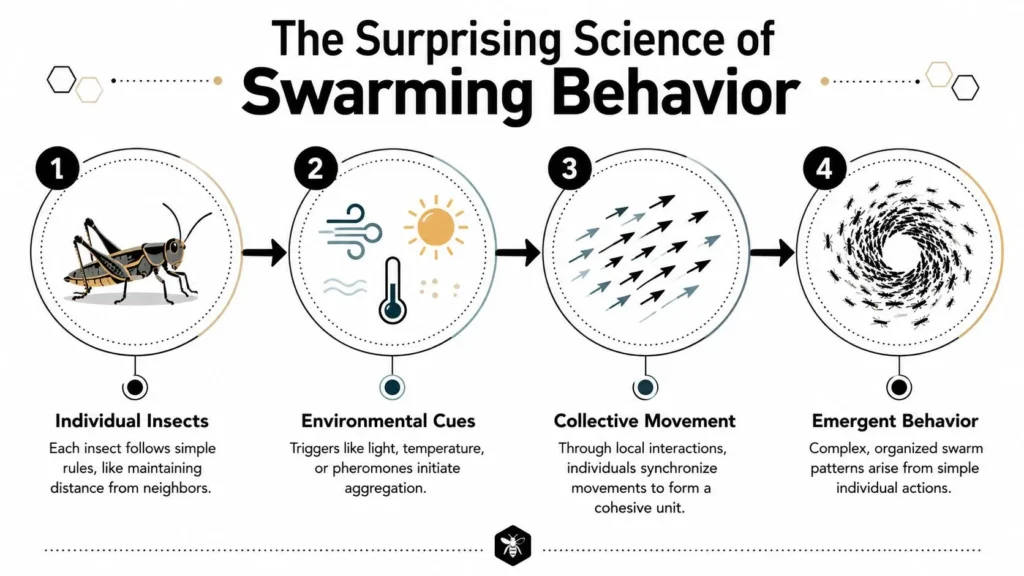
Think of a crowd in a train station. No one person controls the whole room, yet people still adjust to one another, avoid collisions, and flow around obstacles. Swarming insects do something similar, except their “rules” are built into their behavior rather than spoken aloud.
A swarm can act like a fluid
One of the most interesting findings about swarms comes from research discussed by Quanta Magazine on insect swarms acting like fluids. That report describes 2019 research published in Science Advances showing that swarming insects such as flying midges maintain cohesion against environmental disturbance, with the swarm’s viscosity overpowering its elasticity and producing a strong damping effect that stabilizes the group.
That sounds technical, but the idea is simple.
If you stir a pot of soup, the liquid shifts as one body. A fly swarm isn’t a liquid, of course, but it can behave in a similar collective way. Wind pushes. Individuals adjust. The group absorbs the disturbance instead of instantly scattering.
Why insects bother swarming at all
For many flies, the answer is mating.
A swarm can function like a meeting point. Instead of random individuals searching a huge area, many gather in one location and use motion, position, and timing to recognize each other. That’s one reason you may see hovering columns or loose clouds over a patch of grass, a landmark, or the edge of water.
Here’s the part that surprises many readers. A stationary swarm isn’t just a messy clump of insects. It can be a structured space where insects identify the right partners and hold the group together under shifting outdoor conditions.
Swarming isn’t simply insects piling up in one place. It’s a coordinated response that helps the group stay together long enough for mating and recognition to work.
Local rules create a group pattern
You don’t need a physics background to picture this. Each insect is responding to nearby neighbors, not managing the whole swarm. That creates what scientists call emergent behavior. In plain language, small choices at the individual level produce a visible group pattern.
A few common ingredients usually matter:
- Spacing from neighbors keeps collisions low.
- Visual or positional cues help insects hover near a landmark.
- Environmental feedback such as wind or light affects how tightly the group holds together.
- Biological purpose gives the swarm a reason to form in the first place.
That’s why swarms of flies can look almost suspended in place, as if they’re attached to an invisible frame in the air. They’re not random. They’re constantly correcting.
Why this matters for homeowners
When people assume all swarms are chaotic, they often choose random solutions. They wave a towel, spray a surface, or set one trap and hope the problem disappears. But if the swarm is driven by mating behavior or a seasonal gathering pattern, the better approach is to identify the setting and interrupt the conditions that support it.
In other words, the swarm itself is information.
Environmental Triggers That Cause Fly Swarms
A swarm doesn’t appear out of nowhere. Something in the environment usually nudges it into motion.
That trigger may be seasonal light, evening humidity, a warm wall, a pond edge, damp organic material, or a sheltered spot that acts like a landmark. When people say, “They showed up overnight,” what they often mean is that they only noticed the insects once conditions lined up.

Time of day and season matter
Many flying insects are strongly tied to daily rhythms. You may notice outdoor swarms near sunset because the air becomes calmer and the light changes. Indoors, you may notice flies clustering on bright windows because light draws attention to their presence.
Season also shapes what you see. Cluster flies often become noticeable when temperatures shift and they seek protected indoor spaces. Other swarming insects appear when local breeding sites, moisture, and temperature line up.
A useful habit is to keep notes for a few days:
- Where they gather
- What time they peak
- Whether rain, heat, or calm air changes the swarm
- Whether the swarm stays outdoors or moves indoors
Those clues narrow the cause faster than guessing by appearance alone.
Some swarms are environmental signals
This is the part most fly articles leave out. Not every swarm is just a nuisance to erase.
According to this discussion of midge swarms as water-quality bioindicators, specific midge species can signal very different environmental conditions. Some emerge only when water quality is pristine, while others indicate pollution. That means a swarm near a stream, retention pond, or wetland may be telling you something about the ecosystem nearby.
That doesn’t mean you should welcome insects into your porch light. It means you should pause before assuming every outdoor swarm is meaningless.
A useful perspective: If a swarm is tied to nearby water, the insects may be reporting on the landscape before any test kit does.
This is especially relevant if you live near stormwater features, creeks, or backyard ponds. A sudden pattern of recurring swarms may justify looking beyond the insects themselves. You may want to inspect drainage, runoff, algae growth, or nearby organic buildup. If your property includes compost, careful maintenance also matters, and a practical guide to composting at home can help reduce conditions that attract nuisance flies without treating every insect as the same problem.
Read the setting, not just the insect
Here’s a simple way to think about it.
| Environmental clue | What it may suggest |
|---|---|
| Swarm near standing or flowing water | Possible midge activity linked to aquatic conditions |
| Swarm on warm exterior walls | Seasonal clustering behavior |
| Swarm around overripe plant matter or waste | Decay-driven breeding or feeding |
| Swarm at dusk over a fixed point | Likely mating-related gathering |
Homeowners often focus on the visible cloud. The surrounding habitat usually tells the fuller story.
Assessing Risks From Health to Home
The sight of swarms of flies tends to trigger one thought right away. “Is this dangerous?”
Sometimes the answer is yes, especially when you’re dealing with species that breed in filth or move repeatedly between waste and human spaces. But many swarming insects create far more annoyance than direct medical risk.
The biggest problem is often nuisance
For cluster flies and many midges, the immediate issue is disruption. They crowd windows, collect in rooms, interrupt meals outdoors, and make people feel as if the house is unclean even when it isn’t.
That nuisance is real. It affects comfort, sleep, and how willing you are to use a room, porch, or patio.
A few common household effects include:
- Indoor mess from specks on walls, blinds, and window frames
- Noise and distraction when insects bump against glass or lights
- Outdoor discomfort during meals, gardening, or pet time
- Repeated false alarms when a seasonal reappearance feels like a new infestation
Health concerns depend on the type of fly
Calm identification is helpful here. A cloud of insects around a yard isn’t automatically a public health emergency. Many swarming species don’t bite and aren’t interested in feeding on people.
That said, if you’re seeing flies around garbage, pet waste, or indoor decay, your concern should shift from the swarm itself to the source supporting it.
If someone in your household has unusual reactions to bites, respiratory irritation, or anxiety from a heavy indoor infestation, use common sense and seek medical guidance when symptoms go beyond ordinary annoyance. A general resource on when to see a doctor can help you think through that decision.
Pets and animals feel the stress too
Dogs, cats, and backyard animals may not face severe harm from every swarm, but they can still be bothered by constant buzzing around eyes, ears, noses, and food areas. Outdoor pets often show the problem before people do. They paw at the face, avoid one part of the yard, or become restless at certain hours.
If your pet keeps reacting to one corner of the yard, pay attention to that spot. Animals often notice a developing insect problem before people connect the dots.
Respond in proportion
A useful rule is to match your response to the evidence.
- If the swarm is seasonal and localized, focus on exclusion and cleanup.
- If it’s tied to waste, drains, or rot, find and remove the source.
- If it’s persistent, internal, and hard to trace, move toward professional help.
Fear tends to blur these categories. Observation sharpens them.
Your Action Plan for Fly Prevention
You wipe the counter, take out the trash, and the room feels normal again. Then a fresh cluster of flies shows up at the window two days later. That pattern is frustrating, but it also gives you a clue. Flies are often less a random invasion than a signal that something in the home or yard is supporting them.
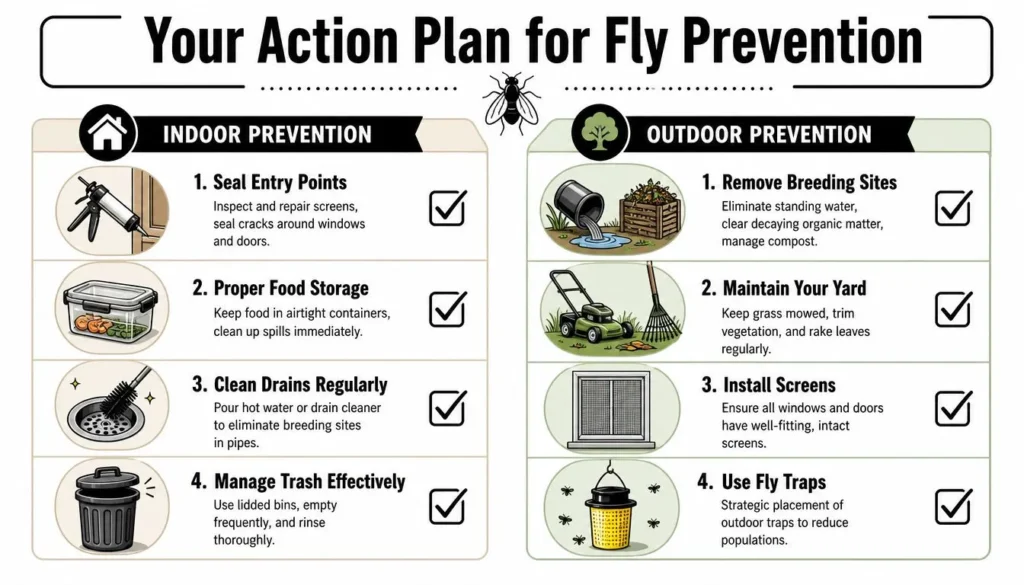
Prevention works best when you treat flies like smoke from a small fire. The adults are what you notice first, but the primary job is to find the warm spot producing them. In practical terms, that means sealing entry points, removing damp organic material, and paying attention to where activity concentrates. Those hotspots can tell you a lot about moisture, waste handling, drainage, and air movement around your property.
Fortify the house
Small gaps matter. A fly does not need much space to get inside, especially around window trim, door frames, attic penetrations, and vent openings. University extension guidance on exclusion commonly recommends the same core steps: close cracks, repair screens, and reduce easy access to sheltered indoor spaces. A useful reference is the University of Kentucky’s advice on fly prevention and exclusion.
The goal is simple. Make your home less easy to enter and less rewarding once a fly gets inside.
- Seal the edges. Check frames, siding joints, utility lines, and attic openings for small cracks.
- Repair screens. One torn section can turn ventilation into an open door.
- Clean hidden food and moisture sources. Residue under appliances, sticky recycling, and film inside drains can support small populations.
- Use lidded trash cans. Open bins give flies food, moisture, and a place to lay eggs.
Break the life cycle, not just the visible swarm
Many homeowners often get tripped up. You remove the flying adults, but the next group is already developing out of sight in damp trash, a dirty bin, wet compost, or organic buildup in a drain.
Flies work a bit like weeds after rain. Pulling the stems helps for the moment, but the root problem stays put if the conditions remain right. A better response is to assume that any spot producing odors, moisture, or decaying material deserves a second look, even if the room seems clean at first glance.
Start with the places that collect residue:
- Empty food waste promptly, especially in warm weather.
- Rinse trash cans and recycling bins instead of only changing liners.
- Check the bottom of outdoor containers for leaked liquid.
- Turn and balance compost if it has become soggy and dense.
- Clean beneath bins and storage containers where drips dry into a thin organic layer.
For readers who spend time eating outside, effective fly control for outdoor dining offers practical patio-focused ideas that pair well with source reduction.
A short visual walkthrough can also help if you’re trying to think through everyday prevention habits at home:
Treat indoors and outdoors as one system
Recurring fly activity often makes more sense once you stop dividing the property into separate zones. The kitchen, trash area, pet space, drains, patio, and attic edges interact. A damp outdoor bin can feed an indoor annoyance. A gap near a vent can turn seasonal outdoor activity into a room-by-room problem.
That is why swarms can function as bioindicators. Repeated activity near one side of the house may point to excess moisture, poor drainage, animal waste, overripe fruit, or airflow that carries odors from a hidden source. In that way, flies are not only pests. They are also messengers telling you where the environment has become attractive to them.
| Area | Best focus |
|---|---|
| Windows and doors | Screens, weather stripping, caulk |
| Kitchen and pantry | Food storage, spill cleanup, recycling hygiene |
| Drains and utility spaces | Remove organic buildup and moisture |
| Yard and bins | Trash management, compost control, standing water reduction |
If you use repellents or outdoor products, include pets in the plan. Before placing anything where dogs may sniff, lick, or brush against it, read is citronella safe for dogs.
When to Call a Professional Pest Service
DIY steps solve a lot of fly problems, but not all of them. Sometimes the insects are telling you there’s a hidden source you can’t easily reach.
A good rule is to stop guessing once the evidence points behind walls, above ceilings, or into inaccessible voids.
Signs you should escalate
Call a professional when you notice one or more of these patterns:
- The swarm keeps returning after you’ve sealed gaps, cleaned bins, and removed obvious sources.
- Flies are emerging inside living spaces with no clear kitchen, drain, or trash origin.
- Activity is concentrated around attic spaces, wall voids, or light fixtures.
- The numbers feel unmanageable and routine cleaning isn’t changing the pattern.
Those situations usually need better identification and source tracing than a homeowner can do alone.
What a professional adds
A trained technician doesn’t just apply product. They identify the insect, inspect likely entry points, and look for breeding or resting sites that others might overlook. That may include vents, soffits, hidden voids, or structural gaps.
If you want an example of what that kind of service typically involves, professional fly control services gives a homeowner-oriented overview of how pest teams approach persistent infestations.
The best time to call a professional is when you can describe a pattern but still can’t find the source. That’s when expertise saves the most time.
Bring notes when you call. Mention where the flies gather, when they appear, and what cleaning or sealing you’ve already tried. That helps the technician narrow the cause faster.
Frequently Asked Questions About Fly Swarms
Are swarms of flies dangerous to pets?
Usually, the bigger issue is irritation rather than severe harm. Pets may become agitated if insects gather around their eyes, ears, bedding, or food bowls. If your dog or cat keeps avoiding one area of the yard, inspect that spot for moisture, waste, or decaying material. Also check water bowls, kennel corners, and trash storage nearby.
Why do some fly swarms seem to hover in one place?
Many swarms form around a landmark or a small patch of airspace that insects keep revisiting. With midges, the motion can be surprisingly structured. According to Inside Science on spring-like zigzag behavior in swarming midges, pairs can engage in transient, spring-like zigzag interactions with a spring length of 25 to 75 mm, or 1 to 3 inches, and these brief non-random movements help males identify females. So that hovering cloud may be doing far more than drifting.
Can travelers predict where swarms will be worst?
You usually can’t forecast them with perfect precision, but you can reduce surprises by understanding the environment. Wet areas, calm evenings, still coves, marsh edges, and places with lots of organic material tend to produce more insect activity. If you’re traveling near lakes or rivers, ask locals about seasonal insect peaks and bring simple barriers like long sleeves or head nets if needed.
Does a swarm always mean my property is dirty?
No. Some swarms are seasonal, outdoor, and tied to local ecology rather than poor housekeeping. But if the insects are concentrated around trash, drains, or indoor residue, sanitation does matter. The best approach is to treat the swarm as a clue, not a verdict.
If you enjoy practical, readable guides that connect everyday problems with science, explore more articles at maxijournal.com. It’s a good place to keep learning, whether you’re curious about home, health, pets, travel, or the natural world around you.
Discover more from Maxi Journal
Subscribe to get the latest posts sent to your email.