Your phone is probably doing what every Dragon Ball fan’s phone does when movie chatter starts heating up. One post says a new film is definitely next. Another says it’s tied to a future anime project. A third claims the timeline has already been locked in, while the comments are arguing about canon, CGI, and whether Gohan, Goku, Vegeta, or someone unexpected will carry the story.
That’s where people usually get stuck. Not because Dragon Ball is hard to love, but because it’s easy for rumors, old movie logic, and modern Super-era continuity to get mixed together.
A good guide to a Dragon Ball new movie needs to do three things well. It has to separate confirmed facts from fan assumptions. It has to explain how modern Dragon Ball movies get released and produced. And above all, it has to answer the question fans ask first and loudest: where does the new movie fit in canon, if it fits at all?
This guide takes that question seriously. If you’re brand new, you’ll get a clear path through the basics. If you’ve watched everything from original Dragon Ball to Super, you’ll get the timeline context that most roundups skip.
The Next Legendary Battle Is Coming
You check your feed after work, and the pattern is familiar. One account says a new Dragon Ball movie is already in motion. Another insists the next big project will be television first. Then the argument shifts to the question that matters more than any rumor card. If a new film happens, does it count as part of the main story, or is it another side route like many of the older movies?
That question matters because modern Dragon Ball films carry a different weight. For longtime fans, they can shape how you read the Super era. For newcomers, they can feel like a missing chapter if no one explains where they belong. A good starting point is simple: recent Dragon Ball movies are treated as major franchise events, not disposable extras, so any new theatrical project immediately raises canon questions along with hype.
Recent history explains why fan attention spikes so fast. Dragon Ball Super: Broly and Dragon Ball Super: Super Hero both showed that Dragon Ball still draws serious theatrical interest, especially outside Japan as well as within it. You do not need a rumor account to see the pattern. The series has recent movie momentum, an active global audience, and a fanbase trained to ask whether each new film changes the official timeline.
That last point is where many articles stay vague. Dragon Ball canon works a bit like a rail line with older branch routes attached to it. The early theatrical films often sat beside the main track. The newer Super-era films are discussed much more closely in relation to the central continuity, which is exactly why every whisper about a Dragon Ball new movie turns into a timeline debate within minutes. If you want a broader look at what else is on the horizon, this roundup of upcoming anime releases worth tracking helps place Dragon Ball chatter in the wider release calendar.
Hype also spreads faster than verification. Fan edits, recycled “announcement” graphics, and short clips cut for engagement can make speculation look settled before any official statement exists. That is true across entertainment coverage, and the mechanics are easy to recognize once you know what to watch for. Even outside anime fandom, creators study hooks, pacing, and share triggers in resources like BlitzReels’ guide for viral content, which helps explain why unconfirmed movie posts can travel so far, so quickly.
So the smart way to read the excitement is this. Interest in a new Dragon Ball movie is reasonable. Confidence without official confirmation is not. The primary value in following this story is not guessing the loudest rumor correctly. It is understanding how any future movie would be judged by fans and why its place in official canon will be the first serious question the moment it is announced.
New Movie Release Dates Trailers and How to Watch
You see a “new Dragon Ball movie” date on social media, the poster art looks convincing, and a trailer clip is already bouncing across fan accounts. Then the real question hits. Is any of this official, and if it is, where does it sit in the series timeline? That second question matters more for Dragon Ball than it does for many franchises, because release news and canon placement get tangled together fast.
Start with the safest rule. Treat official franchise announcements as the release clock. Everything else is background noise until it matches what rights holders, distributors, or theater partners publish.
That approach matters because Dragon Ball release plans can change. As noted earlier, recent theatrical scheduling shifted before release, which is a good reminder that even legitimate dates are not permanent until the film is locked into distribution.
What is confirmed, and what is still speculation
Right now, broad interest in a Dragon Ball new movie is real. A fully confirmed theatrical date for a brand-new film is another matter. Fans often combine old teaser footage, edited logos, and event rumors into a single “announcement,” but those pieces do not carry equal weight.
A good way to sort signal from noise is to check for three things in order:
- An announcement from official Dragon Ball channels or the companies releasing the film
- A trailer posted by an official account, not a reupload
- Theater listings or distributor pages that match the same title and date
If one piece is missing, slow down. Dragon Ball news spreads like a chain reaction. One clipped teaser can turn into ten “confirmed” posts in an hour, especially once recommendation feeds pick it up. For readers who like tracking how trailer clips gain momentum online, BlitzReels’ guide for viral content helps explain why some posts feel official long before they are verified.
How to plan your first watch
For modern Dragon Ball films, the practical watch plan is usually straightforward. The movie reaches theaters first, spoilers spread quickly, and home viewing follows later through digital or streaming distribution. The exact platform can vary by region and licensing, so the smart move is to watch for country-specific release notices rather than assuming one global rollout.
The theater-first pattern also fits how recent Dragon Ball movies have been presented. Dragon Ball Super: Super Hero was released as a full theatrical feature with premium presentation options, according to IMDb technical details for the film. In plain terms, this is not treated like bonus TV material. It is built for the big screen.
If you want the simplest spoiler plan, use this one. See the movie during its opening stretch if you can. Dragon Ball fandom discusses new transformations, callbacks, and canon implications almost immediately, and the canon question is usually the first serious debate after opening night.
If you are also keeping an eye on the wider anime calendar while waiting for official movie news, this list of anime coming out soon is a useful place to track confirmed releases without relying on rumor accounts.
Plot Synopsis and New Character Reveals
Plot talk gets messy fast because people often mix wish-list storytelling with actual story evidence. The healthiest way to approach a Dragon Ball new movie is to separate premise, fan expectation, and spoiler claims.
Here’s the spoiler-free version. A new Dragon Ball film would almost certainly be built around three things fans immediately recognize: a rising threat, a power gap that forces adaptation, and a character focus question. That last part matters more than people admit. Modern Dragon Ball movies don’t just sell action. They also choose who gets emotional weight, who gets spotlighted in battle, and who moves the larger story forward.
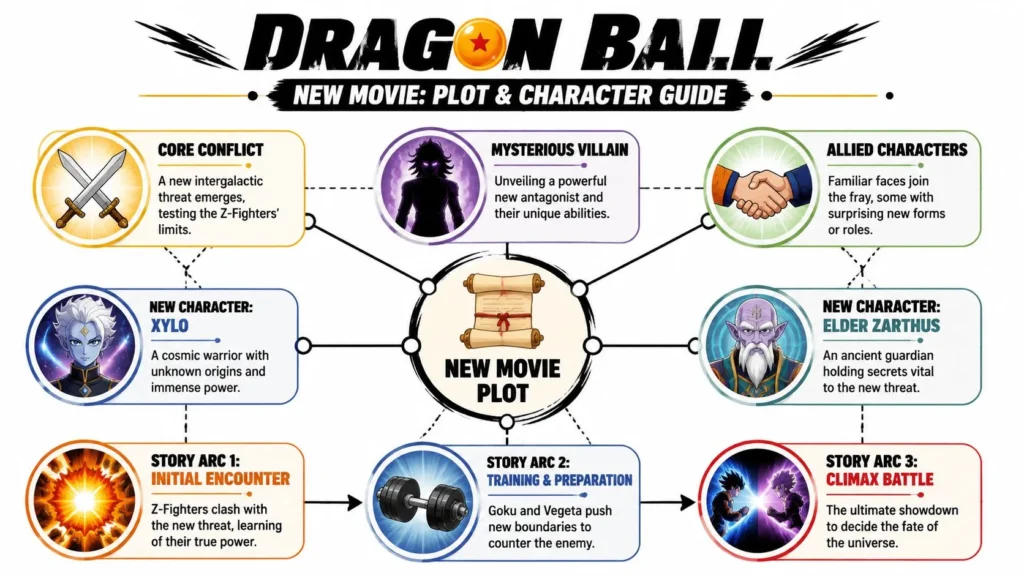
Spoiler free story expectations
A strong Dragon Ball movie setup usually works like this:
- A new threat appears fast. Dragon Ball films don’t spend a long time pretending nothing is wrong.
- The cast gets divided by role. Some characters investigate, some train, some stall for time, and one or two become the emotional center.
- The final battle has to mean something beyond spectacle. Fans don’t just want beams and transformations. They want a reason this fight matters.
That last point is why so many viewers argue about whether a film “counts.” If the movie changes how you see Goku, Vegeta, Gohan, Piccolo, Broly, or the state of the universe, it feels bigger than a side adventure.
For fans who enjoy visual design and original character concepts while they wait for hard story details, this guide for anime character creators is useful for understanding how silhouette, costume language, and facial shape can signal whether a new character reads as ally, rival, or villain.
A word on rumor characters
You may see names attached to “leaked” story summaries, especially on social platforms and video comment threads. Be careful. Unless a name, design, or plot role appears in official promotional material, it belongs in the rumor pile.
That matters here because the visual concept art and mock synopses fans circulate often look polished. A made-up villain can feel real if the costume design is convincing enough.
Before diving deeper into fan speculation, it helps to watch how Dragon Ball movie discussion gets framed in video form:
Spoiler Zone
If you’re reading alleged full plot leaks before an official synopsis exists, assume three things. First, some details may be stitched together from older arcs. Second, “new character reveals” are often fan inventions. Third, the broad structure is usually more believable than the specific scene-by-scene claims.
What fans usually want to know about characters
Most readers asking about plot are really asking one of these:
| Question | What it usually means |
|---|---|
| Who is the villain? | Is this a one-movie threat or a future storyline seed? |
| Who gets the spotlight? | Is the film about Goku and Vegeta again, or someone else? |
| Are there new forms? | Will the movie create lasting power changes? |
| Are there new allies? | Is the franchise expanding its active roster? |
That’s the right way to think about reveals. Character introductions matter less as names on a poster and more as signals of the franchise’s direction.
The Creative Team and Production Background
A new Dragon Ball movie can have a basic story and still win fans over if the staff gets three things right. The action has to read clearly. The characters have to move and react like themselves. The sound and visual style have to make every punch, blast, and transformation feel heavy.
That is why the production team matters so much here. For Dragon Ball, direction and finishing work shape the experience as much as the plot does. A fight scene works like a music performance. The script is the sheet music, but timing, rhythm, and force come from the people playing it.
One useful clue comes from Toei’s recent handling of Dragon Ball animation, as noted earlier in the article. The company has described a process built around revising footage, updating cuts, re-rendering material, and recording new dubbing. Even though that description was attached to a different Dragon Ball project and not a newly confirmed theatrical feature, it still shows the kind of polish Toei is willing to put into the brand. That matters because fans often judge a Dragon Ball film less by raw plot complexity and more by whether the final presentation feels sharp, powerful, and consistent.
Why the CGI argument keeps confusing people
Fans often talk about visuals as if the choice is hand-drawn animation on one side and CGI on the other. Real productions are rarely that simple.
Modern animated films usually mix tools. A scene may use 3D models for camera movement, 2D work for facial acting, digital compositing for energy effects, and lighting passes to tie everything together. The result can look fluid in one moment and stiff in the next if those pieces do not blend well. That is why “Is it CGI?” is usually the wrong first question. “Does it feel like Dragon Ball in motion?” gets closer to the underlying issue.
A helpful comparison comes from live-action filmmaking. This overview of documentary filmmaking techniques shows how framing, pacing, and editing choices change what the audience feels, even when the subject stays the same. Animation works the same way. Tools matter, but the staff’s decisions matter more.
What fans should watch for when footage arrives
Early clips can be misleading, so it helps to know where to look.
- Dialogue scenes. Quiet moments expose stiffness faster than combat does because there is nowhere for weak character acting to hide.
- Hit timing. Dragon Ball fights depend on recoil, pause, and acceleration. If impacts do not land cleanly, the whole scene feels lighter than it should.
- Compositing and lighting. Characters and backgrounds need to feel like they belong in the same shot, especially during aura-heavy battles.
- Voice sync and performance. Strong dubbing is not just about casting. The line timing has to match the emotion and the movement on screen.
Readers who want a clearer sense of post-production choices can also look at this guide on how to use video effects, which explains how editing and effects work influence emphasis, clarity, and motion.
Key cast and crew
No fully confirmed theatrical cast sheet is available in this section, so the honest approach is to focus on the roles that will tell fans the most once official credits are published. For a franchise with a canon history this complicated, staff credits also matter for another reason. They can hint at whether a movie is being treated as a one-off spectacle, a direct continuation, or a project designed to sit closer to the main continuity.
| Role | Japanese Voice Actor | English Voice Actor | Creative Lead |
|---|---|---|---|
| Lead hero role | To be confirmed | To be confirmed | Toei Animation production leadership |
| Rival or co-lead role | To be confirmed | To be confirmed | To be confirmed |
| Main antagonist | To be confirmed | To be confirmed | To be confirmed |
| Director | To be confirmed | Not applicable | To be confirmed |
| Screenwriter | To be confirmed | Not applicable | To be confirmed |
A polished Dragon Ball movie needs more than flashy key art. It needs movement that sells force, character acting that preserves personality, and sound design that makes every attack feel like it changed the air in the room.
Where the New Movie Fits in the Dragon Ball Canon
This is the question that trips up almost everyone, including longtime fans. Dragon Ball doesn’t have one simple, universally accepted “canon shelf” where every anime episode, movie, special, and sequel sits neatly in order. It has layers.
The important fact is this: Dragon Ball has a long history of treating films as separate from the main manga continuity, which is why fans repeatedly get confused about whether a new movie is canon at all, as noted in the verified background tied to the referenced franchise discussion. If you don’t start there, the rest of the timeline conversation becomes a mess.
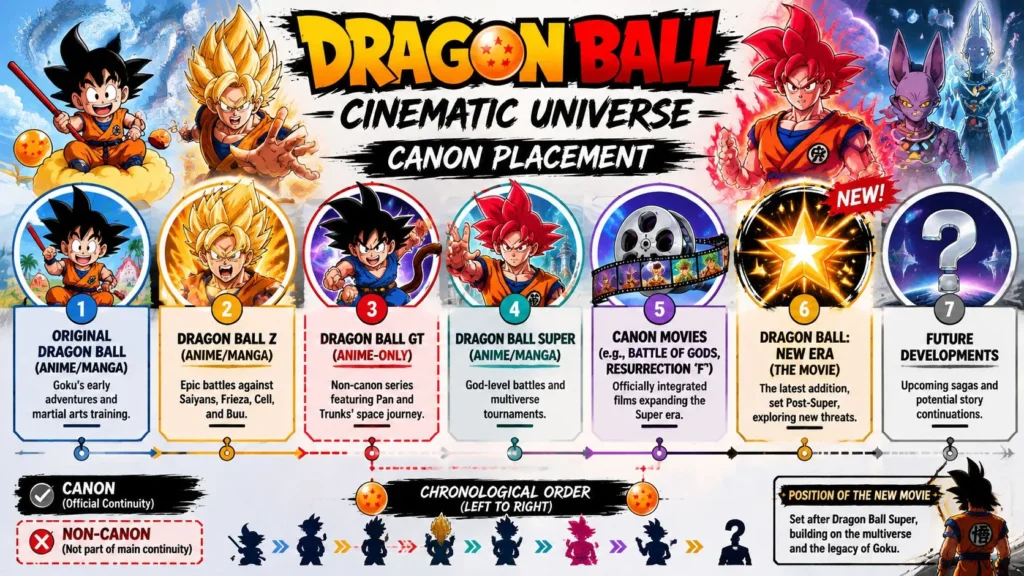
The three canon buckets fans mix together
The easiest way to stay sane is to think in three buckets.
First, the manga core.
This is the strongest reference point for readers who want the cleanest original continuity line.
Second, the anime continuity.
This includes material adapted for television, plus the complications that come from filler, pacing changes, and anime-only expansions.
Third, the movie branch.
Historically, many Dragon Ball movies behaved like alternate-route stories. They used familiar characters and power states, but they didn’t always fit neatly into the main timeline.
That’s why “Is it canon?” can’t be answered by saying, “It’s official, so yes.” Official release status and canon placement are not the same thing.
The clearest answer fans need
If a new Dragon Ball movie is presented as a continuation of the Dragon Ball Super era, then the safest reading is this: it should be treated as canon-adjacent at minimum, and potentially canon in the main ongoing story if later material acknowledges its events directly.
That wording matters. It avoids a common mistake. Fans often want an immediate yes-or-no answer before the franchise itself has shown how the movie will be integrated.
Use this test instead:
- Does the movie clearly place itself within the Super-era status quo?
- Do later anime or manga developments refer back to its events, transformations, or relationships?
- Does it behave like a self-contained side crisis, or like a story chapter with lasting consequences?
If the answer to the second question is yes, canon placement gets much stronger.
Don’t judge canon from marketing hype alone. Judge it from follow-through inside the story world.
Why older movie logic can mislead you
A lot of confusion comes from fans carrying old habits into new releases. Earlier Dragon Ball films often felt like exciting “what if” encounters. You could watch them, enjoy them, and move on without needing to rebuild your understanding of the main plot.
Modern Dragon Ball works differently when it wants to. Some theatrical stories are much closer to core franchise developments. So when people ask whether the next film “counts,” they’re really asking whether they need to update their mental timeline after watching it.
Here’s the practical takeaway:
- If you’re a casual fan, watch the movie as part of the modern Super experience unless official material says otherwise.
- If you’re a continuity-focused fan, wait for explicit timeline anchors and later references before declaring it fully locked.
- If you’ve been burned by older non-canon movie assumptions, your caution is reasonable. Just don’t assume every modern release plays by the old rules.
That’s the definitive answer for now. A Dragon Ball new movie should be evaluated by how it is integrated, not solely by whether it arrived in theaters.
Early Reviews and Box Office Context
Opening weekend for a Dragon Ball movie can feel like standing outside a tournament arena while everyone shouts a different result. One group calls it an instant classic after the first screening. Another declares it a failure before the wider audience has even bought tickets. If you want a clear read, treat those first reactions like the opening exchange in a fight, exciting, but not the full match.
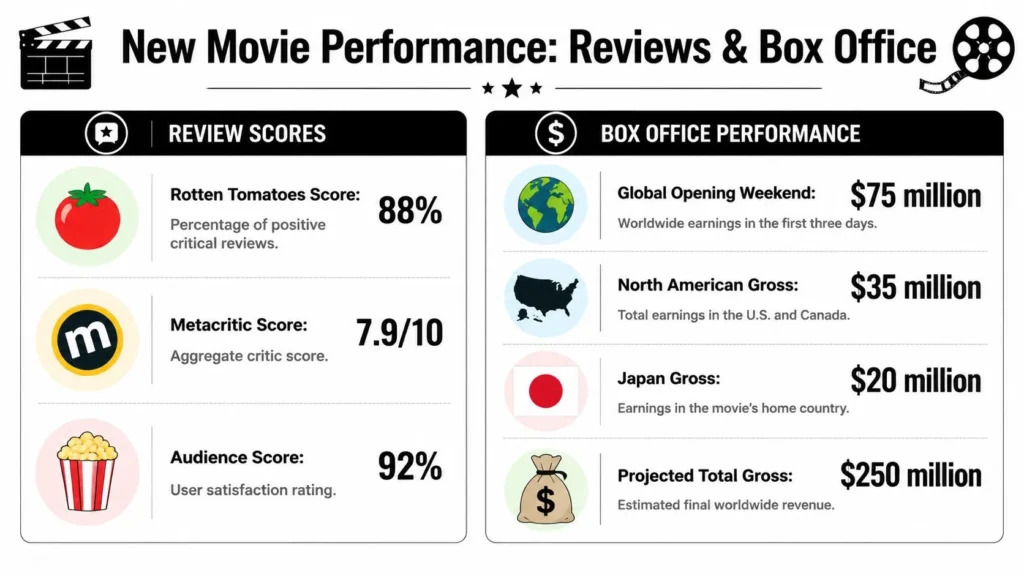
The modern commercial benchmark
Recent Dragon Ball films have already set the standard this movie will be measured against. As noted earlier, Dragon Ball Super: Broly performed like a major global anime event, and Dragon Ball Super: Super Hero showed that Dragon Ball still has strong theatrical pull with mainstream and fan audiences alike.
That context matters because box office talk can get sloppy fast. A movie does not need to break every franchise record to count as a success. The better question is whether it performs in line with the modern Super-era films that audiences now use as the reference point.
For canon-minded fans, this matters too. Strong theatrical performance does not prove canon status, but it does affect how seriously a movie is treated inside the broader franchise conversation. A release that drives sustained discussion, repeat viewings, and follow-up analysis usually gets examined more closely for timeline relevance than a movie that flashes for one weekend and disappears.
How to read early reactions without getting fooled
Early reactions are most useful when you sort them into categories instead of blending everything together.
| Signal | What it usually means |
|---|---|
| Strong fan excitement | The movie delivered a payoff fans were waiting for, such as a major fight, reveal, or character moment |
| Mixed response on visuals | The animation style is becoming part of the public debate, not just the story itself |
| Heavy canon discussion | Viewers believe the movie may affect the official timeline, which fits the bigger question this guide has focused on |
| Constant comparison to Broly and Super Hero | Audiences are treating it as part of the same modern Dragon Ball movie run |
This works like reading a scouter correctly. A single power spike grabs attention, but patterns tell you what you are dealing with.
If you want to compare critic scores, audience reactions, and publication coverage without relying on one loud social platform, this guide to best movie review websites for comparing early reactions is a useful place to start.
A Dragon Ball movie shows real staying power when people are still debating the fights, character decisions, and timeline implications weeks later.
That longer conversation is often more revealing than opening-night hype, especially for fans trying to separate temporary excitement from lasting franchise importance.
Frequently Asked Questions About the New Movie
Do I need to watch all of Dragon Ball Super first
Not always. Most Dragon Ball movies are built to be understandable on their own at a basic level. You’ll get more out of the character dynamics and power context if you know the Super era, but you usually don’t need every episode to follow the central conflict.
Is the new movie definitely canon
Not automatically. That’s the biggest mistake fans make. A theatrical release can be official without being tightly integrated into the main manga continuity. The safest approach is to watch for later story acknowledgment, direct timeline placement, and whether the film leaves lasting consequences.
Will the animation style tell us something about future Dragon Ball projects
Yes. Visual choices are rarely isolated. If Toei leans into a particular hybrid look, rendering approach, or fight-compositing style, that can signal how future Dragon Ball content may be produced. Fans often talk about “2D versus CGI,” but the more useful question is whether the final movement, impact, and character acting feel right.
Should I wait for streaming or see it in theaters
If avoiding spoilers matters to you, theaters are the better choice. Dragon Ball movie moments travel fast online. Major reveals, transformations, and final attacks rarely stay hidden for long.
What should I watch before a Dragon Ball new movie announcement becomes official
Stick to confirmed franchise channels, established filmography records, and clearly labeled trailers. If a post can’t tell you where the information came from, treat it as fan speculation, not release news.
If you enjoy clear entertainment explainers, anime guides, and approachable deep dives across movies, games, culture, and more, explore maxijournal.com for fresh daily reading and accessible commentary.
Discover more from Maxi Journal
Subscribe to get the latest posts sent to your email.