You’re probably here because you’ve stood in a pet aisle or scrolled an online shop, trying to do one simple thing: buy something good for your pet without adding more waste, plastic, or vague “green” promises to the pile.
That’s a very normal place to be.
Most of us don’t want a perfect zero-waste pet life. We want a chew toy that won’t fall apart in a day, a bed that lasts, treats that feel responsible, and packaging that doesn’t make us sigh when it lands in the trash. The problem is that the label eco friendly pet products can mean almost anything unless you know what to look for.
The Growing Paw Print of Our Pets
Pet owners aren’t imagining this shift. Interest in eco friendly pet products has moved well beyond a niche corner of the market. The American Pet Products Association reported that 51% of pet owners said they’re willing to pay more for ethically sourced, environmentally friendly pet care products, and reporting on that same trend noted that 24% of U.S. pet owners bought pet foods with eco-conscious packaging in February to March 2023, up from 19% the previous year, according to Pet Food Processing’s coverage of APPA and Packaged Facts.
That matters because it changes the conversation. Choosing greener products for your dog or cat isn’t a fringe hobby anymore. It’s part of how many people now define quality.
Why this feels confusing
The hard part is that pet care is full of tradeoffs. A toy may be made from plant-based material but wear out fast for a heavy chewer. A bag might be recyclable, but only if your local system accepts that material. A dog run might solve mud, mess, and lawn damage, but you still want to think about maintenance and durability. If you’re considering your outdoor setup too, practical options like pet-friendly artificial grass solutions can help reduce the cycle of worn-out lawn patches and constant replacement.
You don’t need to get every purchase “right.” You need a repeatable way to make better choices more often.
That’s where a good, better, best mindset helps.
A simpler way to think about it
Instead of asking, “What’s the most perfect sustainable product?” ask:
- Good means you avoid the most wasteful option.
- Better means you choose durable materials and clearer sourcing.
- Best means you support products designed for a longer life and a cleaner end-of-life path.
That approach lowers the pressure. It also matches real life. Maybe this month you replace disposable puppy pads with washable ones. Maybe later you upgrade to a recycled-fiber bed with a removable cover. Both count.
Here’s the key idea: sustainable pet care isn’t one giant leap. It’s a series of smaller decisions that get easier once you know how to read the signals.
What Makes a Pet Product Truly Eco Friendly
A product isn’t eco friendly just because it has a leaf on the package or uses the word “natural.” A better way to judge it is to picture a three-legged stool. If one leg is missing, the whole thing wobbles.
The three legs are sustainable sourcing, ethical production, and end-of-life responsibility.
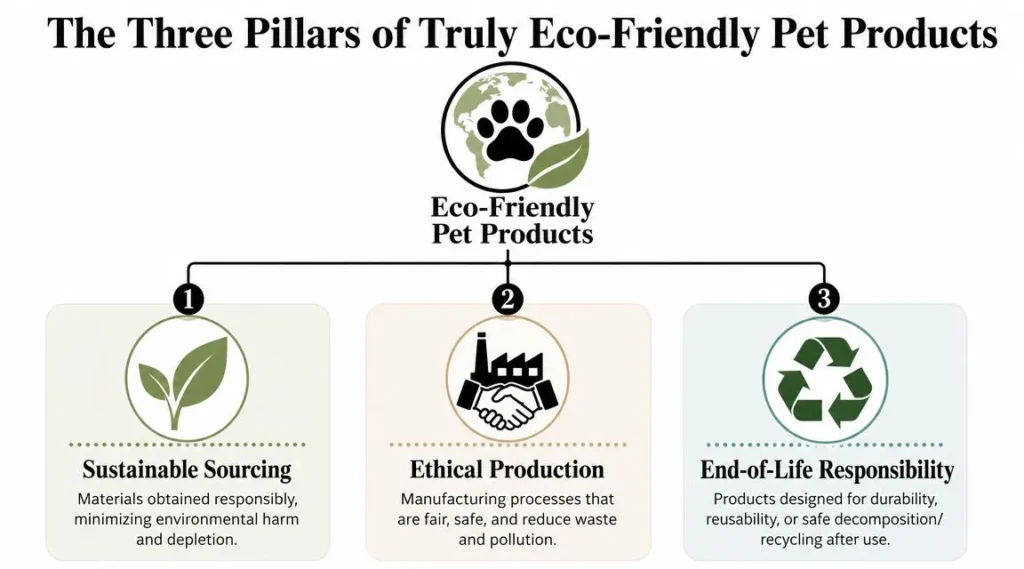
The reason this matters isn’t just philosophical. One market estimate valued the eco-friendly pet products category at USD 43.65 billion in 2024 and projected it to reach USD 85.9 billion by 2035, with a reported 6.35% CAGR, reflecting a broader shift toward bio-based, biodegradable, and recycled materials, according to Metatech Insights market analysis.
Sustainable sourcing
This is the “what is it made from?” question.
If a dog toy uses recycled plastic, hemp, bamboo, natural latex, or another clearly identified lower-impact input, that’s stronger than a generic green claim. The point isn’t that every plant-based or recycled material is automatically superior in every use case. The point is that the brand is naming the feedstock, which gives you something concrete to evaluate.
Food and treat ingredients belong here too. If you’re curious about how alternative feed inputs fit into sustainability conversations, this explainer from Pure Grubs on sustainable protein is useful because it focuses on the material and systems side, not just the marketing.
Ethical production
A responsibly sourced material can still pass through a wasteful or opaque factory. Ethical production asks different questions.
- How much waste does the process create
- Is the brand transparent about how it makes the product
- Are workers treated fairly and safely
- Does the company avoid unnecessary coatings, dyes, or additives
You won’t always get perfect answers. But brands that care usually tell you more, not less.
Practical rule: If the product page says “eco-friendly” three times but never tells you what it’s made from, where it’s made, or what happens after use, treat that as a weak claim.
End-of-life responsibility
This is the leg people forget.
Can the product be repaired, washed, refilled, reused, composted, or recycled through a clear path? A durable bowl that lasts for years may be a better choice than a flimsier “green” bowl that cracks quickly. A bed with a removable cover may outlast a cheaper one-piece bed because you can clean it without destroying the fill.
A thoughtful product doesn’t stop at the cash register. It has a life after purchase, and ideally, a plan after it wears out.
Decoding Sustainable Materials and Green Labels
Once you start reading labels closely, eco friendly pet products become much easier to sort. I think of this as becoming a material detective. You’re not asking, “Is this product green?” You’re asking, “What is this made of, and does that make sense for how my pet will use it?”
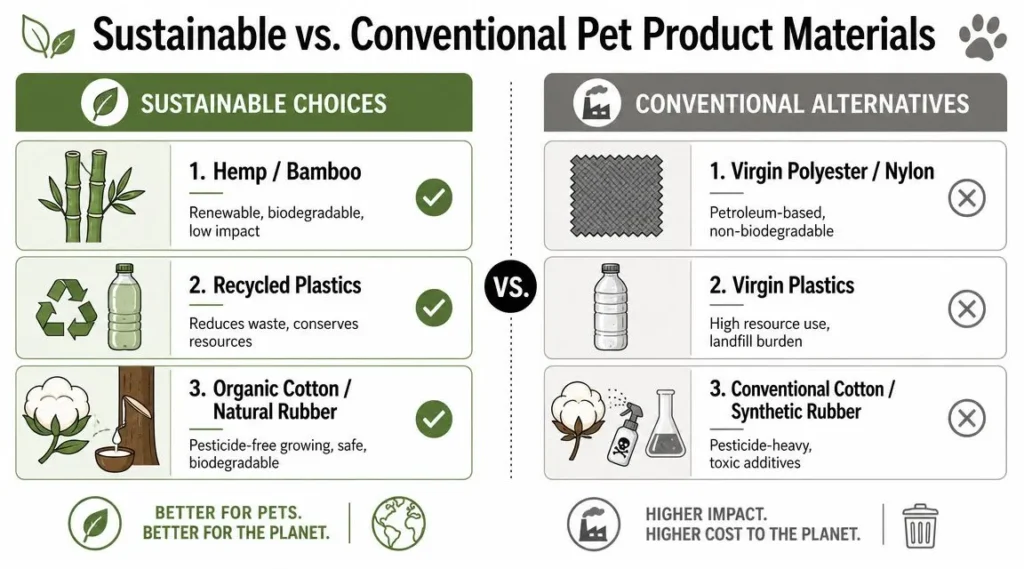
Market analysis helps show where brands are putting effort. It reports that plant-based materials in this sector are projected to grow at 11.2% CAGR through 2034, while recycled materials already make up 28.4% of the sustainable-material share, according to Market Intelo’s eco-friendly pet products analysis. That tells us two material families deserve special attention: bio-based inputs and recycled content.
Plant-based materials in plain language
Plant-based doesn’t mean “soft and fragile.” It means the starting material comes from a renewable biological source rather than virgin fossil feedstock.
Here are a few common examples:
| Material | Often used for | What to watch for |
|---|---|---|
| Hemp | Rope toys, collars, soft accessories | Strong fiber, but stitching quality matters |
| Bamboo | Bowls, grooming items, some textiles | Check whether it’s blended with plastic binders |
| Natural latex or natural rubber | Chew toys, balls | Good bounce and grip, but durability varies by design |
| PLA and other bio-based polymers | Packaging, some molded items | End-of-life rules can be specific, so read carefully |
The simple analogy is wood versus particleboard. Two things can sound similar on the label and behave very differently in daily use. Material family matters, but build quality still decides whether the item lasts.
Recycled materials and why they matter
Recycled content gives existing plastic or textile waste another life. In pet products, that often shows up in beds, leashes, outer fabrics, stuffing, and packaging.
That doesn’t make a recycled item perfect. It does mean the brand is substituting away from virgin material, which is a meaningful design choice. For many owners, recycled-content beds, harnesses, and storage bins are a practical “better” option because they often balance durability with lower feedstock impact.
A recycled-fiber dog bed that survives years of washing usually does more good than a “natural” bed that collapses in one season.
Green labels that deserve a closer look
People often get tripped up on this point. Not every label means the same thing.
A few questions help:
Does the label refer to the material itself
“Made with post-consumer recycled plastic” is more useful than “earth-friendly.”Does it refer to farming or fiber standards
Labels tied to cotton, wool, or forest products can tell you more about sourcing than a generic eco icon.Does it refer to the company, not the product
Some certifications evaluate broader business practices rather than the single item in your cart.
If you already follow clothing or textile sustainability, the same habit applies here. This guide on what is sustainable fashion is helpful because pet beds, blankets, and soft gear often involve many of the same material and labeling questions as human textiles.
How to spot greenwashing fast
Use this quick filter when a product makes big environmental claims:
Specific beats vague
“Recycled polyester shell” tells you more than “planet kind.”One clear claim beats ten soft ones
A single verifiable material statement is stronger than a paragraph of lifestyle language.Performance still matters
A chew toy has to survive chewing. A litter mat has to clean up easily. Sustainability that fails at the basic job usually creates more waste, not less.
The goal isn’t to memorize every material. It’s to match material to purpose. A senior dog’s washable bed, a strong-jawed dog’s chew toy, and a cat’s scratching surface all ask for different things.
How to Choose Sustainable Pet Products Wisely
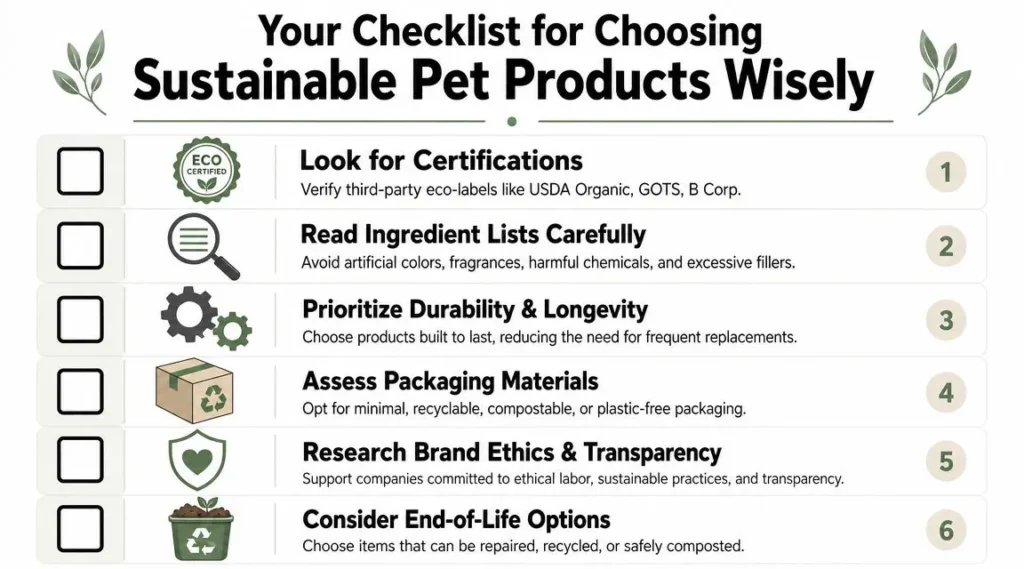
You don’t need to research every brand like a journalist every time you buy poop bags or a new bowl. You need a short checklist that helps you make a solid decision in a minute or two.
Start with this visual reminder:
The six-question shopping filter
When I’m comparing products, I ask these questions in order:
Does my pet need this
The greenest product is often the one you don’t buy.Will it last
Durability is sustainability in work clothes. It’s not glamorous, but it matters.Can I identify the main material
If the listing hides the material or uses fuzzy language, I move on.Is the packaging minimal or easier to handle responsibly
Extra plastic windows and layers usually signal convenience-first design.Is the brand transparent
I’m looking for plain answers, not polished slogans.What happens when this wears out
Recyclable through what system. Refillable. Repairable. Compostable. Take-back program. Any clear answer is better than silence.
A short video can help reinforce that mindset before your next purchase.
Good, better, best in real life
This is the easiest way to avoid all-or-nothing thinking.
Good
Choose the less wasteful version of something you already buy. Maybe that’s a sturdier toy instead of the cheapest one, or a refill option instead of a one-time plastic bottle.
Better
Look for products with named materials like recycled plastic, hemp, bamboo, natural rubber, or organic cotton. Better choices usually pair a clearer material story with stronger construction.
Best
Support products and brands that plan for the full lifecycle. That might mean replaceable covers, refill systems, repair parts, or take-back options.
A fast decision table
| If you’re buying | Good | Better | Best |
|---|---|---|---|
| Toy | One durable toy instead of several disposable ones | Recycled or plant-based material with clear description | Brand offers repair or recycling path |
| Bed | Washable cover | Recycled fill or natural fiber with removable cover | Replaceable parts or refillable insert |
| Grooming item | Bigger format to reduce repeat packaging | Clearly identified ingredients and recyclable bottle | Refill system or concentrated format |
Shopping mindset: Don’t chase the most ethical-looking product. Chase the product that does the job well, lasts, and comes with honest information.
That standard cuts through a lot of noise.
Beyond Buying DIY and Low Waste Pet Care
Some of the most satisfying sustainable pet choices never involve a store at all.
A torn T-shirt can become a braided tug toy. A cardboard box can become a sniffing puzzle for treats. An old blanket can become stuffing for a washable pet cushion. Those swaps aren’t second-best. For many pets, they’re more interesting because they smell like home and invite interaction.
DIY that’s simple and safe
The trick is to stay practical. Choose projects that suit your pet’s habits, and avoid anything with loose parts, toxic finishes, or strings that can come apart too easily.
A few low-waste ideas:
Braided fabric tug
Cut old cotton or fleece into strips and braid tightly. Good for supervised tug play.Cardboard treat search box
Drop treats into a box filled with paper tubes or crumpled paper so your dog has to sniff and paw.Homemade bedding refill
Use worn soft fabrics as insert fill inside a zippered cover you can wash.Frozen enrichment from kitchen leftovers
Pet-safe ingredients can turn into simple lick or sniff activities without buying extra plastic gadgets.
Daily habits that cut waste quietly
The biggest wins often come from routines, not one-time purchases.
Wash and rotate
Rotating toys extends their life and keeps them interesting.Repair before replacing
Restitching a seam or replacing a cover often saves an otherwise usable item.Buy less novelty
Pets usually value scent, interaction, and routine more than constant newness.
If you want to broaden that mindset beyond pet care, this guide on how to reduce plastic waste fits well because the same principles apply: use what you have, buy less often, and make each item work harder.
A low-waste pet routine often feels less cluttered, less expensive, and more personal. That’s one reason it tends to stick.
There’s also a bonding benefit here. Making a toy, hiding treats in a homemade puzzle, or refreshing a bed with reused materials shifts sustainability from guilt to care. Your pet doesn’t know the item came from a special “green” collection. They know you made something useful for them.
The Full Lifecycle Care Disposal and Recycling
A sustainable purchase isn’t finished when you bring it home. The full value shows up in how long the item lasts and what happens when it’s finally worn out.
That’s why lifecycle thinking matters so much with eco friendly pet products. The same bowl, toy, bed, or bag can create very different outcomes depending on care and disposal.
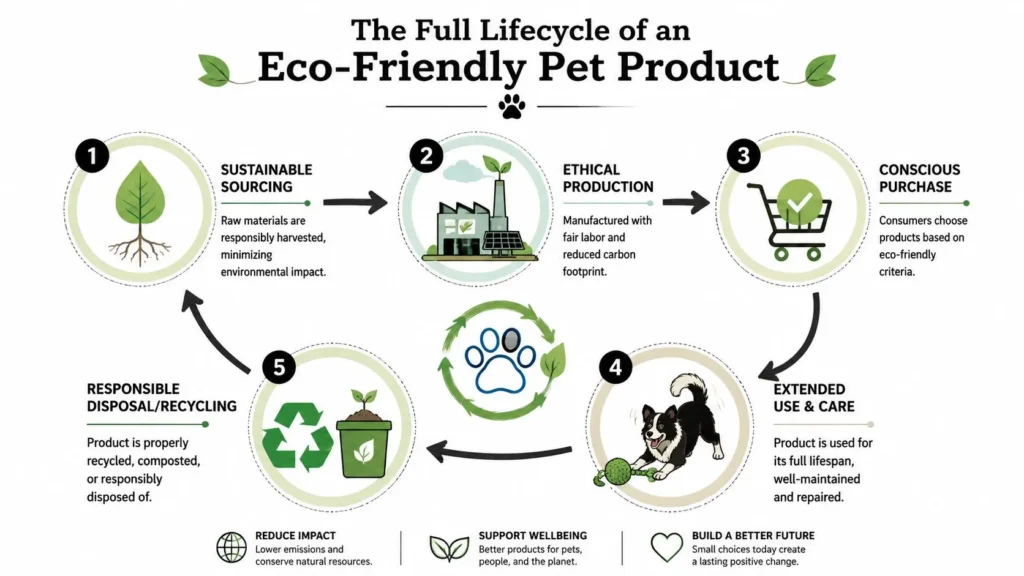
Extend the useful life first
Before thinking about recycling, try to get the full use out of the item you already own.
A few habits help:
Follow care instructions
Wrong washing temperatures and harsh cleaners can shorten product life fast.Separate heavy-duty from light-duty use
Keep the strongest toys for intense chewers and softer ones for gentler play.Store clean and dry
Mildew, odors, and material breakdown often start with damp storage.
Even the most efficient disposal system comes after manufacturing, transport, and purchase. Therefore, longevity does real environmental work.
Disposal gets easier when design is simpler
Single-material products are often easier to recycle than products made from several fused layers. A plain rubber toy, a clearly labeled plastic container, or a bed with removable components is usually easier to manage than a mixed-material product glued together with no instructions.
That’s one reason manufacturer take-back programs stand out. According to the Pet Sustainability Coalition, West Paw’s Loop Recycling Program diverted over 1,000 pounds of raw material from landfills in one year by creating a closed-loop recovery system for its products, as described by the Pet Sustainability Coalition’s example of closed-loop pet product recycling.
Brand-run take-back programs are often stronger than hoping a complex pet item will fit neatly into curbside recycling.
A practical end-of-life checklist
When a pet product reaches the end of its use, work through this order:
| Step | What to ask |
|---|---|
| Reuse | Can this be repurposed for lighter use, training, or shelter donation if still safe and clean? |
| Repair | Is one broken seam, cover, zipper, or strap the only real issue? |
| Recycle | Does the brand provide a specific path, or is the material clearly accepted where you live? |
| Compost | Is the item actually compostable under the conditions stated by the maker? |
| Trash | If none of the above is realistic, dispose of it safely and use what you learned next time |
For households trying compostable pet-related items or natural-fiber waste at home, it helps to understand the limits of the process. This primer on how to compost at home is a solid companion because it explains why “compostable” only works when the disposal method matches the material.
The most significant aspect of sustainable pet care is this: you influence the whole chain. You choose what comes into your home, how long it stays useful, and where it goes next. That’s more power than most labels admit.
If you enjoy practical, grounded writing like this, maxijournal.com publishes approachable articles across pets, health, science, fashion, technology, business, and more. It’s a good place to keep learning without the usual hype, and it’s also worth exploring if you like thoughtful independent publishing.
Discover more from Maxi Journal
Subscribe to get the latest posts sent to your email.