The most popular advice about education technology trends is to keep buying newer tools. That advice misses the harder problem. Schools have largely learned how to distribute devices and connect learners to digital platforms, but many still struggle to turn those tools into deeper learning, better teaching, or more sustainable systems.
I’ve watched schools adopt platforms with enthusiasm, build crowded digital ecosystems, and later abandon tools that teachers never had time to integrate. The useful question for 2026 isn’t which product category is growing fastest. It’s whether a technology improves a specific learning workflow, fits the people expected to use it, protects students, and can survive after temporary funding ends.
Why Education Technology Trends in 2026 Are Really About Transformation
A connected classroom isn’t automatically a transformed classroom. UNESCO reports that the share of internet users worldwide rose from 16% in 2005 to 66% in 2022, while learners enrolled in MOOCs grew from 0 in 2012 to at least 220 million in 2021. About 50% of lower secondary schools worldwide were connected to the internet for pedagogical purposes in 2022, according to the same UNESCO education technology data.
Those figures describe a major change in distribution. More learners can reach online content, learning platforms, and digital communication than in earlier generations. They don’t prove that students are receiving more useful feedback, practicing more effectively, or understanding difficult ideas at greater depth.
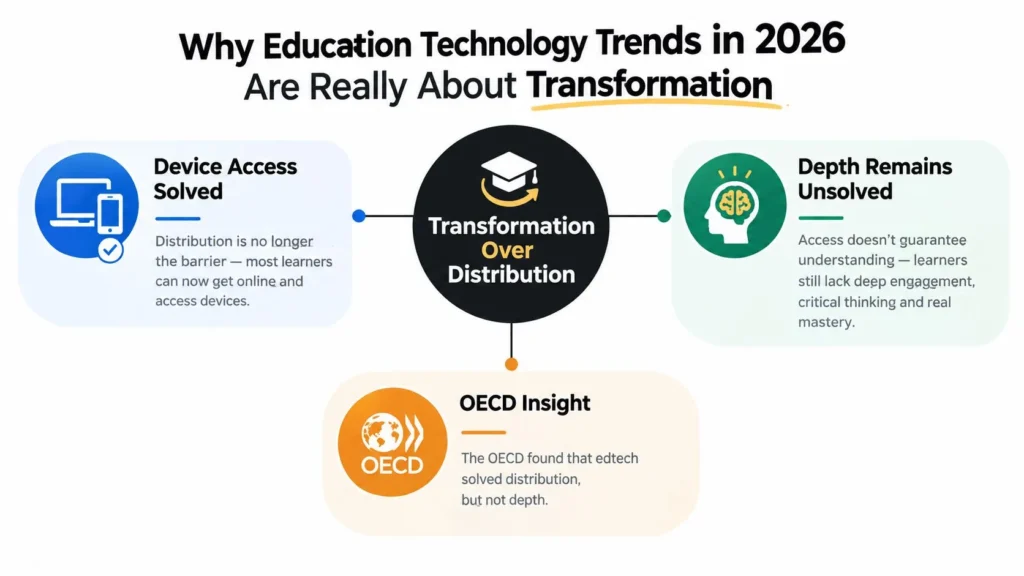
The OECD’s 2026 Digital Education Outlook places the central question elsewhere. Technology must improve learning, teaching, and system performance, yet large-scale evidence still shows that schools often use digital tools to reproduce existing teaching instead of redesigning learning. Access has expanded, but better-resourced settings can still benefit more than fragmented, low-impact implementations, as summarized in this OECD Digital Education Outlook discussion.
Four tests for every trend
I use four tests when evaluating a new platform or practice:
- Pedagogical fit: Does the tool improve explanation, practice, feedback, collaboration, or assessment?
- Operational fit: Can teachers use it without duplicating data entry or creating another disconnected login?
- Equity fit: Does it work for learners with different bandwidth, accessibility, language, and support needs?
- Policy fit: Are privacy, procurement, accountability, and long-term funding addressed?
A product can perform well on one test and fail the others. A polished AI tutor may offer quick explanations but create supervision problems. A dashboard may reveal patterns but add work if teachers can’t act on its recommendations. Readers who want a broader overview of technological trends shaping e-learning should still ask the same question: what changes for the learner and the educator?
Practical rule: Treat adoption as the beginning of evaluation, not evidence that transformation has happened.
The most important trend in 2026 is therefore slow and unglamorous. Schools are trying to integrate existing tools into coherent classroom practice, with clearer evidence of learning impact and fewer burdens on staff.
The Foundational Layer of Digital Learning
Education technology rarely fails because a school lacks another application. It fails when a new application rests on weak connections between the systems already in place.
Digital learning was assembled layer by layer. Wider internet access made online reference material and communication possible. Learning management systems gave institutions a shared location for assignments, announcements, grades, and course materials. MOOCs extended participation beyond a local campus, while open educational resources made reusable materials easier to access. Cloud platforms reduced the need for schools to host every system themselves. During the pandemic, digital delivery became a continuity mechanism for many institutions.
The resulting stack has distinct layers. Connectivity and devices form the physical layer. Identity systems, student information systems, and learning management systems form the administrative layer. Content libraries, assessment tools, communication platforms, and analytics sit above them. AI tutors and automated recommendations are newer applications built on this older plumbing.
Stable foundations, fragile connections
Some functions now feel routine:
- A cloud LMS distributes resources and collects work.
- Digital classrooms support asynchronous communication.
- Online documents allow collaborative authoring.
- Video and interactive content supplement direct instruction.
The connections between these functions remain less dependable. Content may not transfer cleanly between platforms. Rosters can become outdated. A learner may have reliable access at school but inconsistent connectivity elsewhere. Accessibility features can differ across resources, even when a district has a broad digital strategy.
Those weaknesses shape the learner experience. A new platform inherits problems from the systems beneath it. An AI feature cannot repair an unreliable identity layer. A digital textbook cannot organize poorly managed content. A dashboard cannot create instructional time for teachers to act on its recommendations.
Tool comparisons should therefore begin with the classroom workflow, not the product category. The education technology tools guide can help readers identify common platforms, but local evaluation still needs to examine interoperability, teacher support, student access, and the work created behind the screen.
Award recognition signals market momentum, but this 2025 EdTech award winner also illustrates why vendor claims must be tested against local infrastructure. Recognition may show where investment and attention are gathering. It does not show whether a district’s identity systems, data practices, connectivity, or staff capacity can support the product over time.
The newer the feature, the more carefully you should examine the older infrastructure it depends on.
AI Tutoring and Adaptive Learning
AI tutoring is often discussed as if all systems do the same thing. They don’t. Adaptive learning platforms generally adjust a sequence, difficulty level, or practice path based on learner responses. Generative AI tutors can conduct open-ended dialogue, explain an idea in different ways, and respond to questions that weren’t prewritten.
That flexibility creates value and risk. A structured adaptive system may be easier to validate because its pathways are bounded. A conversational tutor can feel more responsive, but teachers must consider inaccurate explanations, misplaced confidence, inappropriate advice, and the quality of the student’s prompts.
The strongest evidence currently points toward augmentation. Stanford’s 2026 brief classifies human tutoring with AI support as an emergent model with potentially equal or better outcomes than human-only tutoring. It also describes major evidence gaps and engagement problems for AI-only tutoring. In one cited study, 40% to 47% of students never used the AI platform when left independently, as reported in the Brookings review of generative AI in tutoring.
That non-use range is more than a participation detail. It changes the design brief. A school can’t assume that assigning access produces sustained use, thoughtful questioning, or productive struggle.
AI tutoring approaches compared
| Approach | How It Works | Evidence of Impact | Key Limitation |
|---|---|---|---|
| Human tutoring with AI support | A teacher or tutor uses AI for scaffolding, retrieval practice, or decision support | Stanford identifies it as an emergent model with potentially equal or better outcomes than human-only tutoring | Requires trained adults and clear authority boundaries |
| AI-only tutoring | A learner interacts directly with an automated tutor | Evidence remains limited, with engagement concerns | Independent learners may not use the platform consistently |
| Adaptive learning | Software changes sequence or difficulty from learner responses | Can organize targeted practice and reveal gaps | May narrow learning if teachers can’t connect practice to broader instruction |
| Generative AI tutoring | A conversational system explains, questions, and responds dynamically | Promising use cases exist, but validation remains uneven | Responses can be inaccurate, inconsistent, or difficult to audit |
Teachers should retain control over learning goals, intervention decisions, and judgments about understanding. AI can handle repetitive scaffolding, draft practice questions, or flag a possible misconception, but it shouldn’t decide that a student has mastered a concept without human review.
A practical guide to AI for teachers can help educators think through classroom use, but implementation still needs local rules. Schools should define acceptable data, review prompts and outputs, teach students how to challenge an answer, and record when human intervention is required.
The wider discussion of AI ethics and governance belongs beside the tutoring conversation, not after it. The durable trend isn’t replacement. It’s a human-in-the-loop model in which educators remain responsible for instruction and calibration while AI supports the repetitive work around them.
Immersive, Modular, and Hybrid Learning Models
Education technology trends often promise transformation through new formats. In practice, a headset, a short lesson, or a remote schedule changes learning only when it gives students a better way to observe, practise, discuss, or receive feedback. The implementation question comes before the product category: what can this model provide that a conventional lesson cannot provide as well?
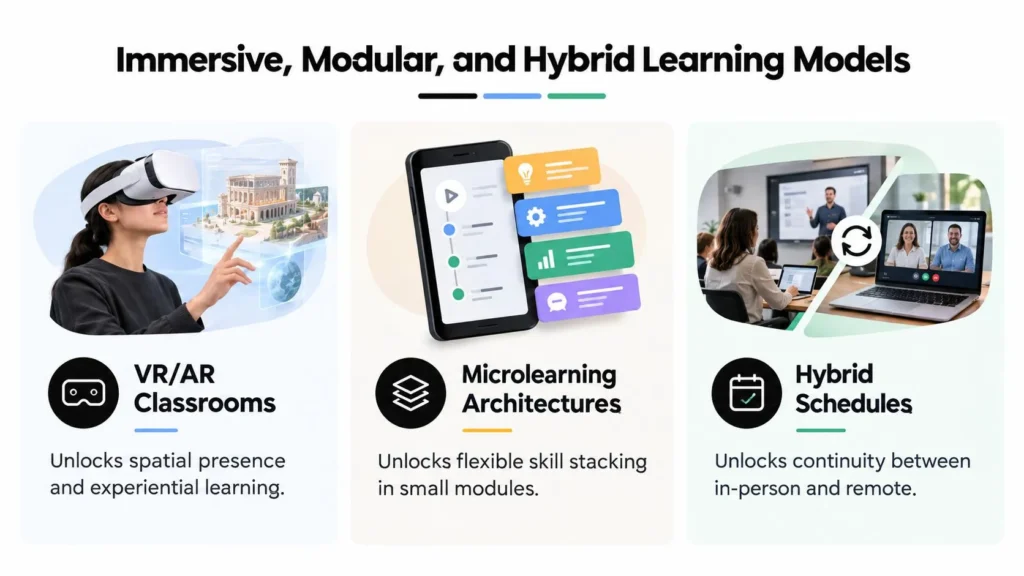
VR and AR can create spatial presence and experiential learning. A virtual environment may let learners examine a place, process, or structure that would otherwise be inaccessible. A simulated field trip still requires preparation, guided observation, language for describing what students see, and a task that connects the experience to disciplinary knowledge. Without those supports, immersion may produce attention without understanding.
The same test applies to modular and hybrid designs.
VR and AR classrooms work best when presence adds something important. A teacher might use a virtual environment for observation before students interpret evidence, draw conclusions, or complete a practical task. The hardware choice should follow the learning purpose, accessibility requirements, classroom management plan, and capacity to maintain the equipment.
Microlearning architectures divide content into focused units. This can help learners return to a skill between other responsibilities, especially when each unit has a clear outcome and immediate practice. Short content is not automatically better content. Without retrieval, feedback, and a connected progression, separate pieces become a catalogue rather than a learning pathway.
Hybrid schedules matter when teachers redesign time rather than moving a lesson online. Students may receive direct instruction in one setting, practise independently in another, then return for discussion or intervention. The schedule is visible, but teacher collaboration, reliable communication, and a shared progress record determine whether the arrangement holds together.
Before funding a rollout, ask:
- What will students do differently?
- What evidence will show understanding?
- Which teacher actions become easier?
- What happens when the technology fails?
- How will learners receive feedback?
These questions also apply to assessment. A simulation, modular course, or hybrid project should produce evidence teachers can interpret, not only activity logs.
This overview from the video’s creator shows how changing learning models can reshape classroom arrangements and blended instruction:
Novelty attracts attention. Rehearsal and feedback create learning. Each model earns its place when instructional intent leads, integration work is planned, and funding can support the experience after the launch.
Learning Analytics and Next Generation Assessment
Analytics become useful only when they change a decision. A dashboard that displays clicks, time, or completed activities may describe participation without explaining understanding. A teacher needs to know what the pattern means and what action is reasonable during the available instructional time.
It helps to distinguish three levels:
| Analytics Tier | Example Platform | Typical Use Case | Governance Need |
|---|---|---|---|
| Descriptive | LMS activity reports, such as Canvas engagement views | Reviewing participation and submitted work | Clear definitions of what each measure does and doesn’t represent |
| Predictive | Early warning or risk-flagging systems | Identifying learners who may need support | Transparent models, human review, and safeguards against harmful labeling |
| Formative | Skill diagnostics connected to instructional recommendations | Adjusting practice, grouping, or feedback | Teacher control, explainable recommendations, and timely intervention |
The first tier answers, “What happened?” The second asks, “Who may need attention?” The third should help answer, “What should we do next?” That final question is where analytics either enters teaching practice or remains an administrative display.
Assessment beyond the score
Next-generation assessment is moving toward richer evidence, including portfolios, project rubrics, demonstrations, and digital credentials. These formats can capture revision, application, collaboration, and reflection more effectively than a single test, but they also require consistent criteria and time for review.
The data trail itself needs careful interpretation. A clickstream can indicate that a learner opened a page. It can’t, on its own, show concentration, comprehension, confusion, or independent reasoning. Parents and students deserve plain explanations of what institutions collect, why they collect it, who can access it, and how long it remains available.
A useful dashboard doesn’t merely identify a problem. It helps a teacher choose the next defensible action.
Administrators should therefore evaluate analytics by asking whether the system reduces uncertainty without increasing teacher workload. They should also separate data used for immediate support from data used for placement, discipline, or long-term profiling. Those uses carry different risks and require different governance.
Implementation Friction and Funding Durability
A pilot often succeeds because it receives conditions that ordinary adoption cannot sustain. A small group gets focused training, leaders check in regularly, and technical staff resolve problems quickly. Once a district expands the tool, those supports thin out. Integration, troubleshooting, and staff time become part of the cost.
Jotform’s 2026 EdTech Trends report says 73% of educators cite a lack of integration between systems as their primary difficulty, although 77% say their current digital tools work well. The apparent contradiction matters. A platform may function adequately on its own while creating extra work beside an LMS, student information system, identity provider, assessment platform, and communication channel. These figures appear in Jotform’s EdTech Trends announcement.
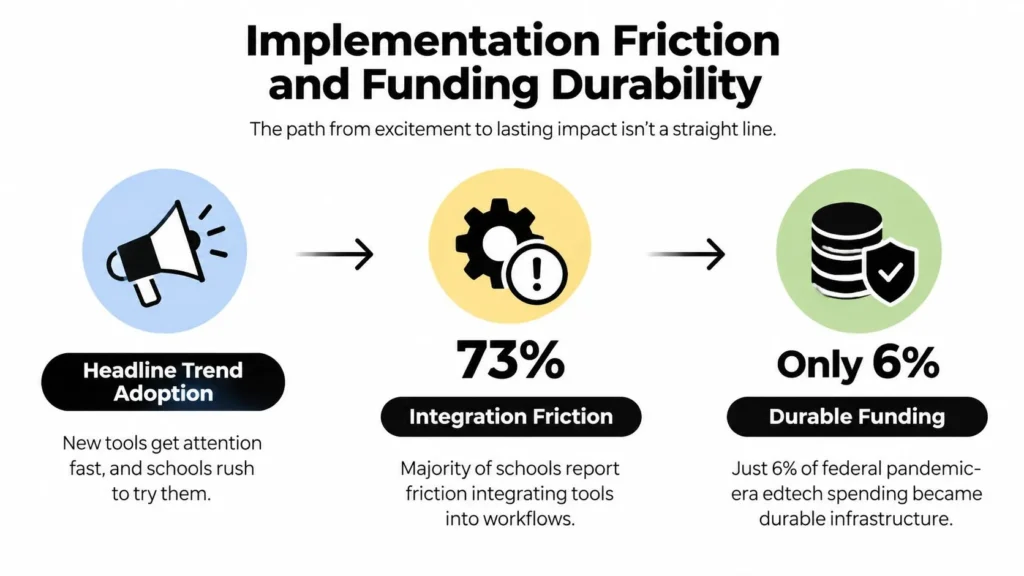
Funding creates a similar test after purchase. SETDA’s 2025 State EdTech Trends report found that only 6% of respondents reported durable funding plans for ongoing edtech work, down from 27% in 2024. SETDA’s findings suggest districts should map recurring costs to identified budget lines before signing multi-year contracts, as reported in the SETDA funding findings.
A district using temporary money may still inherit recurring obligations:
- Licences: Renewals become difficult when a grant or emergency allocation ends.
- Professional learning: Teachers need continued support, not only an introductory workshop.
- Refresh cycles: Devices, batteries, headsets, and network equipment need planned replacement.
- Instructional coaching: Staff must connect the platform to curriculum and classroom routines.
- Integration work: Rosters, authentication, data exchange, and support tickets consume time.
Procurement should test the full lifecycle before approval. Can the vendor export usable data? Can the district reduce seats or terminate the contract? Does the agreement explain model training, retention, support, accessibility, and incident response? Can teachers complete the core workflow without entering the same information twice?
The durable trend is procurement maturity. Districts need fewer abandoned pilots and clearer commitments about integration, staffing, evaluation, and renewal. A technology purchase changes learning only when the surrounding system can keep it working.
Access, Equity, and the Policy Landscape
Counting devices is an incomplete equity audit. A learner may receive a laptop and still lack dependable home connectivity, a quiet place to work, accessible content, appropriate language support, or an educator who has time to use the available data well.
UNESCO’s broader reporting shows why access still matters, including the expansion of internet use and school connectivity described earlier. But the OECD’s finding that better-resourced settings can benefit more from technology points to the next question. Who can convert access into high-quality learning?
Equity beyond device counts
| Legacy Equity Metric | Why It Is Insufficient | Stronger 2026 Indicator |
|---|---|---|
| Devices distributed | Doesn’t show reliability, suitability, or meaningful use | Availability, repair access, accessibility, and continuity of learning |
| Platform access | A login doesn’t prove effective participation | Completion of purposeful learning activities with feedback |
| Internet availability | A connection can be slow, shared, or unstable | Quality and consistency across school and home contexts |
| AI availability | Access can expose learners to unreviewed outputs | Human oversight, explainability, and safe escalation |
| Data collection | More data doesn’t equal better support | Clear purpose, consent practices, retention rules, and student rights |
Policy literacy has become part of educational leadership. Leaders need to understand how vendors use student data, how AI systems are evaluated, which decisions require human review, and how contracts address security and accessibility.
The policy environment is also moving beyond general statements about innovation. Procurement teams increasingly need to ask whether a product’s design serves marginalized learners, whether students can opt out where appropriate, and whether teachers can challenge an automated recommendation. A district that lacks negotiating power may accept weaker data residency, transparency, or exit terms than a larger system can demand.
Equity in 2026 is therefore about bandwidth, pedagogy, capacity, and dignity. The device remains important, but it’s only the first condition for participation.
Access opens the door. Instructional quality and data rights determine what happens inside.
Practical Recommendations and Where to Read Next
The useful response to fast-moving education technology trends is not tracking every product announcement. Schools need a repeatable way to choose, test, govern, and discontinue tools that fail to improve learning. A platform is like a new piece of lab equipment. Its value depends on whether people can use it reliably, whether it fits existing routines, and whether the school can maintain it after the launch period.
For teachers
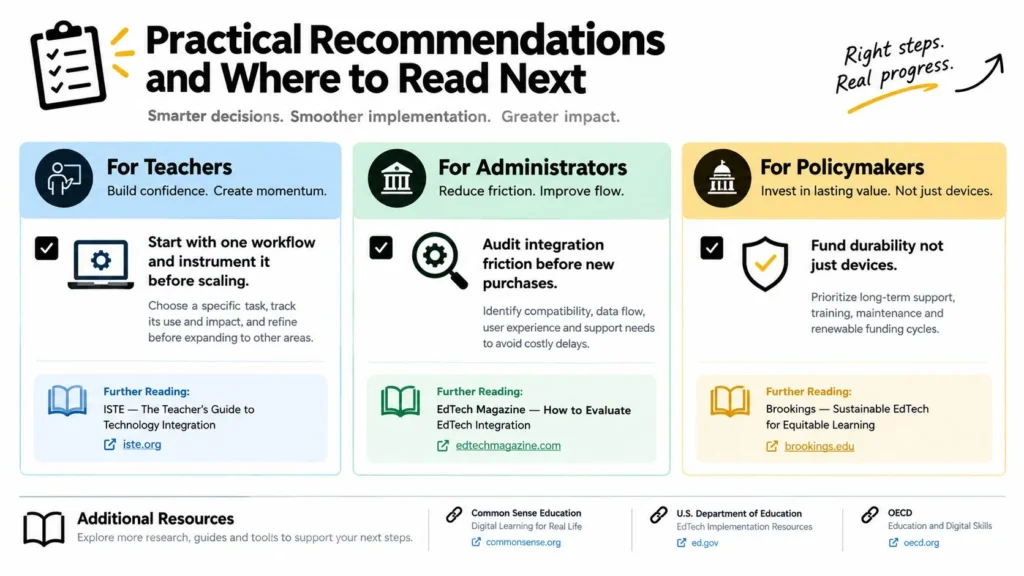
Begin with one workflow, such as writing feedback, retrieval practice, small-group planning, or family communication. Define what the learner will do and what the teacher will do before opening the platform. Then check whether the tool saves time, improves feedback, or exposes a misunderstanding that instruction can address.
Keep the first trial narrow. Ask students what confused them, review the outputs yourself, and remove features that create activity without improving learning. A simple classroom measure often gives clearer guidance than a large collection of engagement signals. The question is not whether students clicked, but whether their work changed.
For school leaders
Make integration part of the purchase requirement. Ask vendors to demonstrate roster synchronization, accessibility, data export, identity management, and teacher workflows with the school’s actual systems. A polished demonstration in isolation can hide the daily work required to make a product function.
Put renewal conditions in the contract. The platform needs an exit path, clear support obligations, and evidence that staff can use it without unsustainable workarounds. Delay a broad rollout until the school has assigned responsibility for training, troubleshooting, data review, and instructional alignment.
For district technology teams
Form a cross-functional governance group that includes teachers, instructional leaders, privacy staff, accessibility specialists, and technical administrators. Review vendor data practices, retention periods, security responsibilities, model behavior, and changes introduced during renewals. This group can also distinguish a temporary pilot problem from a design flaw that will persist across schools.
Funding deserves the same scrutiny as technical fit. Earlier findings on durable funding show that long-term ownership cannot be assumed. Separate one-time acquisition from recurring costs, then identify the budget source for each before adoption. Multi-year commitments, outcomes-tied renewals, and pooled regional procurement may withstand budget pressure better than isolated purchases, but each still requires local review.
For policymakers
Fund the conditions that let tools support instruction, including professional learning, interoperability, accessibility, evaluation, cybersecurity, and the staff who maintain coherent systems. Funding rules should reward durable instructional capacity rather than short-term adoption totals.
For further reading
Choose resources according to the decision you need to make:
- OECD digital education work: useful for examining whether technology changes teaching and learning, rather than merely expanding access.
- Brookings research: offers analysis of tutoring and education technology policy.
- Stanford studies: helps readers examine evidence about AI-supported learning.
- ISTE and EdSurge guidance: provides practitioner-oriented advice for school implementation.
- The U.S. Department of Education’s Office of Educational Technology: supports policy and planning decisions.
- Computers & Education and the Journal of Learning Analytics: offer research on learning technology and evidence.
- Bryan Alexander and Doug Levin’s State of EdTech: follows broader developments and implementation questions.
Maxi Journal’s education technology news provides approachable coverage across education and technology. Use it as a starting point, then verify important claims against original research, official guidance, and classroom evidence.
Transformation begins when a teacher can use a tool reliably, a student receives better support, leaders can explain the data, and the budget can sustain the practice. Start with one durable workflow, measure what changes for learners, and expand only when the evidence and the people are ready.
Visit maxijournal.com for approachable coverage of education technology, science, business, health, and other subjects that shape everyday life. If you are evaluating classroom tools or following education technology trends, use Maxi Journal to find fresh commentary and practical starting points for an informed decision.
Discover more from Maxi Journal
Subscribe to get the latest posts sent to your email.