Could our entire universe be nothing more than a giant computer simulation? It’s one of those questions that sounds like it was lifted straight from a late-night dorm room debate, but it has become a serious topic of discussion in both scientific and philosophical circles.
The idea is that what we perceive as “reality” isn’t the real deal. Instead, it’s an artificial construct—a breathtakingly detailed program running on some unimaginably powerful computer, created by an even more advanced civilization.
What Is the Simulation Hypothesis?
In a nutshell, the simulation hypothesis suggests that everything and everyone you know—the planet, the stars, your own thoughts—is part of a complex digital simulation. Imagine the most realistic open-world video game you can think of, then scale it up to the size of the cosmos. In this scenario, we’re the characters, completely unaware that we’re living inside a system built by someone else. The laws of physics? They’re just the underlying code that keeps the whole thing running.
This isn’t just a fun sci-fi trope anymore. Prominent thinkers, from physicists to philosophers, are giving it serious consideration. The concept really broke into the mainstream after philosopher Nick Bostrom published his now-famous paper on the topic in 2003. He laid out a brilliant probabilistic argument that, if it’s even possible for a civilization to create ancestor simulations, then it’s statistically very likely we’re in one right now.
The Core Concept Explained
The logic behind the hypothesis is surprisingly straightforward. It unfolds in a few key steps. If a civilization reaches a “posthuman” stage where they have immense computing power, they would probably run a lot of simulations. We’re talking millions, maybe even billions.
This leads to a few critical points:
- Ancestor Simulations: A future civilization might want to simulate their own past. Think of it as the ultimate history lesson, allowing them to study their evolution, society, and key historical events with perfect fidelity.
- The Statistical Argument: If countless simulations are running, the number of simulated worlds would dwarf the one “base” reality. The ratio would be astronomical.
- Our Probable Place: Given those odds, any conscious being—like you—is far more likely to be one of the trillions of simulated minds than one of the original biological beings in the single base reality.
The core idea is this: the fundamental laws governing our universe might just be lines of code in a cosmic computer program. If that’s the case, our entire existence is the output of a calculation being run by an intelligence far beyond our own.
This completely reframes how we look at our own existence. Suddenly, things like the “fine-tuning” of the universe—where physical constants seem perfectly set to allow for life—don’t look like a lucky coincidence. They look like parameters deliberately chosen by the simulation’s creators. It also opens up a rabbit hole of questions about consciousness, free will, and the very definition of “real.” While it can feel like a dizzying thought experiment, it also touches on real questions in physics, such as whether there is an end to the universe. Getting your head around this hypothesis is the first step toward exploring one of the most mind-bending possibilities in modern thought.
Exploring Bostrom’s Simulation Argument
While people have kicked around the idea of a fake reality for centuries, the debate really caught fire thanks to philosopher Nick Bostrom. Back in 2003, he published a paper that dropped a logical bombshell on the scientific and philosophical communities, forcing them to take the question seriously: is our universe a simulation?
Bostrom wasn’t outright claiming we’re living in The Matrix. What he did was lay out a “trilemma”—a sharp, three-pronged argument where at least one of the propositions has to be true. The whole thing hangs on a simple question: what would a hyper-advanced, “posthuman” civilization be capable of, and what would it choose to do?
His logic acts like a filter, and when you pass our own existence through it, the results are pretty mind-bending.
The Three Pillars of Bostrom’s Trilemma
Think of this as a process of elimination. If you find the first two scenarios unlikely, you’re almost forced to accept the third one. Let’s walk through them.
- The Great Filter: This is the grim option. It suggests that civilizations like ours almost never make it to a “posthuman” stage where they could run ancestor simulations. We might wipe ourselves out with nukes, cook the planet, or get hit by an asteroid we never saw coming. Something always gets in the way.
- Universal Apathy: In this scenario, advanced civilizations do get the tech to run simulations, but they just… don’t. For whatever reason, they collectively lose interest in recreating their past. Maybe they develop ethical rules against it, or maybe they just have better things to do than watch digital history unfold.
- The Simulation Conclusion: This is the big one. If the first two are false—meaning civilizations do survive and do run these simulations—then we are almost certainly living inside one.
The reasoning here is shockingly simple. If a civilization can run one ancestor simulation, it can probably run billions.
Probability and the Russian Doll Universe
This is where the argument pivots from philosophy to a game of cosmic odds. Picture reality as a set of nested Russian dolls. The biggest, outermost doll is “base reality”—the one true, un-simulated universe.
Now, imagine a civilization inside that doll builds a computer powerful enough to simulate its own past, creating a new, smaller doll. And what if a civilization inside that simulation eventually does the same thing? You get an exponential cascade of simulated worlds.
If even a single civilization in base reality creates billions of simulated ancestors, then the number of simulated people would vastly outnumber the original “real” people. From a statistical standpoint, you are overwhelmingly more likely to be one of the simulated minds than a member of the original civilization.
When Bostrom fired this shot across the world’s bow in 2003, he suggested that if posthumans run huge numbers of these ancestor simulations—maybe billions for every one base reality—the odds are stacked against us being in that top-level reality.
For some scale, our own universe has somewhere between 10^22 to 10^24 stars. If even a tiny fraction of those host civilizations that start running simulations, the number of simulated worlds could dwarf the real ones by a factor greater than 10^30. You can dive deeper into these mind-boggling numbers and the original arguments in this detailed overview of the simulation hypothesis.
This flowchart gives you a simplified way to think through the argument.
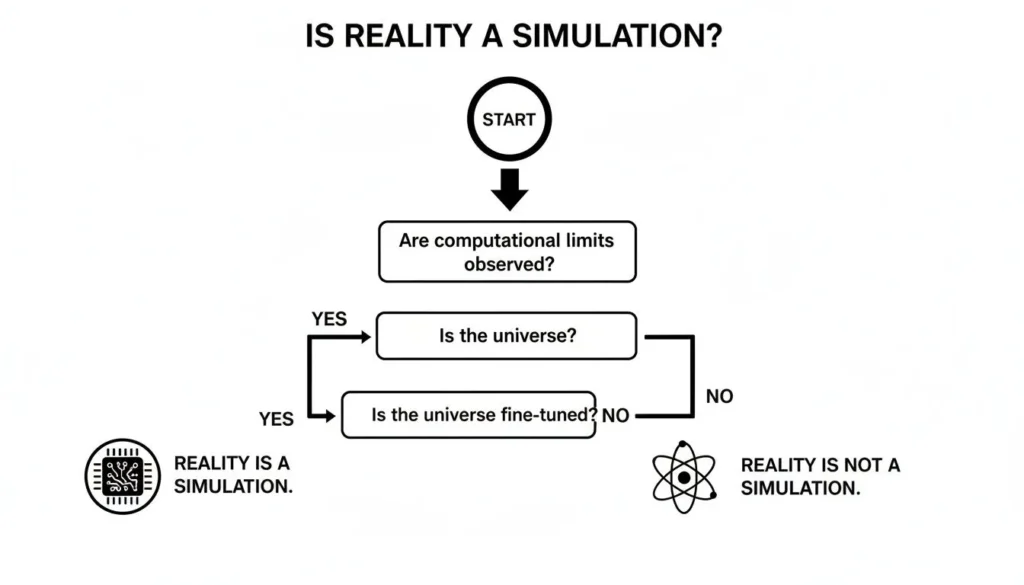
It really forces you to make a choice: is the universe fundamentally computational (a simulation) or physical (base reality)?
A Solution to Cosmic Silence
Bostrom’s argument also offers a wild, but fascinating, potential answer to the Fermi Paradox—the eerie silence from the cosmos when we’d expect it to be buzzing with alien life.
- If proposition one is true (The Great Filter), that explains the silence perfectly. Nobody makes it long enough to send a signal.
- If proposition two is true (universal apathy), maybe advanced civilizations are out there, but they’re intentionally quiet, uninterested in making contact or running simulations we might one day detect.
- And if proposition three is true (we are a simulation), then our creators might have just programmed a universe without any other intelligent life. Or perhaps other species exist, but they’re outside the boundaries of our specific simulated sandbox.
In the end, Bostrom’s trilemma doesn’t hand us a neat answer. But what it does, brilliantly, is give us a logical framework to ask the question “is our universe a simulation?” It makes us confront some deeply uncomfortable possibilities about where we came from, where we’re going, and the very ground beneath our feet.
Searching for Glitches in the Cosmic Code
If our reality is just a sophisticated program, then it has to be running on some kind of hardware. This one simple idea is what elevates the simulation hypothesis from a late-night philosophical debate to a question science can actually try to answer.
Think about it like a video game. No matter how advanced the graphics, if you zoom in far enough, you’ll eventually see the individual pixels. A simulated universe would likely have a similar limit—a fundamental “pixelation” to its very structure.
This means space and time might not be the smooth, continuous fabric we perceive. Instead, they could be made of incredibly tiny, discrete units, like a cosmic grid. If that’s true, this underlying structure should create detectable artifacts—glitches in the matrix, if you will—that physicists can hunt for. The catch, of course, is that this grid would be unimaginably fine, far smaller than anything we could ever hope to see directly.
Thankfully, we don’t have to build the tools ourselves. The universe provides them.
Hunting for Spacetime Pixels
The most promising approach for spotting this cosmic grid involves looking at ultra-high-energy cosmic rays (UHECRs). These are subatomic particles, mostly protons, launched across the cosmos at nearly the speed of light by cataclysmic events like supernovae or supermassive black holes. They are the fastest things we’ve ever observed.
Here’s the theory: if spacetime is a grid, it wouldn’t be perfectly fair. A particle traveling straight along the grid’s “x-axis” might behave differently than one moving diagonally. This directional preference is a phenomenon known as anisotropy.
For UHECRs, this effect should be noticeable. As these particles scream across the universe, their paths ought to show a tiny but consistent preference for certain directions, betraying the grid’s hidden orientation.
The core idea is that a finite, grid-like universe would not be perfectly uniform. By looking for tiny, systematic irregularities in the behavior of the most extreme phenomena in the cosmos, we might just be able to see the seams of our simulated reality.
This specific test was proposed back in 2012 by a team of physicists: Silas Beane, Zohreh Davoudi, and Martin Savage. They calculated that if our simulators built spacetime on a grid—similar to the way particle physicists use grids around 10^-15 meters for their own simulations—then cosmic rays above an energy of 10^20 eV would show this telltale anisotropy.
So far, the search has come up empty. Facilities like the Pierre Auger Observatory, which has been gathering data since 2004, haven’t found any significant directional bias. While this doesn’t disprove the simulation hypothesis entirely, it does cast doubt on this specific model. For a deeper look at the physics behind these tests, you can check out this deep dive into infodynamics and the simulation theory.
The table below summarizes some of the main scientific methods proposed to test the simulation hypothesis.
Proposed Scientific Tests for the Simulation Hypothesis
Here’s an overview of the methods scientists have proposed to detect evidence of a simulated reality, along with their current status.
| Proposed Test | What It Looks For | Current Findings (as of 2026) |
|---|---|---|
| Cosmic Ray Anisotropy | A preferred direction of travel for ultra-high-energy cosmic rays, which would indicate a grid-like structure of spacetime. | No significant anisotropy has been detected by observatories like Pierre Auger, challenging models with a simple grid structure. |
| Infodynamics | Evidence of data compression or optimization in physical laws, such as a measurable decrease in the universe’s information content over time. | Theoretical stage. This idea is new and has not yet been experimentally verified. |
| Cosmic Microwave Background (CMB) Anomalies | Unexpected patterns or “glitches” in the faint afterglow of the Big Bang that don’t fit standard cosmological models. | Some anomalies (like the “Cold Spot”) exist, but they currently have plausible, non-simulation explanations. |
| Fundamental Constants | Any sign that the fundamental constants of nature (like the speed of light or the fine-structure constant) are not truly constant, but might change over time or in different locations. | All measurements to date show these constants to be stable within our ability to measure them. |
While these tests haven’t yielded a smoking gun, the search continues as our instruments and theories become more sophisticated.
Is the Universe Optimizing Itself?
Another fascinating, and more recent, line of inquiry comes from a field called “infodynamics.” This theory flips our perspective, suggesting that information isn’t just something we use to describe the universe—it’s a fundamental physical component, just like mass and energy.
Physicist Melvin Vopson has taken this a step further with his “second law of infodynamics.” He proposes that a system’s total information content naturally trends toward a minimum over time. In other words, it self-compresses.
Let’s bring it back to video games.
- Game Development: Developers use clever tricks to shrink file sizes and reduce the processing power needed to run a game. They might render distant objects with less detail or use algorithms to generate landscapes instead of storing every single tree and rock.
- The Universe as a Computer: If our universe is a simulation, it would be logical for its creators to build in similar optimization protocols to save on cosmic-scale computational resources.
Vopson even suggests that some fundamental forces we observe, like gravity, might just be a side effect of this information-compression process. Maybe matter clumps together because it’s more “computationally efficient” for the system to track one large mass instead of many smaller, separate ones. This is a radical new way of looking at the laws of physics.
Of course, the processing power needed to run a simulation of this magnitude would be astronomical, a concept tied closely to our burgeoning understanding of what quantum computing could make possible.
While these ideas are still on the frontiers of theoretical physics, they mark a serious attempt to ground the simulation hypothesis in physical evidence. The hunt for cosmic glitches—whether in particle flight paths, the background radiation of the universe, or the very laws of physics themselves—is our best shot at finding out if we’re all just living inside a computer.
The Mathematical Proof Against a Simulated Universe

While hunting for cosmic glitches is an exciting search for physical proof, a much deeper challenge to the simulation hypothesis comes not from physics, but from pure mathematics. This argument doesn’t need to find pixelated spacetime or weird particle glitches. Instead, it hits at the very core of what a computer program—no matter how advanced—can and cannot do.
The main idea is this: our universe appears to be fundamentally non-computable. This means its staggering complexity can’t be fully bottled up or described by algorithms, which are the lifeblood of any computer simulation. If that’s true, the question “are we in a simulation?” gets a loud, definitive “no.” Our reality would simply contain truths and complexities that a simulation, by its very nature, could never create.
This powerful argument rests on one of the most mind-bending discoveries in the history of logic: Gödel’s incompleteness theorems.
Gödel’s Incompleteness and the Limits of Code
Back in 1931, the brilliant mathematician Kurt Gödel threw a wrench in the gears of the quest for a perfect mathematical system. His incompleteness theorems proved something truly startling: any formal system of logic or math, like a computer program, will always have statements that are true but can’t be proven true using only the rules inside that system.
Think of it like a game with a rulebook. Gödel proved that no matter how detailed you make that rulebook, there will always be legitimate moves or game states that the book itself can’t prove are legal. The system is forever incomplete.
So, how does this relate to the simulation idea?
- Simulations are Formal Systems: At its heart, any computer simulation is a formal system. It runs on a finite set of rules and algorithms—its source code.
- The Universe’s Complexity: Our universe, with all its quantum strangeness and seemingly infinite detail, is the “system” we are living in.
- The Gödelian Contradiction: If our universe were a simulation, it would be governed by a set of algorithms. But Gödel’s theorems tell us that such a system could never contain all the truths about itself. And yet, our universe does seem to contain its own complete set of operating rules, even if we haven’t found them all yet.
This line of reasoning suggests reality’s richness is just too vast for any possible algorithm to describe.
The core takeaway from this mathematical proof is that a simulated universe, bound by algorithmic rules, would be fundamentally limited. However, our physical reality appears to operate with a level of complexity that transcends what any finite set of computational instructions could ever produce, suggesting it is not a simulation.
This is the exact logic behind a recent mathematical proof that seriously shook up the debate. In late 2025, physicists from UBC Okanagan, including Dr. Mir Faizal, published groundbreaking work arguing our universe is non-computable. By applying Gödel’s theorems, they contend that a full description of our universe’s complexity demands more than algorithms can offer, which makes the simulation hypothesis mathematically untenable. You can dive into the concepts behind this powerful mathematical debunking of the simulation idea.
The Infinite Cost of a Perfect Simulation
Beyond these logical paradoxes, there are also some massive physical and practical roadblocks to simulating a universe like ours. These arguments boil down to the sheer computational resources needed, which might not just be astronomical but literally impossible to gather.
One major problem is quantum mechanics. A particle’s properties are described by a quantum wave function, which is a continuous mathematical object—not a series of discrete steps. To perfectly simulate even a single particle, a computer would need to store an infinite amount of information to capture that continuous nature with perfect accuracy.
Another issue is something called exponential resource decay. This tackles the “simulations all the way down” scenario, where our simulators are themselves in a simulation. Each nested layer of reality would need its own computing power, pulling it from the level above. This creates a cascade where the available resources would shrink exponentially, making a deep stack of nested realities a mathematical impossibility. The universe at the very bottom would have next to no processing power left to run anything at all.
Ultimately, these mathematical and physical arguments build a formidable case. They suggest that while asking “is our universe a simulation?” is a fascinating thought experiment, the answer is likely written into the fundamental fabric of reality itself: it’s too complex, too continuous, and too complete to just be code.
The Cultural and Technological Impact of the Debate
The question of whether we’re living in a simulation has broken free from the confines of philosophy departments and physics labs. It’s an idea that has burrowed deep into our culture and is now even starting to nudge the direction of our technology, bridging the gap between abstract thought and the real world. This isn’t just academic curiosity; it taps into a fundamental human need to understand the true nature of reality.
You can see this fascination everywhere in pop culture. Films like The Matrix weren’t just blockbusters; they were cultural events that dragged the simulation hypothesis into the mainstream. The movie gave us a powerful visual language for a complex idea, making simulated realities something millions could grasp and discuss. Since then, the concept has become a recurring theme in TV shows, novels, and video games, solidifying its place in our shared imagination.
It doesn’t stop with fiction, either. The idea has become a favorite talking point for tech visionaries and popular thinkers. Their public debates have elevated the concept from a sci-fi trope to a topic worthy of serious, if still speculative, discussion, encouraging more people than ever to question the ground beneath their feet.
From Thought Experiment to Real-World R&D
While the debate often feels philosophical, its ripples are now making waves in some very practical, high-tech fields. As scientists and engineers push the boundaries of what’s computationally possible, their work has real consequences for research and development—especially in areas that depend on massive-scale simulations.
This is most apparent in the worlds of quantum computing and medicine. The global conversation around simulation theory has started to affect major R&D markets. For instance, some quantum computing firms have reportedly put a hold on certain large-scale simulation projects after 2026 trials revealed significant, 23% efficiency drops when operating at immense scales.
It has also forced us to redraw some ethical lines in healthcare. Neural simulations used in drug trials now come with stricter boundaries, specifically to prevent the creation of systems so complex they might approach consciousness. Even the video game industry is bumping up against these limits, with some advanced engines hitting computational “Gödel walls” in their quest for hyper-realism, echoing the theoretical constraints of any simulated system. In a major shift, 62% of physicists now dismiss the theory, a big jump from 41% in 2023, suggesting the conversation is moving from speculative fun toward a settled scientific consensus. You can read more about how mathematical proofs are shaping these scientific conclusions.
The Human Element: Why We Care
Ultimately, the reason this debate captivates so many of us is that it forces a confrontation with the biggest questions of all: what does it mean to be human? It puts our assumptions about free will, purpose, and our own uniqueness on trial.
The simulation hypothesis acts as a modern-day creation myth. It offers a framework—albeit a technological one—for understanding our origins and place in the cosmos, prompting us to ask whether our lives are the product of chance, design, or simply an elaborate cosmic program.
This line of thinking pushes us to explore not just the universe, but ourselves. It’s a catalyst for thinking critically about the very technology we’re building and whether we might one day become the creators of simulated worlds ourselves. This introspection connects the grand, cosmic scale of the hypothesis directly to our own actions and ethical responsibilities. You can learn more about how these ideas are shaping our world by exploring the latest news and developments in artificial intelligence.
So, the cultural impact isn’t just about fun movie plots; it’s about a widespread re-evaluation of reality itself. And the technological side shows that even the most abstract scientific debates can have very concrete effects on innovation and ethics. Whether our universe is a simulation or not, the question has proven to be an incredibly powerful engine for both cultural and scientific progress.
So, Are We Living in a Fundamentally Real Universe?
We’ve taken quite a journey through one of science’s most mind-bending questions: “is our universe a simulation?” It’s a trip that has dragged us from compelling philosophy all the way to hard physics.
We started with Nick Bostrom’s probabilistic trilemma, an argument so slick it basically forced the mainstream to take this sci-fi trope seriously. He painted a picture where simulated realities could eventually outnumber the one and only “base” reality. If that’s the case, simple statistics suggest we’re more likely to be in one of the many fakes than the single original. This idea alone launched a fascinating hunt for cosmic glitches—pixels in the fabric of spacetime.
But for all the philosophical appeal, the weight of scientific evidence is now pulling us in a very different direction.
The Verdict from the Lab
The most powerful findings we have today seriously challenge the simulation hypothesis. First, that search for a cosmic grid—a dead giveaway of a simulated world—has come up completely empty. After extensive observations of ultra-high-energy cosmic rays, scientists have found no detectable anisotropy, which is a fancy way of saying spacetime doesn’t seem to be pixelated.
Even more definitively, some recent mathematical work might have slammed the door shut on the idea. This proof, grounded in Gödel’s famous incompleteness theorems, demonstrates that our universe is fundamentally non-computable. Its natural complexity is just too wild to be fully captured by any set of algorithms, and algorithms are the very engine of any computer program.
While the simulation hypothesis has been an incredible thought experiment, pushing the boundaries of what we thought was possible, the current evidence suggests our reality is far more complex and fundamentally ‘real’ than any computer could ever hope to run.
Ultimately, the question has shifted from a speculative “what if” to a more grounded “what is.” And the answer, based on everything we know today, is that we live in a tangible cosmos whose deepest mysteries might just be fundamentally uncomputable.
This shouldn’t feel like a letdown. If anything, it should inspire a deeper sense of wonder at the intricate, authentic, and beautifully messy universe we get to observe and explore.
Frequently Asked Questions
As we journey from philosophical curiosity to the hard reality of scientific testing, it’s natural to have a few lingering questions. What does all this really mean for how we see the universe? Let’s unpack some of the most common ones.
So, Is the Simulation Theory Totally Disproven?
While “disproven” is a very strong word in science, the simulation hypothesis has definitely taken some heavy fire. Key scientific tests, like the hunt for cosmic ray anisotropy, have come up empty. They were looking for a sort of “pixelation” in the fabric of spacetime that many simulation models would require, and it just wasn’t there.
More recently, some compelling mathematical arguments suggest our universe is fundamentally non-computable. This means its staggering complexity can’t be bottled up into algorithms, which are the lifeblood of any computer program. So while it remains a mind-bending thought experiment, most physicists now believe the evidence points to a reality that’s physical, not digital.
What’s the Difference Between a Simulation and a Multiverse?
It’s easy to get these two ideas tangled up, but they’re describing very different concepts.
- Simulation Hypothesis: This idea proposes that our one universe is an artificial creation. Think of it like a video game running on a computer in another, more “real” reality. The whole debate is about whether our reality is the base, physical one or just a copy.
- Multiverse Theory: This theory suggests our universe is just one of many physical universes existing side-by-side. These other universes would be just as real as ours, but they could have wildly different laws of physics, historical timelines, or fundamental constants.
Simply put, the simulation hypothesis asks if our reality is fake. The multiverse theory asks if our reality is alone.
Here’s one way to picture it: In a simulation, there’s one “base reality” and potentially lots of digital fakes. In a multiverse, there are many base realities existing in parallel, with no single “original” to point to.
If We Aren’t in a Simulation, What Are the Other Big Ideas?
With the simulation hypothesis on shakier ground, what are physicists exploring to get to the bottom of reality? The field is buzzing with theories trying to connect the universe of the very large (gravity) with the bizarre rules of the very small (quantum mechanics).
Two of the biggest players on the field are:
- String Theory: This theory suggests the most basic building blocks of our universe aren’t particles, but incredibly tiny, vibrating, one-dimensional “strings.” Just like a violin string can produce different notes, these strings vibrate in different ways to create everything we see, from electrons to photons.
- Loop Quantum Gravity (LQG): This theory takes a different route, proposing that spacetime itself isn’t a smooth, continuous sheet. Instead, it’s made of discrete, indivisible chunks or “quanta.” In LQG, space and time themselves are pixelated, woven from a fabric of finite loops.
Both theories offer exciting, though still unproven, paths toward a grand “theory of everything.” They remind us that even if we’re not living in a simulation, the true nature of our universe is likely far stranger and more fascinating than we can currently comprehend.
Discover more from Maxi Journal
Subscribe to get the latest posts sent to your email.