You’ve finished a draft, checked the facts, and read it aloud. Something still sounds wrong. The opening feels stiff, the advice sounds bossy, or a serious paragraph suddenly turns cheerful. You start replacing words, but the more you polish, the less the piece sounds like you.
That’s often a problem of tone and voice in writing, not grammar. The useful question isn’t whether the paragraph sounds good. It’s which choices express your identity, which express your attitude toward this reader, and which need changing.
Voice vs Tone Explained Side by Side
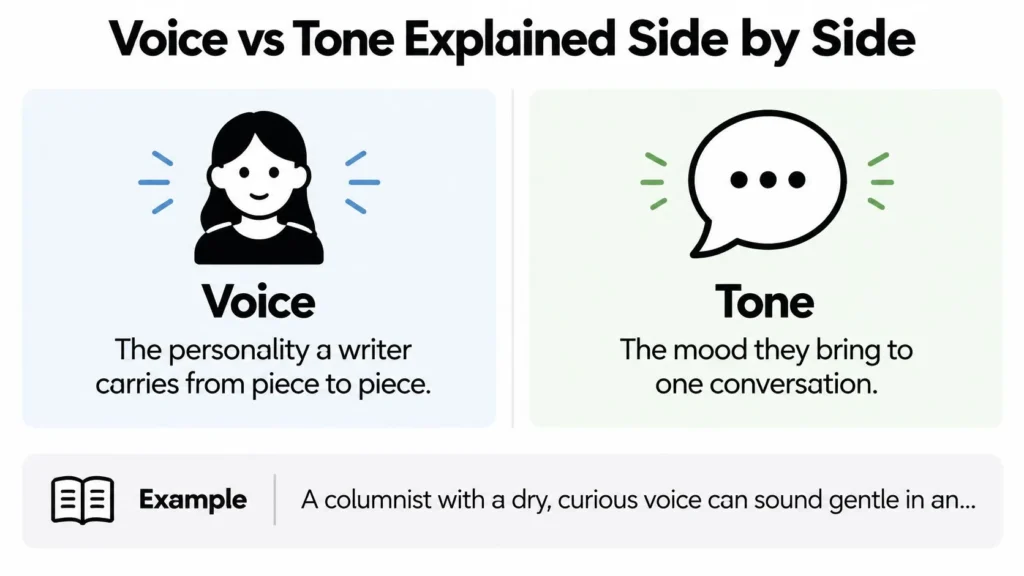
Think of voice as the personality you carry from conversation to conversation. Tone is the mood and attitude you bring to a particular exchange. You can remain recognizably yourself while speaking gently to someone who’s worried and firmly to someone who needs a clear warning.
A columnist with a dry, curious voice might sound tender when discussing a sick pet and sharp when reviewing a disappointing product. The underlying perspective remains recognizable. The emotional setting changes.
Voice and tone compared
| Element | Voice | Tone |
|---|---|---|
| Core question | Who is speaking? | How does the writer feel about the subject and reader here? |
| Stability | Stays consistent across a writer’s or publication’s work | Changes from article to article |
| Built from | Recurring perspective, word choice, rhythm, and stance | Diction, modality, emotional intensity, and evidential framing in one piece |
| Example | A pet columnist’s wry, curious persona | Gentle reassurance in a piece about rising vet bills |
| Can you change it? | Refine it over time; don’t swap it per piece | Adjust it deliberately for each audience |
The distinction is easier to remember visually.
Voice isn’t merely a recent branding term. A Post45 study of voice examined 1,698 American book reviews covering 1900–2003 and found that 11% of reviews in its American Periodicals Online corpus mentioned voice at least once. The study also distinguishes voice and genre from style, the broader pattern of linguistic choices.
For professional writing, RedactAI’s guide to how you express your professional personality in words offers a useful companion to this distinction.
Test a paragraph
Ask yourself:
- Identity: Would this perspective or rhythm remain recognizable in another piece?
- Situation: Would this attitude change for a different subject or reader?
- Overlap: Does this choice communicate both personality and a local emotional response?
Mark a paragraph from your draft voice, tone, or both. Label individual choices rather than forcing the whole paragraph into a single category.
How Voice Shows Up Across Genres
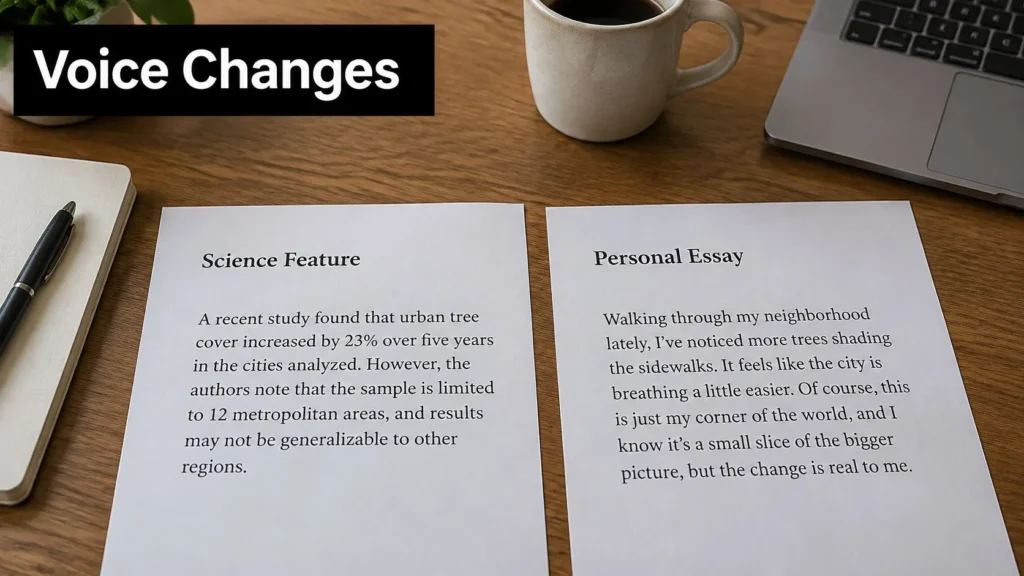
Consider a hypothetical report about a tool that reduced processing time. A science feature might say the tool reduced processing time in the study, while noting that a small sample limits the conclusion. A business brief might declare the tool the faster option.
Neither sentence needs I to reveal a writer’s presence. The difference lies in how the writer evaluates evidence and limits a claim. The second version may also overreach if the study doesn’t support a general verdict.
The contrast between formal reporting and personal prose makes these choices visible.
A corpus study indexed by ERIC analyzed literature reviews from 204 research articles in computer networks and communications and second-language writing, finding that writers preferred appreciation, evaluation of ideas’ quality or value, over personal emotion and judgments about people. They also used force resources, which strengthen or soften evaluations, more often than focus resources, which sharpen or soften category boundaries.
In practical terms, a writer reveals a position through what they praise, question, qualify, and leave unstated.
Recognizable choices across subjects
These are useful starting patterns, not rigid genre rules.
Voice markers and tone by genre
| Genre | Typical voice markers | Typical tone |
|---|---|---|
| Science news | Explains mechanisms, names sources, qualifies findings | Measured and curious |
| Health feature | Calibrated hedging, plain second person, clear next steps | Reassuring but precise |
| Business analysis | Direct claims tied to figures, few adjectives | Confident and sober |
| Travel writing | First-person sensory detail, local specifics | Warm and exploratory |
| Pet care | Practical, conversational, speaks to the owner | Friendly and reassuring |
| Arts and entertainment review | Opinionated first person, vivid comparisons | Playful, personal, and decisive |
| Opinion column | Clear stance, supported argument, named counterpoints | Assertive but fair |
| Academic essay | Formal register, controlled self-mention, explicit stance | Objective and cautious |
A travel writer can describe uncertainty without sounding academic. An academic writer can guide readers without becoming impersonal. For help organizing that guidance, our approach to writing a research paper without the overwhelm complements sentence-level decisions.
Teams publishing across channels can also use PostSyncer’s brand voice lessons for social media teams to consider which habits should survive a change of format.
For another way to approach the distinction, use this video alongside your own paragraph annotations.
Choose a genre you publish in. List the recurring markers you’d preserve, such as naming sources early, explaining unfamiliar terms, and stating reservations plainly. Those are more useful editorial instructions than asking everyone to sound engaging.
Diagnosing the Right Tone Before You Write
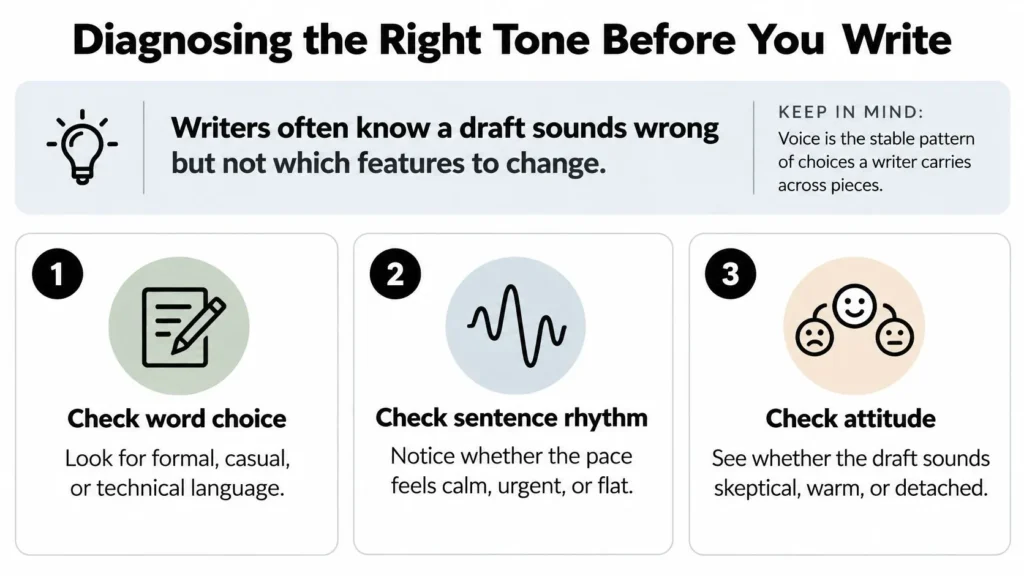
Writers often recognize discomfort before they can name its cause. A paragraph may feel condescending because it explains something the audience already knows, or evasive because it softens an answer the reader needs directly.
Confusion between the terms is a teaching problem, too. A study of adolescent multilingual writers published by Springer found limited explicit teaching of authorial voice and continuing difficulty distinguishing it from tone.
Don’t replace your personality to fix a situational mismatch. Diagnose the situation first.
Answer the reader questions
- Audience: Who will read this, and what do they already know? Beginners need definitions without embarrassment. Specialists need enough precision to assess your reasoning.
- Purpose: Are you informing, persuading, reassuring, or entertaining? A persuasive article needs a visible position; reassurance needs usable information, not cheerful dismissal.
- Power relationship: Are you an expert, a peer, or a guest? A guest describing a community should avoid presenting personal impressions as the community’s own judgment.
- Emotional risk: Could the wording frighten, shame, anger, or mislead someone? A health explainer calls for calm language and careful separation of possibilities from conclusions.
- Desired reader action: Should someone understand, compare, test, or change a habit? Make the next step clear without applying pressure the evidence doesn’t justify.
Use the visual check to locate the sentence-level choices behind your answers.
Change the attitude, not the identity
Say your usual voice is practical and plain-spoken. For a routine pet-care reminder, you might write: Set a reminder so the appointment doesn’t slip your mind. For an anxious owner, you might write: If keeping track feels difficult right now, a reminder can help.
The perspective remains practical. The second version acknowledges the reader’s circumstances and removes the implication of carelessness.
Diagnostic rule: Preserve the writer’s values and perspective. Adjust the wording that signals pressure, certainty, distance, or sympathy.
You can retain characteristic sentence rhythms while changing modal verbs, intensifiers, and evaluative adjectives. Consistency doesn’t mean emotional sameness. A thoughtful writer responds differently when the reader’s situation changes.
Adjusting Tone for Audience and Format
Set tone for the reader’s task, not just the publishing channel. A newsletter about a medical concern needs different restraint from a newsletter announcing a film festival.
Work with diction, your word choices; sentence structure, the way you organize emphasis and pace; and modality, the language of possibility, necessity, and certainty. May indicate presents a bounded inference. Proves makes a much stronger commitment.
The Textbook & Academic Authors Association’s academic writing guide connects precise, appropriate language with readers’ perceptions of credibility, accuracy, and validity. Treat that precision as a safeguard, not a demand to sound cold.
Choose a setting for the format
Tone and hedging by format
| Format | Reader expectation | Tone setting | Hedging rule |
|---|---|---|---|
| Long-form feature | Has time to read and wants context | Warm and immersive | Hedge wherever the evidence is thin |
| Newsletter | Skims and trusts a familiar voice | Conversational and direct | Name the source early and retain its limits |
| Social post | Scans and makes a quick choice | Crisp and energetic | Keep claims short and link the source |
| Product or service page | Compares options and wants proof | Clear, confident, and benefit-led | Use supported specifics, not absolute promises |
| Academic or white paper | Checks methods and citations | Formal and precise | Calibrate each claim to its evidence |
| Beginner explainer | Needs definitions and reassurance | Patient and friendly | Define terms consistently and explain uncertainty plainly |
Don’t sprinkle possibly over every sentence to manufacture caution. State established details directly, then qualify the actual uncertainty. Our business writing tips can help you keep that distinction clear when readers need a decision rather than an extended discussion.
Inspect loaded wording
Mark every intensifier, absolute term, accusation, and unsupported emotional descriptor. Then ask whether it contributes evidence, necessary interpretation, or merely heat.
Words such as obviously can make a reader feel foolish for asking a reasonable question. Calling a result disastrous substitutes a verdict for an explanation unless you establish what happened and why that description fits.
Science, health, business, and technology coverage need particular care around certainty. Playfulness may suit travel, fashion, pets, and entertainment, but it shouldn’t blur factual claims.
For a hypothetical study that found an association but couldn’t establish causation, compare these treatments:
- General newsletter: Participants who followed the routine reported better sleep. That doesn’t tell us whether the routine caused the improvement.
- Specialist journal: Adherence to the routine was associated with improved self-reported sleep; the study design does not establish causality.
The language changes. The evidential boundary doesn’t.
Building a Voice Your Team Can Maintain
A usable publication voice must survive different writers, deadlines, and subjects. An adjective list won’t accomplish that unless editors translate the adjectives into observable decisions.
A Medical Education article on authorial voice describes voice through register, stance, and reader engagement, and reports that health researchers sought writing that was clear, logical, engaging, and attention-holding. These categories give a team something concrete to discuss: formality, confidence, evaluation, and the relationship with readers.
Turn traits into editing instructions
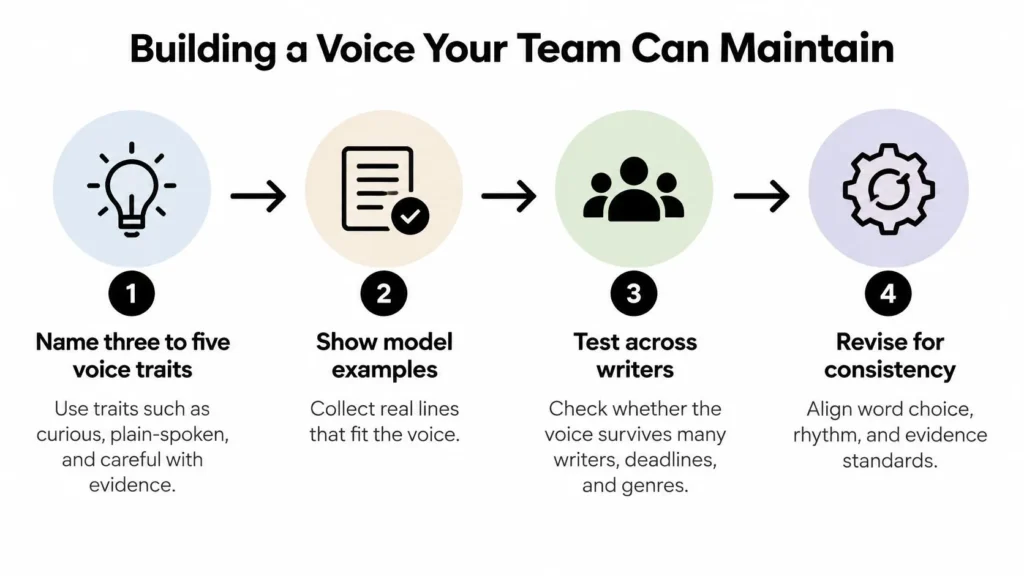
- Name a small set of traits. For curious, instruct writers to explain how something works before delivering a verdict. For plain-spoken, prefer familiar wording without deleting necessary technical terms. For careful with evidence, distinguish what a source found from what the writer infers.
- Set a formality range. Specify whether contractions, direct reader address, and first person belong in each section. Set evidence rules by claim type, not by an arbitrary quota of qualifying words.
- Build do-and-don’t pairs. Take actual lines from your own published pieces, retain their context, and annotate why each fits or misses the intended voice. Don’t present an invented sentence as a quotation from a publication.
- Collect approved paragraphs by genre. Include an opening, an explanation, and a passage handling uncertainty or disagreement. A model paragraph should demonstrate a decision, not become a template everyone copies.
- Review published work regularly. Choose pieces across contributors and categories. Mark drift in terminology, reader address, evidence standards, and recurring sentence habits.
- Give newcomers a small trial. Ask them to recast an approved paragraph in their own words while preserving the agreed traits. Discuss the choices rather than rewarding imitation.
The routine becomes easier to use when writers can see its overall shape.
Leave room for individual authors
A shared voice shouldn’t require every writer to use identical sentence lengths or metaphors. Agree on the relationship with readers and the standards for claims, then allow authors to bring different expertise, experiences, and ways of noticing.
A voice guide should help an editor explain a decision, not disguise a personal preference as a rule.
When disagreements recur, add an annotated example to the guide. Assign someone to maintain it so contributors aren’t choosing between conflicting versions.
As a closing test, remove the publication’s name from an excerpt. Ask a familiar reader what identifies it. An answer about its clarity, questions, or evidence habits is more useful than recognition based only on a slogan.
Protecting Your Voice When AI Edits Your Draft
An AI edit can remove awkwardness and also remove deliberate texture. Accepting every suggestion may leave you with smoother sentences that no longer reflect your judgment, humor, or cultural phrasing.
Axios’s reporting on changing writing patterns describes a University of Southern California study finding reduced diversity in sentence structure and vocabulary across scientific journals, local news, and social media after the release of widely used generative writing tools, and a survey of 1,175 U.S. writers in which 33% used AI for grammar, clarity, or tone and 24% believed it had changed their style or voice. Those findings justify scrutiny, not the assumption that every automated edit is harmful.
Run a voice-preservation pass
- Keep a personal phrase bank. Save idioms, characteristic explanations, and passages that sound like you. Include ordinary phrasing, not just polished highlights.
- Compare the rhythm. Read the original and edited versions aloud. Flag places where short emphasis disappeared or varied sentences became uniformly balanced.
- Question generic transitions. Keep moreover or in conclusion only when it helps readers follow the relationship between ideas. Don’t ban a useful word because a tool also uses it.
- Protect intentional features. Check first-person language, cultural expressions, humor, and uncertainty before accepting substitutions. Distinguish a deliberate choice from an accidental obstacle.
- Request options rather than replacement. Ask the tool to identify a tonal mismatch and propose alternatives with explanations. Choose the version that fits your purpose.
- Check meaning line by line. Compare each accepted edit with the original claim and phrase bank. A change from association to causation, or possibility to certainty, requires evidential review.
Decide what improvement means
Use tracked changes or a side-by-side document comparison so you can inspect individual revisions. Rejecting a suggestion doesn’t mean rejecting clarity; you can solve the same problem another way.
The writer remains responsible for the result. AI can assist with editing, but your judgment determines whether an edit improves readability without misrepresenting the claim or replacing your voice.
Practice Exercises and Sample Rewrites
Practice separating tonal changes from changes in meaning before you edit a high-stakes submission. Use material you’ve already written so you can check every revision against the intended claim.
Try the exercises
- Change the format. Take a short paragraph and recast it as a newsletter item, a feature passage, and an academic note. Keep the underlying facts, limitations, and recommendation unchanged. Underline only the words that alter distance, warmth, or certainty.
- Audit published work. Review recent pieces and mark intensifiers, absolute claims, and first-person judgments. Decide which serve the genre and which merely announce an attitude the reader hasn’t been given reason to share.
- Compare editorial identities. Write a hypothetical product note as a pet columnist, then as a business analyst. Notice changes in the questions asked, evidence emphasized, and relationship with readers. Some of those differences are voice, not merely tone.
For broader drafting habits, our blog writing tips provide a useful companion to this focused sentence work.
Check what the rewrite actually changes
The following are hypothetical editing scenarios, not reports about tested products, travel destinations, companies, or pet-food buyers. The proposed factual revisions are publishable only if the writer has the evidence they imply.
Before and after tone rewrites
| Original | Revised | What changed |
|---|---|---|
| This shocking gadget will change your life forever. | In our testing, the gadget made daily routines noticeably easier. | Removed hype and the absolute claim; tied the replacement claim to testing that must exist |
| Honestly, the old harbor is an absolute must-see for everyone. | The old harbor district rewards a full afternoon, especially in spring. | Cut intensifiers; substituted a specific recommendation that needs an informed basis |
| The company is clearly lying about its battery figures. | The company’s battery claims differ from the independent test results we reviewed. | Replaced an accusation about intent with a comparison requiring documented results |
| Hey pals! Our dog food is da best ever!!! | Many owners of sensitive-stomach dogs choose single-protein formulas, and ours is one of them. | Dropped slang and superlatives, but introduced buyer-behavior and product claims requiring support |
These examples expose an important editing trap: a calmer sentence isn’t automatically a factual sentence. The gadget revision introduces testing. The dog-food revision introduces a claim about owners’ choices. Neither is a tone-only repair.
If those facts aren’t available, remove the unsupported claim and return to what you can establish. Don’t manufacture specificity to make the prose sound credible.
Before publishing: Ask not only whether the sentence sounds better, but whether it now says something different.
For a genuine tone-only change, compare You must check the methods before trusting that conclusion with Check the methods before accepting that conclusion. The instruction remains; the second version reduces interpersonal pressure.
Keep the claim stable during a tonal edit. If you change what’s being claimed, treat the revision as an edit of substance and verify it before publication.
Apply a Contributor Voice Guideline to Your Next Draft
Check your own editorial choices before submitting. A short note explaining the intended reader relationship gives an editor something more useful than a request to make the piece sound professional.
Your submission doesn’t need to arrive stripped of personality. It needs to make deliberate choices that an editor can understand, question, and refine with you.
Attach a practical submission checklist
- Preserve your perspective. Identify the observations and sentence habits that matter to the piece. Editors can adjust an unsuitable attitude without treating your identity as a defect.
- Match confidence to support. Separate findings, interpretations, and recommendations. Make it easy to locate the source behind each factual claim.
- Review loaded language. Flag emphatic or accusatory wording and explain anything you consider necessary. Remove expressions that add pressure without information.
- Follow the section’s formality range. Check terminology, reader address, and source introductions against the publication’s expectations.
- Include a diagnostic note. State the audience, purpose, power relationship, emotional risk, and intended action. Keep it brief enough for an editor to use.
- Disclose your editing decisions. Treat AI suggestions as proposals, retain your phrase bank, and identify any changes that affected meaning.
If you use automated assistance regularly, HeyNews’s guidance on how to keep AI drafts on voice offers another way to make editorial expectations explicit.
Make collaboration easier
At Maxi Journal, contributors work with an editor to refine structure, strengthen arguments, and polish style. Our contributor guidance calls for a distinct, confident, engaging, unmistakably human voice, while allowing different levels of formality and conversational ease. Enforcement decisions are made at editorial discretion.
Original authors receive a byline at the top of the article, an author bio if provided, links to author profiles or websites, and their name in social media shares. That attribution makes preserving authorship a practical responsibility, not just a stylistic preference.
Submit a draft this week with the checklist attached. Name the voice traits you kept, identify the tonal choice you made for the audience, and flag any sentence where you’d welcome an editor’s judgment.
Maxi Journal publishes approachable writing across science, technology, health, business, arts, travel, and other interests, with editorial collaboration for contributors. Visit maxijournal.com to explore the publication and prepare a draft whose voice is recognizably yours and whose tone serves its readers.
Discover more from Maxi Journal
Subscribe to get the latest posts sent to your email.