Yes, a healthy adult cat can eat a few plain, washed blueberries occasionally, up to about three at a time, and they should never replace complete cat food. Plain frozen berries, with nothing added, sit in the same category if the portion stays tiny and you watch the next day.
Most pages treat the berry as a mini health food. That skips the harder question. Can cats eat blueberries safely when the fruit itself is fine, but the cup in the fridge is jam, a muffin, or a sugar-free mix? A non-poisonous plant isn’t the same thing as a useful food. Cats don’t need fruit, feline evidence hasn’t shown an antioxidant payoff, and the label plus the cat’s medical history decide more than the berry.
Short Answer and Safe Serving Sizes
The ASPCA’s list of toxic and non-toxic plants classifies blueberries as non-toxic to cats. Non-toxic means the fruit isn’t expected to cause systemic poisoning or a life-threatening reaction. It doesn’t promise a quiet stomach. The same listing notes that eating plant material can bring on vomiting or gastrointestinal upset in some cats.
What a safe serving looks like
Treat the first berry as a test, not a habit. Cats are obligate carnivores, so fruit never stands in for complete cat food. Offer a new food gradually and watch for vomiting, diarrhea, abdominal discomfort, or a cat who skips the next meal. A whole berry can choke a small cat, so cutting or mashing beats handing the fruit over intact. Fresh fruit and plain frozen fruit are both acceptable, provided nothing is added. Sugar, syrup, seasoning, dairy, or a sweetener changes the answer.
| Cat situation | Amount per serving | How often | Notes |
|---|---|---|---|
| Healthy adult cat, first trial | 1 washed berry | Once, then watch for a day | Start here before any routine |
| Healthy adult cat, routine treat | Up to 3 berries | Occasionally | Keep to about 4-5 berries per week at most |
| Kitten or small cat | 1 berry, cut or mashed | Only after a first trial with no upset | Cut or mash to reduce choking risk |
| Diabetic, overweight, IBD or pancreatitis | Ask a vet first | Only with veterinary approval | Sugar and digestive sensitivity make portions unpredictable |
Practical rule: These berry counts are cautious starting points, not official limits or a measured toxic dose. Your cat’s reaction is the limit that counts.
A healthy adult starts with one washed berry, then waits a day. Later treats stay at up to three berries at a time, offered only now and then, with the week landing around four or five berries. Kittens and small cats get one cut or mashed piece, and only after a quiet trial. If a cat shows vomiting, diarrhea, abdominal discomfort, or skips a meal, pause the treat rather than pushing through. Dairy is a different fridge decision, so check whether cats can eat Greek yogurt before pairing a berry with a spoonful.
Why Blueberries Are a Treat, Not Nutrition
Blueberries are an optional enrichment bite, not a supplement. Complete cat food already supplies what a cat must eat, and no feline requirement makes this fruit necessary. The vitamin C or vitamin K in a berry or two does not fill a gap the bowl left open. Cats eat so little that the nutritional contribution stays minimal, which is why safety and usefulness are separate questions.
Calories that still count
Raw blueberries run about 57 calories and 14.5 grams of carbohydrate per 100 grams, including about 10 grams of sugars and 2.4 grams of fiber. On a human plate that looks trivial. In a small cat it still occupies treat space.
| Blueberries eaten | Approximate calories | Approximate carbohydrate |
|---|---|---|
| 1 berry (about 2 g) | about 1 kcal | about 0.3 g |
| 3 berries (about 6 g) | about 3 kcal | about 0.9 g |
| 5 berries (about 10 g) | about 6 kcal | about 1.5 g |
Five berries land near 6 calories. That slice matters for a small cat, or for a cat with diabetes or extra weight. The Merck Veterinary Manual says treats, which are typically incomplete and unbalanced, should stay below 10% of daily calories so they do not dilute the diet. The same budget works from the other side: most daily calories should come from complete and balanced cat food. Check the day’s calorie target, reserve one-tenth for every snack combined, and count blueberries inside that tenth. They do not get an allowance on top of commercial treats. A solid complete food for indoor cats is the meal that does the work.
Where the antioxidant story breaks
A 2025 analysis of 40 commercial dog and cat foods found that products containing blueberries did not provide significant amounts of dietary polyphenols, and the bioavailability of compounds such as quercetin remains unknown in cats. A 2025 controlled study found that adding 3% whole blueberries for four weeks did not protect dogs against exercise-induced oxidative stress. Dog results do not transfer to cats, and they still weaken the idea that a sprinkle of berry equals cellular protection. Skip powders, extracts, and drops marketed as feline health products. If you want a planned extra, keep the choice cat-specific, and use healthy cat treats rather than a human supplement jar. The product on the label matters more than the berry itself.
Safe is not the same as useful. A tiny portion can be harmless and still add almost nothing a cat can use. Sudden sugar can also trigger digestive signs in diabetic or overweight cats even when the fruit is not poisonous.
Blueberry Products to Keep Away From Your Cat
The berry on the bush is rarely the problem. The jam, the leftover pie, and the blueberry yogurt in the fridge door usually are.
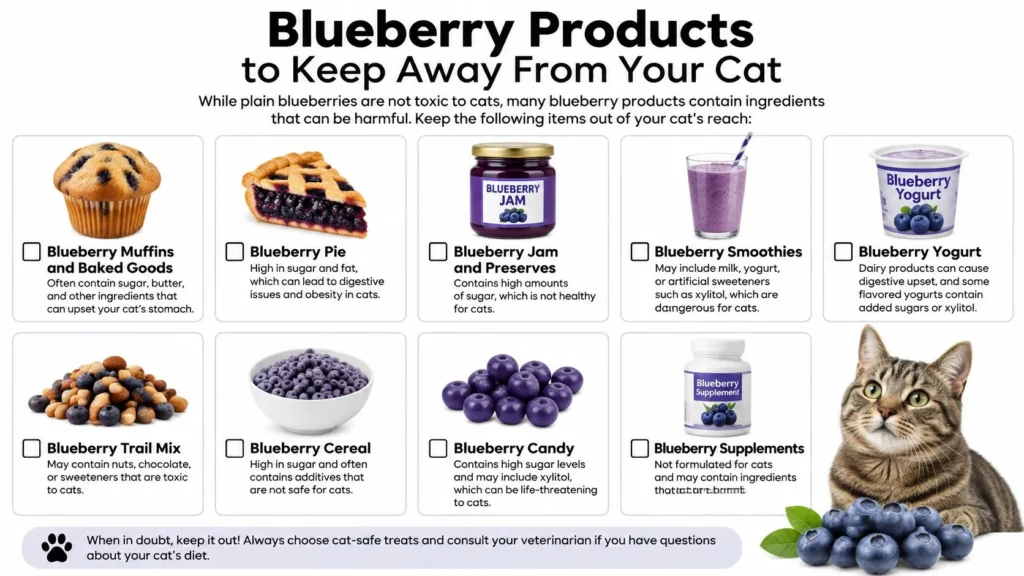
PetMD’s guide to fruits cats can eat treats plain fresh or frozen blueberries as the lower-risk option and warns against sweetened preparations. Extra caution fits diabetes, inflammatory bowel disease, pancreatitis, or a prescribed diet. A “few berries” isn’t a scientifically established universal dose, and available guidance doesn’t define a predictable sugar response for every cat. The ingredient line does more work than the count.
Keep these out of reach:
- Jam and pie filling: Concentrated sugar, often with spices, in a form a cat will lick off a spoon.
- Canned fruit in syrup and muffins: Baked goods and syrup-packed fruit aren’t plain berries.
- Flavored or sweetened yogurt: Dairy and sugar often share the same cup.
- Sugar-free products: Sweeteners, including xylitol, can hide behind a blueberry name.
- Kitchen neighbors: Chocolate, raisins, onions, and garlic often sit beside the berry bowl and are a separate hazard.
Before any blueberry-flavored snack, scan for added sugar, concentrated syrups, dairy, and sugar substitutes. A clean pass looks like this: no added sugar, no syrup, no dairy, no sweetener, no mixed-in ingredients, no toppings. Cats on a therapeutic diet shouldn’t get extras unless the prescribing vet agrees.
How to Wash and Serve Blueberries Step by Step
Preparation decides whether a non-toxic fruit stays a small, boring snack. PetMD’s notes on blueberries for cats use a simple sequence: plain fruit only, a real wash, a smaller piece for cats who gulp, one berry to start, and a day of watching.
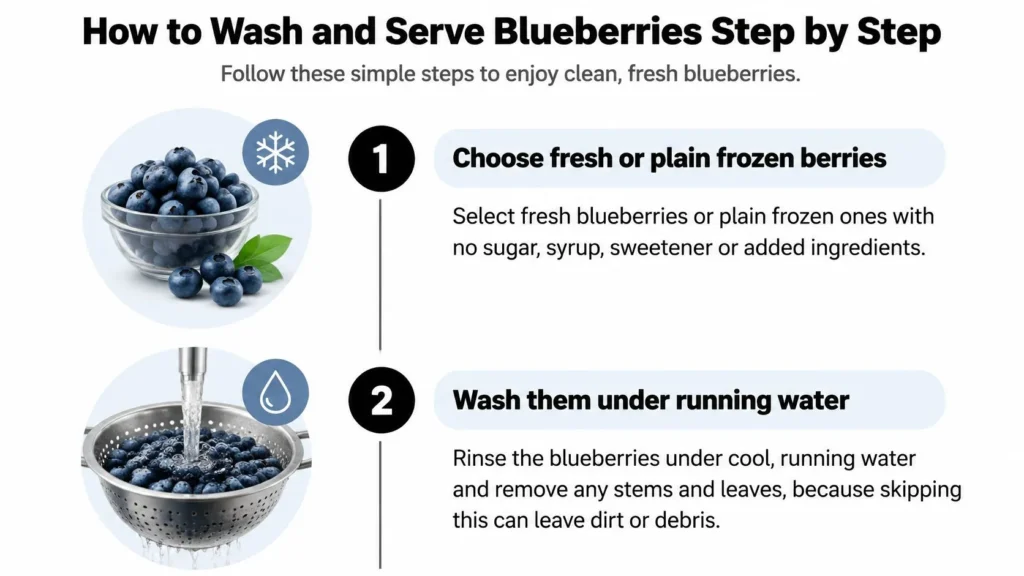
- Choose plain fruit. Use fresh berries or frozen berries with no sugar, syrup, sweetener, or mix-ins. Jam, pie filling, and syrup-packed fruit fail before you open the container. Sugar-free packages still need a label check.
- Wash and strip. Rinse under running water and pull off stems and leaves. A skipped wash leaves dirt and plant bits that can upset a stomach.
- Cut, crush, or mash. Do this for kittens, small cats, and any cat who swallows fast. A whole berry can choke or lodge in the esophagus.
- Serve one berry away from dinner. Use a small plate, not the main bowl, so the extra stays separate from the complete meal.
- Watch the next day. Look for vomiting, diarrhea, abdominal discomfort, flatulence, or a smaller appetite before you offer more.
- Repeat on a schedule. Space later offers out. Don’t turn this into a daily add-on unless a veterinarian has agreed for that specific cat.
Two slips cause most of the trouble. People skip the wash because the berries look clean in the clamshell, or they hand a whole berry to a small cat who inhales food. Excessive fruit can still cause gastrointestinal upset when every berry was prepared correctly. Cats with diabetes, obesity, inflammatory bowel disease, pancreatitis, or another diet-sensitive condition should get veterinary advice before the first try.
A short clip shows the cuts if you want to see the pieces before you offer one.
Habits that keep the portion honest
- Thaw frozen berries: A softened berry is easier to mash than a rock-hard one, and it works as a cool warm-weather bite.
- Keep a one-line log: Write what you offered, how much, and how the cat responded, so the week’s total comes from what happened.
- Don’t stir berries into the meal: Mixing hides how much was eaten and makes a later stomach upset harder to trace.
Start with one berry and let the cat’s stomach set the pace.
Warning Signs and When to Call a Vet
Some cats shouldn’t meet a blueberry until a veterinarian says so. That group includes diabetic cats, cats with obesity, cats with inflammatory bowel disease or pancreatitis, and any cat on a prescribed diet. A therapeutic diet is written to be fed as written, and a “small treat” can still disturb blood sugar or a sensitive gut.
From a mild upset to an emergency
One soft stool after a brand-new food is a reason to pause. Trouble breathing is not a wait-and-see problem. Match the sign to the action.
| Sign | What it may mean | What to do |
|---|---|---|
| One mild vomit or soft stool after a new berry | Gut reaction to a new food | Stop the berries, monitor for a day, retry later at a smaller size |
| Gas, mild belly discomfort or reduced appetite | Fruit overload or sensitivity | Pause treats and watch; call a vet if it lasts beyond a day |
| Repeated vomiting or diarrhea | Significant gastrointestinal upset | Call your vet the same day |
| Choking, gagging or pawing at the mouth | Berry stuck in the throat | Urgent vet visit |
| Weakness, lethargy or trouble breathing | Serious reaction, large intake or other ingredients | Emergency vet visit now |
| Ate a sweetened or unidentified product | Added sugar, sweetener or other toxins | Contact a vet or animal poison control immediately |
A single mild vomit or a soft stool means stop and watch for a day. Retry later with a smaller piece only if the cat is fully back to normal. Gas, a mildly sore belly, or a dipped appetite can follow too much fruit or a sensitive gut. If that picture lasts past a day, call. Repeated vomiting or diarrhea belongs in a same-day call, not an overnight experiment.
When the clock matters
Choking, gagging, or pawing at the mouth means something may be stuck. Treat that as an urgent visit, the same way you’d treat a cat who swallowed plastic rather than hoping it passes. Weakness, marked lethargy, or trouble breathing is an emergency now. Signs can show up hours after the snack. A large amount, or a product you can’t name, raises the urgency on its own, so contact a veterinarian or an animal poison control service immediately.
Have five facts ready when you call: how much was eaten, what the label says, what time it happened, the cat’s weight, and any ongoing conditions. Stop the berries first. If signs continue, don’t spend a second day waiting for them to fade.
Urgent veterinary advice fits choking, vomiting or diarrhea that won’t stop, marked lethargy, or a sweetened product you can’t identify.
Complete cat food stays the meal. A blueberry is an occasional extra for a healthy cat who already tolerated a tiny trial. It isn’t a health supplement, and it isn’t a reason to rearrange a prescribed diet.
Maxijournal publishes plain-language writing on pets, health, and everyday questions, including feeding choices that look harmless until you read the label. If you want more guides that separate a safe snack from a useful one, visit maxijournal.com. New posts run across pets, health, and home topics, so the next question about your cat may already be on the site.
Discover more from Maxi Journal
Subscribe to get the latest posts sent to your email.