What is sustainable tourism? It’s travel that accounts for current and future economic, social, and environmental impacts while meeting the needs of visitors, the industry, the environment, and host communities. In practice, that means a trip can’t be judged by a reusable water bottle or a hotel towel card alone.
Most popular advice stops at “travel green,” but that’s only one slice of the picture. A journey can cut emissions and still be socially extractive if it pushes out residents, funnels profits away from local businesses, or treats culture like a performance stage. For a useful overview of how this plays out in real destinations, discover Slovenia eco-friendly adventure travel is a helpful example of how sustainability gets framed on the ground.
Redefining Sustainable Tourism Beyond Green Travel
The biggest misconception about sustainable tourism is that it’s just a cleaner version of ordinary travel. People picture fewer plastic bottles, more recycling bins, and maybe a hotel that skips daily linen changes. That matters, but it doesn’t define the idea.
The stronger definition is broader and harder to game. The UN system describes sustainable tourism as tourism that takes full account of its current and future economic, social, and environmental impacts while meeting the needs of visitors, the industry, the environment, and host communities. That wording matters because it forces a destination to ask not only, “How much carbon did this trip create?” but also, “Who benefits, who pays, and what gets weakened over time?”
Why a low-carbon trip can still fail
A trip can look responsible on paper and still leave a bad local legacy. If revenue leaks out through foreign-owned suppliers, if residents get priced out of neighborhoods, or if a community’s traditions get packaged into a performance for outsiders, the trip may be low-impact in one sense and harmful in another. Sustainability is not a badge, it’s a balance.
That’s why the most useful question is not whether tourism is “good” or “bad.” It’s whether the way a trip is organized protects the natural assets, the local economy, and the lived culture that make a place worth visiting in the first place. For a broader travel lens, browse conservation trips abroad shows how some operators try to build that balance into the trip design.
Practical rule: if a destination’s sustainability story only talks about waste bins and energy use, you still don’t know whether local people are sharing in the benefits.
The other reason this definition matters is scale. Tourism now sits inside a huge global economic system, so the consequences of weak planning show up far beyond one resort or one beach. That’s why sustainable tourism has moved from niche language to mainstream policy, business, and destination management.
The Three Pillars of Sustainable Tourism
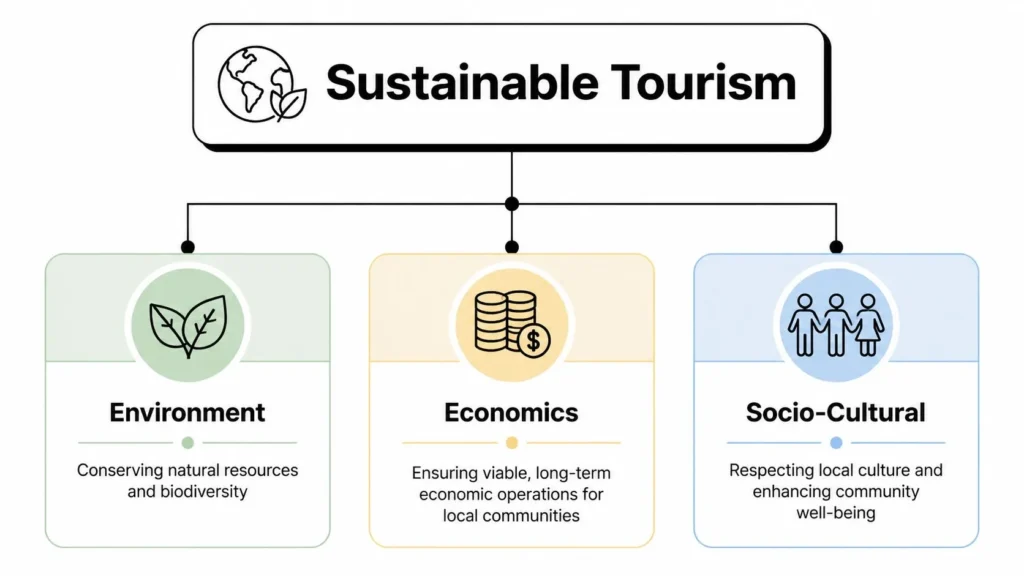
Think of sustainable tourism as a three-legged stool. If one leg is weak, the whole thing wobbles. If one is missing, the destination may still attract visitors for a while, but it won’t stay resilient.
The environmental pillar
This is the part most travelers recognize first. It covers water use, energy use, waste, pollution, habitat loss, and pressure on biodiversity. The UN’s tourism measurement framework points destinations toward indicators such as tourism greenhouse gas emissions per visitor, water use per overnight stay, solid waste, sewage discharge, and other resource pressures, because good intentions don’t show up on their own, data does.
An island resort that pumps huge amounts of freshwater for swimming pools and laundry can strain a system that was already tight before the first suitcase rolled in. The same logic applies to wildlife areas, coastal zones, and mountain towns where fragile ecosystems absorb visitor pressure more slowly than visitor numbers rise.
The economic pillar
Tourism also has to make sense for the people who live there. That means viable local businesses, fair employment, and money that stays in the destination rather than leaking away to distant owners or imported suppliers. A place can attract crowds and still be poor in tourism value if most profits leave quickly.
A destination that earns money but can’t keep it locally is not resilient, it’s exposed.
This is why sustainable tourism is not a call to stop earning. It’s a call to make earning durable, local, and less dependent on volume alone. A city that can support year-round livelihoods without chasing the next surge of arrivals is usually in a better position than one built on short-term spikes.
The socio-cultural pillar
This is the leg that gets ignored most often. It covers cultural integrity, resident well-being, community power, and whether tourism strengthens or weakens daily life. When traditions are reduced to a photo opportunity, when neighborhoods become stage sets, or when residents lose control over how their own place is represented, tourism may still look lively from the outside while becoming hollow inside.
For a deeper practical framing, how to travel sustainably is worth reading alongside the broader concept, because habits only matter if they fit inside a system that respects the local context. The point isn’t to choose one pillar and neglect the others. It’s to hold them together, because real sustainability fails when the trade-offs are hidden.
Measuring What Matters in Sustainable Tourism
A destination can call itself sustainable for years and still reveal very little. Serious tourism planning depends on indicator-based management, because slogans do not show whether a place is coping with the pressure of visitors. The UN’s Statistical Framework for Measuring the Sustainability of Tourism tracks impacts and dependencies at national and subnational levels, which gives policymakers something far more useful than a marketing brochure.
What gets measured gets managed
The clearest way to judge progress is to separate pressure, state, and response. Pressure is the strain tourism puts on water, energy, waste systems, and ecosystems. State is the condition of the destination itself, including environmental quality and community well-being. Response is the set of policies, investments, and rules meant to reduce harm.
That framework explains why indicators such as CO2 emissions from tourism facilities, water use by tourists relative to resident use, municipal waste generation, and recognized environmental scheme participation matter. If a hotel, resort cluster, or city never measures those factors, it cannot claim to understand its own footprint.
Useful test: if a sustainability claim cannot be tied to a measurable indicator, it is probably a slogan, not a management system.
Here is a quick comparison of major certification types that often appear in traveler research and destination marketing:
| Certification | Scope | Audit Type | GSTC Recognized |
|---|---|---|---|
| GSTC-recognized standards | Broad sustainability criteria for tourism businesses or destinations | External review against recognized criteria | Yes |
| EarthCheck | Hotels, destinations, and tourism operators | Benchmarking plus third-party assessment | In many cases, yes |
| Biosphere | Businesses and destinations with sustainability management focus | Independent audit and ongoing verification | In many cases, yes |
Certification can help, but it is not magic. A label only means something if the standard is credible, the audit is real, and the destination keeps measuring after the plaque goes up. For a wider editorial view of destination change and travel planning, a look at emerging travel and tourism trends offers another useful lens on how the industry keeps changing.
The key test is the discipline behind the label. Good programs keep asking whether the destination is reducing pressure, keeping benefits local, and protecting what makes the place livable in the first place.
Real-World Success Stories and Cautionary Tales
Some places have treated sustainability as a long-term operating model. Others have treated it like public relations until the strain became impossible to ignore. The difference usually comes down to governance, not rhetoric.
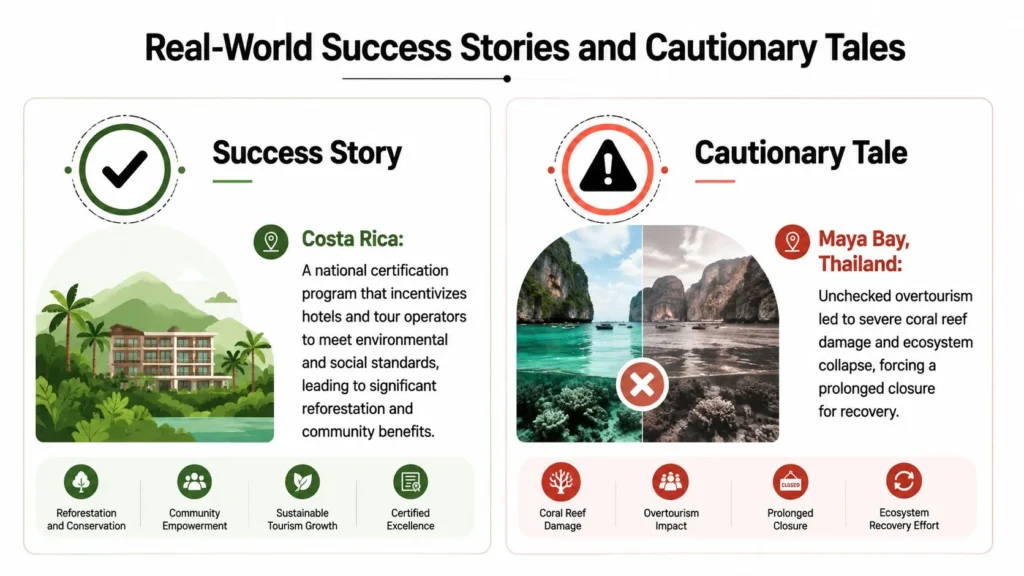
When policy stays consistent
Costa Rica is the classic example travelers hear about because the country made ecotourism part of its national identity instead of leaving it to a few conscientious operators. Over time, that kind of policy consistency helped build a brand around conservation, nature access, and community-linked tourism rather than pure volume.
Bhutan and Rwanda are also often discussed in sustainable tourism circles because they lean more heavily on controlled access and stronger state coordination. The details differ, but the lesson is similar. If a destination wants tourism to support conservation and local benefit, it usually needs rules that shape visitor behavior, not just friendly messaging.
When crowds outrun the system
Maya Bay in Thailand became a cautionary tale because the place was loved to death. Unchecked visitation damaged the reef ecosystem so severely that recovery required closure. That is the central trade-off many destinations now face, especially where recovery in demand pushes them back toward capacity limits before infrastructure or ecosystems have time to breathe.
Resident backlash in cities like Amsterdam and Barcelona shows the other side of the same problem. The issue is not just environmental stress, it’s social stress, housing pressure, congestion, and the feeling that a place is being organized for visitors more than for the people who live there.
The lesson is blunt. Sustainable tourism is not defined by the number of “eco” signs in a lobby. It is defined by whether governance keeps ecological damage, cultural erosion, and resident displacement from becoming the hidden cost of success.
The Scale and Economics of Sustainable Tourism
Sustainable tourism now sits inside the main travel economy, not at its edge. One widely cited industry estimate values the global sustainable tourism market at $2.01 trillion in 2024, with forecasts rising to $8.43 trillion by 2033 and $11.39 trillion by 2034. That scale matters because travel and tourism contributed about 10.4% of global GDP in 2019, or $8.9 trillion, according to industry research summarized in education data. The commercial weight behind the term is visible in SkyQuest’s market overview.
Why demand is pushing the market
Travelers are one reason the sector keeps changing. Major surveys report that 84% of global travelers say traveling more sustainably is important, 75% say they want to travel more sustainably over the next year, and 60% are willing to pay more for businesses that prioritize environmental stewardship. Those figures help explain why hotels, tour operators, and destination boards keep revising how they describe their offerings and how they design them.
The policy side is changing too. One dataset says 25% of countries have national sustainable tourism strategies, while another says 85% of EU member states have adopted such strategies. Together, consumer pressure and government planning are pushing the topic from marketing language into destination management. For a broader editorial context, travel and tourism trends offers a useful companion read.
The hard criticism
The strongest criticism of sustainable tourism is straightforward. If tourism keeps growing, can it still stay sustainable? The question matters because tourism is tied to emissions, infrastructure stress, and pressure on local systems. Research summaries report that tourism accounts for roughly 7 to 8% of global greenhouse gas emissions, while international air travel alone contributes about 2.1% of global CO2 emissions from fuel combustion.
Those figures do not mean travel should stop. They do mean the industry cannot treat growth as costless. Sustainable tourism exists because travelers, businesses, and governments are trying to reduce harm while preserving the economic and social value that travel can bring.
Challenges and Criticisms of Sustainable Tourism
The phrase sounds reassuring, which is exactly why it’s so easy to misuse. A hotel can repaint its brand green, cut plastic straws, and still run a supply chain that leaks money away from the community and burns through energy without much restraint. That gap between language and reality is where greenwashing lives.
Where the system breaks down
The most common failure is shallow compliance. A business may adopt one visible practice and present it as transformation, even though the deeper issues, such as wages, sourcing, and land use, never changed. Supply chains make this harder, because tourism depends on many actors at once, from transport and accommodation to food, guides, and local services.
Another problem is the tension between growth and limits. Local governments often want tax revenue and jobs, while residents want housing, access, and livable streets. Those goals can align, but they don’t always. When they clash, sustainability becomes a political negotiation about who absorbs the inconvenience and who collects the benefits.
Carbon offsets are another area travelers need to treat carefully. Offsets may support some climate action, but they don’t erase the impact of a high-emission trip, and they’re easy to use as a moral shortcut. The better question is whether the underlying trip is being made cleaner, leaner, and more local, not whether a certificate was attached afterward.
For travelers: ask who owns the experience, who works there, and where the money goes.
For businesses: track measurable outcomes, not just promises.
For policymakers: set rules that make sustainability visible, auditable, and enforceable.
Sustainability also has an equity problem. Small operators and developing destinations can end up carrying the cost of compliance while larger brands have more room to absorb it. That’s why serious tourism policy has to support capacity building, not just set standards and walk away.
Practical Steps for Travelers Businesses and Policymakers
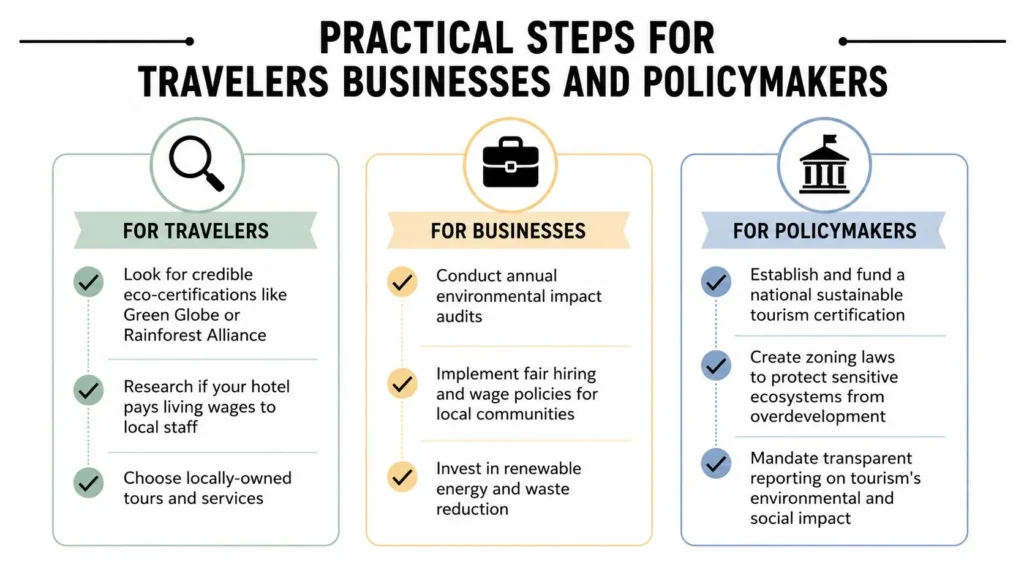
The best decisions come from asking harder questions before the booking is made, not after the trip is over. If you want a simple way to benchmark your own habits, find your travel sustainability score is a useful prompt for thinking beyond the usual eco-checklist.
For travelers
- Check ownership and labor practices. A locally owned guesthouse and a foreign-owned resort may both look green, but they don’t send money through the destination in the same way.
- Ask about community benefit. Look for tours and stays that keep guide work, food sourcing, and transport local.
- Watch for crowding. A place can be “ethical” on paper and still be too full for the neighborhood to absorb.
For businesses
- Measure real outcomes. Annual environmental audits, waste reduction, and energy use tracking should be routine, not optional.
- Build fair hiring into operations. Local wages, training, and promotion pathways matter as much as décor.
- Treat sustainability as management. That means using the indicators discussed earlier, not just posting a mission statement.
For policymakers
- Protect sensitive places. Zoning, visitor caps, and housing rules help keep tourism from outrunning local life.
- Require transparent reporting. If destinations want public trust, they should publish environmental and social impact data.
- Fund participation. Community voices need a formal place in planning, not a ceremonial one.
For readers who want a broader checklist of principles in one place, how to travel sustainably fits naturally with the ideas here. The core lesson is straightforward. Sustainable tourism works when travelers, businesses, and governments stop treating impact as someone else’s problem and start measuring the full cost of the trip.
Maxi Journal publishes clear, practical writing across travel, science, business, health, and more, so you can keep exploring ideas without wading through jargon. If you want more straightforward guides on sustainable travel and the wider trends shaping modern tourism, visit maxijournal.com and read what fits your next trip.
Discover more from Maxi Journal
Subscribe to get the latest posts sent to your email.