In 2019, Google’s quantum team dropped a claim that split the tech world in half. One camp saw a historic leap forward, while the other saw a clever benchmark with a very long road still ahead.
That tension still defines Google quantum computing today, and it’s exactly why the topic matters.
The Dawn of a New Computing Era
Google Quantum AI first entered public conversation in a dramatic way, but the work behind it had been building for years before the headlines caught up. In 2019, Google announced what it described as the first demonstration of “beyond classical” performance on a quantum computer, using its Sycamore chip. In 2023, it announced the first experimental evidence that quantum error correction can be scaled, which it describes as a logical qubit prototype.
Those milestones matter because they show two very different kinds of progress. The 2019 result answered a narrow question, whether a quantum device could outperform a classical machine on a specific task. The later result pointed toward the harder challenge of keeping quantum information stable long enough to support useful computation. That difference is the line between a striking lab result and an engineering platform that can eventually do real work.
A plain-language way to read the story is this. The earlier milestone said, “This machine can do something classical computers struggle to copy.” The later milestone said, “We are starting to build the error protection needed for practical machines.” That second step matters because quantum systems are fragile, and without protection, their advantages disappear before they can be used.
Practical rule: In quantum computing, a headline about speed is interesting, but a headline about error correction usually tells you more about future usefulness.
Google Quantum AI is also a useful case study in how quickly the field is moving, and how easy it is to confuse progress with readiness. The hardware keeps improving, but the question is whether those improvements can become dependable computation for science, industry, and security planning. That is where the gap between hype and reality becomes visible.
Quantum Computing Fundamentals Explained
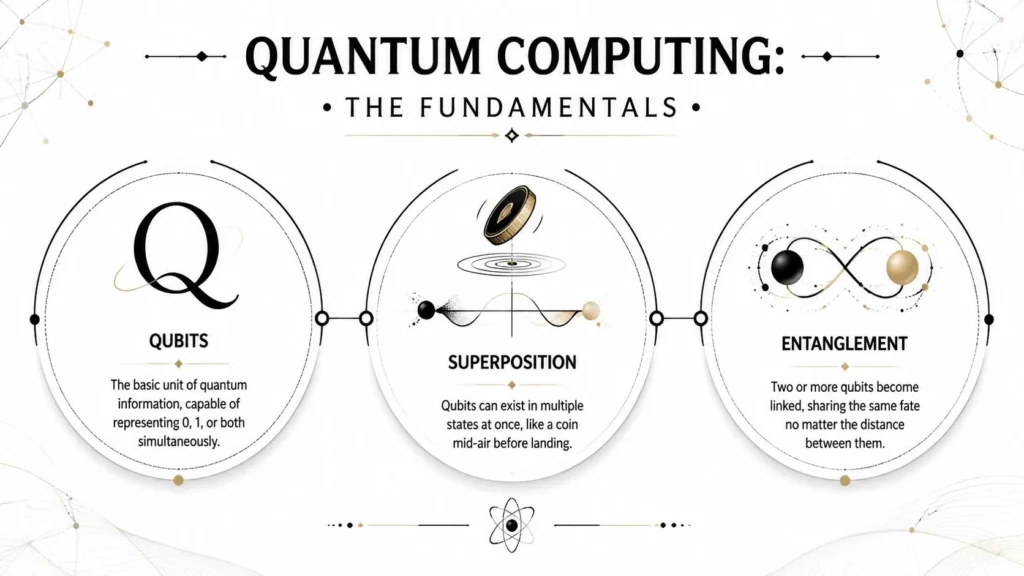
A classical computer stores information in bits, and each bit is either 0 or 1. A quantum computer uses qubits, which behave differently because they follow the rules of quantum physics. If a bit is a light switch, a qubit is more like a spinning coin that hasn’t landed yet.
That “spinning coin” idea helps with superposition, the feature that lets a qubit exist in more than one state at once until measurement forces a definite outcome. People sometimes describe this as “parallelism,” but that can mislead readers into thinking quantum computers are just faster classical computers. They’re not. They operate with a different kind of information structure.
Why entanglement changes the game
The second concept, entanglement, is even stranger. Two qubits can become linked so that measuring one gives information about the other, even when they’re far apart. A better analogy than magic is a pair of gloves in separate boxes. If you open one box and find the left glove, you immediately know the other box holds the right glove.
That connection isn’t a trick of hidden labels. It’s a quantum relationship that lets groups of qubits behave as coordinated systems. For computation, that matters because quantum algorithms depend on carefully choreographed interactions among many qubits, not just on individual ones doing isolated tasks.
If you want a deeper physics detour on the particles behind all this, the relationship between bosons and fermions is a useful side path to keep in mind: how particle behavior shapes quantum systems. The key idea is that quantum computing doesn’t ignore physics, it leans on it.
Plain-English takeaway: A quantum computer isn’t powerful because each qubit knows more. It’s powerful because many qubits can be arranged to interfere with each other in useful ways.
Why this vocabulary matters for Google
Google’s hardware progress only makes sense once these basics are clear. More qubits alone don’t guarantee better results. The system has to preserve superposition, maintain entanglement, and keep error rates low enough that the calculation survives long enough to finish.
That’s why you’ll hear so much about fidelity, coherence, and error correction in the sections that follow. Those aren’t decorative technical terms. They’re the difference between a promising experiment and a machine that can hold onto information long enough to do something useful.
Inside Google’s Quantum Hardware
Google’s hardware story starts with a design choice that sounds technical but has a straightforward logic. The company has focused on superconducting qubits, tiny circuits that must be chilled and controlled with extreme precision. Google’s earlier Sycamore processor used up to 54 qubits arranged in a square-grid lattice, with calibration for single- and two-qubit gates plus individual and simultaneous readout (Google Sycamore datasheet).
That layout matters because a quantum chip is judged differently from a laptop chip. The key question is not only how many qubits sit on the chip. It is whether those qubits can interact cleanly enough to support deeper circuits before noise breaks the calculation.
Sycamore to Willow, what changed
Google’s current flagship Willow processor uses 105 superconducting qubits, with 99.97% single-qubit gate fidelity, 99.88% entangling-gate fidelity, and 99.5% readout fidelity across the full array (Google Quantum AI hardware update). Those figures matter because errors build quickly in quantum circuits. If a qubit slips often enough, the computation loses its shape before it can deliver an answer.
Willow also shows a major advance in T1 coherence times approaching 100 µs, up from the earlier Sycamore-era roughly 20 µs cited in third-party summaries. Coherence time is the period during which a qubit can keep its quantum state. More time gives the machine more room to complete useful work.
| Specification | Sycamore (c. 2019) | Willow (c. 2024) |
|---|---|---|
| Qubit count | Up to 54 | 105 |
| Layout | Square-grid lattice | Superconducting array |
| Gate calibration | Single- and two-qubit gates | Single-qubit, entangling, and readout metrics reported |
| Single-qubit gate fidelity | Not specified in the verified data | 99.97% |
| Entangling-gate fidelity | Not specified in the verified data | 99.88% |
| Readout fidelity | Not specified in the verified data | 99.5% |
| Coherence time | About 20 µs in Sycamore-era summaries | Approaching 100 µs |
A good way to read that table is to stop thinking like a shopper and start thinking like an engineer. More qubits help, but only if the machine can keep those qubits stable and measure them correctly. That is why fidelity often matters more than raw qubit count in serious discussions of Google quantum computing.
The hard part is that every extra layer of control creates new chances for error. Google’s progress suggests the team is improving both the size and the quality of the platform at the same time, which is the right direction for fault-tolerant computing. It is still early, but the machine is becoming more usable in the engineering sense, not just the headline sense.
A quantum processor is only as good as the errors it can survive.
The hardware also fits into a larger physics conversation about why matter can behave in ways that ordinary electronics cannot. For readers who want that connection, this primer on a new state of matter helps link the lab language to the underlying science.
Major Milestones and Defining Moments
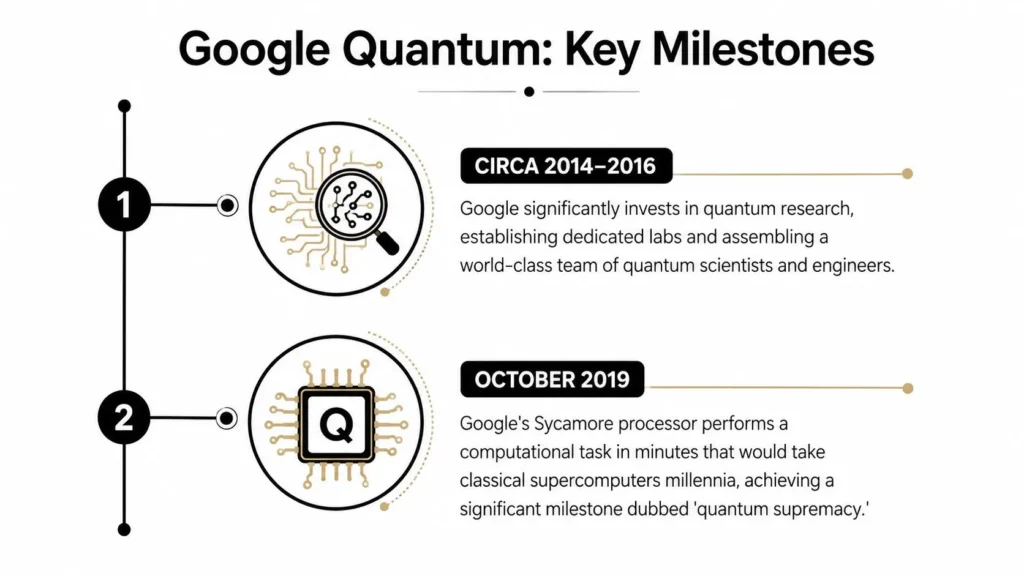
Google’s quantum story has two turning points, and they serve different purposes. One shows that a quantum processor can outperform classical methods on a highly specialized task. The other shows that the hardware is learning how to protect itself from the noise that normally ruins quantum states. As noted in the overview above, Google Quantum AI treats 2019 as the year of “beyond classical” performance with Sycamore, and 2023 as the year it reported the first experimental evidence that quantum error correction can be scaled.
That sequence matters. A speed demonstration grabs attention because it feels like crossing a finish line. Error correction matters more because it is the scaffolding for any machine that has to work long enough to solve useful problems.
The 2019 benchmark and the argument around it
Google’s 2019 experiment used a random-circuit-sampling task on Sycamore. In the original framing, Google said the result would take a classical supercomputer about 10,000 years to complete, or 200 seconds. The point of the test was not to simulate a weather model or factor large numbers, but to show that a quantum device could perform a calculation beyond the reach of ordinary hardware in practice.
That claim created the phrase “quantum supremacy,” which quickly became the public shorthand for the milestone.
The debate that followed was predictable. Critics pointed out that the comparison depended on the classical methods chosen for the benchmark, and that the task itself was not a practical application. That criticism lands for a reason. A machine can be extraordinary on paper and still be far from useful in daily computing. Those are different kinds of progress.
The larger lesson is simpler. The field had reached a point where quantum computing could no longer be treated as a purely theoretical idea. Google had shown a machine doing something very hard to reproduce classically, even if the task was narrowly defined. For readers who want a broader science context, this overview of new discoveries in quantum physics helps explain why milestone experiments can reshape what researchers think is possible.
The 2023 error-correction milestone
The 2023 result is less familiar outside the field, but many researchers see it as the more important step. Google said it had shown the first experimental evidence that quantum error correction can be scaled, describing the result as a logical qubit prototype. That matters because a logical qubit is built from multiple physical qubits, with the group working together to protect information from errors.
If the 2019 result was a race for speed, the 2023 result was a race for stability. Stability is the part that matters for real machines, because a quantum computer only becomes useful if it can keep its fragile states alive long enough to finish a calculation.
The shift from one milestone to the other also helps separate hype from reality. The first result answered a basic question about whether a quantum machine could do something classical computers struggle to match. The second asked whether the system can survive the constant interference that makes quantum hardware so difficult to scale. That is the difference between a demonstration and a foundation.
Real-World Impact of Google’s Quantum Work
The first question people ask about Google quantum computing is simple. What does it do? The most honest answer is that its near-term value is likely to be narrow, specialized, and tied to problems that classical computers struggle to model efficiently. Google itself has said it is expanding beyond superconducting qubits into neutral-atom quantum computers, which suggests the company sees different hardware designs as better suited to different kinds of problems (Google neutral-atom strategy).
That matters because the race is no longer only about making one chip better than another. It is about matching the machine to the task, the same way a microscope and a telescope solve different problems even though both are instruments. For some workloads, superconducting hardware may fit best. For others, another architecture may be a better tool.
Where the promise is most believable
The strongest near-term cases still point to simulation and optimization. In medicine, that could help scientists study molecular behavior in more detail. In materials science, it could make it easier to model structures that are hard to capture with classical tools. In logistics or finance, it could support difficult optimization problems where the number of possible answers becomes enormous.
Google’s own recent work points to this more focused view. As noted earlier in the hardware discussion, the company reported a 65-qubit physics-simulation experiment completed in about 2.1 hours versus 3.2 years on Frontier, a roughly 13,000x speedup. That does not mean every future business problem will get a quantum shortcut. It does suggest that the first areas to show value may be specific scientific workloads, not general-purpose computing.
Why businesses should be cautious
The gap between impressive hardware and real deployments is still wide. Google has published a framework for moving from abstract algorithm discovery to deployment, and the missing middle is often the hardest part, identifying real-world problem instances that are hard enough to matter and structured enough to benefit from quantum methods. That gap helps explain why so many forecasts remain vague.
Useful rule: If a quantum use case sounds like a replacement for all classical computing, it is probably oversold.
The more realistic story is narrower. Quantum computers will likely work alongside classical systems, not replace them. They may become valuable for certain classes of molecules, materials, and optimization tasks where brute-force classical approaches run into practical limits. That is a slower story than a hype cycle, but it is a more believable one.
Google also shows its caution by widening its hardware portfolio. Neutral atoms are not a retreat from superconducting qubits. They are a sign that useful quantum computing may not come from one architecture alone. That kind of strategic shift usually matters more than a flashy benchmark.
Navigating Quantum Challenges and Limitations
Quantum computing is fragile by design. That’s not a bug in the conversation, it’s the main engineering obstacle. Qubits are sensitive to their environment, which means they can lose their quantum state through decoherence or accumulate errors from imperfect control. In a classical machine, a bad bit flips and can often be corrected straightforwardly. In a quantum machine, the information is harder to inspect because measurement itself changes the state.
That’s why error correction sits at the center of the field. Google’s peer-reviewed work shows that error suppression can improve with scale, which is a meaningful step toward fault-tolerant machines, but it is not the same as having a commercially useful computer (Nature paper on below-threshold error correction). The distinction matters because public discussion often blurs it.
Why more qubits is not enough
A larger chip does not automatically mean a better computer. If the extra qubits are noisy, the system can become more difficult to control. The engineering task is to keep the machine coherent long enough, and accurate enough, to run circuits that are deep enough to matter.
Google’s move toward logical qubits shows the right direction, but it also shows how much work remains. A logical qubit is built from many physical qubits, and each layer of protection adds overhead. That overhead is the price of trying to beat noise with redundancy.
There’s a reason researchers are so careful with language here. A proof that error suppression improves with scale is encouraging. It says the design may become more stable as it grows. But it does not yet mean the machine is ready to run long algorithms, replace classical infrastructure, or transform a market on demand.
The hype versus the deployment gap
Readers often get confused. A result can be both real and limited at the same time. Google’s milestone papers are real. They show progress in physics and engineering. They do not prove immediate commercial disruption.
The next layer of difficulty is operational. Future useful machines will need to manage drift, calibration, and long runtimes without constant human intervention. That’s a much harder problem than one benchmark run. It’s also why many of the most interesting recent advances are about control systems, not just chip design.
The safest way to read the field is with two thoughts held together. First, Google’s progress is genuine and important. Second, the road to a practical fault-tolerant machine is still long, and no single benchmark has ended that debate. Those can both be true.
The Future of Quantum and How to Get Involved
A useful way to read Google’s roadmap is to follow the destination rather than the headline number. The company has pointed toward a machine with about 1,000 logical qubits, and that matters because logical qubits are the protected units that make long computations plausible (Google Quantum Computing roadmap summary). Raw qubit counts can sound impressive, but logical qubits are closer to the working parts of a car than the number of bolts in the garage. They are the pieces that have to stay stable long enough to do real work.
That focus changes how the field should be judged. Progress is no longer just about adding more hardware to a chip. It is about building an architecture that can correct errors, hold state, and keep control over a system that wants to drift the moment the environment gets involved.
Google’s latest Willow chip offers a good example of why the hype needs context. It ran a benchmark in under five minutes that would take the Frontier supercomputer an estimated 10 septillion years, a figure often written as 10^25 years (Google Quantum Computing roadmap summary). That result is striking, but it does not mean a quantum computer can now replace classical systems across the board. It shows that quantum hardware can be extraordinary at specific tasks while still being a very long way from broad practical use.
Good places to keep learning
If Google quantum computing has you curious about the bigger science and technology picture, the best next step is to follow sources that explain how the pieces fit together, not just what the latest chip is called.
- Cirq, Google’s open-source quantum programming library, lets you see how quantum circuits are written in software, which makes the abstract math feel more concrete.
- Google Quantum AI’s updates show the company’s own view of hardware and research progress, so you can compare stated goals with the actual direction of the work.
- Peer-reviewed papers remain the best way to separate laboratory results from promotional language, especially when a claim sounds bigger than the method behind it.
- Neutral-atom and superconducting research are both worth watching, because the field is still testing more than one hardware path and no single design has settled the question yet.
A steady learning path helps more than chasing every announcement. Start with qubits, then learn how error correction changes the picture, then look at what hardware metrics really measure. Only after that does it make sense to read benchmark claims with a critical eye. That order keeps the field understandable, especially when the numbers are impressive but the practical meaning is still developing.
For readers who want a broader mix of reporting, maxijournal.com publishes approachable coverage across science, technology, and other topics. It is a useful place to keep exploring complex ideas in plain language, with more attention paid to tradeoffs than to headline repetition.
Discover more from Maxi Journal
Subscribe to get the latest posts sent to your email.