It’s late afternoon. The walk was short, your dog is pacing by the door, and the usual toy no longer holds attention. You don’t necessarily need a longer outing. You need a game that matches your dog’s body, motivation, and current energy.
These ten games to play with a dog range from quiet indoor searches to organized sports. Each one explains what to do, which equipment helps, and how to adapt the activity for puppies, seniors, small dogs, dogs with limited mobility, and high-energy breeds. Some games build focus. Others offer physical exercise, scent work, or a structured way to practice useful cues.
Start with the simplest option that fits your dog today. A calm scent search may suit a senior better than repeated sprinting. A short tug session may engage a terrier more effectively than a long walk. If you’re planning a wider outing, you can also plan pet-friendly outings around your dog’s interests and stamina.
1. Hide and Seek
Hide and seek works well when your dog enjoys food, toys, people, or sniffing. You can hide yourself behind a doorway, place a toy under a towel, or scatter a few treats for a simple “find it” search. The activity gives your dog a clear problem to solve without requiring much space.
Start with the easiest version. Ask your dog to wait, let them watch you place a toy nearby, then say “find it.” Reward the discovery immediately with praise, a treat, or a short toy game. If your dog struggles, make the hiding place more obvious rather than repeating the cue.
Adjust the search to the dog
A confident adult dog may search for a family member in another room. A nervous puppy should begin with a person partly visible and an easy reward. Small dogs and seniors can search at floor level, while dogs with limited mobility can work from a comfortable bed or mat.
Keep hiding places accessible. Don’t ask a dog to climb furniture, squeeze behind unstable objects, or search near unsafe household items. If the dog wanders away, lower the difficulty and make the reward more valuable.
Practical rule: End while your dog is still eager to search. Frustration is a sign to simplify the next round, not to hide the reward better.
2. Name Game
The name game turns toy selection into a short vocabulary exercise. Place two toys on the floor, give one a consistent name such as “ball,” and reward your dog for touching or picking up that item. Use toys with different shapes and textures at first, such as a soft plush toy and a rubber ball.
Don’t test several objects too quickly. Say the chosen name once, point if needed, and reward any movement toward the correct toy. When your dog understands the first label, introduce another object and practise each name separately before asking for a choice.
A dog who enjoys retrieving may find this especially engaging. A small dog can work from a short distance, while a senior can identify toys without running. The activity also suits rainy days because it requires little room and puts more emphasis on attention than speed.
Keep the language consistent
Everyone in the household should use the same name for each toy. “Rope,” “tug,” and “toy” may sound interchangeable to a person, but inconsistent labels make the task harder for the dog. Review familiar names often, then add a new object only when the current choices are reliable.
For broader training foundations, use this guide to training your dog alongside the game. Small dogs may also differ widely in motivation and responsiveness, so temperament notes on small dog breeds can help you set realistic expectations.
3. Puzzle Toys and Treat-Dispensing Games
Puzzle toys suit dogs that enjoy food searching, manipulation, and quiet concentration. A treat-dispensing ball, a stuffed KONG, or a Nina Ottosson-style puzzle can turn part of a meal into an activity. The dog must push, lift, nudge, or roll the object to reach the food.
Begin with a toy that gives a quick result. If the puzzle is too difficult, your dog may chew the equipment, abandon it, or become frustrated. Place a few pieces of the dog’s regular food in an easy compartment and show how the toy works without taking over the task.
Make food play safe
Use part of the dog’s daily food allowance rather than adding unlimited treats. Supervise first, especially if your dog chews forcefully or tries to swallow puzzle pieces. Inspect the toy before and after use, remove loose parts, and replace damaged equipment.
- Match the difficulty: Start with simple rolling or lifting actions before using multi-step puzzles.
- Rotate the options: Put some toys away and bring them back later so they remain interesting.
- Clean the equipment: Wash food-contact surfaces regularly and follow the manufacturer’s cleaning guidance.
- Watch the body: A dog that paws calmly and keeps trying is engaged. A dog that bites, vocalizes, or walks away needs an easier design.
This is a good indoor choice for dogs that need mental work but shouldn’t perform repeated jumps or sharp turns. It’s also useful after a physically demanding walk, when the dog needs a calmer activity rather than more running.
4. Fetch
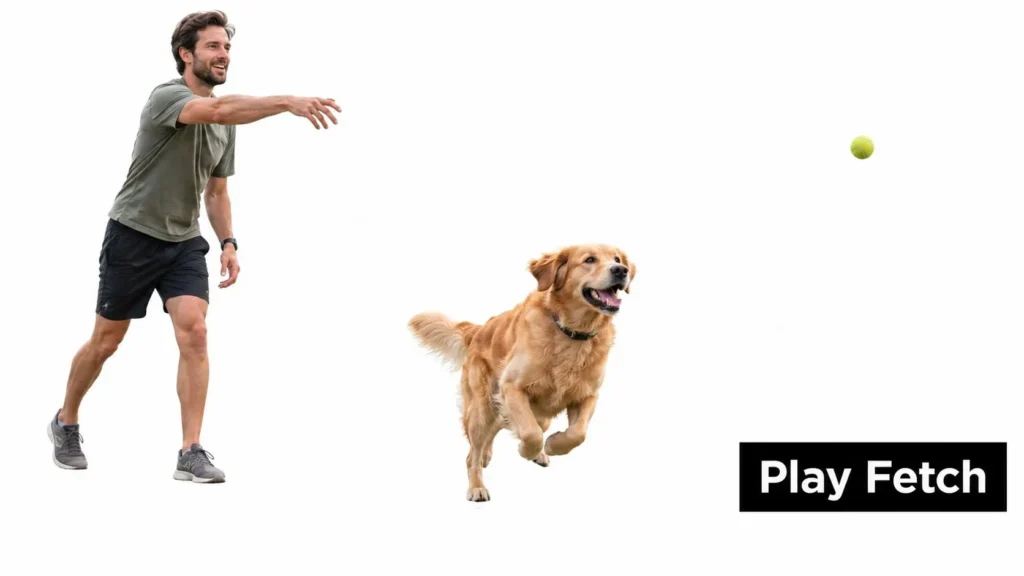
Fetch is simple, familiar, and easy to adapt. Choose a safe toy, toss it a short distance, and reward your dog for returning toward you. The return matters as much as the chase. If your dog grabs the toy and runs away, reduce the distance and trade the toy for food or another toy rather than chasing.
A puppy can start with a gentle roll across a rug. A small dog may prefer a lightweight toy and a hallway. An adult retriever may enjoy longer outdoor retrieves, but repeated sprinting can create too much arousal and physical strain, particularly on hard surfaces or slippery ground.
Teach the return, not just the chase
Use a “drop it” cue by offering a treat near the dog’s nose. When the dog releases the toy, give the treat and return the toy if the dog is still calm. This teaches cooperation instead of turning every retrieval into a contest.
Fetch is a poor choice when the dog becomes frantic, slips during turns, ignores rest, or struggles to recover after play.
Choose a ball large enough that your dog can’t swallow it. Avoid throwing toward stairs, traffic, unfamiliar dogs, or obstacles that encourage collisions. Vary the game with short rolls, gentle tosses, and pauses. A 2022 study of human descriptions of dog relationships found that play was important to the bond for 100 participants, or 65% of the sample, which supports using shared games as social activities rather than treating fetch as exercise alone (PLOS ONE research on human-dog relationships).
5. Tug-of-War
Tug-of-war suits dogs that enjoy gripping, pulling, and close interaction with a person. It can work well indoors for a healthy adult or adolescent dog, provided the floor offers secure footing. Choose a long tug toy with handles, invite the dog to take it, then pull gently from side to side.
Winning the pull matters less than the dog’s ability to start, pause, release, and restart under control. If the dog drops the toy, offer it again while the body remains relaxed. If teeth reach clothing, skin, or furniture, end the round briefly and restart with the toy farther from your body.
Set rules before the first pull
Teach “take it” and “drop it” in separate short sessions. Keep your movement low and steady. Avoid upward yanks, twisting, or hard resistance, especially with a dog that has pain, dental problems, or physical restrictions.
- Use a proper toy: A rope or fleece tug with room for your hands gives better control than a small object.
- Allow successful turns: Let the dog win sometimes, then finish with a calm release.
- Stop on contact: Teeth on skin ends the round immediately. Do not shout or wrestle.
- Manage guarding: Dogs that guard toys need professional help before tug becomes a regular activity.
Read posture, facial expression, pauses, and re-engagement with this guide to understanding dog body language. Stop while the dog can still respond to cues and walk away calmly. A 2019 comparison of human-dog pairs associated frequent play with broader relationship patterns, including reported happiness, stress, walks, trainability, and behavior. The findings show an association, not proof that tug caused those outcomes (peer-reviewed study of human-dog compatibility).
6. Nose Work
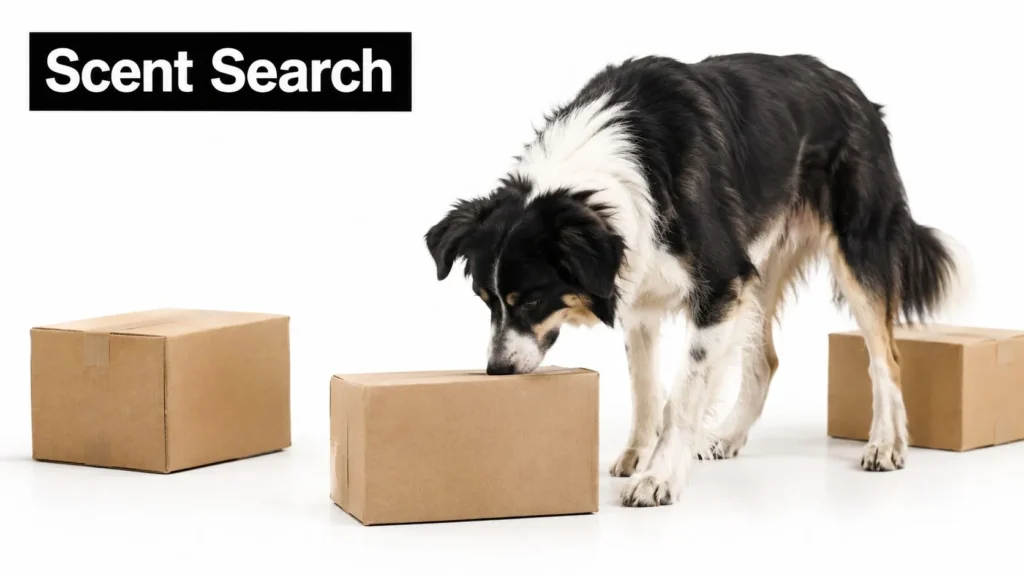
Nose work is a strong option for dogs that prefer searching to chasing. Hide a food reward in a cardboard box, under a towel fold, or behind an easy household object. Give a cue such as “search,” then stay quiet while your dog works.
Start in a calm room with one obvious target. Reward the moment your dog finds it. Once the search is reliable, add more boxes or move to a different room. Don’t make the hiding place so difficult that your dog starts guessing, scratching randomly, or leaving the area.
A scent-focused game suits seniors, small dogs, and dogs that tire quickly from impact. It also gives high-energy breeds a job without requiring constant running. Keep the floor clear, prevent access to unsafe food, and make sure another pet can’t steal the reward.
Build a clear search routine
Use the same sequence each time: cue, search, find, reward, reset. You don’t need competition equipment for home practice. If your dog enjoys structured work, look for an experienced scent-work instructor or a local club that can teach odor handling and search-area etiquette.
A large observational review of 187 owner-submitted videos from 19 countries identified approximately 30 forms of dog-human play, including fetching, chasing, tug, teasing, and physical play (study summary on dog-human play). That variety matters. A dog that dislikes fetch may still enjoy scent work, and a dog that becomes overstimulated by tug may settle into a search.
7. Canine Freestyle
Canine freestyle, or dog dancing, combines simple obedience cues into a routine set to music. You might teach a hand touch, a spin, a slow weave between your legs, and a stop on a mat. The performance can stay informal. Your living room is enough for a short sequence.
Choose movements that fit your dog’s body. A large dog may weave around your legs without needing tight turns. A small dog may perform close-position work comfortably, but repeated jumping can still be tiring. Seniors can practise stationary behaviors such as chin rests, hand touches, and changes between standing and sitting if those movements are pain-free.
Assemble the routine in pieces
Teach each behavior separately. Reward the cue, then add a second movement only when the first remains relaxed. Use music with a steady rhythm, but keep the volume low enough that your dog can focus.
Watch for hesitation, pinned ears, repeated yawning, avoidance, or a sudden loss of interest. Those signs mean the routine is too difficult, too long, or physically uncomfortable. A dog that willingly approaches, performs, pauses, and returns to you is giving better feedback than one that follows only because the handler keeps prompting.
This game works best for owners who enjoy training detail. It’s less suitable when the dog is overtired, physically restricted, or easily frustrated by repeated shaping. Short, successful practice is more useful than trying to complete a full routine immediately.
8. Disc Dog
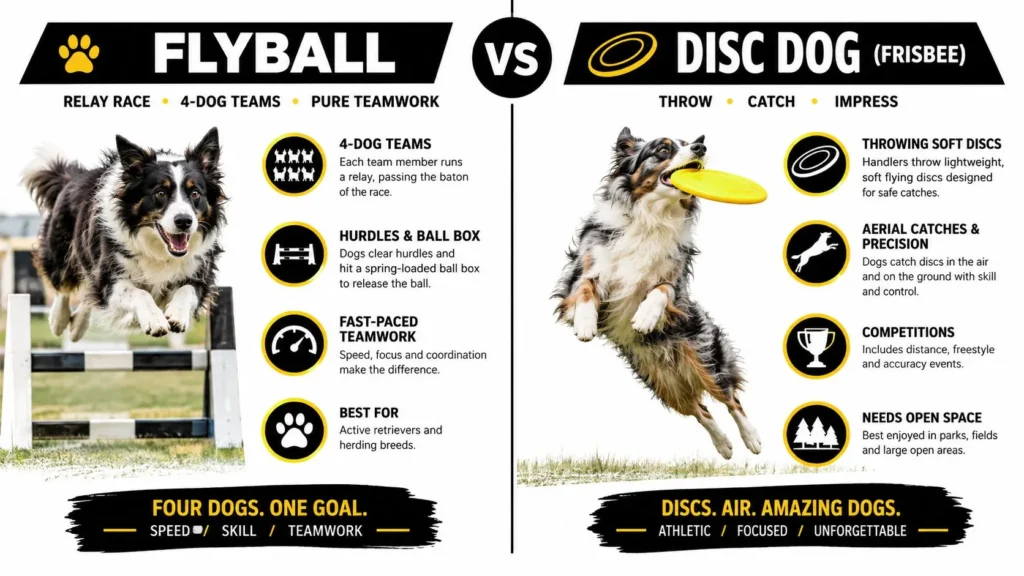
Disc dog is for dogs that enjoy fast movement and carrying an object. Start on the ground by rolling a soft dog-safe disc. When your dog willingly follows and picks it up, add a short, low throw. Keep the first catches close to the ground rather than encouraging high jumps.
Warm up with walking, hand touches, and easy toy play. Use grass or another forgiving surface, and avoid wet ground, concrete, and areas near roads. A dog that limps, slows down, refuses the disc, or lands awkwardly needs a break and may need veterinary assessment.
Keep athletic play controlled
High-energy breeds may love disc work, but enthusiasm can hide fatigue. Stop while the dog still moves cleanly and responds to you. Don’t turn every throw into a maximal sprint. Roll the disc, change direction gradually, and use rest periods.
A dog with a heavy build, joint concerns, poor impulse control, or a history of fear around fast-moving objects may be better suited to scent work or low-impact retrieving. Breed type can guide your first idea, but it shouldn’t replace observation. Research using behavioral data from 89,352 dogs across 132 breeds found higher human-directed play behavior among herding and sporting breeds than among non-sporting and toy groups (research on breed-related play behavior). Individual health and preference still determine whether disc is appropriate.
9. Dog Agility
Agility gives a dog a sequence of obstacles and a handler’s directions to follow. At home, begin with a low-risk setup such as walking around cones, going through a wide cardboard-box tunnel, or placing front paws on a stable platform. Don’t start with high jumps, narrow equipment, or improvised obstacles that can collapse.
The sport rewards communication as much as speed. Teach your dog to follow a target hand, move around an object, pause on a mat, and respond to basic direction changes. These foundation skills make the course clearer and reduce the temptation to chase the dog through obstacles.
Protect growing and vulnerable bodies
Puppies shouldn’t be pushed into repetitive jumping or sharp turns before their bodies are ready. Seniors and dogs with orthopedic problems may enjoy low-impact targeting and tunnels, but they may not be suitable for a full course. Check the surface for grip and remove furniture, cables, and unstable objects from the practice area.
Good agility is controlled problem solving, not a race through household clutter.
Use positive reinforcement and keep the session short. A certified instructor can adjust obstacle height, handling technique, and progression for the individual dog. For a cautious home setup, follow this guide to a DIY dog agility course.
10. Flyball
Flyball is a team relay for dogs that enjoy speed, retrieving, jumping, and working around other dogs. In a typical run, a dog clears hurdles, triggers a box, retrieves a ball, and returns over the hurdles. The activity is organized, noisy, and physically demanding, so it’s not the right first game for every dog.
Build the basics at home or in a class. Practise a reliable retrieve, a release cue, controlled recalls, and calm work around distractions. Introduce low obstacles gradually and reward each successful step. A beginner club should help you assess whether your dog can handle the environment before adding speed.
Choose the team carefully
Look for a local club with beginner instruction and a training area that uses safe surfaces. Ask how the group manages warmups, rest, collisions, and dogs that become overwhelmed. A dog that barks continuously, hides, freezes, or loses focus may need slower social exposure rather than more repetition.
Older dogs and dogs recovering from injury should receive veterinary clearance before high-intensity sport. Even an athletic dog needs gradual conditioning. Build strength and coordination before asking for repeated jumps and fast turns.
Flyball can be rewarding for confident, motivated dogs and owners who enjoy a club setting. It’s a poor match for a dog that prefers quiet searches, becomes reactive around groups, or can’t recover comfortably after exertion. Choose the activity that leaves your dog engaged and physically sound, not merely exhausted.
10 Dog Games Comparison
| Activity | Implementation Complexity | Resource Requirements | Expected Outcomes | Ideal Use Cases | Key Advantages |
|---|---|---|---|---|---|
| Hide and Seek (Find It) | Low to moderate, can be scaled from simple to hard | Minimal, treats/toys and safe hiding spots | Improved focus, problem-solving, recall, confidence | Indoor/outdoor enrichment, recall practice, shy dogs | Little equipment, easily scalable, builds confidence |
| Name Game (Object Recognition) | Moderate to high, requires consistent, repeated training | Toys with distinct names, time, consistent reinforcement | Vocabulary acquisition, memory, stronger owner-dog communication | Cognitive enrichment, advanced training, motivated retrievers | Deep cognitive stimulation; enhances communication |
| Puzzle Toys & Treat-Dispensing Games | Low to moderate, select and adjust difficulty | Purchased puzzles, treats/kibble, supervision and cleaning | Foraging behavior, reduced boredom, slower eating | Alone-time enrichment, mealtime slow-feeding, boredom prevention | Strong mental stimulation; adjustable challenge levels |
| Fetch | Low, simple to teach but may need retrieve/drop training | Ball/disc/soft toy, open space or indoor alternatives, optional launcher | Physical exercise, improved recall, impulse control | High-energy exercise, basic obedience, outdoor play | High physical output with minimal equipment; widely applicable |
| Tug-of-War | Low to moderate, effective when rules are enforced | Tug toy, clear start/stop cues, handler control | Bonding, bite inhibition, impulse control | Interactive reward-based training, short play sessions | Strong bonding tool; powerful training motivator |
| Nose Work (Canine Scent Detection) | Moderate to high, requires odor training and structure | Target odors, training time, possible classes or kits | Deep mental stimulation, confidence, scent detection skills | Dogs with limited mobility, scent sport, enrichment at home | Highly stimulating; suitable for seniors; scalable difficulty |
| Canine Freestyle (Dog Dancing) | High, choreography and precise cues required | Training time, space, music, optional classes | Coordination, obedience, creative expression | Performance, competitions, advanced obedience work | Creative outlet; strengthens handler-dog partnership |
| Disc Dog (Frisbee) | Moderate to high, teaches aerial catching and control | Dog-safe discs, open space, conditioning and warm-up | Cardiovascular fitness, agility, precision catching | High-energy breeds, performance and competitive play | Excellent cardio; competitive and social opportunities |
| Dog Agility | High, technical skills and course strategy needed | Agility equipment, classes, conditioning, coaching | Coordination, fitness, teamwork, advanced handling skills | Sport training, structured classes, competitive trials | Structured progression with community and competition access |
| Flyball | High, team coordination and rapid exchanges required | Flyball box, hurdles, lanes, trained team members | Intense physical exertion, teamwork, speed and retrieval skills | Team sport, competitive relay events, social clubs | High-energy team activity; strong social and competitive element |
Choose One Game and Play It Twice This Week
Don’t choose a game because it looks impressive online. Choose it because your dog can perform it safely, understand what earns the reward, and remain willing to participate. A calm search may be more useful than fetch for a dog that is recovering from restricted exercise. A short tug session may suit a dog that needs interaction but doesn’t enjoy chasing thrown objects. A puzzle toy may be the best choice for a rainy afternoon or a senior that tires quickly.
Pick one activity and try it for about 10 minutes on two separate days. Keep the first session easy. Observe whether your dog approaches voluntarily, stays loose in the body, takes breaks, and returns to the game after a pause. These responses tell you more than breed stereotypes or a generic list of popular games.
Use the dog’s response as feedback
Modify one factor at a time. Reduce distance if fetch creates frantic running. Lower the difficulty if a puzzle causes frustration. Replace jumping with ground-level targeting if agility makes your dog hesitant. For nose work, make the scent easier to find before adding more distractions.
Stop when you see warning signs such as avoidance, freezing, repeated lip-licking, unusual posture, irritability, or difficulty recovering. Veterinary guidance also recommends avoiding excessive arousal, repeated sharp turns, high jumping, and strenuous play for dogs with physical limitations (veterinary guidance on play and exercise). Toy safety matters too. Use equipment that’s large enough to reduce swallowing risk, inspect it for detachable parts, and replace it when damaged.
Daily play varies widely between households. In a 2024 survey of 616 respondents, 437 identified as dog people. Among those respondents, 18.8% reported less than 15 minutes of active play daily, 45.8% reported 15 to 45 minutes, 24.3% reported 45 to 90 minutes, and 11.2% reported more than 90 minutes, meaning 35.5% exceeded 45 minutes (survey data on dog play). You don’t need to copy anyone else’s routine. Consistent, suitable play is more useful than chasing a target that doesn’t fit your dog.
If you move into agility, disc, or flyball, find a qualified instructor and check your dog’s health first. For a dog that becomes frantic, avoids the toy, or guards resources, consult a veterinary behavior professional before increasing intensity. The right game should create cooperation, not pressure.
Maxi Journal publishes approachable writing across pets, health, sports, science, and other practical topics. Visit maxijournal.com for more guidance, including ideas that can help you build safer, more structured activities with your dog.
Discover more from Maxi Journal
Subscribe to get the latest posts sent to your email.