Retro fashion is clothing that deliberately borrows recognizable design codes from an earlier era and adapts them for contemporary wear. Vintage is different because it refers to an original garment that was made in that earlier period.
You’ve probably felt the gap between those two ideas in a shop. A dress looks like the 1970s, the label says it’s new, and you don’t know whether to call it retro, vintage, or just old-looking. Once you can name the difference, you can shop with much more confidence.
Defining Retro Fashion in Plain Language
You stop at a shop window because an outfit catches your eye. The trousers flare, the print is geometric, and the whole look reminds you of photographs from another decade, yet the fabric and fit clearly belong to today. That small moment of confusion is exactly where a plain definition helps.
Retro fashion is best understood as the deliberate revival, reinterpretation, or reuse of styles associated with earlier periods rather than as one fixed look, and it isn’t the same as vintage, which refers to original garments from those earlier periods, as explained in the overview of retro style and its distinction from original period clothing. In simple terms, retro copies or reworks the past. Vintage survived from the past.
A useful one sentence test
Ask who made the garment and when. A newly made dress with a cinched waist and full skirt that echoes the 1950s is retro. An original dress sewn in the 1950s, even if a previous owner altered it, is vintage. The visual result can be similar, but the object behind it is not.
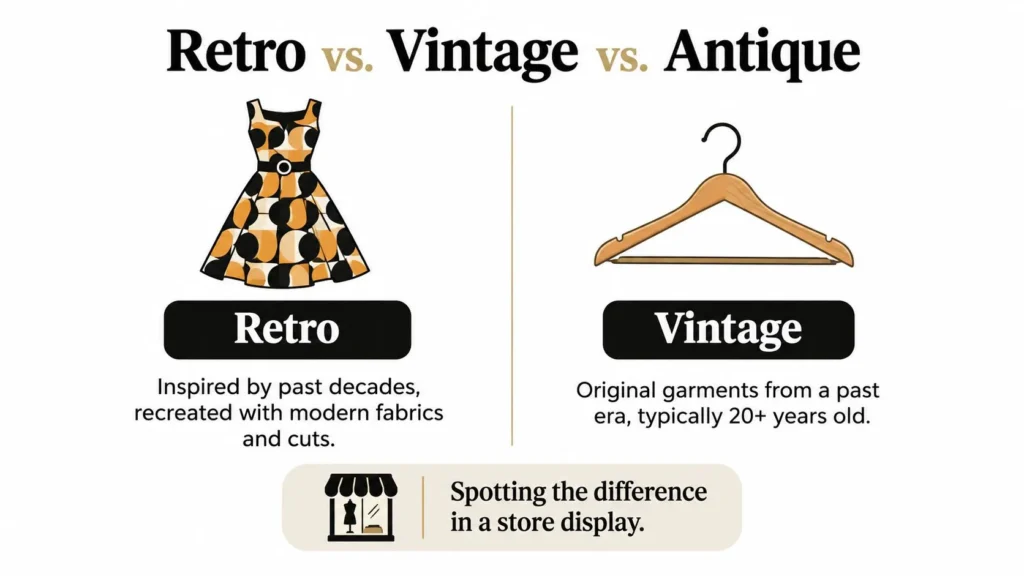
That distinction changes practical decisions. Vintage sizing often runs differently from modern sizing, construction may need repair, and provenance can affect price. Retro clothing usually offers current sizes, modern closures, and easier care, but it doesn’t automatically carry the history or durability of an original piece.
- Retro means newly made: Designers borrow a silhouette, print, or color story from an earlier era.
- Vintage means originally made then: The garment itself comes from the period it represents.
- Retro isn’t one decade: It can reference the 1950s, 1960s, 1970s, 1980s, 1990s, or another recognizable period.
Practical rule: If you can describe the reference era in a few words, you’re already reading retro style rather than just reacting to an old-looking print.
Think of retro like a modern cover version of an older song. The melody is recognizable, but the recording, instruments, and production belong to the present. Vintage is the original recording.
You don’t need expert knowledge to use that test in a store. Look at the label, seams, fastenings, and overall shape, then ask whether the piece quotes history or comes from history. That one question clears up most confusion around What Is Retro Fashion Style and gives you a working definition you can use anywhere.
Where Retro Style Actually Comes From
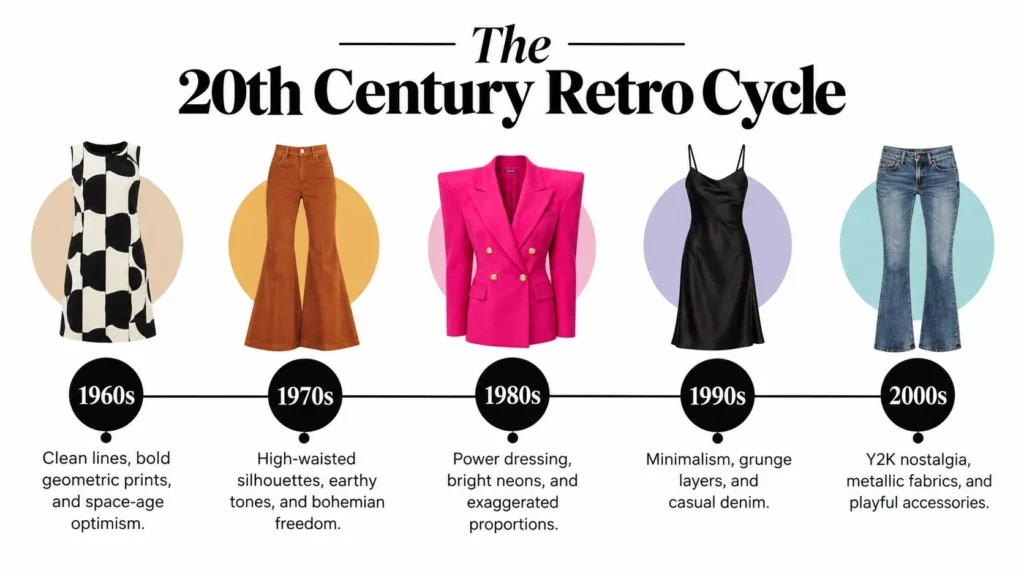
Retro style draws from a twentieth century cycle in which designers repeatedly quoted earlier fashion, then changed those references for a new generation. That’s why retro never settles into a single uniform. Each revival selects different details and leaves the rest behind.
The 1960s show this clearly because one decade contained several directions at once. Early in the decade, many women still wore polished, ladylike elegance inherited from the 1950s. At the same time, youthful British styles linked to Mary Quant and Swinging London pushed hemlines up and shapes simpler. By the late 1960s, hippie clothing influenced by Eastern dress and counterculture added loose layers, tie dye, and vintage textiles.
Why one decade can mean three outfits
A 1960s inspired outfit might therefore mean a geometric mini dress, a brightly colored mod suit, or a relaxed layered ensemble. None of those choices is wrong. They’re different answers from the same historical window.
Concrete milestones help anchor that variety. The Victoria and Albert Museum dates the first paper dresses to 1966, when an American company used disposable clothing as a marketing stunt, and manufacturers in the United States and United Kingdom then turned printed paper dresses into a novelty trend that remained popular until 1968, according to the Fashion History Timeline account of 1960s dress. Paper dresses sound extreme, but they show how quickly a visual idea could become a commercial trend.
The broader shift mattered more for everyday wardrobes. Tailoring loosened, skirts became shorter, hats and gloves declined, and trousers developed a flared outline by the late 1960s. Dress codes relaxed, and clothing began to signal youth and personal identity more openly.
For readers who want to see how materials also carry that kind of historical change, Pandemonium Millinery’s fur history offers a focused example of how one material and its alternatives evolved over time. It’s a useful reminder that a retro reference isn’t only a shape. It’s also a texture, a finish, and a set of associations people bring to it.
Once you see retro as a cycle of quotation, the mix stops feeling random. A designer borrows a collar here, a hemline there, and a color palette from somewhere else in the same era. Your job as a wearer is simpler. You just need to recognize which part of the past a garment is quoting.
The Visual Codes That Make a Look Read Retro
A vintage looking print alone doesn’t make a garment retro in a legible way. You read retro style through visual codes, starting with silhouette and garment architecture. If the overall shape points to a specific era, the smaller details usually fall into place.
Consider a clear contrast. In 1947, Christian Dior’s New Look used a pronounced bust, sharply defined waist, and full skirt, reviving an hourglass structure influenced by Victorian dress, while 1960s fashion moved toward shorter hemlines, simplified shift silhouettes, brighter color, and increasingly relaxed dress codes, a comparison detailed in the Whatcom Museum discussion of historical clothing codes. Put those two outlines side by side and you don’t need a label. The body shape tells the story first.
Start with shape then check the details
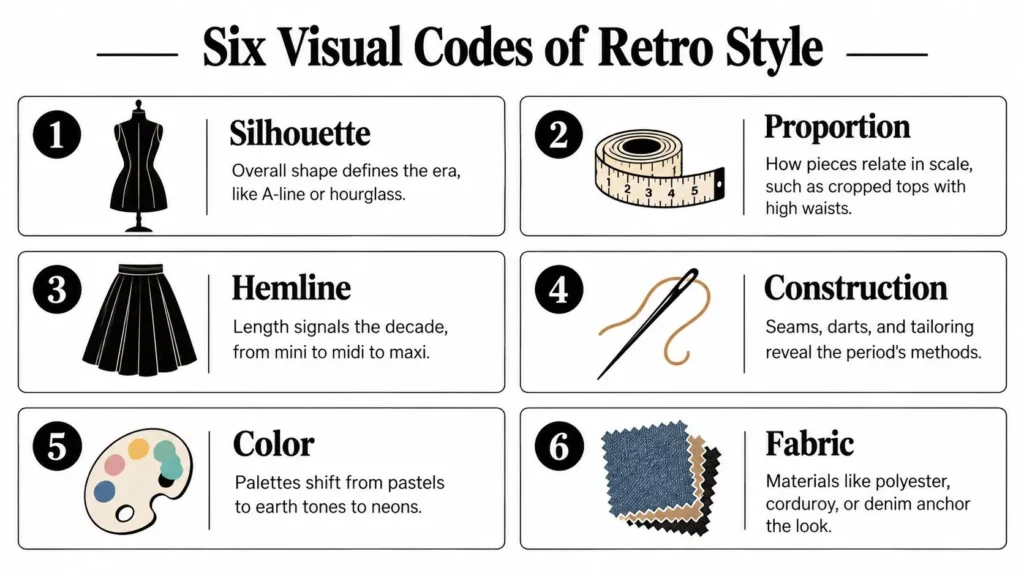
Use this order when you’re holding a piece in a shop.
- Silhouette comes first: Is the outline hourglass, straight shift, flared, oversized, or slip like?
- Proportion clarifies the era: A cropped top with a high waist reads differently from a long tunic over flares.
- Hemline narrows the window: Mini, midi, and maxi lengths each carry different period associations.
- Construction confirms intention: Darts, seams, closures, and tailoring show whether the shape is built in or only printed on.
Color and print work after shape, not before it. Bold geometrics strengthen a mod reference, earthy tones support many 1970s looks, and neon accents push a garment toward the 1980s. If you’re sewing or altering a piece, browsing polka dot fabrics at More Sewing can help you see how scale and spacing change a familiar retro print, since a large spot reads bolder and more graphic than a tiny one.
Why fabric changes the message
Material is the code many shoppers overlook. Nylon, acrylic, polyester, and spandex entered fashion after World War II, and synthetic production expanded during the 1960s. Those fibers enabled vivid color, smooth or glossy surfaces, stretch, easy care, and sharply engineered shapes.
That cause and effect matters when you recreate a period. A crisp polyester often supports a saturated, futuristic 1960s effect better than a soft, slubby natural fiber would. A fabric with elastane can achieve a close fit that period tailoring handled differently.
Match fiber behavior to the silhouette you want, then check proportion, closures, seam structure, and surface finish before you decide a piece truly reads retro.
Mary Quant offers a practical model for this kind of translation. She adapted details linked to older garments, including Norfolk jackets, tab collar shirts, and Liberty bodices, while prioritizing relaxed clothing suited to everyday movement. She didn’t copy the past exactly. She redesigned selected codes so modern wearers could live in them.
That’s the checklist to carry with you. Shape first, then proportion, hemline, construction, color, print, and material. When several codes point in the same direction, the retro reference becomes obvious without any costume effect.
Recognizable Substyles Across the Decades
Decade profiles turn abstract codes into outfits you can picture. You don’t need to memorize every trend. You need a dominant silhouette, a color mood, and two or three key pieces for each era.
1950s. Think cinched waists, full skirts, fitted cardigans, ballet flats, and cat eye glasses. The formula is polished and structured. A full skirt with a tucked in blouse instantly signals the reference.
1960s mod. Picture a geometric mini dress, bold color blocks, slim tailoring, and clean lines. The look feels graphic and youthful. A shift dress in a strong print does most of the work by itself.
Material history helps explain why the next shift looked so saturated. Non-cellulosic synthetic fiber consumption exceeded cellulosic fiber consumption in 1965 and reached approximately four billion pounds in 1970, which helped produce the vivid coloration, smooth surfaces, and sharply engineered shapes strongly associated with 1960s and 1970s retro references, as documented in the White Rose research chapter on postwar synthetic fibers.
From flares to minimalism
1970s. Flares, high waists, peasant blouses, suede textures, and earthy palettes define the most recognizable version. The silhouette lengthens the leg and relaxes at the top. Flared trousers with a soft blouse and a wide belt create the reference quickly.
1980s. Strong shoulders, high waisted trousers, neon accents, and layered textures take over. Proportion becomes more exaggerated. A shoulder padded blazer over a simple top and tapered trousers reads unmistakably of the decade.
1990s. Slip dresses, denim, logo tees, and minimalist grunge layers simplify the outline again. The mood is casual and less constructed. A slip dress over a plain tee, or straight denim with a boxy jacket, captures it without much styling effort.
If you want the decade just before the 1950s for comparison, the guide to 1940s clothing styles and their wartime context shows how utility and postwar change set up the fuller shapes that followed.
| Decade | Dominant Silhouette | Signature Colors and Prints | Key Pieces |
|---|---|---|---|
| 1950s | Hourglass with full skirt | Pastels, polka dots, florals | Circle skirt, cardigan, ballet flats |
| 1960s mod | Straight shift, mini length | Bold blocks, geometrics | Mini dress, slim suit, ankle boots |
| 1970s | High waist and flared leg | Earth tones, paisley, stripes | Flares, peasant blouse, suede jacket |
| 1980s | Strong shoulder, tapered leg | Neons, brights, bold graphics | Padded blazer, high waist trousers |
| 1990s | Slip and relaxed straight shapes | Neutrals, plaid, denim blues | Slip dress, logo tee, straight jeans |
Choose the profile whose proportions already suit your wardrobe. If you live in straight jeans, a 1990s reference will feel easier than a full 1950s skirt. If you love defined waists, start there. Familiarity makes the styling look natural.
Three Common Misconceptions About Retro Style
Most confusion about retro fashion comes from three assumptions that sound reasonable at first. Each one leads shoppers toward the wrong purchase or an outfit that feels forced. Clearing them up gives you a sharper way to buy and dress.
Misconception one is that retro and vintage are identical
They’re not, and the difference isn’t just vocabulary. A vintage garment can offer original construction and provenance, but it may also need delicate care, repairs, or size adjustments. A retro garment is newly manufactured, so its price, durability, and care depend on its current maker, not on the decade printed in the product description.
Shoppers often assume an old looking item is historically old. Check the label, manufacturing details, seams, and fastenings instead. A modern zip, contemporary size range, and synthetic care label usually point to a retro reproduction, even when the print looks convincingly period based.
Misconception two is that retro automatically means sustainable
Wearing an existing vintage garment reuses something already made. Buying a brand new retro inspired garment creates demand for new production, even if the design looks old. Those are different practices with different likely impacts, and a nostalgic label doesn’t erase that distinction.
Interest in genuine older pieces is clearly growing. The RealReal reported that nearly 30% more members searched for vintage in 2025 than in the previous year, while sales of heavily worn fair condition items rose 32% and timeworn bags rose 45%, figures noted in the Encyclopedia entry on retro styles and resale interest. Those numbers point toward lived in, repairable pieces rather than pristine collecting alone.
That doesn’t make every secondhand purchase automatically sustainable. Repeated buying, fragile construction, and unworn themed pieces still create waste. Durable construction, repairability, verified fiber information, local resale or swaps, and repeated wear matter more than whether a tag uses the word retro.
A worn, repairable original can align more closely with circular fashion than a brand new vintage inspired item, even when both create the same visual effect.
Misconception three is that retro requires a full period outfit
Head to toe period dressing is where costume creeps in. Retro styling works better with restraint. Pick one dominant era, keep a few recognizable details, and let modern basics do the quiet work.
Mary Quant’s approach points in that direction. She borrowed historical details but designed for relaxed everyday movement. You can do the same with a single flared trouser, a geometric print, or a defined waist, without reconstructing an entire decade around it.
How to Wear Retro Without Looking Like a Costume
Start with one dominant reference era, not three. Decide whether today’s outfit is mainly 1960s mod or mainly 1970s, then let that choice control silhouette and color. Mixed references blur the message and make the result harder to wear.
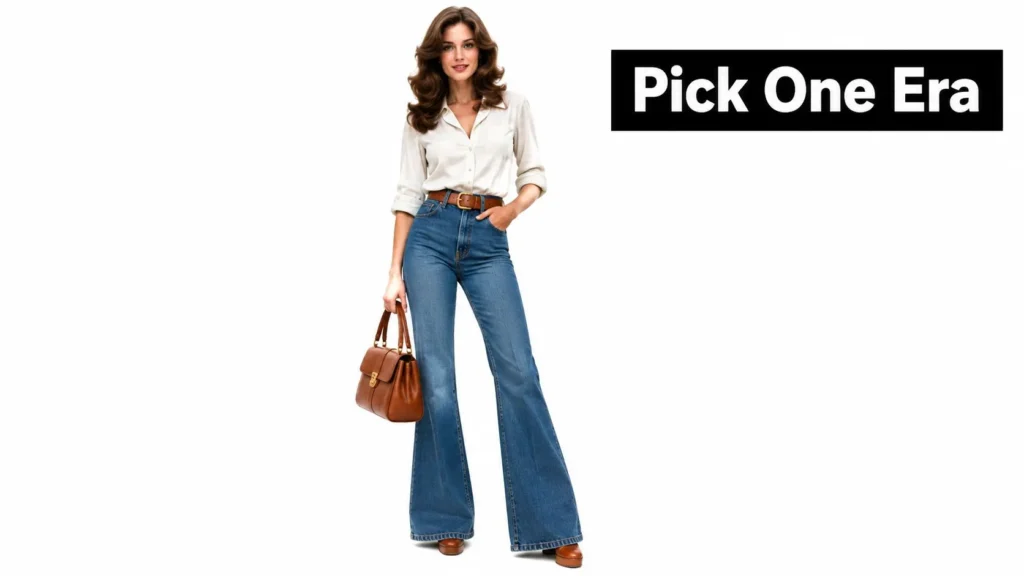
The outfit below shows the principle in a simple form, with one clear retro trouser shape grounded by a plain modern top.
A repeatable building method
- Pick the hero code: Choose a silhouette, print, or accessory that carries the era.
- Add modern anchors: Pair it with neutral basics in contemporary cuts, such as a plain knit or minimalist sneakers.
- Limit secondary references: Stop at two or three period signals so the look stays intentional.
- Check movement and fit: Modern tailoring or stretch is fine if the dominant code still reads clearly.
A 1970s inspired flared trouser works with a plain modern knit because the leg shape tells the story. A 1960s mod mini dress works with current minimalist sneakers because the geometric dress remains the focus. If casual pieces are your entry point, a retro t shirts for women guide can help you judge graphics and fits before you build the rest of the outfit around one tee.
This short video gives you a visual way to compare proportions as pieces move, which is often where a look tips from styled to costume like.
Build retro pieces into clothing you already repeat. The method in the capsule wardrobe starter guide pairs well with this approach because a small set of reliable basics gives one statement retro item several modern combinations. You’re styling a wardrobe, not assembling a themed outfit for one photograph.
Where Retro Style Is Heading Next
Retro style is moving toward pieces people can keep, repair, and wear repeatedly, not just decade themed items bought for one occasion. Growing interest in older and lived in garments suggests shoppers increasingly value character and usability over flawless condition. That shift favors strong seams, replaceable buttons, clear fiber information, and shapes that work with modern basics.
Local resale, clothing swaps, and secondhand contemporary pieces styled with retro codes offer practical middle ground. You can get the flare, print, or waist definition you want without assuming new production is the only route. To place those choices beside current silhouettes, browse the latest fashion trends for women and notice which retro codes keep returning in updated cuts.
Take one step this week. Pull a modern basic you already love, add a single retro hero piece, and wear the combination twice in different ways. If it earns repeat wear, you’ve found your era.
Visit maxijournal.com for approachable fashion guides that connect historical styles like retro dress to practical wardrobe decisions you can use every day. Explore more articles on period clothing, current trends, and building a wardrobe that reflects your taste, then start with one retro piece and style it your way this week.
Discover more from Maxi Journal
Subscribe to get the latest posts sent to your email.