A classroom can buzz with activity while learning remains shallow. Students collect points, race through questions, and watch badges appear, yet still struggle to explain the idea behind an answer. That’s why the most popular advice about gamification in education, add rewards to make learning fun, misses the central question: what should students understand or be able to do when the game ends?
Game elements can shape attention, practice, feedback, and persistence, but they can’t guarantee understanding. Their value depends on the learning task, the way the mechanic is designed, and what the teacher checks afterward. Use them when a clear learning challenge calls for stronger practice, motivation, feedback, or persistence, not just because an activity would look more exciting on a screen.
Why Gamification Needs a Learning Purpose
A leaderboard can tell you who answered the most questions. It can’t tell you whether those students can explain the reasoning, remember the content later, or apply it to a new problem. Participation, motivation, and learning are related, but they aren’t interchangeable. A lively room may be a useful sign that students are engaged with an activity. It isn’t proof that they’ve learned what the activity was meant to teach.
Start by naming the problem you want to solve. Are students avoiding useful practice because they fear getting answers wrong? Do they need clearer feedback to spot a misconception? Are they struggling to keep working through a difficult task? A game element may help with one of those challenges, but it’s unlikely to help if it doesn’t address the actual obstacle.
Consider a vocabulary lesson. If students can recognize a word on a screen but can’t use it in a sentence, a faster quiz round may generate more answers without improving the skill that matters. A better design might ask learners to use the word in context, then offer feedback that distinguishes a correct use from a lucky guess. Points could mark completed practice, but they shouldn’t substitute for evidence of skill.
The learning purpose comes first; the mechanic comes second. Once you know what students need to learn, you can decide whether a choice of paths, a progress marker, a team challenge, or no game element at all would help. The decision should leave room to change course. If the game produces activity without better understanding, revise it or remove it.
Understanding the Core Concepts
Gamification means using selected game elements in a setting that isn’t itself a game. A teacher might add goals, progress markers, challenge, feedback, or choice to a reading activity. Game-based learning uses a game as the vehicle for learning. A class might learn through a complete simulation or a board game designed around the subject. Adding a tablet or learning platform is different again. Technology can support either approach, but a digital tool isn’t automatically gamified.
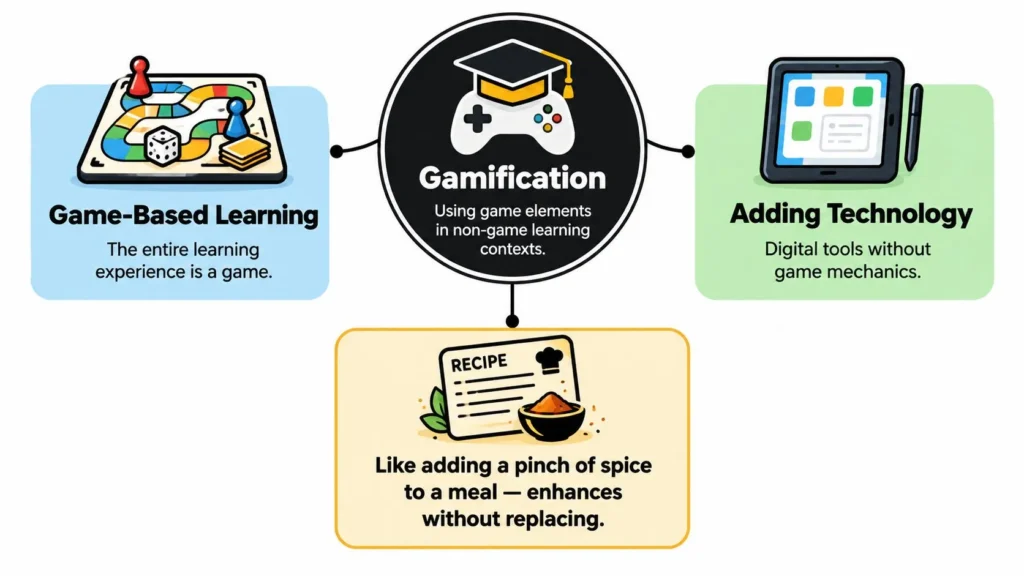
Think of a lesson as a journey. The learning objective is the destination; the task gives students a route, and feedback helps them see whether they’re on course. A progress bar might show how much practice remains, while a choice of tasks offers more than one route to the goal. But a map decorated with icons won’t teach someone to move through it. The structure matters only if it helps students do the learning.
That’s also why it helps to distinguish several outcomes:
- Participation means a student takes part, such as attempting a quiz question.
- Engagement describes involvement in the activity, which might show up as focus, discussion, or sustained effort.
- Motivation concerns why a learner chooses to act or keep going.
- Performance is what a learner demonstrates during a particular task or assessment.
- Durable learning means knowledge or skill remains available later and can be used beyond the original activity.
These outcomes can support one another, but one doesn’t prove another. For practical ideas about designing engaging digital learning, gamification in eLearning engagement tips can help translate mechanics into an online setting. The useful question remains the same in any format: what learning behavior should this element support, and how will you tell whether it worked?
Reading the Evidence Beyond the Hype
The research story isn’t a simple march from novelty to proof. Educational gamification became a recognizable research area as educators and researchers began studying elements such as points, badges, challenges, and progress feedback. But early interest outpaced clear evidence about which approaches worked, for whom, and under what conditions.
A systematic mapping study examined 34 empirical papers published from January 2010 through June 2014. In that period, 53% reported positive outcomes, 3% negative outcomes, and 29% inconclusive findings. For the period from July 2014 through June 2015, the results were less decisive: 24% of papers reported positive results, 7% negative results, and 49% were inconclusive. A later critical review of 51 empirical papers published through the end of 2015 concluded that educational practice was moving faster than research understanding of how and when gamification works (the systematic mapping study and critical review).
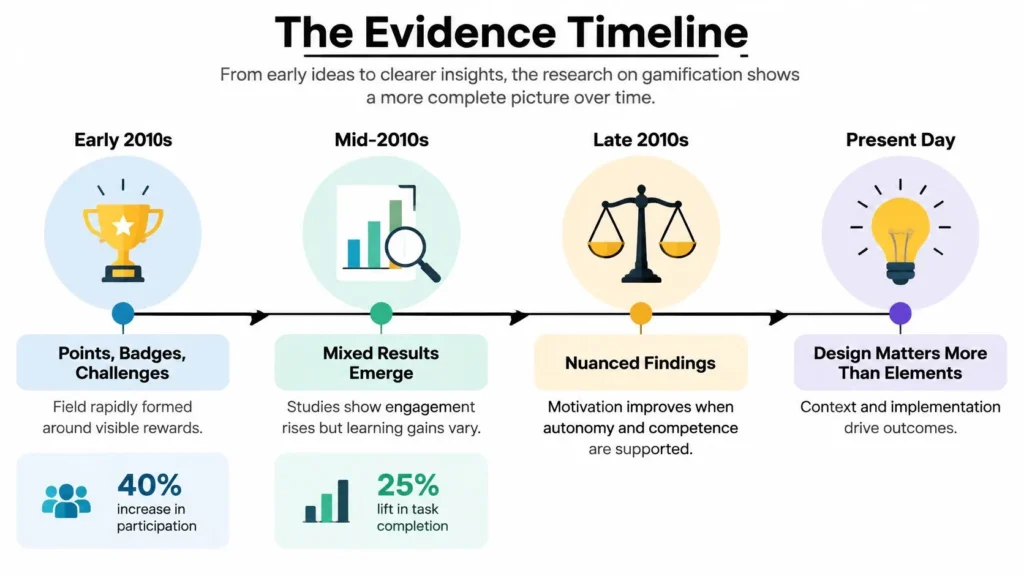
Later quantitative reviews offered firmer support, while still showing that outcomes differ. A 2019 meta-analysis reported Hedges’ g = 0.49 for cognitive learning, 0.36 for motivation, and 0.25 for behavior, drawing on separate groups of studies for each outcome. Another synthesis reported an overall Hedges’ g of 0.504, with a 95% confidence interval from 0.284 to 0.723 (the 2019 meta-analysis and related synthesis). These figures favor gamified instruction in the studies reviewed, but they don’t mean every game element produces the same effect. Nor do they show that students necessarily retain or transfer what they learned after a game ends.
A further complication is what researchers measure. More attempts or higher participation can be useful signals, yet they answer different questions from test performance, delayed recall, or the ability to solve a new kind of problem. Even the same design might produce a noticeable change in one outcome and little change in another.
When you see a claim about gamification, ask what was measured, who took part, how long the intervention lasted, what it was compared with, and whether learning was checked after the activity.
A classroom decision shouldn’t depend on a general claim that gamification “works.” Look for evidence that fits the particular learning goal, learners, and measure you care about.
Connecting Learning Theories to Game Mechanics
A mechanic doesn’t teach on its own. It changes the conditions around a task, for example by making progress visible or offering a choice. Whether that helps depends on what learners do with the task and the feedback they receive.
A progress marker can make a long assignment feel manageable because it shows students where they are and what remains. A choice between two practice paths may give learners more control, as long as both routes support the same objective. A team challenge can invite students to explain their reasoning to one another. These are design possibilities, not guaranteed results: a choice that offers no meaningful difference may feel cosmetic, while a team task can let one student do all the work.
Badges show why the learning target matters. A badge for “participating” may reward attendance or activity. A badge tied to a defined competency, such as supporting a claim with relevant evidence, can instead mark a skill students can demonstrate and apply. The badge is still just a marker. The explanation, practice, and assessment behind it are what give it meaning.
Leaderboards need the same scrutiny. If a class ranking rewards speed, it may favor quick responses rather than careful reasoning. A private indicator of personal progress could better fit a task where students need time to revise their work. The question isn’t whether competition is good or bad; it’s whether the chosen measure reflects the objective and gives learners a fair opportunity to show what they know.
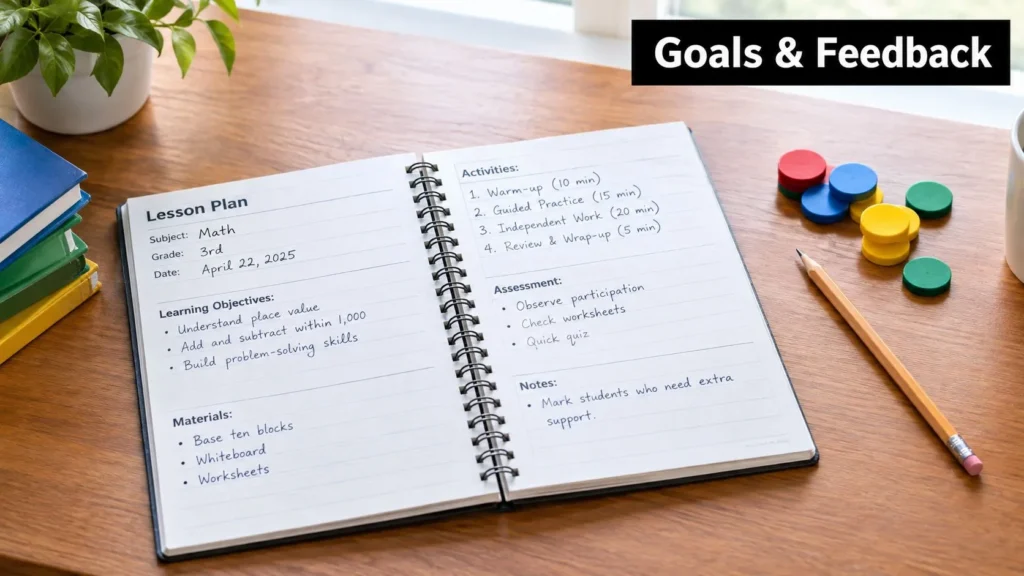
For educators working with competency-based approaches, the Keybaki CBE student guide offers a useful point of reference for thinking about goals and progress. That focus can make game mechanics more purposeful: progress should reflect something students can do, not just the time they’ve spent on a platform.
Regular study routines matter too. A progress system can support students as they build those routines, but it shouldn’t become the reason they work. Teachers can help learners connect a game-based practice activity to broader study habits that support consistent learning. The design test is straightforward: does the mechanic make useful practice clearer, better supported, or easier to sustain?
Designing a Classroom Gamification System
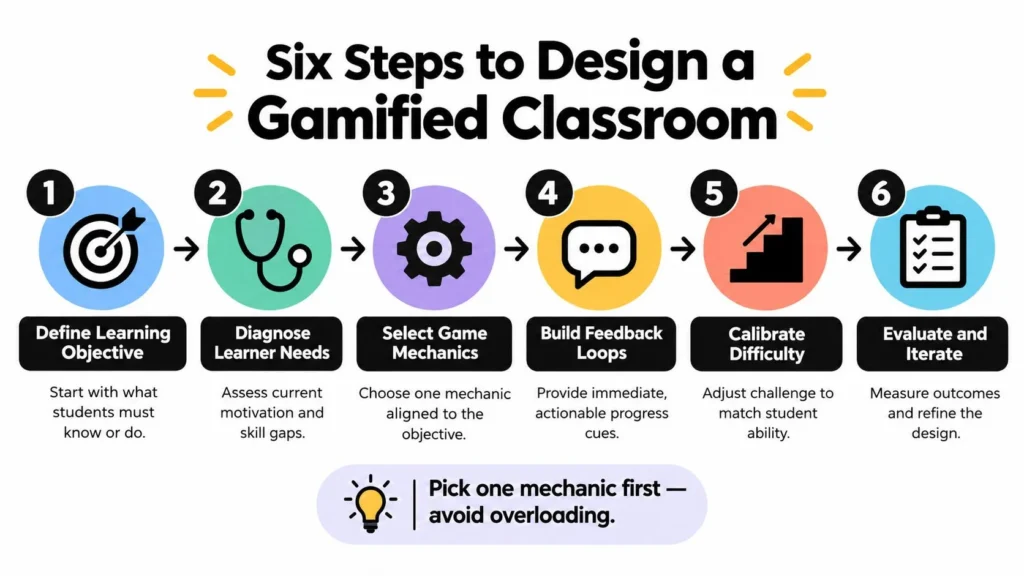
A reliable design begins with what students should learn, not with the features offered by an app. Define the target in observable terms. “Understand fractions” is broad; “compare two fractions and explain the reasoning” gives you something specific to teach, practise, and assess.
Begin with a learner need
Find out where students are getting stuck. They might understand a method but avoid practising it, or they might be practising often without recognizing why their answers are wrong. Those are different problems. A motivation-focused mechanic won’t fix confusing instruction, and a progress bar won’t help much if students need clearer explanations.
Choose a mechanic that fits
Start small. Use a branching choice if the learning goal involves making decisions, a progress indicator if learners need to see a long sequence of work, or a team challenge if explaining ideas to peers is useful. One carefully chosen mechanic is easier to evaluate than a stack of points, badges, timers, and rankings.
Keep rules visible and explain what earns progress. Reward evidence that matters to the objective, such as a correct explanation or a meaningful revision, rather than actions that are easy to count but weakly connected to learning. Build feedback into the activity so a wrong answer helps students identify a next step rather than merely lose a point.
Calibrate challenge and choice
Adjust difficulty so learners can make progress while still doing worthwhile thinking. Offer hints or examples where appropriate, and give students a way to try again without making every attempt a public event. Choice can take different forms: students might select a problem set, work individually or with a partner, or use a paper-based route instead of an online interface.
A low-tech design can work just as deliberately. A paper quest map can mark completed practice stations, with a teacher conference or a written note providing feedback at each checkpoint. The core idea is not the screen or the theme. It’s whether students can see what to do, understand how they’re progressing, and act on the feedback.
Before expanding the system, try it with a limited activity. Check whether the instructions are clear, whether the mechanic adds unnecessary work, and whether students can show learning without relying on the game’s reward. The embedded video below can serve as another prompt for considering classroom implementation.
Examples Across Subjects and Classrooms
The same game element can serve different purposes in different subjects. These classroom scenes are examples of design choices, not claims about measured results.
In a language class, students might follow a story in which a character needs to solve a problem using new vocabulary. At each checkpoint, learners choose a response and explain which word or phrase fits the context. The goal is using vocabulary in context; the mechanic is narrative choice; the feedback identifies why a response works or doesn’t. Students who need more time can respond in writing or work through the story without a timer. Evidence of learning comes from whether they can use the words accurately in a fresh sentence, not from reaching the final story screen.
In mathematics, a teacher could arrange practice as a series of increasingly demanding fraction problems. Students track their own progress toward a mastery goal rather than compete on a public ranking. After a missed problem, a worked example or targeted hint can help them identify the next step. A student who benefits from manipulatives can use paper fraction strips or classroom materials instead of completing every item on a device. The teacher checks both the solution and the student’s explanation to see whether the concept is taking hold.
A science class might use branching scenarios for an investigation. Students choose a procedure, review feedback about the result, then revise their plan. The mechanic supports decision-making, but the learning evidence is the quality of their reasoning and how well they connect a changed result to the evidence. Learners can work in pairs, use a printed decision tree, or explain their choices orally if typing creates a barrier.
For an example of language practice and study routines, rewarding study habits for Irish learners offers a related resource. Whatever the subject, keep the same planning questions in view: what is the learning goal, what does the mechanic invite students to do, what feedback helps them improve, and what work will show that learning occurred?
Choosing Tools and Measuring Learning
Choose the simplest tool that can support the learning task and give you useful evidence. A paper checklist may be portable and easy to adapt, though the teacher must record progress manually. A learning platform may provide a shared activity and immediate responses, but it can add setup work or limit student choice. A data-rich system may offer detailed tracking, yet collect more information than the instructional decision requires.
| Implementation path | Best instructional use | Teacher trade-off | Evidence question |
|---|---|---|---|
| Paper-based challenge or progress map | Low-tech practice, flexible pacing, and visible checkpoints | Easy to adapt, but feedback and record-keeping may take more teacher time | Can students explain or apply the target skill without the map? |
| Learning platform with game elements | Guided practice, quick responses, and structured feedback | Convenient to distribute, but access and interface choices can create barriers | Does performance improve on the intended learning task? |
| Data-rich adaptive system | Personalized practice and tracking patterns over time | May require more setup and careful review of privacy and accessibility | Which collected information is necessary, and does it help guide instruction? |
Digital options aren’t interchangeable, and a platform’s features don’t determine the quality of a lesson. For a broader look at choosing educational software, education technology tools for classroom use can help frame decisions around instructional fit rather than novelty.
Assessment should separate activity from learning. Participation counts, attempts, or completed levels show what students did during the experience. They don’t establish whether students can recall ideas later, explain their reasoning, transfer a skill to a new problem, or perform without rewards.
The 2019 synthesis discussed earlier found positive average effects across cognitive, motivational, and behavioral outcomes, but those categories remain distinct. Don’t use participation as a proxy for durable learning. Pair a process measure, such as whether students attempted the practice, with a learning measure suited to your objective, such as a fresh problem, an explanation, or a later check of retention. Then ask whether the tool helped you make a better instructional decision than a simpler option would have.
Use Gamification Responsibly in Real Classrooms
Game mechanics can create costs as well as opportunities. A public leaderboard may expose students who are still learning; a timed activity can disadvantage learners who need more processing time. A reward-heavy routine may also shift attention from the learning itself toward earning the reward. These risks don’t mean teachers should avoid gamification. They mean the design needs to account for who can take part comfortably, what data a platform collects, and whether students can demonstrate learning in more than one way.
A 2024 meta-analysis of 15 studies found a positive effect on learning achievement, while its tested moderators were statistically insignificant, offering limited guidance about which design elements or contexts work best. Recent discussion also identifies accessibility, privacy, technological equity, superficial achievement, reward dependency, and inequitable learning experiences as concerns (the 2024 meta-analysis and review). Those limits matter in real classrooms, where learners differ in access to devices, familiarity with the activity, language background, and support needs.
Keep an alternative available. Students might use private progress tracking instead of a public ranking, join a team goal instead of competing alone, or complete an equivalent low-tech activity. Make the rules clear, avoid collecting information you don’t need, and offer a route to opt out of competition without opting out of learning. Classroom routines and expectations can support those choices; these classroom management strategies for teachers offer related ways to structure participation.
Before you launch, check that you can answer six questions: What learning need are you addressing? What is the smallest useful mechanic? Can every student access it? What will you measure beyond activity? Will you check retention or transfer? Who benefits, and who may be disadvantaged? If students are busier but don’t understand more, revise the design or remove the game element.
MaxiJournal publishes approachable writing across education, science, technology, and other subjects, including practical commentary for curious readers. Explore more ideas about learning and classroom design at maxijournal.com.
Discover more from Maxi Journal
Subscribe to get the latest posts sent to your email.