You open your phone to check a space-launch update and leave with tabs about AI funding, climate research, and a medical breakthrough. By lunchtime, you remember the excitement but not what researchers established. Keeping up with science and technology news shouldn’t require turning every spare moment into homework.
Why This Guide Exists
Being informed means understanding what changed, how we know, and why it matters. It doesn’t mean recognizing every company name or reading every announcement before breakfast. A useful reading habit leaves you able to explain a development in plain language, including its limits.
Science and technology reporting can feel disjointed because the stories arrive at different stages of development. An experiment might reveal a promising mechanism. An engineer might build a working prototype. A business might announce plans to sell something based on related research. Those aren’t interchangeable milestones.
The confusion grows when headlines flatten those distinctions. A reader may reasonably wonder whether a discovery is ready for everyday use, whether an impressive demonstration represents normal operating conditions, or whether an announcement contains any new evidence at all.
Read for understanding, not completion
Treat the beat like a neighborhood you’re learning to manage. You need recognizable landmarks, dependable routes, and a reason to take an occasional unfamiliar turn. You don’t need to enter every building.
A manageable approach starts with a few questions:
- What interests me? Choose subjects you’d willingly explain to someone else, such as climate, health, computing, or space.
- What decision does this support? Reading for professional research requires different depth from reading out of curiosity.
- What remains unresolved? Keep track of open questions rather than collecting headlines that sound conclusive.
Practical rule: Finish a story by writing what changed and what remains uncertain. If you can’t separate them, keep the conclusion provisional.
This approach also helps prospective contributors. Before pitching an article, you need to understand which question readers still can’t answer after seeing the existing coverage.
A beat-by-beat map, a portable credibility check, and a modest reading stack are more useful than another headline reel. The aim is a routine that still works when a social feed changes, your interests shift, or you have a busy week.
What Counts as Science and Technology News
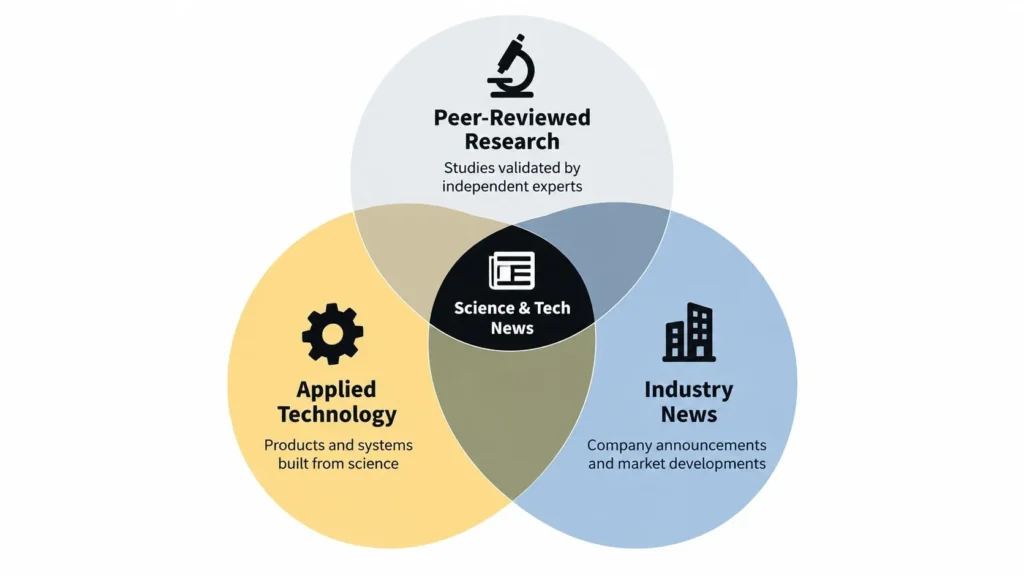
Think of science and technology news as the intersection of research, engineering, and reported context. Research asks what can be established about the world. Engineering asks how something can work under practical constraints. Reporting examines the evidence, consequences, institutions, and people involved.
A hypothetical battery announcement shows the overlap. A materials scientist might investigate its chemistry, an engineer might test manufacturing feasibility, and a reporter might examine sourcing or industrial policy. The subject is the same, but each story answers a different question.
This concept map shows how those areas connect.
Recognize the document before judging the claim
The document’s form tells you what kind of scrutiny to apply. It doesn’t automatically tell you whether its conclusion is correct.
| Document type | How to approach it |
|---|---|
| Press release | Treat it as an interested party’s announcement, then look for supporting material. |
| Preprint | Check its review status and avoid treating a preliminary result as settled. |
| Journal paper | Examine methods, limitations, and the scope of the conclusion. |
| Reported feature | Look for how the writer connects evidence, independent perspectives, and consequences. |
Technical vocabulary creates another barrier. If a story uses an unfamiliar abbreviation such as STT, a terminology resource like AIDictation’s STT guide offers a place to clarify the term before evaluating the larger argument. Understanding a label isn’t the same as validating a product claim.
Don’t force stories into isolated categories. A technology used in a classroom can raise education, privacy, business, and accessibility questions simultaneously. A cross-disciplinary magazine can connect those questions without treating every announcement as a scientific discovery.
Before digging deeper, label what you’ve opened: announcement, preliminary finding, evaluated research, implementation report, or contextual analysis. That simple classification helps you choose the right expectations.
Five Signals That a Science or Tech Story Is Credible
Credibility isn’t a badge you award permanently to a publication. It’s a judgment about whether a particular article gives you enough evidence to assess its claims. A polished page can still conceal a weak argument.
Use the following signals together rather than treating any single feature as proof.
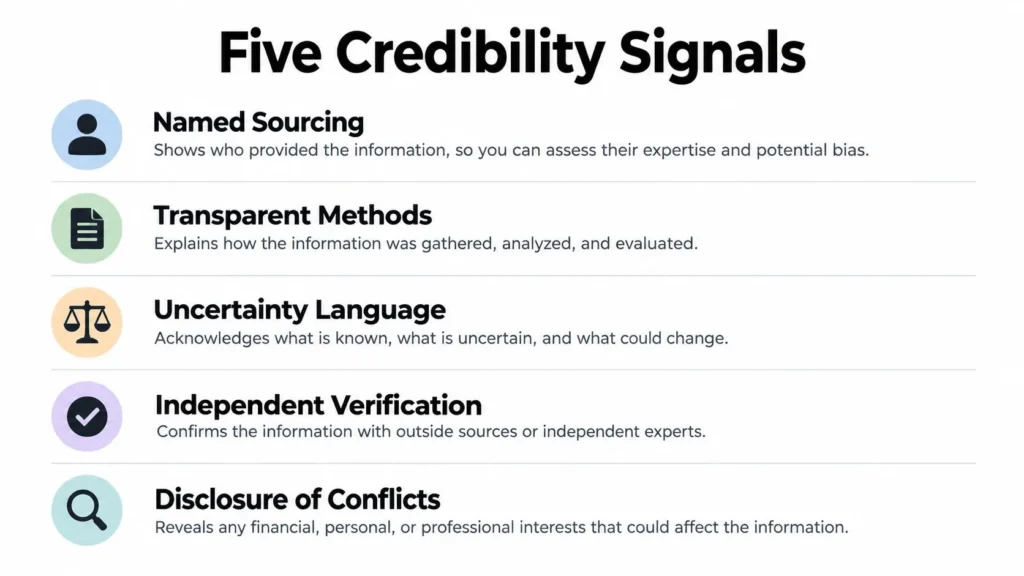
A reusable reading check
- Named sourcing. Can you identify the researchers, institution, paper, or underlying document? A phrase such as scientists say gives you no practical way to check the claim.
- Transparent methods. Does the article explain what was tested and what it was compared with? An accuracy claim needs a task, a test setting, and a meaningful baseline.
- Honest uncertainty. Look for the boundary between what researchers observed and what they hope to achieve. Could become isn’t equivalent to is available.
- Independent confirmation. Ask whether anyone outside the originating team evaluated the claim. Several articles repeating the same announcement don’t provide separate confirmation.
- Accountable authorship. Check the writer’s relevant work, corrections, and disclosure of interests. Familiarity is useful, but a recognizable byline shouldn’t replace scrutiny.
For a repeatable checking process, keep a source-verification reference alongside your reading notes. Record which claims you verified and which remain dependent on the original announcement.
Check the supporting media too
Images and clips deserve their own questions: Who created them? What do they depict? Could the caption describe something the visual doesn’t establish? A digital media forensics guide is a relevant starting point when you need to investigate media provenance rather than judge appearance alone.
A striking demonstration is evidence of that demonstration, not automatic evidence of dependable everyday performance.
Compare a press-release rewrite with a reported article about the same hypothetical device. The rewrite may repeat the performance claim; the reported piece should explain testing conditions, missing comparisons, and who benefits if readers accept the announcement.
Your corrective question is straightforward: What would I need to inspect before repeating this claim to someone else?
Recent Trends Shaping the Beat Right Now
Capacity, power, reliability, and access provide a more useful reading lens than novelty alone. The Apollo Guidance Computer offers a historical example: the meaningful story is not small memory by modern standards, but engineering a dependable system under demanding constraints. Use that trade-off lens when reading today’s computing announcements.
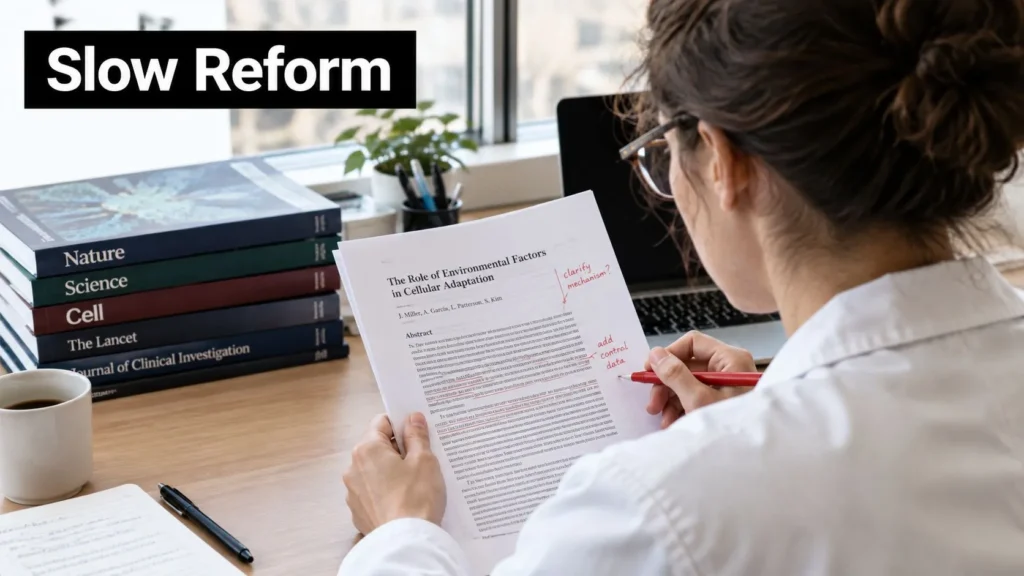
Scientific review also deserves attention behind the headline. The following image illustrates the less dramatic work of examining a research document.
Read breakthroughs as engineering proposals
An MIT research report describing electronic-photonic integration outlines a target of more than 1 petabit per second, not evidence that commercial systems already provide that capability. The proposed approach addresses connections between electronic components and components that carry information using light.
Think of the interface as a transfer point between transport systems. Improving the vehicles won’t help enough if the interchange remains inefficient. Ask about coupling losses, heat, energy per transmitted bit, manufacturing, and performance under comparable workloads.
The environmental question belongs beside the performance question. NPR’s reporting on AI’s energy and water demands discusses projections that data centers could use as much as 12% of U.S. electricity by 2028, alongside an estimate of 4.2–6.6 billion cubic meters of global AI-related water withdrawals in 2027. These are projections, and withdrawal isn’t the same as water permanently consumed.
Ask who receives the benefit
Technical reach isn’t universal access. The International Telecommunication Union estimated that 68% of the global population was online in 2024, while 2.6 billion people remained offline. Read rollout stories with affordability and infrastructure in mind, not just capability.
Use the embedded video as another format to examine with the same questions about evidence and context.
The same approach applies to a healthcare AI clearance, satellite proposal, or classroom tool. Ask what changed, under which conditions, and for whom. Those questions connect technology coverage to health, business, education, and entertainment without assuming that technical progress automatically produces public benefit.
Building Your Own Science and Tech News Stack
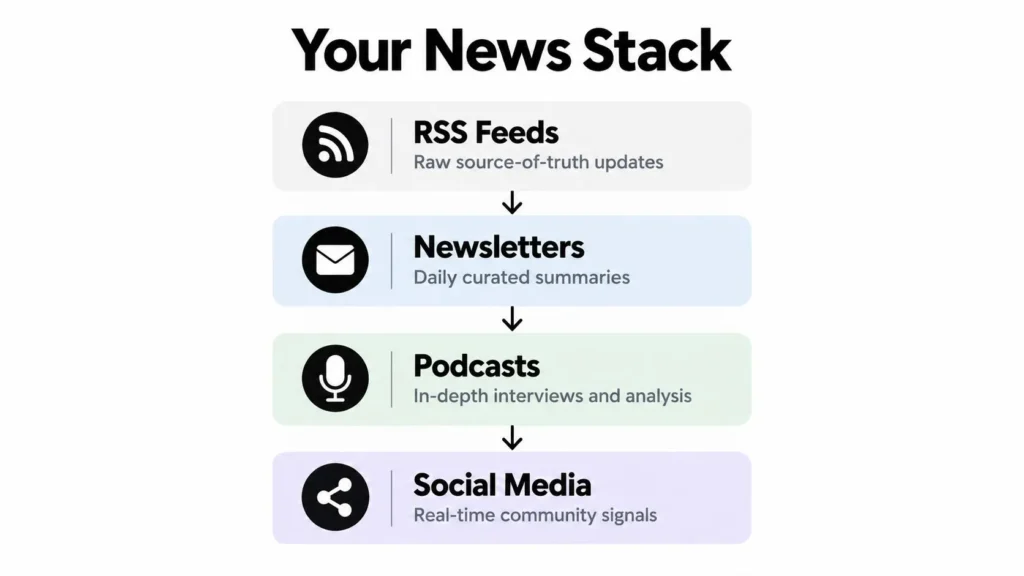
Build a reading stack around different jobs, not different logos. RSS, newsletters, podcasts, and alerts should complement one another rather than deliver overlapping versions of the same announcement.
The diagram offers a useful arrangement, with social discovery supporting rather than replacing deliberately chosen sources.
Start with a durable foundation
RSS is your subscription layer. Where feeds are available, use a reader such as Feedly or Inoreader to follow selected institutions and publications. Keep primary announcements separate from independent reporting so you can recognize their different roles.
An RSS feed is a delivery mechanism, not a guarantee of truth. Its advantage for this routine is that you choose the subscriptions instead of depending entirely on recommendations.
Newsletters supply editorial selection. Choose one whose editor explains why a story matters and points toward supporting material. For the distinction between collecting links and adding useful context, consult this explanation of content curation.
Add depth without multiplying obligations
A podcast can make room for a detailed conversation that doesn’t fit a brief. Use your existing podcast app, and prefer episodes with useful show notes when you expect to follow up on technical claims. Listening is a starting point for investigation, not a substitute for checking a document you intend to cite.
Keep push notifications narrow. An alert about a decision relevant to your work may deserve interruption; a broad stream of company announcements probably doesn’t. Treat social posts as leads to investigate rather than a reading queue you owe your attention.
- Subscribe deliberately. Start with a primary-source feed and an independent reporting feed.
- Choose a curator. Add a newsletter with a clear editorial purpose.
- Queue selectively. Save an interview tied to a question you already have.
- Limit interruptions. Enable alerts only for a subject that requires timely action.
If you later curate your own digest, use newsletter topic ideas for writers to develop a focused editorial promise rather than another general roundup.
Keep a plain-text list of subscriptions and a separate saved-reading folder. That makes your routine easier to reconstruct if you change apps.
How to Personalize Coverage Without Drowning in It
More information doesn’t necessarily produce greater understanding. In the Public Attitudes to Science survey, the share feeling well informed fell from 51% in 2019 to 43% in 2025, while 62% reported encountering too little science information. These findings don’t establish a cause, but they challenge the assumption that availability and understanding are interchangeable.
Personalize for the question you want answered, not merely the subject you click most often. Someone interested in climate might need practical energy reporting rather than a stream of dramatic temperature headlines. Someone learning about AI might need explanations of evaluation methods rather than product launches.
Assign each subscription a job
Use topic, format, and cadence as separate filters. You might want hardware as a short brief, health research as a longer explanation, and space policy as an occasional interview. Those preferences don’t have to match across subjects.
Mapping Science and Tech News Sources to Reader Jobs
| Source type | Best reader job | Time cost | When to prune |
|---|---|---|---|
| Primary-source feed | Inspect an announcement or document | Brief scan, deeper checking as needed | It rarely relates to your questions |
| Reported newsletter | Understand selected developments | Bounded reading session | Summaries repeatedly omit qualifications |
| Podcast | Follow reasoning and disagreement | Extended attention | Conversation adds little beyond promotion |
| Alert or aggregator | Notice a relevant event promptly | Small interruptions | Notifications rarely lead to useful action |
| Long-form feature | Understand systems and consequences | Deliberate reading block | The argument remains unsupported |
Review the stack monthly. Ask what you used, what changed your understanding, and what you saved out of guilt.
Keep sources that help you answer better questions, not sources that merely make you feel behind.
A useful pruning test is whether you can name the subscription’s distinct contribution. If several sources provide interchangeable summaries, retain the one that best supports your purpose.
Leave room for discovery, but keep it separate from the core routine. An unfamiliar subject can earn a permanent place after you develop a specific question about it. You don’t need to subscribe immediately just because an article was interesting.
For Contributors and Editors at Independent Outlets
A promising pitch begins with an unanswered reader question, not a fashionable keyword. An editor needs to understand what your article adds, what evidence supports it, and why the intended reader should spend time on it.
Consider AI’s environmental footprint. A broad pitch about whether AI is sustainable leaves the reporting task unclear. A narrower proposal about how to distinguish local water concerns from electricity-related emissions gives the writer a defined explanatory job.
Turn an interest into an assignment
Start by reviewing existing coverage, including the science and technology magazine coverage relevant to your proposed topic. Identify the missing explanation rather than claiming nobody has covered the subject.
Then assemble a reporting file with original documents, possible independent interviewees, and unresolved questions. Mark what you have already checked separately from what you hope to establish. That distinction prevents a pitch from promising a conclusion before reporting begins.
A practical pitch can include:
- The reader’s problem. State the question in ordinary language.
- Your fresh framing. Explain what existing coverage leaves unclear.
- The reporting route. Identify documents and people you intend to consult.
- The boundaries. Say what the proposed article won’t attempt to prove.
- The deliverable. Suggest a realistic scope, format, and filing plan.
Show editorial judgment early
Don’t describe your intended conclusion as inevitable. A proposal becomes more credible when it acknowledges what could change during reporting. If access to an essential document or interview is uncertain, tell the editor before accepting the assignment.
Common pitch problems include overstating novelty, burying the reader’s question beneath terminology, and relying entirely on organizations with a stake in the outcome. Correct these by showing your reporting plan, not by adding more confident adjectives.
Before sending, write the proposed opening paragraph. Does it introduce a recognizable problem, or merely announce that a technology is important? A reader-centered opening helps an editor assess both the angle and your ability to explain it.
Follow the outlet’s published submission policies, and don’t assume that general editorial advice describes a particular publication’s acceptance requirements.
Your First Seven Days and Quick Answers
Use this starter schedule as a manageable experiment, not a completion challenge.
- Monday: Choose a subject and write the question you’re following.
- Tuesday: Add primary and independent reporting feeds.
- Wednesday: Subscribe to a focused newsletter.
- Thursday: Queue a relevant podcast conversation.
- Friday: Configure a narrow alert in your preferred app.
- Saturday: Read a feature slowly and follow its evidence.
- Sunday: Remove duplication and choose next week’s deeper read.
Quick answers
Can I reliably spot AI-generated science writing by style?
Don’t make authorship guesses your main test. Verify the claims and supporting documents.
Where should I check whether a paper is a preprint?
Inspect its landing page and publication history rather than relying on a social caption.
Does independent mean more trustworthy?
No. Independence describes organizational circumstances, not an automatic standard of evidence.
What if I miss a day?
Resume with your current question. Don’t treat unread headlines as debt. Aim for brief daily check-ins and a deeper weekly read.
For daily writing across science, technology, health, business, and other connected subjects, visit maxijournal.com, an independent web-based magazine, journal, and blog. Choose an article that matches your current question, then use the reading checks above to decide what deserves a closer look.
Discover more from Maxi Journal
Subscribe to get the latest posts sent to your email.