Across UNESCO’s Member States, 171 countries acknowledge media and information literacy in national policy, but only 17 have substantive standalone policies, according to UNESCO’s global mapping announcement. That contrast reframes the debate over media literacy importance. Recognizing the need isn’t the same as teaching people how to judge a claim, and teaching people to distrust questionable content isn’t the same as helping them identify evidence they can trust.
What Media Literacy Means in Everyday Terms
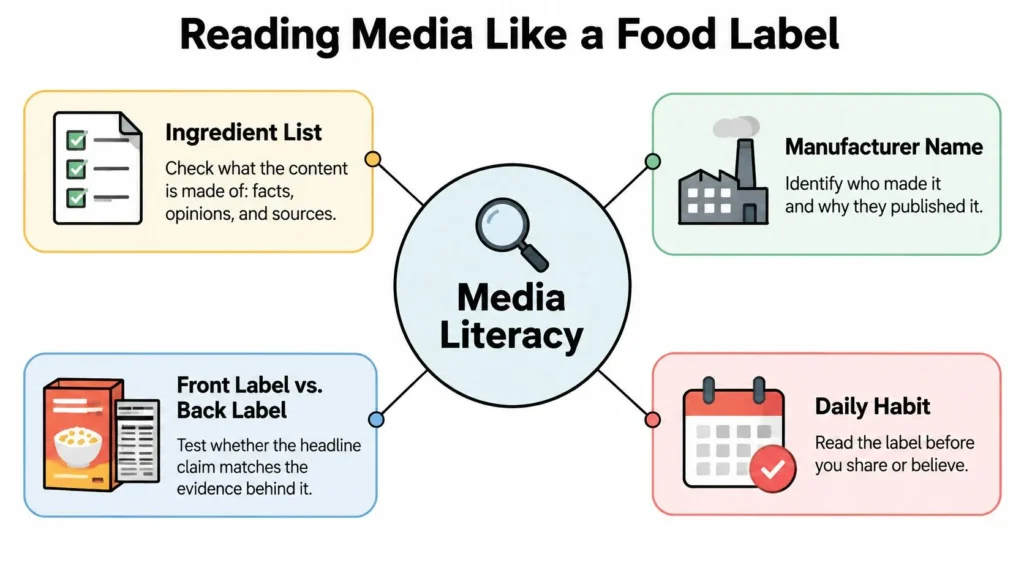
Think of checking a food label. The packaging makes a promise, but the ingredient list, manufacturer’s name, and nutritional information help you decide whether that promise holds up. You don’t need to become a food scientist to notice that the front of the packet and the contents tell different stories.
Media literacy applies that habit to messages. It means being able to access, analyze, evaluate, and act on information, whether you’re reading an article, watching a video, comparing products, or deciding what to share.
Media literacy is the difference between reading a message and understanding why it reached you.
A useful distinction is between digital skills and critical media literacy. Opening an app, uploading a video, and searching for a phrase are operating skills. Judging whether the result deserves your confidence requires a different kind of work.
Your phone can open a post almost instantly. It can’t make the judgment for you about whether its central claim is supported.
Read the message and its packaging
Apply the food-label analogy to an influencer’s review. The enthusiastic recommendation is the front label; the sponsorship disclosure, testing method, and purchasing links are part of the information behind it. A payment doesn’t automatically make the recommendation false, but it gives you something relevant to consider.
The same distinction applies to a travel guide, health post, sponsored article, or AI-generated image. Ask what the content actually establishes, rather than accepting what its presentation encourages you to assume.
This concept map turns those checks into a familiar everyday comparison.
For learners who want structured subject practice, MasteryMind’s Media Studies practice for UK learners offers a relevant place to extend classroom work. Treat learning resources as opportunities to explain your reasoning, not just memorize labels for different media formats.
Keep these questions close enough to use while browsing:
- Creator and purpose: Who made this, and why did they publish it?
- Supporting evidence: What supports the central claim?
- Selection and omission: What’s emphasized, and what important context is missing?
- Independent assessment: What do sources outside this account say?
- Responsible action: Should I share this, act on it, or leave it unverified?
You don’t need an elaborate investigation for every entertainment post. You do need a way to recognize when a message asks you to believe, buy, vote, or make a consequential decision.
Why Media Literacy Matters in 2026
58% of respondents across the Reuters Institute’s surveyed markets worried about distinguishing true from false online news, while only 22% reported receiving news-literacy training, according to its Digital News Report findings. These are survey-market findings, not a census of everyone worldwide. They nevertheless reveal a clear mismatch between concern and preparation.
The practical stakes are straightforward: people need to judge sources, recognize manipulation, and assess evidence before acting. That applies to an election allegation, a health product, a school decision, or a purchase.
Media literacy survey figures, 2024-2025
The Reuters rows below summarize the same report findings cited above. The other rows identify separate US surveys, so their results shouldn’t be treated as measurements of one shared population.
| Indicator | Figure | Source and year |
|---|---|---|
| Worried about telling true from false online, global surveyed markets | 58% | Reuters Institute Digital News Report, 2025 |
| Same concern in Africa and the United States | 73% | Reuters Institute Digital News Report, 2025 |
| Same concern in Western Europe | 46% | Reuters Institute Digital News Report, 2025 |
| Received news-literacy training, all respondents | 22% | Reuters Institute Digital News Report, 2025 |
| Received training, under 35 versus 35 and older | 36% versus 17% | Reuters Institute Digital News Report, 2025 |
| US adults saying media-literacy skills matter against misleading media | 72% | Boston University and Ipsos survey, 2024, 1,000 US adults |
| US teens saying schools should require media-literacy teaching | 94% | News Literacy Project and SSRS survey, 2024, 1,110 US teens |
| US teens answering all three news, advertising, opinion, and entertainment classification questions correctly | 18% | Minitex’s account of the News Literacy Project and SSRS survey, 2024 |
The most useful conclusion isn’t that audiences are helpless. It’s that wanting a skill, worrying about its absence, and demonstrating it are different things. Public support for instruction doesn’t establish competence, while low performance on a classification task doesn’t mean learners can’t improve.
The age difference in reported training also matters for program design. Schools are an important route, but a school-only response won’t reach adults who need help evaluating unfamiliar formats today.
A shared competency, not just personal protection
Questions about media literacy now extend beyond conventional reporting. For example, ClipCreator.ai’s AI dubbing safety guide provides a topic-specific starting point for considering dubbed media. The useful educational question is what a recording represents, not merely whether the voice sounds convincing.
Likewise, understanding what citizen journalism is helps separate the value of eyewitness participation from the separate question of verification. A person can provide important firsthand material without establishing every interpretation attached to it.
The society-level goal is shared: better-grounded voting, sound public-health decisions, and greater resilience to coordinated disinformation. Those outcomes require more than individual vigilance. They require accessible instruction and credible information people can use in practice.
How Misinformation Exploits Surface Credibility
A student opens a climate-science website. It looks organized, uses technical language, and offers plenty to read. The decisive question, however, concerns who finances it, not whether its pages look professional.
In Stanford’s national assessment of 3,446 US high-school students completing six tasks on the live internet, 96% failed to investigate a climate-science website’s financial relationship with the fossil-fuel industry; about two-thirds couldn’t distinguish advertisements from news stories, and 52% judged an anonymously posted video filmed in Russia to be strong evidence of US voter fraud.
Those results identify specific difficulties, not a reason to dismiss teenagers as incapable. The tasks asked students to evaluate information in the environment where they encounter it, with the internet available for checking.
When presentation stands in for proof
The central mistake was treating surface signals as substitutes for investigation. A professional design, an About page, a familiar-looking domain, or a large archive can suggest seriousness. None establishes that a particular claim is accurate.
It’s like trusting a jar because its label is beautifully printed without checking what’s inside. The packaging may be legitimate, but it hasn’t answered the question you need resolved.
The challenge is to move from attentive reading to active investigation.
Consider a hypothetical supplement website with a doctor’s photograph but no named author. The photograph doesn’t tell you who wrote the recommendation, whether the pictured person endorsed it, or what evidence supports the promised benefit.
Or take a destination guide that reads like independent travel advice but is paid advertising. Its practical details may still be useful, yet the commercial relationship matters when deciding whether its recommendations represent a comparison or a placement.
A viral clip creates another problem. Real footage from another country can be paired with a false local caption, so proving that the video exists doesn’t establish the claim attached to it.
Investigate the relevant uncertainty
For account-based claims, Digital Footprint Check’s guide to identify fake Facebook profiles offers a relevant extension of identity checking. Establishing who controls an account is useful, but it doesn’t replace checking what the account says.
Practical rule: A polished appearance shows effort, not accuracy.
The checks that matter are authorship, funding, provenance, and corroboration. Keep their purposes distinct: authorship establishes responsibility, funding reveals relevant incentives, provenance establishes where material came from, and corroboration tests whether the claim survives examination outside its original setting.
How to Check a Claim in Five Steps
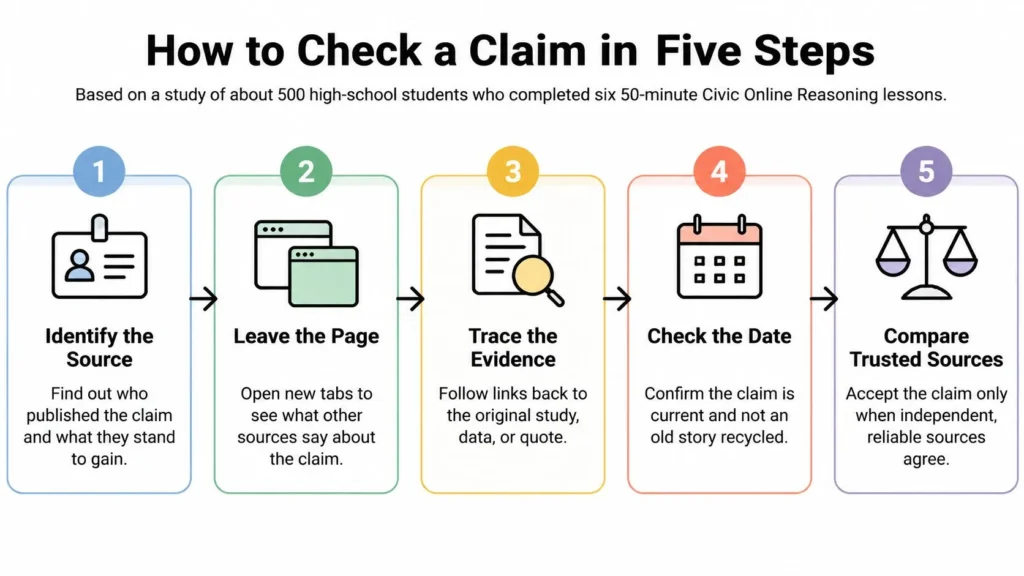
Evaluation behavior can be taught. In a randomized Stanford study involving approximately 500 high-school students, a Civic Online Reasoning intervention combined six 50-minute lessons with teacher professional development; by semester’s end, participating students performed twice as well as they had previously when identifying questionable websites.
That finding supports instruction in a specific setting. It doesn’t establish that a brief lesson permanently protects every learner against every kind of misinformation.
The central technique is lateral reading: leave the page and investigate the organization, author, and reputation through other sources. Instead of asking a website to certify itself, examine what can be established beyond its own description.
The following visual summarizes the workflow.
A repeatable checking procedure
Pause and state the claim plainly. Before sharing, write the factual assertion in a sentence. Separate it from the emotional framing: a frightening headline may imply more than the article really claims.
Leave the page. Search for the organization or author in a new tab, looking for independent reporting and relevant professional affiliations. The common slip is stopping at the source’s About page, which is a self-description rather than independent confirmation.
Check ownership, funding, and incentives. Look for the publisher, parent organization, sponsorship disclosures, and commercial relationships. Don’t treat a conflict of interest as automatic disproof; use it to decide what additional evidence you need.
Trace the original evidence and inspect its context. Follow the claim to the study, dataset, official record, interview, or complete recording. Check its date, population, and actual conclusion, rather than relying on a summary that may have broadened the finding.
Seek unrelated independent confirmation. As a practical default, look for at least two independent outlets or relevant authoritative sources before consequential action. Multiple pages repeating the same press release aren’t separate confirmations, and an unsupported claim can remain unverified even when it’s widely repeated.
For a more detailed approach to source selection, use this guide to finding credible sources for research. The important question is whether each source contributes independent evidence, not how many browser tabs you’ve opened.
Adjust the check to the material
For health claims, prioritize systematic reviews and relevant public-health or scientific bodies over product testimonials. Check whether the evidence concerns the same treatment, dose, and population described in the post, and don’t substitute online verification for individualized medical advice.
For images and video, try Google Lens or another reverse-image search tool, then look for the earliest accessible posting and the fuller recording. An early upload is a clue, not proof of original authorship, and failure to find a match doesn’t authenticate the material.
Use this video alongside a real claim, pausing to record what you would investigate.
Finish with an explicit judgment: supported, contradicted, or not yet established. Keeping an unresolved claim unresolved is better than forcing a confident answer the available evidence can’t justify.
Where Schools and Policy Still Fall Short
UNESCO’s global mapping across all 194 Member States, conducted between February and June 2025, distinguishes curriculum integration from policy recognition. That distinction is essential: a government can acknowledge a competency without ensuring that teachers have lessons, training, or assessment tools.
The table summarizes UNESCO’s reported categories. Policy percentages not stated directly are calculated from its country counts and rounded to the nearest whole percentage.
Media and information literacy in national curricula and policy, 2025
| Indicator | Countries | Share of 194 |
|---|---|---|
| Integrated into national school curricula | 84 | 43% |
| Limited elements, mainly technical digital skills | 56 | 29% |
| Not integrated into national curricula | 43 | 22% |
| Acknowledged in national policy frameworks | 171 | 88%, calculated |
| Substantive standalone media-literacy policy | 17 | 9%, calculated |
| No reference in national policy documents | 23 | 12% |
The curriculum categories shouldn’t be presented as exhaustive. UNESCO’s listed curriculum counts total 183 of 194 Member States, calculated from the counts in the linked mapping; the remaining classification isn’t established by these figures. The policy rows also aren’t mutually exclusive, because a standalone policy can sit within the broader group acknowledging related competencies.
Those qualifications matter. A careful account of media literacy shouldn’t flatten incomplete categories into a cleaner story than the evidence supports.
What implementation actually requires
Does giving people access to technology make them media-literate? No. Access allows participation, but it doesn’t demonstrate the ability to evaluate evidence, recognize manipulated context, or make responsible publishing decisions.
A useful curriculum must translate aspirations into observable work. Rather than asking students whether a website looks trustworthy, ask them to explain who owns it, locate the evidence behind a claim, and justify a judgment using material from outside the original page.
Teachers also need time to practice those tasks themselves. A lesson plan that names critical thinking without showing what successful reasoning looks like leaves too much to interpretation.
Schools and policymakers should require concrete deliverables:
- Teachable activities: Use real examples of disputed claims, advertising, missing context, and source relationships.
- Teacher preparation: Model the checking process, including uncertain results and unsuccessful searches.
- Assessment criteria: Reward justified conclusions and relevant evidence, not agreement with a preferred answer.
- Responsible participation: Include correction, privacy, consent, and the consequences of sharing identifiable material.
A policy document is therefore a starting condition, not a completion certificate. Treating recognition as achievement can create false confidence while leaving classroom provision fragmented.
Instruction outside formal schooling deserves equal attention. Libraries can host guided verification sessions; workplaces can teach staff to evaluate industry claims; community organizations can support accessible practice; and newsrooms can publish transparent explanations of how they checked contested material. These are practical delivery options, not evidence that every program already works equally well.
The standard should be what participants can demonstrate afterward, not how prominently an institution says it values media literacy.
When Media Literacy Training Backfires
Teaching people to spot misinformation doesn’t automatically produce confident, well-calibrated trust. A learner may become better at noticing warning signs without becoming better at deciding which sources deserve reliance.
The Reuters Institute’s 2025 Digital News Report found that trained respondents used more checking methods and were slightly more trusting, yet 83% viewed social and video networks as a major threat, compared with 74% of respondents without training. That combination complicates the assumption that greater literacy reduces concern.
These are associations, not proof that training caused anxiety. People who were already concerned may have sought instruction, and the findings don’t establish whether different teaching approaches had different effects.
Verification should produce calibrated trust
Healthy verification ends with a reasoned judgment about a claim. Generalized cynicism ends with the assumption that no claim can be established and no institution deserves consideration.
Skepticism is a tool; it should lead to a verdict, not to giving up.
Instruction should therefore teach positive criteria for trust, not just warning signs. Established news outlets, official statistical agencies, scientific bodies, and independent fact-checkers matter when they provide identifiable responsibility, relevant expertise, inspectable evidence, and meaningful correction practices.
None deserves automatic acceptance on every topic. Trust should attach to demonstrated methods and a relevant track record, with room to revise the judgment when an organization falls short.
Don’t teach doubt without offering alternatives
Access also matters. Where readers have few reliable local outlets or face language and accessibility barriers, telling them to abandon questionable sources without identifying usable alternatives leaves the practical problem unresolved.
Educators should help learners build a source shortlist appropriate to their subjects and circumstances. Evaluate each candidate using this trust-calibration test:
- Accountability: Who is responsible for publication, and can you identify the relevant expertise?
- Correction: How does the organization acknowledge and repair mistakes?
- Checkability: Can you inspect the evidence and distinguish reporting from interpretation?
The desired outcome isn’t less trust everywhere. It’s better-placed trust, accompanied by reasons.
Build Verification Habits Starting Today
Choose an action small enough to repeat rather than attempting to investigate your entire information diet.
Readers: Take the next health or money claim you’re tempted to share and record the claim, its original evidence, and your judgment. Keep a short log of what changed your mind or remained unresolved.
Educators: Give learners an unfamiliar page and ask them to document their investigation, not just name a verdict. Compare their reasoning before and after instruction using equivalent tasks, without treating a classroom exercise as directly interchangeable with a national survey.
Make the process visible
Publishers and contributors: Add source-owner, funding-disclosure, and original-evidence fields to submission forms. Ask editors to check whether the wording stays within what the cited material establishes.
For broader practice, these approaches to improving critical thinking skills can help turn an initial reaction into a question you can investigate. Keep notes brief enough that the habit remains usable.
Start today with a claim already in your feed. Open its evidence, record what you can establish, and decide whether sharing it would inform someone or merely pass along your uncertainty.
maxijournal.com publishes approachable writing across science, technology, health, education, business, and culture. Visit to explore a subject you care about, then practice evaluating an article’s central claim and following its named sources before deciding what to share.
Discover more from Maxi Journal
Subscribe to get the latest posts sent to your email.