The Super Mario Bros. Movie earned roughly $1.36 billion worldwide and became the first video game adaptation to pass the billion-dollar mark, according to Wikipedia’s record of game-to-screen adaptations. That number took three decades to arrive. The same franchise’s first Hollywood attempt, a 1993 live-action production, is remembered mostly as a warning about selling a brand without a working film underneath it.
The gap between those two movies is the argument of this list. An adaptation doesn’t succeed because it borrows a logo. It succeeds when the film keeps whatever the player does: running, exploring, fighting, hiding, or sitting in a particular kind of dread. Each entry below gets judged on four things: box office, critical reception, fidelity to the game’s identity, and whether it works for someone who has never held a controller.
Every film here is treated as worth watching. Some are good movies. Others are fascinating objects. Each entry says what it does well and where it falls short, so you can decide whether you’re watching for craft or for recognition.
The pattern that emerges isn’t subtle. Films that translated a game’s feel outearned films that only borrowed its names, and the numbers back that up year after year.
1. The Super Mario Bros. Movie (2023)
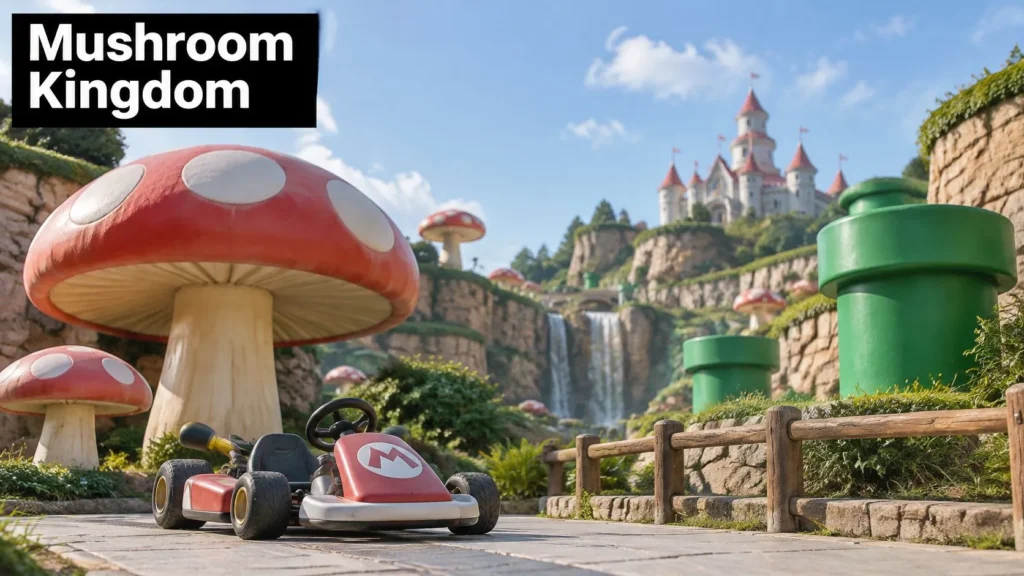
Illumination and Nintendo treated the Mushroom Kingdom as a playground. Mario and Luigi drop through a pipe. Bowser arrives to marry Peach. The film spends its energy on movement: the sprint, the item block, and a kart race that keeps Rainbow Road’s geometry.
The pipeline behind the polish
Making animation look like a game takes an industrial build. A French National Centre for Cinema case study on Arcane, described by The Game Business, tracks the shift from a few dozen generalists to a workflow involving several hundred artists. That crew size is what turns pipes, blocks, and karts into shots instead of copied sprites.
The Donkey Kong fight is the clearest proof of the strategy. The game has a punching move, so the film builds a whole arena around that move.
Watch the power-up scene closely. It’s staged as a tutorial, and it’s the only stretch where the film slows down to teach the audience a rule.
The Galaxy-era treatment of Luigi explains why a brother who spends most of the film captured still lands as a character.
Weak spot: the pop songs carry more emotional weight than the script, and Bowser’s plan gets less attention than his entrance.
2. Pokémon Detective Pikachu (2019)
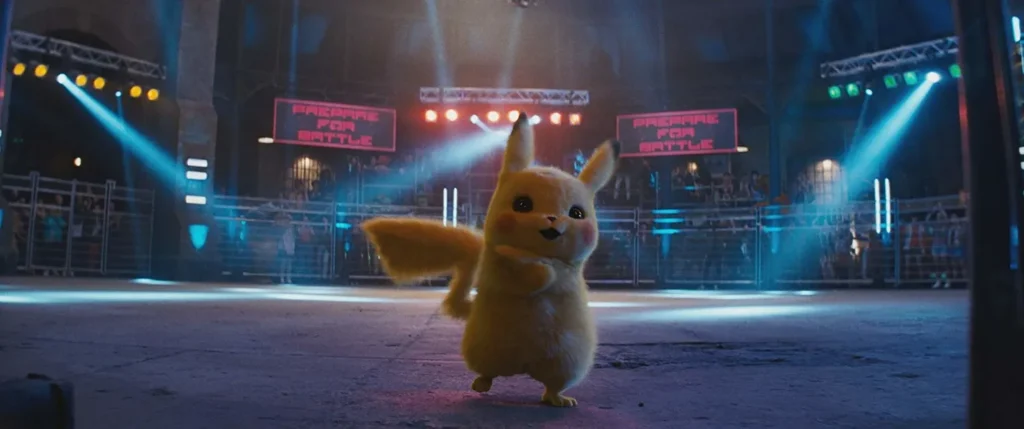
The games run on catching and turn-based fights. This film drops both and builds a city. Ryme City puts humans and creatures on the same streets, and the plot is a missing-person case, the nearest thing the series has to a detective mechanic.
AMT Lab’s research on game-to-film audiences found that 67% of gamers were more likely to watch a film based on a video game, against 32% of non-gamers, and that 48% of gamers had already watched one versus 30% of non-gamers. Recognition fills an opening weekend. A second weekend depends on whether the film still feels like the game.
What Reynolds gives the film
Ryan Reynolds voices Pikachu as a fast-talking noir partner. The joke works because the games treat that character as the quiet straight man. Justice Smith’s Tim Goodman learns the rules of a city the viewer has never walked.
The third act spends that advantage. A story built on detecting collapses into a CGI monster fight, the scene the games avoided by keeping combat turn-based.
Keep the case moving when the game is about investigation. Every minute on a boss battle is a minute the audience is not solving anything.
Creature design holds. The mystery stays thin. Pikachu is the franchise’s most recognizable face, and the most popular Pokémon list shows why.
3. Sonic the Hedgehog (2020)
Sega’s hedgehog arrived with the most public course correction in the genre’s history. The first trailer revealed a Sonic with human teeth and realistic fur, the reaction was brutal, and the studio rebuilt the character before release. The delay cost money. It bought a film that looks like the game.
The timing mattered. FTI Consulting’s analysis of gaming IP in media puts the average U.S. domestic gross for video game adaptations at $70 million in 2016, rising to $356 million in 2023, a 410% increase. Sonic landed in 2020, at the start of that climb.
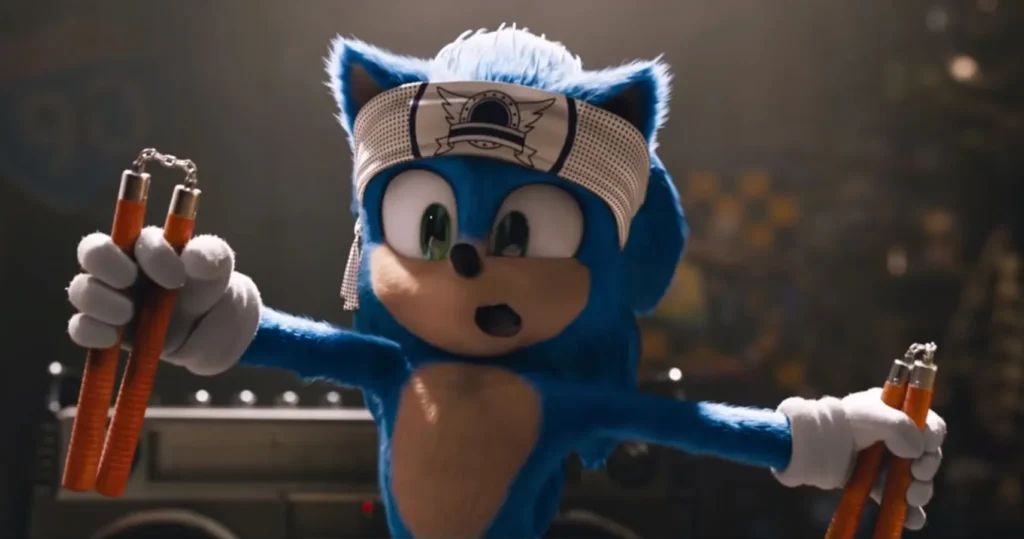
Speed is the whole mechanic
The film works when Sonic moves and the world doesn’t: the bar fight staged in frozen time, the highway chase where every vehicle hangs mid-air. James Marsden’s small-town sheriff exists to be the slow human in the room, and that’s a structural job, not a thankless one.
The rebuilt design and the tone that came with it are visible in the trailer.
Test the silhouette before you test the trailer. A character design that fails on a billboard will fail on a screen too, and fixing it after the campaign starts costs more than fixing it before.
Where it falls short: the middle act parks the fastest character in the genre in a truck for twenty minutes.
4. Mortal Kombat (2021)
Fighting games have no plot to adapt, only a roster and a ruleset. The 2021 reboot answers that problem with a new protagonist, Cole Young, a mixed martial artist with a birthmark, plus a great deal of time spent explaining the tournament.
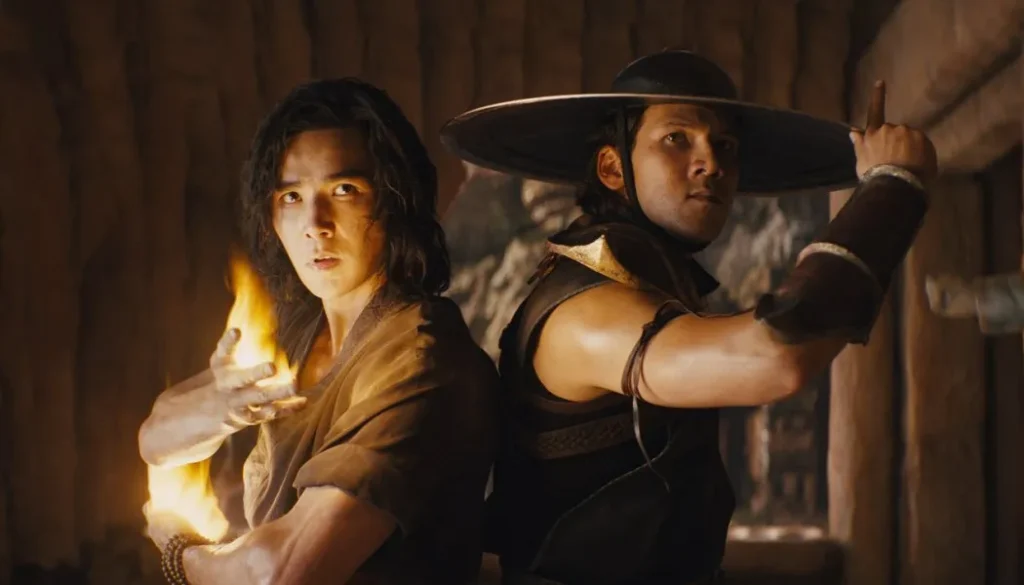
Audience research suggests the opposite instinct would have paid. In AMT Lab’s follow-up on adaptation strategy, more than 80% of respondents said they wanted expanded backstories for secondary characters from games they love. Mortal Kombat already knows this: its best ten minutes are the prologue, where Scorpion and Sub-Zero fight in feudal Japan with no newcomer in sight.
What works
- The rivalry: Scorpion’s fire and Sub-Zero’s ice are staged as opposing visual systems, not just two power sets.
- The finishers: the film earns its fatalities by keeping them rare enough to land.
- The architecture: the tournament is set up rather than spent, which leaves room for a sequel.
What doesn’t
- Cole Young: a blank guide through a world that never needed one.
- The release plan: arriving in theaters and on HBO Max on the same day made the film easy to postpone.
A fighting game’s identity lives in its rivalries. Invent a neutral hero and you’ve spent your first act teaching the audience nothing about the game they came for.
5. Resident Evil (2002)
Paul W.S. Anderson took a survival horror game about scarce ammunition and locked doors and turned it into an action vehicle for Milla Jovovich. Alice wakes up with amnesia inside an underground facility called the Hive, and the Red Queen has already sealed the exits.
That’s a real adaptation decision. The game’s tension comes from resource management: you count bullets, you avoid rooms, you solve a puzzle before something reaches you. The film keeps the architecture and drops the counting. What’s left is a corridor, a countdown, and a team getting picked off.
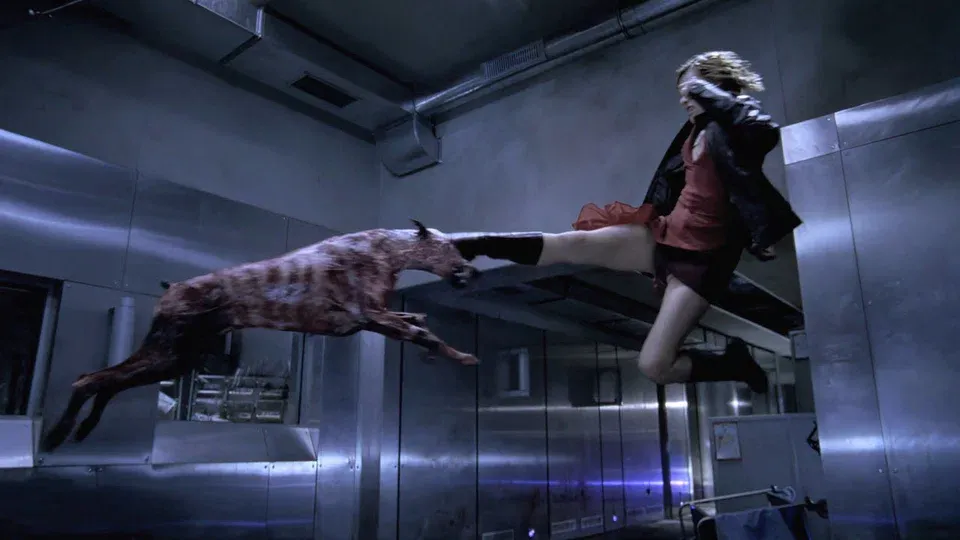
The laser corridor is the thesis
One scene explains the whole franchise. A security system cuts a grid of lasers through a hallway, and the team has to move through it. In the game, that’s a puzzle with a solution. In the film, it’s a body count with a punchline. Anderson chose spectacle over systems, and audiences followed him through five more films built on the same lead character.
Practical rule: identify what the player does moment to moment, then decide whether you’re keeping it or replacing it. Replacing it is fine. Pretending you didn’t is where adaptations lose people.
Where it falls short: Alice’s invincibility removes the fear the game sold. Where it works: the Umbrella Corporation and the Red Queen give six films a spine that no single plot summary could.
6. Lara Croft: Tomb Raider (2001)
Angelina Jolie’s Lara Croft is the rare case where casting does the adaptation work. The character’s identity in the games was always physical confidence plus an appetite for old things, and Jolie brought both to a script that mostly needed her to walk into a room and own it.
The commercial context explains why that mattered. CNBC’s reporting on game IP in Hollywood notes that between 1993 and 2018, only three video game films cleared $100 million at the domestic box office: Lara Croft: Tomb Raider in 2001, The Angry Birds Movie in 2016, and Rampage in 2018. The first of those three was this film.
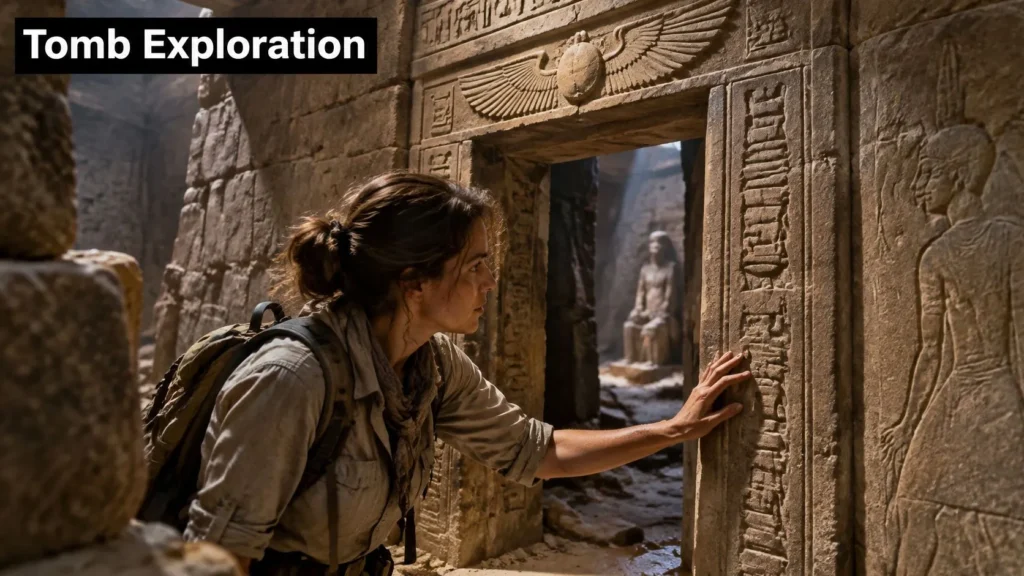
Exploration is a genre, not a mechanic
Tomb raiding translates because it’s already cinematic: a room, a mechanism, a trap, a leap. The film’s best sequences behave like levels, especially the Cambodia temple with its swinging blade traps and the giant clock-hand mechanism that has to be solved under pressure.
Cast the character, not the costume. Jolie’s version works because she plays an enthusiast rather than a mascot, and the dual pistols read as characterisation instead of merchandise.
Readers tracking the reboot’s different approach can compare it against the new Tomb Raider era, which trades confidence for survival and changes the entire tone of the character.
Where it falls short: the plot is a fetch quest with a light show at the end.
7. Uncharted (2022)
Tom Holland’s Nathan Drake spends the cargo-plane sequence hanging off a chain of crates while the fuselage tears open around him. That shot is the film’s real test. Naughty Dog’s Drake is a quipping climber who solves ancient puzzles between gunfights. The movie gives the role to Holland opposite Mark Wahlberg’s Sully, then asks whether the climb still feels like the game once the face changes.
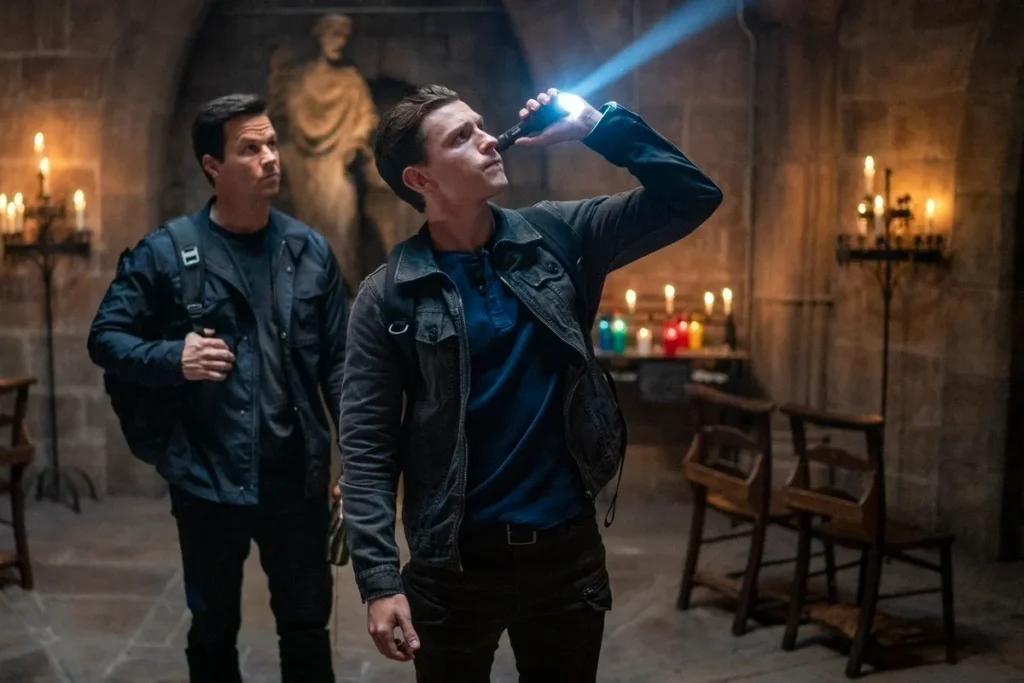
What the film gets right
The set pieces come straight from the games. The cargo plane, the auction heist, and the collapsing ship each play as a platforming problem, with the camera parked in the middle of the fall. Movement carries the identity. Lore speeches do not.
Holland plays Drake as a kid who has not grown into the legend. The film turns into a prequel by accident. Newcomers get a reason to watch him learn the grabs and the jokes. Players who wanted the finished Drake get a trainee instead. The puzzles are built in clear steps. The reason to care what sits inside the box stays thin, so the hunt reads as stunt design more than exploration.
Where it falls short: Sully’s moustache gets more characterisation than the villain. The names and the look travel. The opponent’s motive does not. A film can translate the climb and still miss the treasure hunt that made the climb matter.
8. Five Nights at Freddy’s (2023)
Five Nights at Freddy’s is the adaptation that proves atmosphere beats fidelity. Scott Cawthon’s game is almost entirely interface: you sit in an office, you watch cameras, you close doors, you ration power. There’s no protagonist to follow and no plot to compress.
The film solves that by inventing a security guard with a backstory, then keeping the camera language of the game. Long static shots. A room you can’t see into. An animatronic that only moves once the frame allows it.
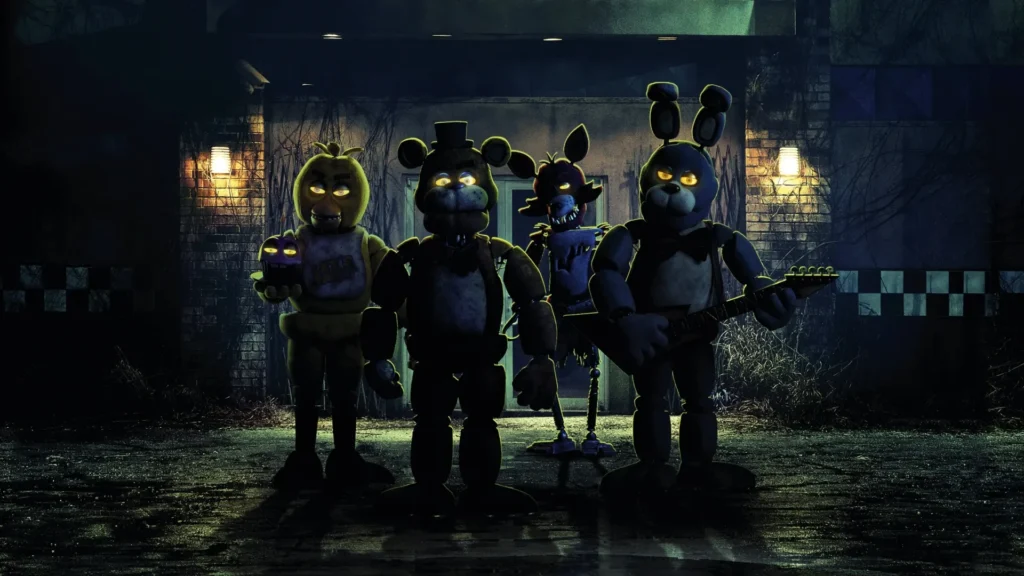
The scares come from the interface
The best sequences borrow the game’s structure directly, and the structure is a game design pattern. Night one is quiet. Night two adds a rule. Night three breaks it. That escalation survives the jump to film better than most action mechanics do, because it’s built on withheld information rather than on movement.
What the film understands
- Sound does the work: the arcade ambience and the door clunks carry more dread than any jump scare.
- The animatronics are physical: they sit in a real room, on a real set, and the camera respects their weight.
- The fandom arrived first: a decade of lore videos and theory threads meant opening weekend was decided before reviews landed.
For anyone adapting an indie horror game, remember the audience already knows the rules. Your job is to make them dread the moment the rules stop applying.
Where it falls short: critics were unkind, and the human plot is the least interesting thing in it. Where it works: it trusts silence.
9. Warcraft (2016)
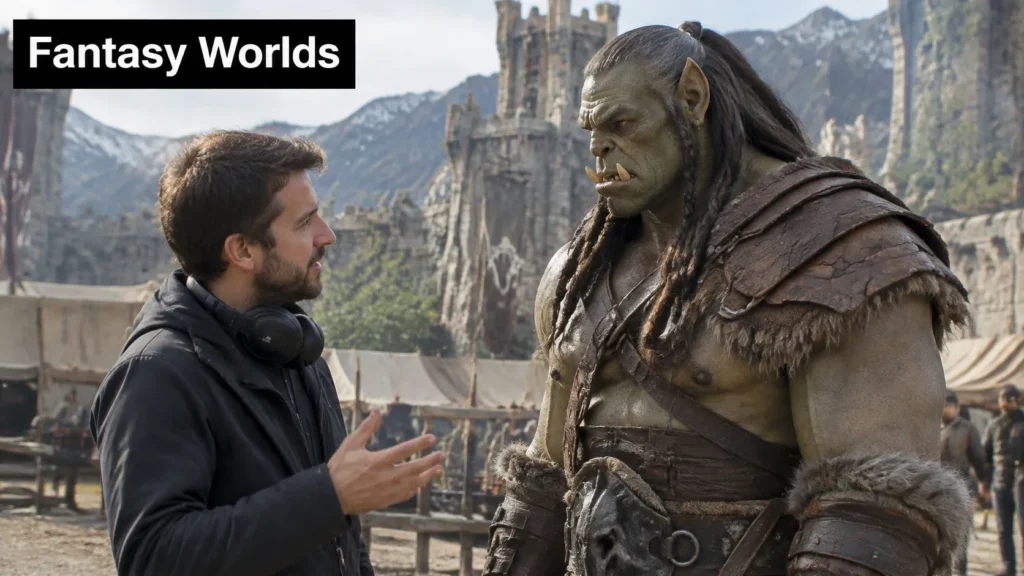
Duncan Jones took on the hardest adaptation in the genre: a strategy game with a world bible thicker than most novels. The result treats Azeroth as a place rather than a brand, and the orc motion-capture performances still hold up a decade later.
Critics didn’t follow. That split is the story. A 2023 Capital News Service analysis of 52 video game movies found that releases from the previous five years averaged 59% on Rotten Tomatoes, compared with 20% for films released before 2018. Warcraft sits on the wrong side of that line.
Two sides, one story
The structural gamble is telling the story from both the human and the orc perspective, which is what the game asks of you when you pick a faction. It’s ambitious, and it costs the film its momentum. Every time one side gets interesting, the camera moves.
Structural note: if your source material has two playable factions, give the audience one viewpoint and let the other stay foreign. Dual perspectives work across a forty-hour campaign. In two hours they flatten both sides.
Where it falls short: the lore density is a wall, and the human leads get outacted by the orcs. Where it works: the production design and those performances create a world you can believe in, which is exactly what the game asks you to do.
10. Prince of Persia: The Sands of Time (2010)
Prince of Persia: The Sands of Time is the adaptation that understood its own hook. The game’s identity was never the prince. It was movement and rewinding: running along walls, vaulting gaps, and undoing a mistake with a dagger.
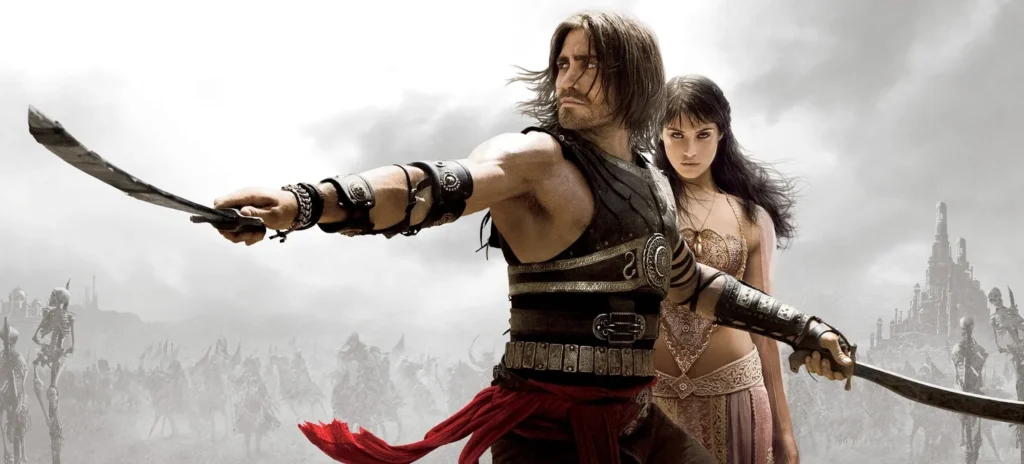
The film keeps both. Dastan, played by Jake Gyllenhaal, traverses rooftops like a platforming level, and the dagger that turns back time is the plot’s central object rather than a cameo prop. When the mechanism is the story, the audience learns the rules without a tutorial.
Parkour as choreography
Watch the rooftop chase through Alamut. The camera stays wide, the jumps are continuous, and the geography stays legible, so you always know where the next handhold is. That’s a level designer’s discipline applied to action editing.
A mechanic becomes cinematic when the film shows the cost of using it. Every rewind here takes something away, and that’s why the dagger reads as a weapon instead of a gimmick.
Where it falls short: the script sands off the game’s melancholy, and Gyllenhaal’s accent wanders between continents. Where it works: it’s one of the few adaptations that treats a game mechanic as a plot engine rather than a visual reference.
How the 10 Video Game Adaptations Compare at a Glance
| Item | Release Year | Lead Studio | Key Cast | Tone |
|---|---|---|---|---|
| The Super Mario Bros. Movie | 2023 | Illumination | Chris Pratt, Anya Taylor-Joy, Jack Black | Family-friendly, playful adventure |
| Pokémon Detective Pikachu | 2019 | Legendary Pictures | Ryan Reynolds, Justice Smith, Kathryn Newton | Mystery-driven, humorous |
| Sonic the Hedgehog | 2020 | Paramount Pictures | Ben Schwartz, James Marsden, Jim Carrey | Lighthearted, fast-paced adventure |
| Mortal Kombat | 2021 | New Line Cinema | Lewis Tan, Hiroyuki Sanada, Jessica McNamee | Brutal, action-heavy |
| Resident Evil | 2002 | Constantin Film | Milla Jovovich, Michelle Rodriguez, Eric Mabius | Dark, suspenseful horror |
| Lara Croft: Tomb Raider | 2001 | Paramount Pictures | Angelina Jolie, Jon Voight, Iain Glen | Adventurous, action-oriented |
| Uncharted | 2022 | Columbia Pictures | Tom Holland, Mark Wahlberg, Sophia Ali | Action-packed, globe-trotting |
| Five Nights at Freddy’s | 2023 | Blumhouse Productions | Josh Hutcherson, Elizabeth Lail, Piper Rubio | Eerie, fan-focused horror |
| Warcraft | 2016 | Legendary Pictures | Travis Fimmel, Paula Patton, Toby Kebbell | Epic, lore-rich fantasy |
| Prince of Persia: The Sands of Time | 2010 | Walt Disney Pictures | Jake Gyllenhaal, Gemma Arterton, Ben Kingsley | Swashbuckling fantasy adventure |
Where to Start and What to Watch Next
Ten films, one recurring result. The adaptations that held their audience translated something the player physically did: Mario’s jump, Sonic’s speed, Lara’s climb, the prince’s rewind. The ones that borrowed a name and a costume and then made a generic action film are the ones audiences forgot by the second weekend.
The category is now big enough that studios plan around it. Deloitte’s 2024 predictions on the blurring line between games and movies forecast that video game IP would claim a larger share of theatrical box office revenue. The report is a forecast. It shows where the money is pointing.
A viewing order that teaches you something
Start with The Super Mario Bros. Movie if you want the purest example of a film built from a game’s verbs. It’s gorgeous, and almost every set piece is a mechanic. Pair it with Five Nights at Freddy’s for the opposite lesson: a small film that keeps a game’s atmosphere and scares people with a camera that doesn’t move.
Then move to live action. Uncharted shows how set pieces transfer and how casting reshapes a character. Prince of Persia: The Sands of Time shows a mechanic used as a plot engine. Lara Croft: Tomb Raider is the historical baseline, the film that proved a game could open a summer. Resident Evil is the franchise lesson, where one decision about tone carried six films.
For the craft side, Sonic the Hedgehog is the case study in listening to an audience before release, and Warcraft is the case study in spectacle without a way in. Watch those two back to back and the difference is obvious within twenty minutes.
The test to apply to the next one
When a new adaptation is announced, set the casting rumours aside for a moment and ask a simpler question. What does the player do, over and over, for hours? If the answer is fight, the film needs choreography worth watching. If the answer is explore, the film needs geography. If the answer is hide, the film needs silence and a camera that refuses to blink.
Trailers sell characters and logos. Films hold an audience by what happens between the logos, and that is where the failures happen. The next wave will be judged the way this list was judged: by whether the film kept the thing your hands were doing, not by how recognizable the costume is.
Maxijournal covers gaming and film as one connected culture, from box-office analysis to the production choices behind the adaptations you grew up with. If this list changed how you watch game movies, browse the gaming and movies sections at maxijournal.com for more of that kind of breakdown, and check back as the next wave of adaptations arrives.
Discover more from Maxi Journal
Subscribe to get the latest posts sent to your email.