Water exists beyond Earth in forms that vary in both certainty and accessibility. Mars once had far more surface water than it does today, though the claim that it held a vast ocean is an inference from geological evidence. Water measured or detected elsewhere can mean something quite different: ice, vapor, molecules bound to dust, brine, or an ocean inferred beneath an icy shell.
The largest known water reservoirs may be inside moons, hidden beneath ice. Spacecraft have not seen those oceans directly. Instead, scientists infer them from clues such as gravity, magnetism, and geysers, much as a sealed room can be understood by the sounds and vibrations coming through its walls.
So “water found” is not one kind of discovery. Some water is measured as ice or vapor; some is inferred to be a subsurface ocean; and some may be liquid brine, not an open, reachable sea. Water is widespread, but accessible liquid water on the surface is rare.
Yes, Water Exists Beyond Earth, but Rarely as Seas
Water is one of the most common molecules in the universe, and that abundance shows up wherever we point good instruments. The claims behind it are no longer a single fuzzy spectrum that might mean something. They come from rovers digging in soil, an orbiter mapping ice from above, a spacecraft that flew through a geyser, and a telescope reading the air of a planet hundreds of light-years away.
What’s rare is the version people picture. Open, stable liquid water with air above it and a shore to stand on is the exception. Away from Earth, water mostly behaves like a material. It freezes into caps and permafrost, sublimates straight from solid to gas, dissolves into brine salty enough to stay fluid far below freezing, binds chemically into minerals, or sits under an ice shell kilometers thick.
| World | Water status | Form | Main evidence |
|---|---|---|---|
| Mars | Confirmed; abundant in the past, ice today | Ancient rivers, lakes and a possible ocean; polar and underground ice; transient brines | Orbiters, rovers and the Phoenix lander |
| Moon | Confirmed traces | Water molecules bound to soil grains and ice in shadowed craters | Infrared spectroscopy from orbit |
| Europa | Strong evidence | Global salty ocean beneath an ice shell | Magnetic field data, surface geology and tidal heating models |
| Enceladus | Confirmed | Subsurface ocean venting through south-polar plumes | Cassini flew through the plumes and sampled water, salts and organics |
| Ganymede | Strong evidence | Salty subsurface ocean | Magnetic and auroral measurements |
| Callisto | Suspected | Possible subsurface ocean | Magnetic field signatures |
| Titan | Suspected | Deep water ocean beneath surface hydrocarbon lakes | Gravity and radar measurements |
| WASP-18 b | Confirmed vapor | Water vapor in an ultra-hot gas giant atmosphere | JWST transmission spectroscopy |
| Kepler-138 c and d | Inferred | Possibly water-rich water worlds | Density modeling from mass and radius |
Two grades of evidence, never mixed
Read that table again and notice the column that matters most: the last one. Some rows rest on a machine that touched the water. Cassini flew through Enceladus’s plumes and sampled water, salts and organics directly. Phoenix baked a pinch of Martian soil in an oven and identified the gas that came off. JWST split starlight filtered through a planet’s atmosphere and found the absorption lines of water vapor.
Other rows rest on physics. A moon’s gravity field, its slight wobble, its induced magnetic signature or a planet’s density points to water no instrument has visited. Those are inferred, and the word is doing real work. An inferred ocean is a good explanation for the data, not a photograph of a shoreline.
Keep that split in mind for everything that follows. The rest of this guide covers what water looks like on other worlds, how each detection method works and where it can fool you, three deep dives into the strongest cases, and a four-question test you can run on the next “water found in space” headline you see.
What Counts as Water on Another World
Water exists beyond Earth in several forms, but a detection does not automatically mean there is a lake or a drinkable supply. Water vapor drifts through atmospheres. Ice forms caps, permafrost and buried glaciers. Brine is salty water that can remain liquid below the freezing point of pure water. Subsurface oceans lie beneath ice, while hydrated minerals hold water molecules within their crystal structures.
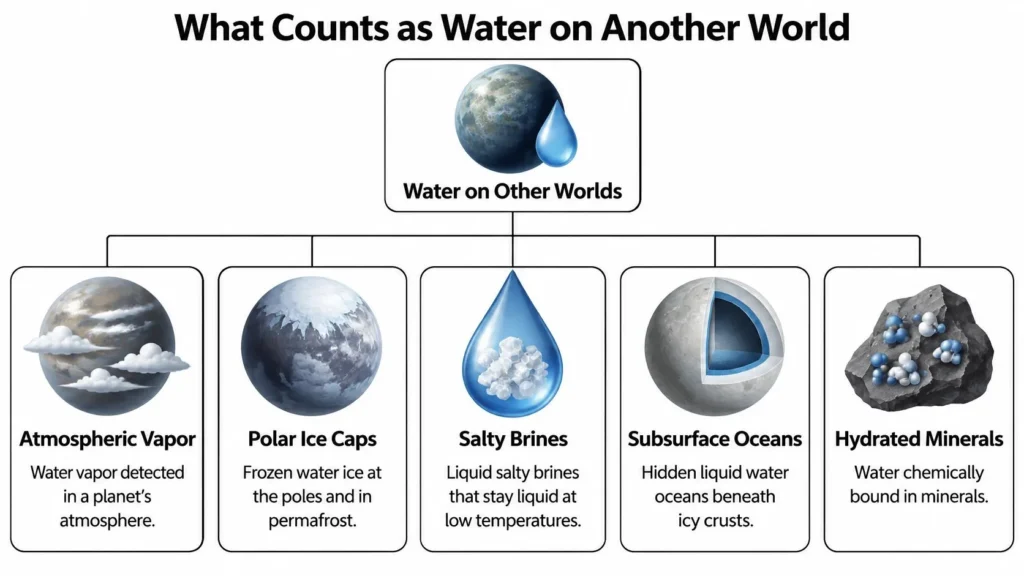
The same water, wildly different usefulness
Measured: Lunar soil in the sunlit Clavius Crater contains water molecules attached to or embedded in dust grains. The water is dispersed through the soil, not collected in pools, so extracting it would require processing the material.
Inferred: Europa likely has a global saltwater ocean beneath its icy crust. Even if that ocean is present, its depth and the ice above it make access a separate question.
These examples show why water claims need two labels: form and certainty. A measured trace of vapor or ice is not the same as an inferred ocean, and neither proves that water is easy to reach or useful to people.
Liquid water remains stable only under suitable temperature and pressure. Earth has both: sunlight warms the surface, and the atmosphere provides enough pressure to keep water liquid. On other worlds, water may freeze, escape as vapor, or persist underground instead.
Sunlight is not the only way to keep water fluid. Tidal flexing can knead a moon’s interior as it orbits a giant planet, much as repeated bending warms a piece of wire. That internal heating can help maintain liquid water far from the Sun.
Finding water is one claim. Showing that it is liquid, accessible, safe to sample, or useful to a crew requires separate evidence.
How Scientists Detect Water on Distant Worlds
A water detection can mean anything from a measured molecule to an inferred ocean. The instrument determines how strong the claim is: light reveals chemical fingerprints, radar maps buried boundaries, and spacecraft instruments can analyze material directly.
Reading light for fingerprints
Spectroscopy measures how matter absorbs or emits particular wavelengths. Water and hydroxyl groups leave characteristic patterns in light, allowing orbiters to map hydrated minerals on Mars and the James Webb Space Telescope to study exoplanet atmospheres during transits.
A spectrum identifies chemistry, not necessarily physical form. Hydrated salts and liquid brines can leave overlapping signatures, so a spectral hint of water does not by itself establish a puddle or ocean.
Instruments that touch the sample
Radar sounding sends pulses into the ground and records reflections from ice layers and other buried boundaries. A lander can also heat soil and identify the released gases, while rovers examine water-altered minerals at the surface.
Spacecraft have sampled material from an ocean world directly, though not the ocean itself. Cassini flew through Enceladus’s plumes and detected water, salts and hydrogen. Those measurements support the inference that warm rock reacts with water beneath the ice.
| Method | What it measures | Famous example |
|---|---|---|
| Spectroscopy | Wavelengths absorbed or emitted by water and hydroxyl | Mars orbiter mineral maps; JWST exoplanet atmospheres |
| Radar sounding | Reflections from ice layers and subsurface boundaries | MARSIS and SHARAD orbiters at Mars |
| In-situ soil analysis | Gases released when soil is baked; hydrated minerals | Phoenix TEGA oven; Curiosity and Perseverance rovers |
| Plume flythrough | Direct sampling of particles vented from an ocean | Cassini through Enceladus’s south-polar plumes |
| Gravity and magnetic fields | Density structure and induced fields from conducting oceans | Galileo at Europa; auroral data for Ganymede |
| Density modeling | Mass and radius combined to infer a water-rich composition | Kepler-138 c and d water worlds |
Where detection turns into argument
On Mars, spectral signatures associated with recurring slope lineae were interpreted as hydrated perchlorate salts. Those salts can lower water’s freezing point and may allow intermittent brines at very low temperatures, as NASA’s account of the evidence for liquid water on present-day Mars explains. The interpretation points to a possible brine, not a direct observation of flowing liquid.
Radar reflections beneath Mars’s south polar ice cap have also been proposed as evidence of liquid water, but later analyses challenged that reading. Similar reflections occur in regions estimated at about minus 63 degrees Celsius, where perchlorate-rich water would generally be frozen; clay minerals can also produce similar signals. The radar measures reflections, so the proposed liquid remains an interpretation.
Match the instrument to the claim. A spectrum can identify a molecule; a sample can reveal what else is dissolved in it.
The confidence ladder
Gravity and magnetic measurements reveal consequences of a possible ocean rather than water itself. A buried ocean can affect a moon’s density, shape and magnetic field. Those effects support an ocean inference, but they are not a direct sample.
Density modeling is less direct still. Scientists compare a world’s measured mass and radius with the expected properties of rock and iron. A lower-than-expected density can suggest a large water fraction, but it cannot confirm whether that water is ice, liquid or vapor.
Direct sampling offers stronger evidence about composition than remote sensing; remote measurements generally support firmer claims than models alone. A useful headline keeps those categories separate: measured material, inferred ocean, or modeled water-rich interior.
Mars, the Planet That Lost Its Water
Mars is the strongest case that another planet had surface water, and the numbers are not delicate. NASA estimates that roughly 4.3 billion years ago Mars held an ocean of at least 20 million cubic kilometers, about 5 million cubic miles, enough to cover the entire planet with a global layer roughly 137 meters (450 feet) deep, a volume that exceeded Earth’s Arctic Ocean, according to NASA’s ocean worlds overview.
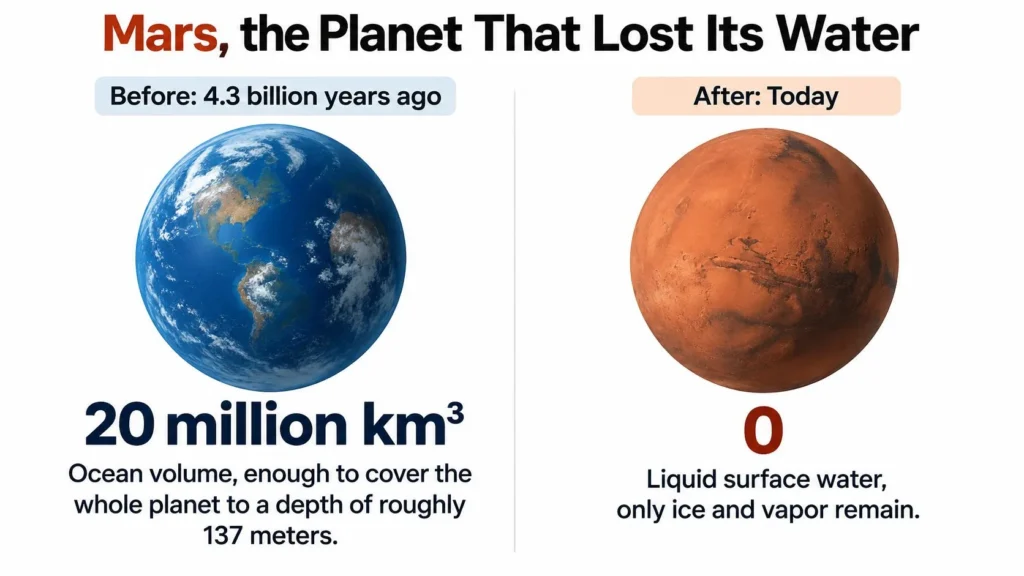
What the rocks remember
You don’t need a chemical argument to see the water. Valley networks, flood channels, ancient lake deposits and deltas all require flowing liquid to form, and rovers have found water-altered minerals sitting in the same layers. Spacecraft and rover evidence indicates Mars was especially wet during its first 1 to 2 billion years, when the atmosphere was thicker and the surface could sustain rivers, lakes and possibly regional seas.
That’s the before picture, and it’s measured rather than imagined. Landforms record flow direction. Mineral chemistry records standing water. Nothing about the case depends on a single ambiguous instrument.
How a planet loses an ocean
The turn is atmospheric. As Mars’s magnetic field faded and its air thinned, the solar wind carried atmospheric particles into space, and with the pressure gone, surface water had nowhere to stay liquid. NASA puts the total loss at approximately 87 percent of Mars’s original water.
What survived went into storage. Most of today’s Martian water is frozen in the polar ice caps or trapped underground rather than sitting in stable lakes or seas. A planet that once had a northern ocean now keeps its water in the same way a freezer does: cold, buried and out of the light.
The brine question, and why it isn’t a lake
NASA’s Phoenix lander settled the ice question directly. Bright material exposed in a trench vaporized within four days, exactly as water ice would, and its Thermal and Evolved Gas Analyzer independently identified water in a soil sample. Phoenix also measured perchlorates at approximately 0.4 to 0.6 percent of northern Martian soil by mass, per NASA’s Phoenix mission page.
Those salts matter because they absorb atmospheric moisture and lower the freezing point. Calcium-perchlorate brines can stay stable near minus 75 degrees Celsius, and modeling indicates some hydrated brines may persist at depths of roughly 15 centimeters or more, where humidity and temperature vary less. Any liquid on Mars today is therefore localized, saline, transient and hard to confirm.
Anyone sketching out how we would eventually make the planet habitable has to start from that inventory of frozen and trapped water, a subject covered in this look at how long it would take to terraform Mars. For now, the verdict is simple. Mars provably had surface water. Today it keeps its water frozen and hidden.
Hidden Oceans Inside Icy Moons
Icy moons hold some of the strongest evidence for liquid water beyond Earth, but the evidence is not equally direct. Enceladus sprays material from its ocean into space; Europa’s ocean is inferred beneath its ice; and Ganymede’s is inferred from magnetic and auroral measurements. These are hidden oceans, not open seas.
Why a frozen moon can hold liquid water
A moon in a slightly elliptical orbit is flexed by its planet’s changing gravity. The repeated stretching and relaxing generates heat inside, much as bending a paperclip warms it. This process, called tidal heating, can help keep water liquid beneath an icy shell even where sunlight is too weak to do so.
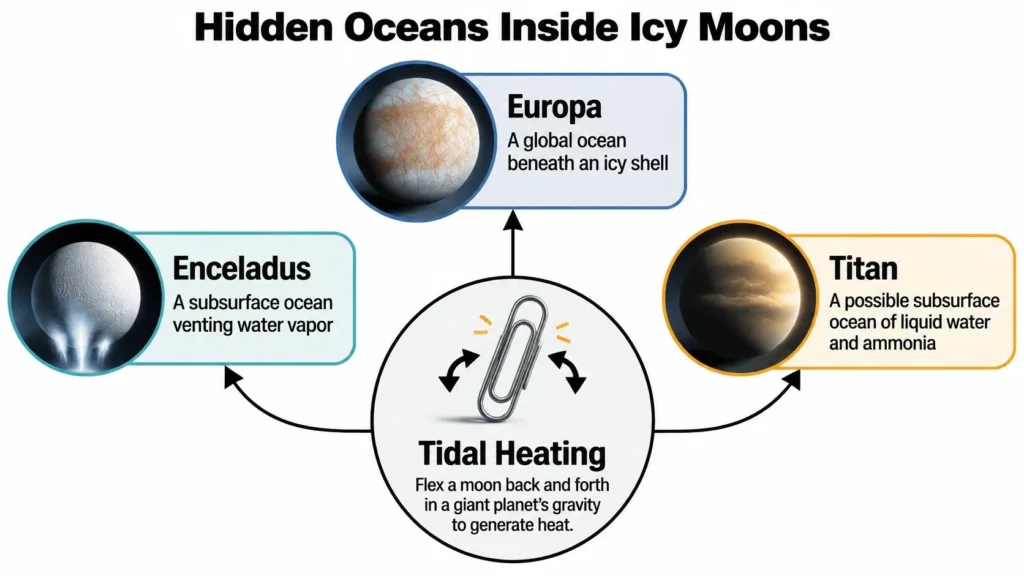
Three oceans we can describe
NASA identifies Europa and Enceladus as ocean worlds with global subsurface oceans of liquid water. Ganymede also has strong evidence for a saltwater ocean beneath its surface. Each case has a different kind of evidence, so “water found” does not mean the same thing for all three.
Europa’s ocean is inferred beneath a fractured ice shell, with tidal heating helping to keep it liquid. At Enceladus, Cassini detected plumes escaping through fractures near the south pole, along with evidence of hydrothermal activity. Those observations support the inference of a global ocean interacting with warm, mineral-rich rock. Ganymede’s ocean, by contrast, is inferred from magnetic and auroral measurements, not from a plume or a direct sample.
The architecture they share
These moons can be understood as layers: an icy exterior, liquid water below, and a rocky interior. The arrangement could bring liquid water, an energy source and chemistry together in darkness, much as deep-sea hydrothermal environments do on Earth. The layers are a useful model, though the ocean itself has not been sampled.
That distinction matters. Evidence from gravity, surface geology, magnetic fields and plumes can support an ocean’s existence without letting scientists inspect its water directly. The oceans remain buried beneath thick ice, making direct measurement difficult.
Why it matters: A moon can have liquid water, an energy source and chemistry without useful sunlight. That makes hidden oceans a distinct kind of water claim: in some cases, water is detected in escaping material; in others, an ocean is inferred from measurements of the moon’s interior and surroundings.
Ice also raises a practical engineering question: how could a mission extract and use it without contaminating the environment it is studying? The NASA Moon Base Challenge entry rules illustrate how a design brief can turn the idea of local ice into constraints involving extraction, power and contamination.
Water Vapor and Water Worlds Around Other Stars
A water detection on an exoplanet can mean a trace of gas, not a sea. When a planet crosses in front of its star, some starlight passes through the planet’s atmosphere. Atmospheric molecules absorb particular wavelengths, leaving patterns in the spectrum that scientists can use to identify them. The measurement reveals which molecules are present along that path, not what the planet’s surface looks like.
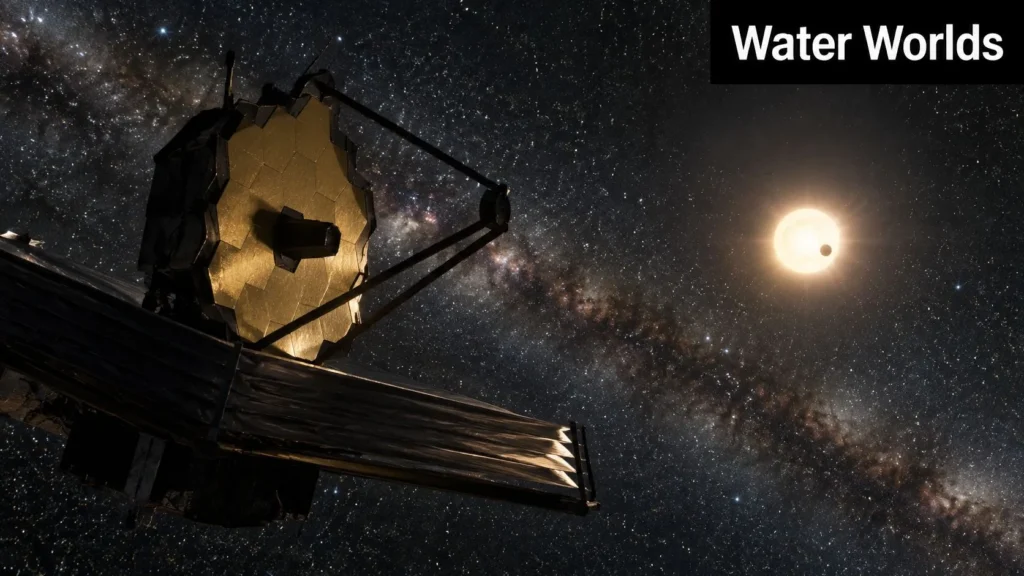
WASP-18 b shows how unusual the conditions can be. NASA reported detectable water vapor in the atmosphere of this exoplanet, where temperatures approach 2,700 degrees Celsius, in its discovery alert about water in an ultra-hot gas giant’s atmosphere. The result is measured atmospheric vapor. It is not evidence of liquid water or a habitable surface.
Where inference takes over
For many other planets, water is a possibility inferred from bulk properties rather than detected directly. Astronomers measure a planet’s radius as it crosses its star and estimate its mass from the star’s motion. Together, those measurements give a density. A low density can fit a planet with a substantial water fraction, but it does not establish that water is present as an ocean or even as surface liquid.
That distinction matters for claims about planets like Earth. A spectrum may measure water vapor; a planet’s density may support an inferred water-rich composition. Neither result alone shows that liquid water can persist at the surface. That requires a climate model, and the conclusion remains an inference.
Vapor, condensation and pressure form one connected system. The same basic relationships considered in atmospheric moisture and water resource management help explain why detecting water molecules does not, by itself, reveal whether they condense into clouds or remain vapor.
The farther the planet, the more its water story depends on remote measurements and models. A detected vapor signature is measured evidence of atmospheric water; a proposed water world is an interpretation of a planet’s density. Those claims carry different levels of certainty and describe different forms of water.
How to Test Any Water Discovery Headline
A water headline is only as clear as its answers to four questions: what form was found, how it was detected, where it is, and whether it could be reached or used.
- What form is claimed? Vapor, ice, brine, hydrated mineral, or a buried ocean are different findings. A headline that says only “water” leaves out the key distinction.
- How was it measured? Direct sampling and on-site chemistry provide the strongest evidence. Remote sensing can identify water-related signals from a distance. Density modeling alone is the weakest; gravity and magnetic data sit in the middle, since they measure the effects of a buried ocean rather than the water itself.
- Where is it? Surface, subsurface, or atmosphere? Location affects whether water could be reached.
- What would it take to use? Consider the energy needed to drill or heat material, how to prevent contamination, and whether extraction could damage a scientifically valuable site.
Enceladus passes these tests in a distinctive way: spacecraft have sampled water in plumes venting into space, making that water physically reachable. WASP-18 b’s water-vapor signal answers the questions of form and detection, but not practical access. Vapor in a 2,700-degree atmosphere does not establish an ocean, a habitable climate, or a place to land.
Presence and provenance are different questions
A water discovery can also raise a question about origin. Researchers identified an ancient water-ice reservoir in the Kuiper Belt from 12 microscopic interplanetary dust particles collected in Earth’s stratosphere. The particles carried oxygen-isotope signatures strongly depleted in oxygen-16, as UCLA and NASA researchers describe in their study of the outer solar system’s water. The finding suggests that water-rich material in the outer solar system remained relatively isolated while the giant planets formed.
That evidence complicates the simple story that comets delivered Earth’s oceans. Finding a distant reservoir does not show that its water traveled inward. Formation dynamics may have limited that movement. Presence and provenance are separate claims; neither alone establishes how Earth’s oceans formed.
Provenance asks where water came from. Presence asks where it is now. Habitability requires a third answer: whether conditions at the surface could support life.
What to watch next
Europa Clipper and ESA’s JUICE are set to test ocean models around Jupiter’s moons. Dragonfly is in development to reach Titan’s surface and atmosphere, while Mars orbiters continue refining ice maps relevant to future crews.
The useful questions are specific: what form of water is reported, how directly it was measured, and how accessible it is. Keep those distinctions in mind, and a headline about “water found” becomes easier to assess.
maxijournal.com is an independent, web-based magazine, journal, and blog that publishes writing across subjects including science and technology. Its plain-language science coverage distinguishes instrument measurements from model-based inferences. Read more at maxijournal.com.
Discover more from Maxi Journal
Subscribe to get the latest posts sent to your email.