So, you’re wondering how long your dog will be in heat. The quick answer is that the most noticeable, “active” part of the heat cycle usually lasts for about 2 to 4 weeks.
But if you’ve ever owned an unspayed female dog, you know there’s a lot more to it than just that one number. The entire process, known as the estrous cycle, is a much longer biological journey. Getting a handle on the full timeline will make everything far less mysterious and help you know exactly what to expect.
How Long a Dog’s Heat Lasts
Think of your dog’s reproductive cycle like the four seasons of a year. Each “season” has its own purpose, signs, and timeline, and they always follow the same order. Once you understand the progression, you’ll feel much more prepared.
Here are the four stages we’ll be walking through:
- Proestrus (Spring): This is the “getting ready” phase. Her body is preparing for the possibility of breeding, but she’s not quite there yet.
- Estrus (Summer): This is the main event. It’s the fertile window when she is actually “in heat” and receptive to mating.
- Diestrus (Autumn): After the fertile window closes, her body enters a winding-down period.
- Anestrus (Winter): This is the long dormant or “resting” phase before the whole cycle kicks off again.
The cycle officially begins with proestrus. This first stage typically lasts around 9 days, though it can be as short as 3 or as long as 17 days for some dogs. A surge of estrogen is what gets the ball rolling, causing the first signs you’ll likely notice: a swollen vulva and some bloody discharge. She’ll definitely start attracting a lot of male attention, but she won’t be interested in their advances just yet. For a deeper dive into the biology, you can always check out this overview of the canine estrous cycle from DVM360.
To help you get the lay of the land, let’s put it all into a simple chart. This will give you a quick snapshot of the entire journey before we break down what each stage means for you and your dog.
The Four Stages of a Dog’s Heat Cycle at a Glance
This table breaks down the four “seasons” of the estrous cycle, giving you an at-a-glance look at the average duration and the key signs you’ll observe in your dog.
| Stage | Average Duration | Key Signs |
|---|---|---|
| Proestrus | 9 Days (Range: 3-17) | Swollen vulva, bloody discharge, attracts males but is not receptive. |
| Estrus | 9 Days (Range: 3-21) | Lighter discharge, receptive to males (“flagging” tail). |
| Diestrus | ~2 Months | No longer fertile, may show signs of false pregnancy. |
| Anestrus | 4-6+ Months | The inactive, resting period between heat cycles. |
Keep this timeline in mind as we explore each phase. Knowing where you are in the cycle is the key to managing your dog’s heat safely and effectively.
Understanding the Four Seasons of a Dog’s Heat Cycle
When people ask, “how long are dogs in heat,” they’re usually only thinking about one part of the story. But a dog’s heat cycle isn’t a single event; it’s more like a year with four distinct seasons. To really get what’s going on with your dog, you have to look at the entire four-part journey.
This whole process is called the estrous cycle, and it kicks off with a stage known as proestrus.
Proestrus: The Spring Thaw
This is the “getting ready” phase, the spring thaw before the main event. Your dog’s body starts prepping for a potential pregnancy as her estrogen levels rise, which is what triggers the first physical signs you’ll notice.
This is when you’ll see a bloody discharge and her vulva will look swollen. Male dogs will suddenly find her fascinating, since they can smell these hormonal shifts from quite a distance. But don’t be fooled—she isn’t fertile yet and will promptly shut down any advances. This warm-up usually lasts about 9 days, but it can range from 3 to 17 days.
Estrus: The Fertile Summer
Right after proestrus comes the part everyone calls “being in heat.” This is estrus, the fertile summer of her cycle. Her body is now officially ready for breeding, and she’ll be receptive to interested males.
The signs change here. The discharge often lightens up, becoming more pinkish or straw-colored. You might also see her “flagging” her tail, which is a clear signal she’s ready to mate. This is the critical window where you need to be most vigilant to prevent an unwanted litter. Estrus typically lasts about 9 days, though it can be anywhere from 3 to 21 days. Ovulation usually happens in the first 48 hours, making that the absolute peak time for conception. For a deeper dive, you can explore these insights on estrous cycles in dogs from VCA Hospitals.
This timeline gives you a great visual of the entire journey.
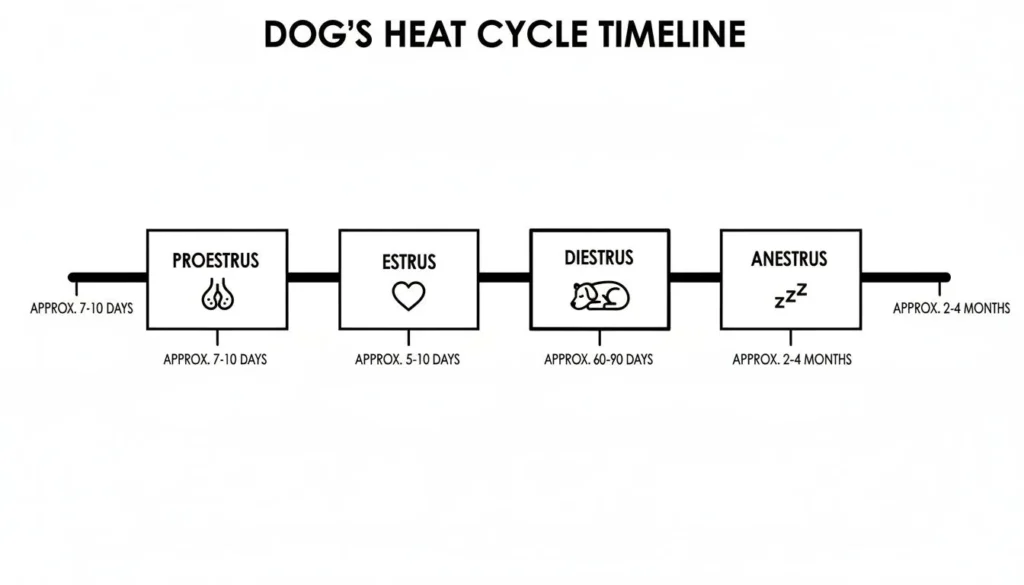
As you can see, the active “heat” stages are pretty short compared to the much longer periods of hormonal adjustment and rest that follow.
Diestrus: The Autumn Wind-Down
Once that fertile window closes, your dog moves into diestrus, the autumn of her cycle. She’s no longer fertile and will go back to rejecting any male attention.
What’s really interesting about diestrus is that her hormones act as if she’s pregnant, whether she was bred or not. Progesterone levels stay high for about two months. This is exactly why some dogs go through a “false pregnancy” (pseudopregnancy), where they might start nesting with blankets, mothering their toys, and even produce a little milk.
Key Takeaway: During diestrus, your dog’s body chemistry is pretty much the same whether she is pregnant or not. This is why signs of a false pregnancy are common and a perfectly normal part of the cycle.
Anestrus: The Long Winter Rest
Finally, the cycle winds down with anestrus, the long winter rest. This is the inactive phase where her reproductive system just takes a break. Hormones are low, and there are zero outward signs of a heat cycle.
This downtime is the longest part of the whole journey, lasting anywhere from four to six months—sometimes even longer for bigger breeds. This resting phase allows her body to fully recover before the cycle starts all over again with the next proestrus. It’s just as important to understand this stage, as it explains why most dogs only cycle once or twice a year.
Why Your Dog’s Heat Cycle Is Unique
Ever wonder why your friend’s little Yorkie seems to be on a totally different heat schedule than your big Golden Retriever? You’re not just seeing things. While we’ve talked about the general timeline, there’s really no “one-size-fits-all” rule for how long a dog’s heat cycle lasts. A few key things make your dog’s cycle completely her own.
The single biggest factor is, without a doubt, breed size. It’s kind of like comparing a zippy compact car to a massive semi-truck. They both have engines, but they operate on completely different scales. The same idea applies to dogs, as smaller breeds tend to mature much faster in every way, including their reproductive cycles.
The Role of Breed and Size
A small dog, like a Chihuahua or a Pomeranian, could have her first heat cycle as early as 6 months old. Their compact bodies mature so much faster, and because of that, they often cycle more frequently. It’s not at all strange for a small-breed dog to have three heat cycles in a single year.
Then you have the giant breeds on the other end of the spectrum. A Great Dane or an Irish Wolfhound is more like a slow-growing oak tree; their bodies just take a lot longer to hit full maturity. Don’t be surprised if they don’t have their first heat until they’re 18 to 24 months old. Their cycles are also much less frequent, sometimes only happening once every 12 to 18 months.
Key Insight: Never compare your dog’s heat cycle to a neighbor’s dog of a different size. A small dog cycling three times a year can be just as normal as a giant breed cycling once every year and a half.
Understanding this variation is key to setting the right expectations. While the active bleeding and fertile stages (proestrus and estrus) usually stick to that 2-to-4-week window, how often those stages show up is all down to your dog’s size and genetics.
How Age Changes the Pattern
Age is another huge piece of the puzzle. It’s a common myth that female dogs go through menopause like people do, but that’s simply not true. Female dogs can stay fertile and continue having heat cycles their entire lives.
That said, their cycles definitely don’t stay the same. Here’s a general idea of what you might see as your dog gets older:
- Longer Gaps: As a dog ages, the time between her heat cycles—that long anestrus or “resting” phase—often gets longer. A senior dog who used to cycle like clockwork every six months might start going eight or even ten months between cycles.
- More Irregularity: The predictability you might have counted on when she was a young adult can start to fade. Her cycles can become less regular, making it tougher to guess when the next one is coming.
- Continued Fertility: Even though fertility might dip a bit, an older dog can still get pregnant. This is a crucial point for owners to remember if they want to avoid a late-in-life litter, which can come with higher health risks.
Getting a handle on these individual factors—breed, size, and age—is absolutely essential. It helps you know what’s normal for your dog, so you can spot potential problems and take great care of her throughout her life.
How to Manage Your Dog in Heat Without the Stress
So, your dog is in heat. First thing’s first: don’t panic. It might seem like a chaotic few weeks are ahead, but with a little prep work and some practical tips, you can get through it without losing your mind. The goal is to keep her safe, comfortable, and happy.
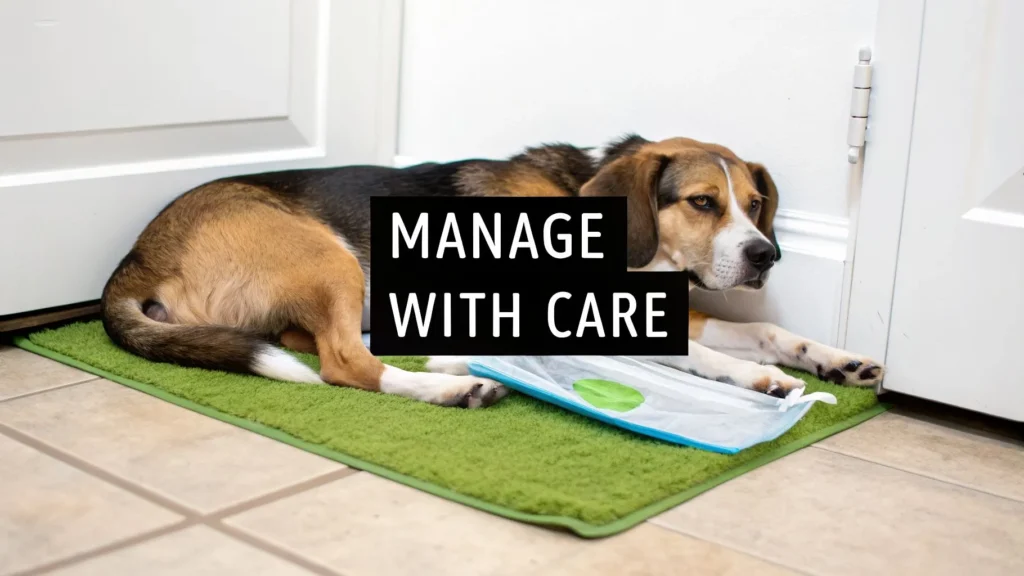
Let’s be real, the first thing most people worry about is the mess. The discharge can be a hassle, but there are some simple fixes. Doggy diapers or special heat pants are lifesavers for keeping your furniture and floors clean. You can also set up a cozy “den” for her in a spot that’s easy to clean, like a laundry room or kitchen with a tile floor.
Keeping Her Safe and Secure
Your absolute number one job during her heat cycle is to prevent an unwanted pregnancy. This means your normal safety routine needs a serious upgrade. Even the best-behaved dog can be driven by powerful instincts, and male dogs can get very creative when they catch a scent.
Here are the safety rules that are simply non-negotiable:
- No Off-Leash Time: Seriously, none. All walks need to be on a leash, without exception. That means no dog parks and no running free in an open field.
- Constant Supervision: Never, ever leave her alone outside, even in a fenced-in yard. A determined male dog can dig under, jump over, or squeeze through a fence you thought was Fort Knox.
- Lock Down Your Home: Double-check that all your windows, doors, and any doggy doors are completely secure. She might try to make a break for it.
During the estrus stage, your girl releases powerful pheromones that male dogs can smell from miles away. This is nature’s billboard, and it’s why a simple fence just isn’t enough protection. Accidental litters are a huge reason for pet overpopulation, so this level of vigilance is critical. You can learn more about canine reproduction from the AKC to get a better handle on what you’re up against.
Providing Comfort and Managing Behavior
Beyond just managing the physical side of things, your dog is going to need some extra TLC. The hormonal shifts can make her anxious, extra clingy, or even a little grumpy and out of sorts. A little patience goes a long way here.
Key Insight: Don’t be surprised if your dog’s personality does a complete 180. She might suddenly become your shadow, following you everywhere, or she might want to be left alone. This is all normal and directly tied to her hormones.
Give her extra cuddle time, engage in some gentle play, and make sure she has a quiet spot to retreat to when she needs it. If you have other dogs, especially any unneutered males, they absolutely must be kept separated to prevent fights and, of course, breeding.
It definitely takes some extra effort, but remember, this is a temporary situation. Good management and basic care can make it a much smoother ride for everyone. And if you want to brush up on general good habits, you might find our guide on how to train your dog helpful.
The Health Benefits of Spaying Your Dog
While you can certainly manage your dog’s heat cycle, it’s a job that requires constant watchfulness and a lot of effort. If you’re looking for a permanent fix that also happens to pack some serious health benefits, then it’s time to talk about spaying. This isn’t just about preventing puppies; it’s one of the most significant health decisions you can make for your dog’s future.
Spaying, known in veterinary circles as an ovariohysterectomy, is the surgical removal of a female dog’s ovaries and uterus. Once those reproductive organs are gone, her heat cycles stop for good, and so does her ability to get pregnant. This single procedure can set your dog up for a longer, healthier life by heading off several dangerous medical conditions before they ever start.
Preventing Life-Threatening Health Issues
The biggest win here is the complete prevention of certain reproductive cancers and infections. And make no mistake, these aren’t rare diseases; they are common and often deadly threats for unspayed female dogs.
The timing of the surgery makes a huge difference. Spaying a female dog before her very first heat cycle slashes her risk of developing mammary (breast) tumors by more than 99%. That risk jumps up with every single heat cycle she goes through.
Spaying also completely removes the risk of pyometra, a horrific uterine infection that strikes nearly 25% of all unspayed female dogs. To see the data for yourself, you can explore the spaying and neutering resources from the AVMA.
Crucial Health Insight: Pyometra is a medical emergency where the uterus fills with pus. It requires expensive, high-risk surgery to treat, and without it, the condition is almost always fatal. Spaying is the only way to guarantee your dog will never have to face this.
Deciding on the Best Time to Spay
The “when” is a big question for most owners, and the answer really depends on your dog’s breed, size, and what your vet thinks is best. For a long time, the standard advice was simple: spay before the first heat, usually around six months of age.
However, some newer research suggests that for certain large and giant breeds, waiting a bit longer might be better for their joint and bone development. This is exactly why you need to have a real conversation with your veterinarian. They’ll help you weigh all the pros and cons to find the sweet spot for your individual dog.
What to Expect After Surgery
Recovery from a spay is usually pretty straightforward. Most dogs are feeling like their old selves within 10 to 14 days. Your vet will send you home with clear instructions, which almost always include a few key things:
- Restricting Activity: No jumping, running, or roughhousing. This is non-negotiable for letting the incision heal properly.
- Preventing Licking: Your dog will likely get to rock the infamous “cone of shame” (an Elizabethan collar) or a surgical suit. This keeps her from licking or chewing at her stitches.
- Monitoring the Incision: You’ll need to check the surgical site every day for any unusual redness, swelling, or discharge.
Some people worry their dog’s personality will change, but that’s mostly a myth. The dog you know and love will still be there. The biggest change you’ll see is a happier, healthier companion, free from the hormonal roller coaster and serious health risks of heat cycles.
When You Should Talk to Your Vet About Her Cycle
While a heat cycle is a perfectly normal part of life for an unspayed dog, you should always monitor it closely. Most of the time, things will progress without a hitch, but sometimes the body sends out warning signs that something isn’t quite right. Knowing the difference between a normal quirk and a genuine red flag is essential for your dog’s health.
Think of it like a train schedule. You expect the train to arrive on time and follow its usual route. But if it’s unusually late, disappears from the board, or seems to be sending out smoke signals, you know it’s time to find out what’s wrong. The same logic applies to her cycle.
Irregular Heat Cycles to Watch
Not every heat cycle is a textbook case. Some dogs have patterns that can be confusing or even point to an underlying issue that needs a professional opinion.
Here are a few common irregularities that warrant a call to your veterinarian:
- Silent Heat: This is when a dog goes through her cycle with almost no visible signs. You might not see any swelling or noticeable discharge, making it nearly impossible to know she’s fertile.
- Split Heat: This happens when a cycle seems to start (you see the usual swelling and discharge) but then stops abruptly before it’s complete. It might then restart a few weeks later.
- Prolonged Heat: A typical heat shouldn’t last much longer than three or four weeks. If your dog is still showing signs like bleeding after the 28-day mark, it’s a definite cause for concern.
A prolonged heat cycle can be more than just an inconvenience; it can sometimes point to problems like ovarian cysts or even tumors. You should also be aware of other critical symptoms. If your dog develops a foul-smelling discharge, seems unusually tired, or starts drinking a lot more water, it could signal a severe uterine infection. For a deeper dive, you can discover more insights about these reproductive disorders on the Merck Vet Manual.
The Emergency of Pyometra
Of all the potential issues, pyometra is the most dangerous. It’s a severe infection where the uterus fills with pus, creating a life-threatening emergency. This condition typically occurs in the weeks following a heat cycle (during the diestrus phase) and can affect nearly one in four unspayed female dogs over their lifetime.
Critical Warning: Pyometra is always a medical emergency. If you suspect your dog has it, do not wait. Get her to a veterinarian or an emergency animal hospital immediately.
The signs can be subtle at first, but they escalate quickly. Be on high alert for symptoms like lethargy, vomiting, loss of appetite, a swollen belly, or a pus-like, often foul-smelling, discharge from her vulva. These signs can sometimes be mistaken for other problems, which is why acting fast is so crucial. A single symptom, like excessive head shaking, could just mean an ear infection, as we cover in our guide on why your dog keeps shaking her head. But when combined with the other signs above, pyometra becomes a primary concern.
Common Questions About a Dog’s Heat Cycle
Once you get the hang of the estrous stages, you’ll probably still have a few lingering questions. It’s completely normal. Let’s tackle some of the most common things dog owners ask about heat cycles.
Here are some quick, straightforward answers to clear up any confusion.
Do Dogs Get Periods Like Humans?
This is easily one of the most frequent questions we hear, and the short answer is no. While you will see bleeding, a dog’s heat cycle is essentially the opposite of a human period.
For people, bleeding means the end of a fertility window. For dogs, that bloody discharge during proestrus is the beginning—it’s her body’s way of announcing that she’s getting ready for her most fertile time. Think of it as a “coming soon” sign for pregnancy, not a sign that it’s all over.
Can a Dog Get Pregnant During Her First Heat?
Yes, 100%. A female dog can absolutely get pregnant during her very first heat cycle. Even if she still looks and acts like a puppy, her body is fertile and ready to breed.
This is a huge reason why so many vets recommend spaying before that first heat ever happens. A pregnancy is incredibly tough on a young dog’s body, which is still growing. It’s also one of the biggest causes of accidental litters and the heartbreaking pet overpopulation problem.
Key Fact: A female dog is fertile from her very first heat cycle. She doesn’t need to be physically or mentally mature to get pregnant, which makes early management and supervision non-negotiable for owners.
Do Dogs Go Through Menopause?
Nope, dogs don’t experience menopause like humans do. Unspayed female dogs remain fertile and will continue to have heat cycles for their entire lives.
That said, the pattern of their cycles definitely changes as they enter their senior years.
- Longer Gaps: The time between heats (the anestrus phase) often gets longer. A senior dog might go eight, ten, or even twelve months between cycles.
- Irregularity: The timing can become much less predictable than it was when she was younger.
Even with these changes, her ability to get pregnant never just disappears on its own. This is a crucial fact for owners of unspayed senior dogs to remember. While you’re learning about your dog’s health, you might also want to know about safe foods, and you can start by checking out our article on whether cranberries are a safe treat for dogs.
Discover more from Maxi Journal
Subscribe to get the latest posts sent to your email.