The universe is a treasure trove of mind-boggling phenomena and human triumphs. From the moment we first looked up at the stars, humanity has been driven by an insatiable curiosity to explore the vast expanse beyond our planet. This curated collection of fun facts about space exploration goes beyond the textbook, revealing the bizarre, the awe-inspiring, and the downright strange truths uncovered by missions to the moon, planets, and distant galaxies.
Here, you will discover the surprising physical changes astronauts experience in zero gravity and learn why a footprint on the Moon can outlast civilizations on Earth. We will explore cosmic oddities, like a day on Venus lasting longer than its year, and the mind-bending density of neutron stars. This isn’t just a list of trivia; it’s a journey through the most astonishing discoveries that redefine our understanding of the cosmos and our place within it.
Prepare to see space in a completely new light. We will examine the epic timelines of celestial events, the peculiar properties of other worlds, and the monumental achievements that mark our ongoing quest to venture into the final frontier. Each fact is a testament to human ingenuity and the universe’s endless capacity to surprise us.
1. Astronauts Can Grow Up to 3 Inches Taller in Space
One of the more surprising fun facts about space exploration involves a temporary, yet significant, physical change: astronauts can grow taller. In the microgravity environment of the International Space Station (ISS), the constant downward force of Earth’s gravity disappears. Without this pressure, the fluid-filled discs between the vertebrae in an astronaut’s spine are free to expand.
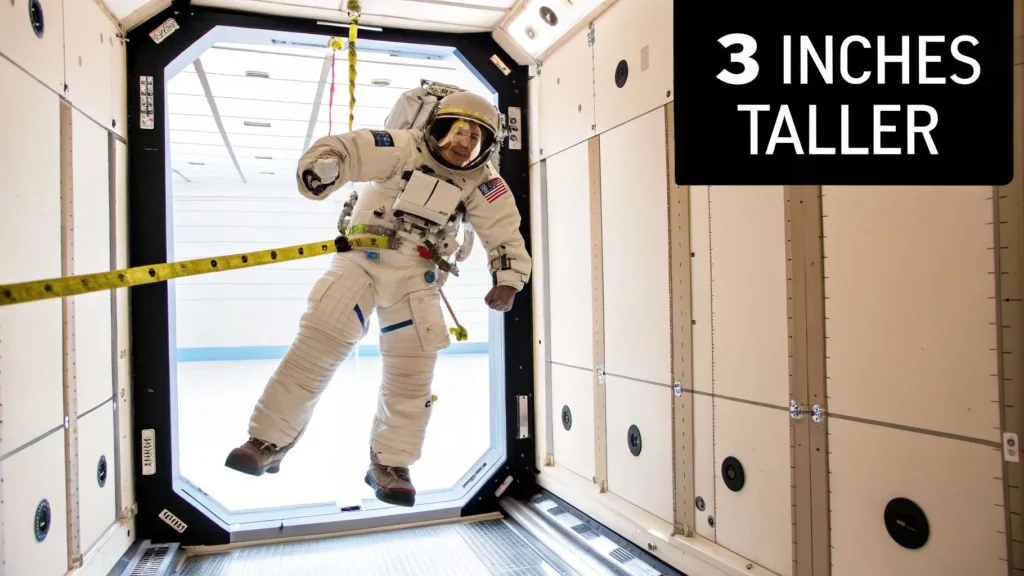
This spinal elongation can add up to 3% of an astronaut’s height, which for a six-foot-tall person, means growing nearly two inches. In some documented cases, astronauts have grown as much as three inches. This effect was observed during Space Shuttle missions and is consistently tracked on long-duration ISS missions.
The Science Behind the Stretch
The human spine is a column of bones (vertebrae) cushioned by intervertebral discs. On Earth, gravity constantly compresses this column. In space, that compression is gone, allowing the discs to swell with fluid and expand.
- Fluid Redistribution: This isn’t just a spinal phenomenon. Bodily fluids shift upward, leading to a condition astronauts call “puffy-head, bird-legs” syndrome.
- A Temporary Gain: The extra height is short-lived. Upon returning to Earth, gravity quickly reasserts its authority, and astronauts shrink back to their normal height within hours or days.
- The Downside: This rapid re-compression can be uncomfortable and sometimes leads to significant back pain as the body readjusts.
NASA and the ESA closely study these physiological changes. Understanding spinal elongation and its reversal is critical for developing countermeasures to protect astronaut health on future long-haul missions, such as a journey to Mars.
2. A Day on Venus is Longer Than Its Year
One of the most mind-bending fun facts about space exploration comes from our planetary neighbor, Venus. Time on the second planet from the Sun operates in a completely alien way compared to Earth. Venus spins on its axis so slowly that one single day on the planet is longer than its entire year. It takes Venus 243 Earth days to complete one rotation but only 225 Earth days to orbit the Sun.
This strange temporal dynamic means that if you could stand on the surface of Venus, you would experience a sunrise, an entire year would pass, and you would still be waiting for that same sun to set. The discovery of this bizarre characteristic was a major achievement of early interplanetary probes and radar astronomy.
The Science Behind the Slow Spin
The reason for Venus’s unusual rotation isn’t fully understood, but it creates a unique planetary calendar. Not only is its day longer than its year, but Venus also exhibits retrograde rotation, meaning it spins backward compared to Earth and most other planets in our solar system.
- Retrograde Rotation: On Venus, the Sun rises in the west and sets in the east. This backward spin is a significant planetary oddity.
- Discovery and Confirmation: The Soviet Union’s Venera program in the 1960s and 70s provided the first direct data from the planet’s surface and atmosphere. Later, NASA’s Magellan mission in the 1990s used powerful radar to map the surface and precisely confirm Venus’s rotation period.
- Leading Theories: Scientists speculate that a massive collision with another planetary body early in its history could have reversed its spin and slowed it down dramatically. Another theory suggests that the planet’s thick, heavy atmosphere created a tidal drag that gradually reduced its rotational speed over billions of years.
This counterintuitive relationship between day and year on Venus highlights the incredible diversity of planetary mechanics within our own solar system. Studying Venus helps scientists refine models of planet formation and evolution, offering clues as to why Earth and Venus, despite their similar sizes, followed such different developmental paths.
3. There Are More Stars Than Grains of Sand on All Earth’s Beaches
One of the most mind-bending fun facts about space exploration isn’t about a mission, but about the sheer scale of the cosmos. The statement that there are more stars in the universe than grains of sand on Earth is not just a poetic expression; it’s a conclusion based on astronomical and geological estimates that highlights the unimaginable vastness we are just beginning to explore.
This comparison, famously used by Carl Sagan, helps put the universe into a perspective we can almost grasp. Scientists estimate Earth has roughly 7.5 quintillion (7.5 x 10¹⁸) grains of sand. In contrast, the observable universe is thought to contain somewhere between 100 billion and 2 trillion galaxies, each with hundreds of billions of stars, leading to an estimated total of over one septillion (1 x 10²⁴) stars.
The Science Behind the Count
Calculating these enormous numbers involves estimation based on samples. Neither stars nor sand grains can be counted one by one, so scientists use mathematical models to arrive at a reasonable figure.
- Counting the Sand: Geologists estimate the total volume of sand on Earth’s beaches and deserts and divide it by the average volume of a single grain of sand.
- Counting the Stars: Astronomers use deep-field observations from telescopes like Hubble to count the galaxies in a tiny patch of sky. They then multiply that number by the total area of the sky to estimate the number of galaxies in the observable universe.
- A Conservative Estimate: The star count only includes the observable universe. The full universe could be infinitely larger, making the comparison even more staggering.
This fact powerfully illustrates why space exploration is so important. With a septillion stars and potentially trillions of planets orbiting them, the statistical probability of finding other worlds, and perhaps even life, becomes a compelling driver for humanity’s journey into the cosmos.
4. Neutron Stars Are So Dense That a Teaspoon Would Weigh as Much as Mount Everest
Among the most mind-bending fun facts about space exploration is the incredible density of neutron stars. These are the city-sized, collapsed cores left behind after massive stars explode in a supernova. Their gravitational pull is so extreme that matter is crushed into an exotic state, creating one of the densest objects in the universe. A single teaspoon of this material would weigh billions of tons, comparable to the weight of Mount Everest.

This unimaginable density arises from the intense pressure during the star’s collapse, which forces protons and electrons to combine into neutrons. These neutrons are packed together with almost no space between them, resulting in an object with the mass of one to two suns squeezed into a sphere just 12 miles (20 kilometers) in diameter. Many neutron stars, known as pulsars, spin rapidly and emit beams of radiation, which were first detected by Jocelyn Bell Burnell in 1967.
The Science Behind the Weight
The extreme density of a neutron star is a direct result of gravitational collapse overcoming the forces that normally keep atoms apart. On Earth, atoms are mostly empty space, but in a neutron star, that space is eliminated.
- Gravitational Squeeze: The star’s gravity is so powerful it crushes atoms, forcing electrons and protons to merge into a dense sea of neutrons.
- Rapid Rotation: Due to the conservation of angular momentum, as the original star’s core collapses, its rotation speed increases dramatically. Some millisecond pulsars, like PSR B1937+21, spin hundreds of times per second.
- Beyond Neutron Stars: If the remnant core is massive enough, even the neutron pressure cannot withstand gravity, and the collapse continues to form a black hole. You can explore modern discoveries by checking out the first real images of black holes.
Studying neutron stars provides astronomers with a natural laboratory for exploring the physics of matter under conditions that are impossible to replicate on Earth. Their properties test the limits of our understanding of gravity, nuclear physics, and the fundamental forces of nature.
5. The Moon is Moving Away From Earth at 3.8 Centimeters Per Year
One of the more subtle but fascinating fun facts about space exploration is that our relationship with the Moon is not static; it’s actively drifting away. This slow separation is happening at a rate of approximately 3.8 centimeters (about 1.5 inches) per year, a measurement confirmed with incredible precision thanks to equipment left on the lunar surface decades ago.
This phenomenon is a direct result of the tidal forces between Earth and the Moon. The Moon’s gravity pulls on Earth’s oceans, creating tidal bulges. Earth’s rotation tries to drag these bulges ahead of the Moon, and this interaction transfers rotational energy from our planet to the Moon, pushing it into a higher, more distant orbit.
Measuring the Lunar Retreat
The exact rate of the Moon’s retreat is known through a technique called lunar laser ranging. Scientists on Earth fire powerful laser beams at special reflectors placed on the Moon’s surface and time how long it takes for the light to bounce back.
- Apollo’s Legacy: Astronauts on the Apollo 11, 14, and 15 missions installed arrays of corner-cube retroreflectors. These devices are designed to reflect light directly back to its source, regardless of the angle of approach.
- Precision Timing: By measuring the round-trip travel time of the laser pulses with atomic clocks, observatories can calculate the Earth-Moon distance with millimeter accuracy.
- Long-Term Implications: While 3.8 cm per year seems small, over geological timescales, it has major consequences. Billions of years ago, the Moon was much closer, and Earth’s day was significantly shorter.
This ongoing measurement campaign is a testament to the lasting scientific value of the Apollo missions. The data not only confirms the Moon’s drift but also helps scientists test theories of gravity and learn about the Moon’s interior structure.
6. Saturn’s Rings Are Made Mostly of Water Ice and Are Relatively Young
One of the most iconic features of our solar system, Saturn’s rings, presents a captivating fun fact about space exploration: they are astonishingly young and mostly made of water ice. For centuries, astronomers believed the rings were as old as the planet itself, but data from modern missions has completely changed that understanding.
Analysis from the Cassini-Huygens mission revealed that the rings are likely only 100 to 200 million years old. This means they probably formed around the time dinosaurs roamed the Earth, making them a relatively recent addition to the solar system’s 4.6-billion-year history. Their composition is over 99% pure water ice, with only trace amounts of rocky material and dust.
The Science Behind the Icy Rings
The age and composition of Saturn’s rings were determined by measuring their mass and purity. Scientists believe such pristine, icy rings couldn’t survive billions of years of bombardment by micrometeoroids, which would have darkened them with dust.
- Cassini’s Grand Finale: During its final orbits, the Cassini spacecraft flew between Saturn and its rings, allowing for a precise measurement of the rings’ mass. This low mass pointed to a much younger age than previously assumed.
- A Cosmic Collision: The leading theory is that the rings were formed from the debris of a large, icy moon that was shattered by a collision or ripped apart by Saturn’s immense gravity after straying too close.
- A Fleeting Beauty: The rings are not permanent. Material from the rings is constantly raining down onto Saturn, and scientists estimate the entire system could disappear in another 100 to 300 million years.
The discovery of the rings’ youth and composition, largely thanks to the Cassini mission, highlights how space exploration continuously refines our knowledge. It shows that even familiar celestial objects hold profound secrets waiting to be uncovered.
7. Light From the Andromeda Galaxy Takes 2.5 Million Years to Reach Earth
One of the most mind-bending fun facts about space exploration is that looking at the night sky is equivalent to looking back in time. The Andromeda Galaxy, our closest large galactic neighbor, is a perfect example. Located approximately 2.5 million light-years away, the light we see from it today began its journey when early human ancestors first appeared on Earth.
This means when we observe Andromeda through a telescope, we aren’t seeing it as it is right now. We are seeing it as it was 2.5 million years in the past. Every photograph, every observation, is a window into the galaxy’s ancient history, long before modern civilization existed.
A Telescope Is a Time Machine
The finite speed of light (about 186,282 miles per second) means that light from distant objects takes a significant amount of time to travel across the cosmos to reach us. This principle turns every telescope into a form of time machine.
- Observational Evidence: The Hubble Space Telescope has captured stunningly detailed images of Andromeda, revealing its spiral arms, star clusters, and dust lanes, all as they existed millions of years ago.
- Beyond Visible Light: Radio and infrared observations allow astronomers to see through Andromeda’s dust clouds, uncovering hidden structures and star-forming regions, providing even more data about its distant past.
- Cosmic Scale: This effect applies to everything we see in space. The farther away an object is, the further back in time we are looking. The scale of the universe itself raises fascinating questions, and you can learn more about the end of the universe and its grand structure.
This time-delay phenomenon is fundamental to cosmology. By studying the light from the most distant galaxies, astronomers can piece together the history of the universe, observing how galaxies formed and evolved just a few hundred million years after the Big Bang.
8. An Astronaut’s Footprint on the Moon May Last for Millions of Years
One of the most enduring fun facts about space exploration is the incredible longevity of the marks humans left on the Moon. Buzz Aldrin’s bootprint, famously photographed during the Apollo 11 mission, is preserved in the lunar soil, or regolith, and could remain visible for millions of years. This celestial permanence is a direct result of the Moon’s unique environment.
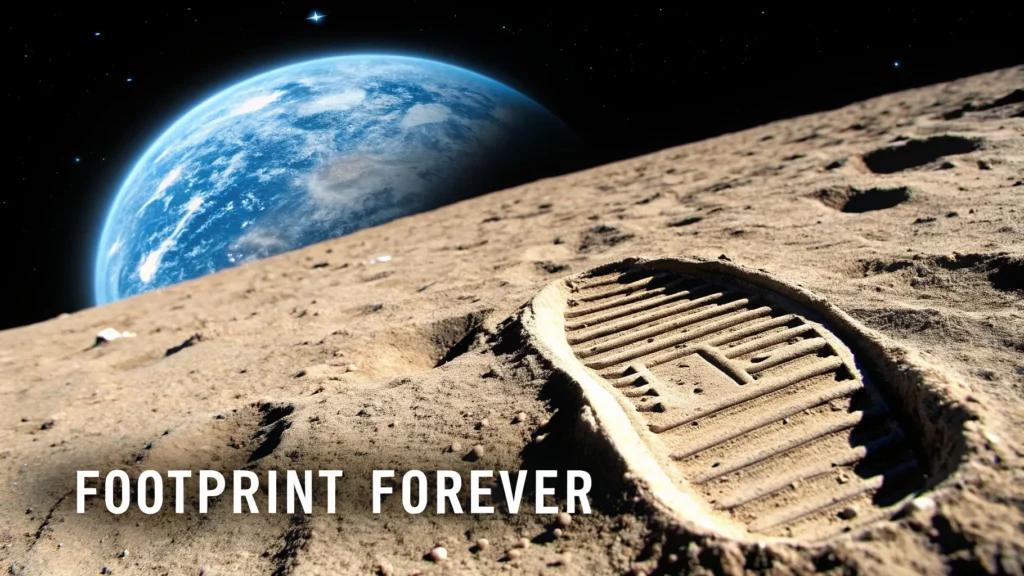
Unlike Earth, the Moon has virtually no atmosphere, which means there is no wind to blow away the dust and no rain to wash the prints away. The footprints, rover tracks, and discarded equipment from the Apollo missions sit undisturbed, creating a silent, static museum of human achievement nearly a quarter-million miles from home.
The Science Behind Lunar Preservation
The primary force of erosion on Earth, driven by weather and water, simply does not exist on the Moon. However, the lunar surface isn’t entirely static; it experiences a much slower form of erosion.
- Micrometeorite Bombardment: The Moon is constantly pelted by tiny dust-sized particles from space. This process, known as “space weathering,” very slowly churns and smooths the lunar surface over immense timescales.
- Solar Wind and Radiation: The surface is also exposed to a continuous stream of charged particles from the sun, which gradually alters the physical and optical properties of the regolith.
NASA’s Lunar Reconnaissance Orbiter (LRO) has successfully photographed the Apollo landing sites, showing the astronaut footprints and rover tracks are still clearly visible decades later. These sites are now considered historically significant, with calls to establish them as protected heritage zones for future lunar explorers.
This preservation highlights the vast differences between celestial bodies. While we have left a lasting mark on the Moon, efforts to change a planetary environment, as explored in concepts for Mars, pose far greater challenges. You can explore this further by learning about how long it would take to terraform Mars.
9. Jupiter’s Great Red Spot Is Shrinking and May Eventually Disappear
One of the most iconic features of our solar system, Jupiter’s Great Red Spot, is not as permanent as it seems. This enormous anticyclonic storm, larger than Earth itself, has been observed for centuries, but one of the most intriguing fun facts about space exploration is that it’s been steadily shrinking and changing shape.
Historical observations from the late 1800s estimated the storm’s width at over 40,000 kilometers (about 25,000 miles). By the time NASA’s Voyager spacecraft flew by in 1979, it had shrunk to 23,000 kilometers. Today, data from the Hubble Space Telescope and NASA’s Juno mission show it’s less than 16,000 kilometers across and becoming more circular.
The Science Behind the Shrinking Storm
The Great Red Spot is a high-pressure system in Jupiter’s atmosphere, with winds that can exceed 430 kilometers per hour (267 mph). Scientists are still working to understand precisely why it’s getting smaller and what that means for its future.
- Atmospheric Dynamics: Changes in Jupiter’s atmospheric jet streams or the absorption of smaller storms could be altering the energy that feeds the Great Red Spot, causing it to lose momentum.
- Ongoing Monitoring: Missions like Juno have provided unprecedented close-up views, measuring the storm’s depth and structure. Juno’s instruments found the storm’s roots extend far deeper into the atmosphere than previously thought.
- The Future is Uncertain: While it has shrunk considerably, some scientists believe it might stabilize at a smaller size. Others theorize it could break apart or dissipate entirely within a few decades.
Data from ongoing observations by both space probes and ground-based telescopes is crucial. Understanding the forces driving this change on Jupiter helps planetary scientists model atmospheric physics on gas giants and even exoplanets.
10. Space Travel Increases Cancer Risk Due to Cosmic Radiation Exposure
Among the many hazards of spaceflight, one of the most serious long-term health concerns is an increased risk of cancer. Outside the protective bubble of Earth’s magnetic field and atmosphere, astronauts are exposed to much higher levels of radiation from sources like galactic cosmic rays (GCRs) and unpredictable solar particle events (SPEs).
This constant bombardment of high-energy particles can damage DNA within an astronaut’s cells, elevating their lifetime cancer risk. Spacecraft offer some shielding, but they cannot block the most energetic particles entirely. This sobering aspect is a critical fun fact about space exploration because it highlights a major obstacle for future long-duration missions.
The Science Behind the Risk
Earth’s magnetosphere acts as a natural shield, deflecting most harmful cosmic radiation. In space, particularly on missions beyond low Earth orbit, that protection is gone. Astronauts on the ISS receive a radiation dose roughly 10 times higher than what people experience on Earth.
- Galactic Cosmic Rays (GCRs): These are high-energy particles originating from outside our solar system, likely from supernova explosions. They are persistent and extremely difficult to shield against.
- Solar Particle Events (SPEs): These are sudden, intense bursts of radiation from the Sun, often associated with solar flares. They can deliver a massive dose in a short time if astronauts are caught unprotected.
- Mission Limits: NASA sets strict career radiation exposure limits for its astronauts to manage this risk. These limits are a primary factor in determining how long an astronaut can stay in space.
Understanding and mitigating radiation exposure is a top priority for space agencies. Research at facilities like the NASA Space Radiation Laboratory is dedicated to developing better shielding materials and medical countermeasures to protect the health of future explorers journeying to the Moon, Mars, and beyond.
10 Fun Space Facts Compared
| Item | Mechanism / Cause | Resource & Measurement Requirements | Expected Outcomes / Effects | Ideal Use Cases / Relevance | Key Advantages / Significance |
|---|---|---|---|---|---|
| Astronauts Can Grow Up to 3 Inches Taller in Space | Spine elongation from microgravity (vertebrae decompress); reversible on return | Onboard anthropometry, medical monitoring, rehab assessments | Temporary height increase, posture changes, possible back pain during readjustment | Crew health monitoring, microgravity musculoskeletal research | Direct insight into human physiological response to microgravity; informs countermeasures |
| A Day on Venus is Longer Than Its Year | Very slow retrograde rotation (243 d) vs faster orbital period (225 d) | Radar and spacecraft telemetry (Venera, Magellan), ground radar | Unique atmospheric dynamics, retrograde rotation implications | Planetary formation and atmospheric evolution studies | Challenges formation models; constrains collision and tidal histories |
| There Are More Stars Than Grains of Sand on All Earth’s Beaches | Large-scale galaxy counts and extrapolation from deep-field surveys | Hubble and ground surveys, cosmological modeling | Extremely large star count estimates; implies many planetary systems | Science communication, probabilistic assessments of extraterrestrial life | Conveys cosmic scale; motivates exploration and public engagement |
| Neutron Stars: Teaspoon = Mount Everest | Core collapse to neutron-degenerate matter producing ultra-high density | Pulsar timing, X-ray/gamma observations, mass–radius modeling | Extremely strong gravity and magnetic fields; exotic physics regimes | Tests of dense-matter physics and general relativity | Provides empirical constraints on fundamental physics and equation of state |
| The Moon Is Moving Away From Earth at 3.8 cm/yr | Tidal friction transfers angular momentum from Earth to Moon | Lunar laser ranging with retroreflectors, mm-accuracy long-term data | Gradual lunar recession, lengthening days, long-term eclipse changes | Orbital dynamics, geophysics, evolutionary models of Earth–Moon system | Direct observational test of tidal theory and long-term orbital evolution |
| Saturn’s Rings Are Made Mostly of Water Ice and Are Relatively Young | Ring particles dominated by water ice; likely formed by recent disruption event | Spectroscopy, Cassini imaging and in situ data, ring dynamics modeling | Dynamically evolving rings, possible future ring loss | Studies of ring dynamics, satellite interactions, recent solar system events | Offers a laboratory for understanding recent planetary system processes |
| Light From the Andromeda Galaxy Takes 2.5 Million Years to Reach Earth | Finite speed of light across ~2.5 million light-years | Multiwavelength telescopes (Hubble, radio, IR), spectroscopic distance measures | We observe Andromeda’s ancient state; informs future merger predictions | Galaxy evolution, distance ladder calibration, observational cosmology | Nearby large galaxy for studying galactic structure and evolution; illustrates light-travel time |
| An Astronaut’s Footprint on the Moon May Last for Millions of Years | Lack of atmosphere and minimal erosive processes on lunar surface | High-resolution site imaging, archival mission records | Long-term preservation of footprints and equipment; slow degradation by micrometeorites | Lunar heritage protection, archaeology of space exploration | Preserves human artifacts as long-lasting records; aids future mission planning |
| Jupiter’s Great Red Spot Is Shrinking and May Eventually Disappear | Storm dynamics, energy dissipation, interactions with other atmospheric flows | Long-term imaging (Hubble, Juno), ground-based monitoring | Continued shrinkage, possible fragmentation or disappearance; changing weather patterns | Gas-giant atmospheric modeling and storm dynamics research | Real-time example of planetary weather evolution; tests atmospheric models |
| Space Travel Increases Cancer Risk Due to Cosmic Radiation Exposure | Penetrating galactic cosmic rays and solar particle events; limited shielding effectiveness | Personal dosimetry, epidemiological tracking, radiobiology experiments | Elevated cancer and other health risks; mission duration and crew selection impacts | Crewed deep-space mission planning, radiation protection development | Drives development of shielding, medical countermeasures, and mission risk mitigation strategies |
Your Journey into the Cosmos Continues
From the astonishing reality that astronauts can grow taller in microgravity to the mind-bending density of a neutron star, our voyage through these fun facts about space exploration has revealed just how strange and wonderful the universe truly is. We’ve seen how our own celestial neighborhood holds countless surprises, such as Venus’s day outlasting its year and the Moon’s slow, steady drift away from Earth. These aren’t just trivia points; they are clues that help scientists piece together the history and future of our solar system.
The insights gained from these discoveries paint a dynamic picture of a cosmos in constant motion. Knowing that Saturn’s iconic rings are relatively young and temporary, or that Jupiter’s Great Red Spot is shrinking, reminds us that even the most massive celestial features are not permanent. This constant change fuels our drive to observe, document, and understand before these phenomena transform or disappear entirely.
Turning Knowledge into Exploration
The true value of learning these fun facts about space exploration lies in what you do with this newfound perspective. The knowledge that a footprint on the Moon can last for millions of years, or that light from Andromeda began its journey when early hominids roamed our planet, should spark a deeper sense of wonder and curiosity. Here are a few ways to continue your own journey:
- Visit a local observatory or planetarium: There is no substitute for seeing Saturn’s rings or the craters of the Moon through a telescope with your own eyes. Many local astronomy clubs host public viewing nights.
- Follow active space missions: NASA, ESA, and other space agencies provide real-time updates, images, and data from missions like the James Webb Space Telescope and the Perseverance rover on Mars. Engaging with this live data makes exploration a present-day adventure.
- Explore citizen science projects: Platforms like Zooniverse allow you to contribute to real scientific research by classifying galaxies, identifying exoplanets, or tracking solar storms from the comfort of your home.
Understanding the challenges of space travel, such as the increased cancer risk from cosmic radiation, also gives us a profound appreciation for the courage and sacrifice of every astronaut. Each mission pushes the boundaries of human endurance and technological capability.
The universe is a book with an infinite number of pages, and we have only just read the first few sentences. The collection of facts we’ve explored is a small sample of the mysteries waiting to be solved. What new wonders will we find beneath the ice of Europa? What will the first human-tended gardens on Mars look like? The quest for knowledge is humanity’s greatest adventure, and your curiosity is the engine that drives it forward.
Ready to discover more and even share your own voice? At maxijournal.com, we feature articles across a wide spectrum of topics, from cutting-edge science and technology to arts and entertainment. We believe that curiosity knows no bounds, which is why we invite you to explore further or even contribute your own unique perspective at maxijournal.com.
Discover more from Maxi Journal
Subscribe to get the latest posts sent to your email.