You’ve finished the article. The draft is clean, the argument holds, and you can finally imagine it with a byline on a real publication.
Then the hard part starts.
Most first-time contributors don’t get stuck on writing. They get stuck on submission. They’re unsure where the piece belongs, whether to send the full article or a pitch, how formal the email should be, whether an editor expects attachments, and how long to wait before following up. That uncertainty leads to bad decisions. The common one is sending the same generic note to a long list of outlets and hoping one says yes.
That approach fails more often than writers expect. Data from publishing trends shows 70% of web magazine rejections stem from mismatched topic fit rather than quality, especially at interdisciplinary outlets that need clear audience relevance rather than purely strong writing publishing trend analysis on web magazine fit.
That’s the gap most advice misses.
A lot of guidance on how to submit article for publication is built for academic journals. It assumes formal abstracts, peer review workflows, anonymized manuscripts, and narrow disciplinary scope. That’s useful in the right context, but it doesn’t help much if you’re trying to place a sharp, readable piece with a modern digital magazine that publishes across science, technology, health, business, arts, travel, games, and culture.
Editors at multi-topic web publications read differently. They ask different questions first.
They want to know whether the piece fits the publication’s voice, whether the subject matches the interests of its readers, whether the angle feels current, and whether the writer understands the difference between informed commentary and a personal blog post. Credentials can help. Fit matters more.
Practical rule: A good article sent to the wrong editor is still a bad submission.
The writers who get published consistently usually do three things well. They choose targets carefully. They prepare the article in the format the editor wants. They write a submission note that proves they know the publication and its audience.
That’s the work that turns a finished draft into a published piece.
From Draft to Published An Actionable Introduction
A strong draft creates a false sense of completion.
Writers often reach the end of the article and assume submission is administrative. It isn’t. Submission is editorial matchmaking. The piece needs the right venue, the right framing, and the right presentation or it never gets a real read.
At a multi-topic digital magazine, the first editorial question usually isn’t “Is this smart?” It’s “Is this right for us?” A thoughtful article on wearable health tech may work well for a publication that likes consumer-facing analysis. The same article will miss badly at a site that wants reported service journalism or highly personal essays.
That’s why first-time contributors misread rejection. They think the no means the article failed. Often, the article arrived in the wrong room.
What editors notice first
Editors scan for signals.
They look at the headline or working title. They read the first lines of the pitch. They ask whether the angle fits a category they already serve. They check whether the writer sounds like someone who has read the publication before submitting. If those signals are off, the draft rarely gets the benefit of a deep read.
A writer might submit a polished piece on AI tools in education and fashion. If the publication typically runs one-topic explainers, the hybrid angle can feel unfocused. At a broader magazine, that same crossover may be exactly what makes the article useful.
A submission succeeds when the writer solves an editorial need, not when the writer sends strong prose.
The practical mindset that helps
Treat publication as selection, not validation.
You’re not asking an editor to certify your talent. You’re showing them a piece that serves their readers. That shift changes everything. It pushes you to study audience, trim self-indulgent sections, sharpen your angle, and present the work in a way that feels publishable before anyone asks for revisions.
That’s also why academic-style advice often feels intimidating but oddly unhelpful for web magazines. Digital editors still care about structure, sourcing, originality, and clean copy. They just care less about ritual and more about relevance.
If you remember one thing, make it this: the submission process starts well before you press send.
Finding the Right Home for Your Article
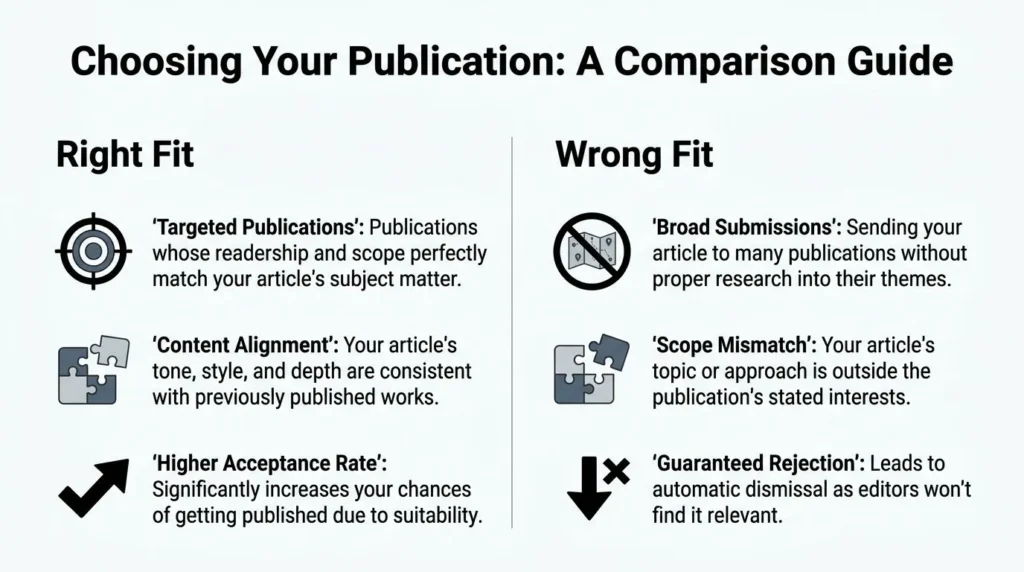
The fastest way to waste a good article is to submit it broadly instead of strategically.
Writers do this because it feels productive. Build a big list. Send one generic pitch. Wait. But broad submission without research usually creates avoidable rejection. In formal publishing, failure to conform to a journal’s aims and scope leads to 30-50% of all rejections, with an additional 20% desk-rejected immediately for style, format, figures, or references Elsevier guidance on aims, scope, and desk rejection. Web magazines use a looser process, but the underlying lesson is the same. Fit comes first.
Read the publication like an editor would
Don’t start with the submission page. Start with the archive.
Open recent articles in the category closest to your piece. Read at least a handful. Look for recurring patterns:
- Audience level: Is the writing beginner-friendly, specialist, or mixed?
- Voice: Does the publication favor analysis, opinion, reported commentary, or service content?
- Angle selection: Are topics broad and explanatory, or narrow and contrarian?
- Packaging: Do articles use short paragraphs, subheads, embedded media, expert quotes, or data-heavy framing?
A publication tells you what it wants by what it already publishes. The guidelines confirm it. The archive reveals it.
Build a shortlist, not a fantasy list
A serious submission list is usually small.
You want a short group of publications where your article clearly belongs, not a long spreadsheet of places you vaguely admire. If you need ideas for potential outlets, a curated list of blogs that accept guest posts can help you identify venue types and submission styles before you narrow your targets.
Use this filter:
Topical fit
If your article is about the business side of indie game launches, is the publication likely to care about business, games, or both?Reader fit
Can the average reader follow the piece without specialized background?Format fit
Does the publication publish features, short commentary, first-person essays, explainers, or reported stories?Depth fit
A 2,500-word argument won’t land well where the outlet mostly publishes brisk takes. The reverse also fails.
Publication Venue Comparison
| Attribute | Academic Journal | Online Magazine (e.g., maxijournal.com) | Niche Blog |
|---|---|---|---|
| Primary goal | Advance formal scholarship | Inform, engage, and interpret for broad readers | Serve a focused interest community |
| Typical editorial lens | Method, novelty, scope compliance | Audience relevance, readability, angle strength | Subject expertise and audience loyalty |
| Submission format | Portal, metadata, formal files | Email or portal, pitch or full draft | Usually email, often informal |
| Voice expectations | Formal and disciplinary | Clear, accessible, polished | Highly specific, sometimes conversational |
| Best for | Research-based work | Commentary, explainers, cross-topic pieces | Deep niche expertise or timely opinions |
Spotting a bad fit early
Good writers still send bad submissions because they ignore warning signs.
Pull back if you notice any of these:
- The category match is vague: You can’t tell where your article would live on the site.
- The tone mismatch is obvious: Your essay is reflective and literary, but the publication runs concise practical pieces.
- The audience mismatch is severe: Your draft assumes expertise that the outlet’s readers probably won’t have.
- You’re forcing relevance: If your explanation for fit sounds clever rather than obvious, the editor will feel that too.
What works better than prestige chasing
A realistic target beats an aspirational miss.
Writers often aim too high or too vaguely. They pitch a piece to a large publication because the name is attractive, not because the article fits the readership. Editors can tell when a writer would have sent the same draft anywhere. That usually kills trust before the article is opened.
The best target is the publication where your article feels inevitable.
A strong home for your piece is one where the topic, tone, and reader need line up cleanly. Once that happens, the rest of the submission process becomes easier. Your cover letter gets sharper. Your title improves. Your article needs fewer defensive explanations. The editor spends less time wondering why you sent it and more time deciding whether to run it.
Preparing Your Manuscript for an Editor’s Eyes
A lot of promising submissions fail before the first editorial read.
The article may be solid, but the file is messy, the title is vague, the author bio is unusable, the links aren’t checked, and the supporting material is missing. That signals work. Editors avoid avoidable work.
A pre-submission checklist that includes reading guidelines, writing a strong cover letter, and understanding policies can prevent 40% of common rejections, while most systems require 100% of submissions to include correct metadata such as title, abstract, and contributors before review Journal of Statistical Software submission guide.
Give the editor a clean file
For most digital publications, the safest format is a Google Doc with view access enabled or a Word file if the guidelines ask for attachments. Plain formatting wins.
Use:
- A clear title: Not a clever placeholder. A working title should already signal subject and angle.
- Readable body formatting: Standard font, normal spacing, sensible subheads, no decorative styling.
- Live links where needed: If you cite sources, test every link.
- Simple image labeling: If you’re submitting visuals, label files clearly and match them to captions.
Don’t send PDFs unless the outlet asks for them. Editors often need to edit, comment, or copy the draft into a CMS. A locked file slows everything down.
Prepare the pieces around the article
First-time contributors focus only on the draft. Editors are usually evaluating the package.
That package often includes:
A short author bio
Keep it concise and relevant. Mention expertise that supports the article, not every credential you’ve ever earned. If you need examples, this guide on how to write author bio shows the level of detail most publications want.A headshot
Use a clear, professional image if the outlet requests one. Don’t over-style it. Editors need a usable file, not a moody portrait crop from social media.A one-line summary
This is useful even when not requested. If an editor likes the piece, they may need a quick description for internal review or homepage packaging.Disclosure notes
If you have a conflict, affiliation, or commercial relationship tied to the topic, say so up front.
Edit for publication, not just completion
A finished draft still needs editorial prep.
Run this pass before submitting:
Tighten the opening
The first paragraphs should state what the article is about and why it matters. Don’t spend half the piece warming up. Editors want to know the payoff quickly.
Remove private context
Writers often leave in references that only they understand. Cut inside jokes, niche background, and personal detours unless they serve the reader.
Check the evidence trail
If you make factual claims, support them with reliable references. If a statement is your interpretation, write it as interpretation. That distinction matters.
Clean copy tells the editor you’ll probably be clean in revisions too.
Standardize names and terms
Pick one style for product names, capitalization, acronyms, and publication titles. Inconsistent copy makes even a strong article feel unfinished.
A practical submission checklist
Before sending, confirm these basics:
- The file opens properly: Broken permissions and locked docs create immediate friction.
- The article matches the outlet’s style: Not perfectly, but clearly enough that an editor can imagine publishing it.
- Your bio is ready: Short, specific, and free of filler.
- Images are usable: Correct files, captions, and rights status if relevant.
- The title, links, and byline are final enough: Editors expect revisions. They don’t want obvious loose ends.
A polished manuscript doesn’t guarantee acceptance. It does something almost as important. It removes easy reasons to say no.
Crafting a Submission Email That Gets Opened
Editors don’t open every email with the same level of interest.
They triage. Fast. Subject line, sender name, first sentence, publication fit. That’s usually enough to decide whether your message feels promising, generic, or annoying. If you want to learn how to submit article for publication in a way that gets attention, the email matters almost as much as the draft.
For blogs and online magazines, querying editors before full submission to confirm fit can boost acceptance odds by 15-20%, compared with the 65.8% rejection rate for manuscripts submitted without clear strategic fit step-by-step publishing guidance for blogs and magazines.

The pitch should do one job
Your submission email isn’t there to tell your life story. It exists to answer a practical editorial question: why should this editor care about this article for this audience right now?
That means your note should be brief and specific.
A weak pitch says, “I’m a passionate writer and would love to contribute to your publication.”
A strong pitch says, “I’m submitting an article on the overlap between AI styling tools and consumer health tracking because your publication regularly covers accessible tech and lifestyle analysis.”
The second version gives the editor something usable.
What to include in the email
A good submission note usually has five parts.
A clear subject line
Examples:
- Article submission: The hidden labor behind travel content creators
- Pitch: How wearable health data is changing amateur sports coaching
- Guest article submission: Why indie game soundtracks are breaking into streaming culture
No clickbait. No vague “Hello editor.” No all caps.
A direct opening
State what you’re submitting in the first sentence. If it’s a pitch rather than a full article, say that. If it’s a completed draft, say that.
A concise article summary
Give the core argument or angle in two or three sentences. Don’t summarize every section. Sell the editorial value.
A fit statement
Many writers get lazy at this point.
Mention one or two concrete reasons the piece suits the publication. Refer to the publication’s audience, category mix, or style. If you’ve published elsewhere, don’t use that as a substitute for fit.
A practical reference point is this article on how to write a cover letter, which shows how to make the case for relevance without sounding rehearsed.
A short credential line
Only include what helps the editor trust your authority on the topic. If your experience doesn’t add much, keep it minimal.
What editors usually dislike
There are a few patterns that trigger quick rejection.
- Mass-email language: “Dear Sir/Madam” or anything that signals the same note went everywhere.
- Long autobiographies: The editor needs the article angle, not your full creative history.
- Fake familiarity: Forced praise is easy to spot.
- Attachment dumps: Don’t send five files with no explanation.
- Unclear ask: If the editor can’t tell whether you’re pitching, submitting, or asking for advice, they’ll move on.
Submission habit that works: Write the email after you’ve read at least a few recent pieces from the publication, not before.
A simple pitch model
You don’t need a script. You need structure.
Try this:
- One sentence stating what you’re submitting.
- Two sentences explaining the article’s argument or usefulness.
- One sentence explaining why it fits that publication.
- One sentence on your relevant background.
- One polite close with links or attachments noted clearly.
That’s enough for most digital outlets.
The best pitches don’t sound “professional” in a stiff way. They sound easy to work with. That’s a major advantage. Editors aren’t just evaluating the article. They’re evaluating what revisions with you will probably feel like.
Navigating the Submission Portal and Beyond
Once the article and pitch are ready, the mechanics matter.
Writers often rush this part because they feel the main work is done. Then they upload the wrong file, leave metadata fields incomplete, forget a contributor name, or skip a required confirmation. Those mistakes are avoidable, and they can slow or derail a submission.
Online submission systems like Sage Track and ScholarOne are now standard, reducing old print-to-publish timelines from months to weeks. Once accepted, articles can appear online within an average of 30 days, and authors can track peer review progress in real time Sage author instructions for online submission workflows.
What to enter carefully
Whether the outlet uses ScholarOne, Sage Track, a custom CMS form, or a simpler in-house portal, the same rule applies. Treat metadata as editorial material.
Check these fields with care:
- Title and subtitle
- Author name and contributor details
- Abstract or summary
- Category selection
- Tags or keywords if requested
- Supplementary files
If the system asks for a short summary separate from the article, don’t paste in a lazy first paragraph. Write a real summary. Editors and reviewers often see that before they open the file.
Common status labels and what they usually mean
Submission systems use different wording, but these updates are common:
With editor
The submission has landed and is waiting for an initial review. This usually means the piece is being screened for fit and readiness.
Under review
Someone is evaluating it more seriously. At a magazine, that may mean an assigning editor or section editor. In more formal settings, it may involve external review.
Revisions requested
This is good news. The article has enough potential to justify more work.
Decision made
Open the message before overinterpreting the label. It can mean acceptance, rejection, or a request for changes.
Following up without becoming a problem
The waiting period makes writers twitchy.
A polite follow-up is fine if enough time has passed and the publication hasn’t stated otherwise. Keep it short. Reference the title, the date submitted, and ask whether the editor needs anything else. One calm message is professional. Repeated nudges are not.
Most editors don’t mind a respectful follow-up. They do mind being managed by a contributor they haven’t accepted.
After acceptance
Acceptance usually triggers practical paperwork.
Read the publishing agreement. Check what rights you’re granting, whether edits will be approved before publication, and whether the publication expects exclusivity. If the terms are unclear, ask plain questions.
Also be ready for production details. Editors may request a sharper headline, shorter bio, image credits, disclosure language, or fact checks. Fast responses help. The cleanest submissions often move through this stage with little drama because the writer handled the details properly at the start.
How to Handle Rejection and Revision Requests
Rejection feels personal because writing is personal. Editorial decisions usually aren’t.
A no can mean the topic missed the outlet, the angle wasn’t distinct enough, the timing was wrong, the draft needed restructuring, or the editor had stronger pieces in the queue. The useful response is to diagnose the kind of rejection you got.
Soft no versus hard no
A soft no often leaves the door open.
You might see language like “not quite right for us,” “please try us again,” or “we’d be open to other pitches.” That usually means the relationship is still fine. Save the editor’s name, note what didn’t fit, and pitch more precisely next time.
A hard no is cleaner. It may be brief or final. Take it at face value and move on without argument.
What to do with a revise request
A revision request is not busywork. It’s editorial interest.
Read the feedback twice. The first read is emotional. The second is strategic. Separate comments into three groups:
- Structural issues: The piece may need a new opening, stronger organization, or a sharper thesis.
- Evidence issues: The editor wants clearer support, better sourcing, or more precise claims.
- Audience issues: The draft may be too technical, too broad, too insider-heavy, or not accessible enough.
Then respond point by point.
A useful revision approach
- Start with the big problems: Fixing wording before fixing structure wastes time.
- Address every substantial comment: Even if you disagree, explain your reasoning respectfully.
- Keep a response note: Briefly list what changed so the editor can review quickly.
- Preserve the article’s spine: Revision should improve clarity and fit, not flatten the piece into something generic.
Good revisions show judgment, not obedience. Editors want to see that you understood the problem.
When rejection still helps
Even a bare rejection gives information.
If several editors pass for similar reasons, the pattern matters. Maybe the angle is too general. Maybe the article belongs in a narrower niche venue. Maybe the opening doesn’t signal value quickly enough. That kind of pattern is useful because it turns disappointment into direction.
Writers improve faster when they stop treating rejection as a verdict and start treating it as sorting.
FAQ Your Submission Questions Answered
Should you send a full article or a pitch first
Check the publication’s preference. If it isn’t stated, a pitch is usually safer for digital magazines, especially for first-time contributors. Send the full article when the outlet clearly invites completed drafts.
Can you submit the same article to multiple places
Only if the publication allows it. Some outlets expect exclusivity during review. Others are fine with simultaneous submissions if you disclose it. Read the guidelines carefully and don’t make assumptions.
How long should you wait before following up
Wait a reasonable amount of time and follow any timeline the publication gives. If no timeline appears, one polite follow-up after a fair interval is fine. Keep it short and useful.
Do you need formal credentials to get published
No. You need a strong article, a clear angle, and a credible reason you can write on the topic. Expertise helps, but many editors care more about clarity, judgment, and audience fit than prestige.
Should you rewrite the same article for a different outlet after rejection
Usually, yes. Not every rejection requires a total rebuild. Sometimes a better title, a different opening, a tighter argument, or a different audience frame is enough to make the piece work elsewhere.
What if the editor asks for changes you disagree with
Decide whether the requested changes improve the piece for that audience. If they do, make them. If they don’t, respond respectfully and explain your reasoning. Publishing is collaborative, but it shouldn’t require you to defend claims you no longer believe in.
If you’re ready to turn a finished draft into a serious submission, explore maxijournal.com to see how a modern multi-topic publication presents approachable writing across science, technology, health, business, arts, travel, education, pets, entertainment, and games. Reading the publication before pitching is still one of the simplest ways to submit smarter.
Discover more from Maxi Journal
Subscribe to get the latest posts sent to your email.