You’re probably here because the car in your life has started to feel less like freedom and more like a demanding roommate. It wants fuel, insurance, maintenance, parking, cleaning, registration, and constant attention. Even when it’s working, it can still trap you in traffic, make every errand feel like a parking strategy game, and shape where you live, what you buy, and how you spend your week.
A lot of people think the alternative is a hard, purist break. Sell the car, swear off driving, and become the sort of person who can recite bus timetables from memory. That’s not how durable car-free life usually works.
The better approach is to build a personal mobility portfolio. That means you stop asking, “What replaces my car?” and start asking, “Which mix of tools handles this trip best?” Walking might cover the coffee run. A bike might handle the short commute. A bus or train might do the heavy lifting. A rideshare or short-term car rental can stay in reserve for the awkward trips.
That shift matters. A car is one tool trying to do every job. A mobility portfolio is several tools, each used when it’s the right fit. That’s how to get around without a car in a way that survives bad weather, schedule changes, big grocery runs, and the occasional cross-town obligation.
Imagining Your Life Beyond the Driver’s Seat
A common pattern goes like this. The day starts with a short drive that should be easy. Then traffic bunches up near a school, the usual parking spot is taken, and you spend the final stretch circling the block. Later that week, the car needs a repair you didn’t plan for. By the weekend, you’ve organized three separate errands around where you can leave the vehicle.
That routine feels normal because a lot of cities were built around it. It still isn’t efficient.
Living without a car changes the friction points. You may spend more time planning some trips. You may have to think about weather, layers, charging an e-bike battery, or whether the train is running on time. But in exchange, many trips become simpler. You walk out the door and go. You stop treating parking as part of your destination. You start noticing which places are convenient and which ones only seemed convenient because you were driving.
Practical rule: Don’t aim for a car-free identity. Aim for a lower-friction life.
The strongest car-free setups aren’t rigid. They’re adaptable. Someone with a solid mobility portfolio might walk for nearby needs, ride transit for predictable corridors, use a bike for medium-distance trips, and keep rideshare or car-share as a backup for edge cases. That’s more resilient than forcing every trip through one mode.
There’s also a psychological shift that matters. Once you stop evaluating every trip by “Could I drive there?” and start evaluating by “What’s the most sensible way to get there today?”, the map gets bigger. Suddenly a route with a train and a short walk doesn’t feel inconvenient. It feels normal.
First Step Audit Your Actual Travel Needs
Individuals often misjudge their transportation needs because they think about the biggest or most annoying trip, not the trips they take every week. If you want a realistic answer to how to get around without a car, start with observation, not aspiration.
For one week, log every trip you make. Keep it simple. Use your notes app, a paper planner, or a spreadsheet if that’s your style.

What to record
Write down these details for each trip:
- Purpose: work, school, groceries, gym, childcare, social visit, appointment, errand
- Time: when you left, and whether timing was flexible or fixed
- Cargo: backpack, laptop, groceries, pet carrier, laundry, bulky item
- People: solo, child, partner, friend, elder, someone with mobility needs
- Conditions: rain, heat, darkness, steep hills, unsafe crossing, awkward transfer
- Current mode: drive, walk, transit, bike, rideshare, borrowed ride
That list does two things. It shows what your life demands, and it reveals where a car has been solving problems that aren’t obvious until you name them. A grocery run isn’t just a grocery run if it also involves a child seat, a late return, and two heavy bags.
What patterns matter most
After a week, sort your trips into three buckets.
Easy to replace
These are usually short, routine trips with light cargo and flexible timing. They’re the first wins.Replaceable with practice
These might need a transfer, a different departure time, or better gear like panniers, rainwear, or a transit app.Hard edge cases
These are the trips that happen early, late, far from transit, or with unusual cargo or care duties. You don’t build your whole transportation life around them. You plan backups for them.
A car-free life usually fails at the margins, not in the middle. The daily coffee run is easy. The dentist appointment across town in the rain is where your system gets tested.
This audit also changes behavior. Research on transit use and vehicle access found that people in zero-vehicle households use public transit almost five times more frequently than those in single-vehicle households, and people without a driver’s license take six times more transit trips than licensed drivers, according to the Southern California analysis published on PubMed Central. Once a car stops being the default, people adapt fast. But adaptation works better when you’ve mapped your real life first.
Questions worth asking yourself
- Which trips happen often enough that convenience matters more than speed?
- Which trips require carrying things?
- Which destinations are clustered enough to combine into one outing?
- Where are your true weak points: weather, darkness, hills, transfers, childcare, accessibility?
You’re not looking for perfection. You’re looking for repeatable patterns.
Building Your Car-Free Transportation Toolkit
A good mobility portfolio uses different modes for different jobs. No single tool wins everywhere. That’s fine. A hammer is not a bad screwdriver. It’s just the wrong tool.

Walking
Walking is the foundation because it connects everything else. It handles the first mile, the last mile, and a surprising number of short errands once you stop treating every outing as a driving trip.
Best use cases include neighborhood errands, station access, school drop-offs nearby, and any trip where parking used to be a hassle. Walking also gives you schedule independence. No charging, no locking, no waiting.
Its limits are obvious. Distance, weather, unsafe streets, and carrying capacity all matter. The workaround is usually not “walk farther.” It’s “walk strategically.” Pair walking with transit, delivery for bulky goods, or a folding cart for regular errands.
Bikes and e-bikes
Bikes are often the mode that makes car-lite become car-free. They’re fast over urban distances, reliable, and flexible. You can park near the door, bypass traffic on many routes, and turn a draining commute into routine movement.
E-bikes widen the map. Hills become manageable. Sweat becomes optional. Cargo bikes can replace many school runs and grocery trips if your local streets are safe enough to use them confidently.
The trade-off is infrastructure. A bike is liberating on calm streets, protected lanes, and connected networks. It’s stressful on high-speed roads with poor visibility. Storage also matters. If hauling the bike up stairs is a daily battle, you’ll use it less.
Public transit
Transit is the load-bearing piece of many car-free lives because it scales. In 2019, Americans took 9.9 billion public transportation trips, and public transit was 10 times safer per mile than driving while helping cut 63 million metric tons of national carbon emissions annually, according to the University of Michigan overview of urban public transportation. At the same time, 45% of Americans lack access to public transportation, which explains why transit can be life-changing in one place and irrelevant in another.
Use transit for corridors where service is frequent, parking is painful, or travel time can be productive. Buses are underrated for crosstown movement. Trains excel where they avoid road congestion. Ferries can be unexpectedly useful if you live near water routes.
If you want a broader mindset on lower-impact travel choices, this sustainable travel guide is a good companion read.
Rideshare and taxis
Uber, Lyft, and local taxi services are expensive if they become your daily commute. They’re valuable when used as backup infrastructure. A missed train, a late-night arrival, or a medical appointment can justify paying for convenience.
The mistake is using rideshare to patch every weak spot in a bad system. If you rely on it several times a week, your mobility portfolio probably needs work.
Car-share and rentals
Short-term car access is what lets many households stop owning a car. Car-share services, traditional rentals, and peer-to-peer options are best for warehouse runs, day trips, moving bulky items, or reaching places with poor transit.
Use them for the trips that are genuinely car-shaped. Don’t use them to preserve driving habits that your other modes could handle just fine.
Micromobility
Scooters and bike-share can solve the awkward gap between station and destination. They’re not always available where and when you need them, but when they are, they make a clumsy trip smooth.
The smart use is selective. Keep them in the portfolio for first-mile and last-mile links, not as the core of your entire transportation life.
Mastering Multimodal Trip Planning
The key breakthrough comes when you stop treating modes as competitors. The best car-free trips often combine two or three. Walk to the bus. Bike to the train. Train downtown, then use bike-share for the last stretch. That’s not a compromise. It’s often the fastest practical option.
A mobility portfolio becomes resilient in such situations. If one leg fails, you can swap the connection instead of cancelling the whole trip.
Here’s a visual way to think about it.
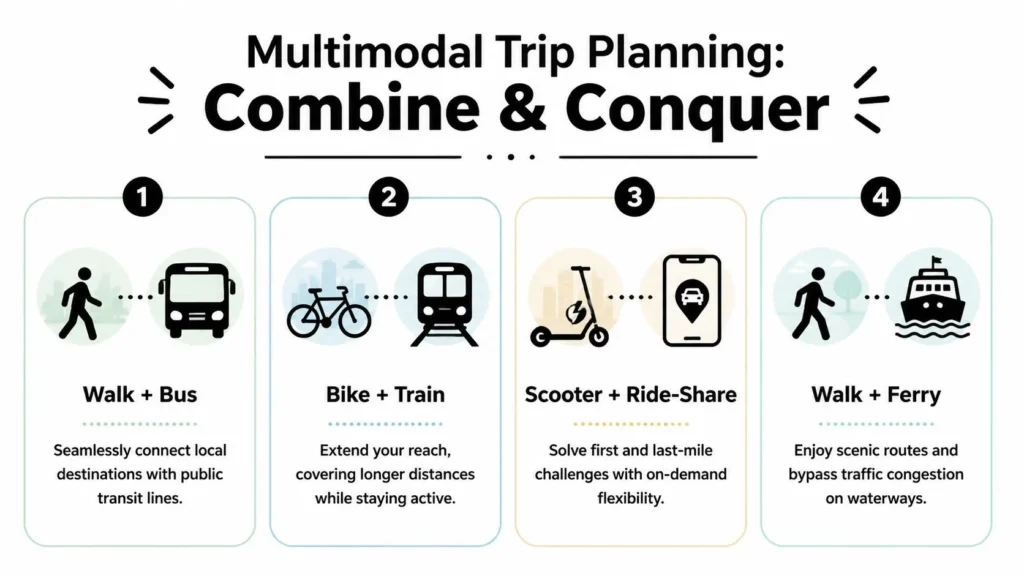
How trip chaining actually works
The key is to assign each mode the part it does best.
- Walking handles access and flexibility.
- Transit handles distance and corridors.
- Bike or scooter handles speed over medium distances and last-mile gaps.
- Rideshare handles failure points, bad weather, or late-night returns.
People often overfocus on total travel time and ignore reliability. A multimodal route that takes a bit longer on paper can still be better if it avoids parking uncertainty, traffic bottlenecks, or stressful driving.
Keep one backup in mind before you leave. If the bus is delayed, will you walk to a different route, grab bike-share, or call a ride for the last leg?
A lot of the same mindset shows up in longer independent travel too. If you like layered planning rather than single-mode dependence, this backpacking trip planning guide reflects a similar way of thinking.
Example multimodal trip plans
| Trip Scenario | Primary Mode | Connecting Mode(s) | Best For |
|---|---|---|---|
| Daily commute to downtown | Train | Walk or bike to station | Predictable peak-hour travel |
| Grocery run from a nearby suburb | Bus | Folding cart, short walk home | Regular errands without parking |
| Rainy-day medical appointment | Transit | Rideshare for last mile | Time-sensitive trips in bad weather |
| Evening social outing | Bike | Train on the main leg | Fast outbound travel with flexible return |
Some people need to see the combinations in motion. This short video is useful for that.
Rules that make multimodal travel smoother
- Choose one anchor mode: Build the trip around the most reliable long segment, usually rail or a frequent bus line.
- Reduce fragile transfers: Two close, intuitive connections are better than one tight, stressful one.
- Carry for transitions: A backpack, compact umbrella, and easy-to-manage bags beat overloaded tote bags every time.
- Plan the return before the outbound trip: Getting there is easy. Coming home late is where weak plans show up.
If you learn that one habit, how to get around without a car stops feeling like improvisation and starts feeling routine.
Essential Apps and Tech for Seamless Travel
Modern car-free life runs on software almost as much as pavement. Your phone is route planner, departure board, wallet, backup dispatcher, and sometimes your bike-share key.
That matters because service changes are real. After pandemic disruption, U.S. bus systems rebounded strongly, gaining 4.1 billion passenger-miles by 2023 compared with 2021, according to the BLS urban transit productivity summary. In practical terms, static assumptions are risky. A route you dismissed two years ago may now be useful. A timetable screenshot from last season may already be wrong.
The core app stack
Start with three categories.
Route planning apps
Google Maps is the default because it covers almost everything. Citymapper is often better where it’s supported because it understands multimodal city travel more intuitively. Transit works well for real-time arrivals and service presentation.
Use these apps for different jobs. Google Maps is broad. Citymapper is excellent for comparing route choices. Transit is good when you’re already on the move and need live information quickly.
Payment and ticketing
Many transit agencies now have their own fare apps. Use them if they reduce boarding friction. If your city supports tap-to-pay directly with a card or phone wallet, even better. Less fiddling means fewer missed vehicles.
Keep one payment method dedicated to transportation if you can. It makes budgeting easier and avoids the “why did three tiny mobility charges hit three different cards?” problem.
Platform-specific mobility apps
Keep your local bike-share, scooter-share, rideshare, and car-share apps installed even if you don’t use them often. Backup tools only work if they’re ready before you need them. Set up accounts, payment, and verification in advance.
The best transport app is the one you configured at home, not the one you’re downloading in the rain while the bus pulls away.
Setup habits that save headaches
- Favorite frequent destinations: Home, work, grocery store, childcare, station, pharmacy
- Turn on service alerts: Detours and delays matter more when you don’t have a car fallback
- Screenshot critical details: Platform numbers, pickup points, access codes, and station maps
- Download one planning guide: If you want a broader roundup, this guide to travel planning apps is a useful starting point
Tech won’t fix bad infrastructure. It does reduce friction, uncertainty, and missed connections.
How to Budget for Your New Commute
The biggest financial mistake people make is assuming they can keep the car and still capture most of the savings by just driving less. Usually, they can’t.
According to Victoria Transport Policy Institute’s transportation affordability analysis, most vehicle costs are fixed expenses, which means owners realize minimal savings from reducing mileage. The major gains come from shifting entire trips to lower-cost modes like walking, bicycling, and public transit.
What this means in practice
If you still own a car, skipping a few drives each week may save some fuel. It usually won’t remove the expenses that shape your budget the most. The more meaningful change happens when the car stops being necessary for recurring trips.
That’s why the strongest financial transition often follows this sequence:
- Replace daily commuting first
- Replace routine errands second
- Use occasional paid access for odd trips
- Only then decide whether ownership still makes sense
This is also why car-free budgeting should look different from car budgeting. You’re not trying to make every month identical. You’re building a system where most months are lean, and a few include a rental, rideshare splurge, bike tune-up, or transit pass renewal.
A practical transport budget
Build your monthly budget in layers.
| Budget Layer | What goes there | Why it matters |
|---|---|---|
| Base costs | Transit pass, bike parking, basic maintenance | Covers your recurring essentials |
| Flexible costs | Rideshare, scooter trips, occasional taxis | Handles convenience and disruptions |
| Reserve fund | Car-share, rental, delivery for bulky items | Protects you from edge-case panic spending |
A lot of people underbudget the reserve layer and then conclude car-free life is “too expensive” after one awkward month. It isn’t. They just treated unusual trips as surprises instead of part of the system.
The budget rule that works
Track transportation by trip function, not just by vendor. “Commute,” “errands,” “social,” and “exceptions” will teach you more than a list of app charges.
If your commute is cheap but every social outing ends in a rideshare, that’s useful information. Maybe the issue is timing. Maybe it’s safety after dark. Maybe your transit corridor is good outbound and weak on the return. A budget can diagnose mobility problems if you categorize it well.
Navigating Safely and Accessibly
Car-free travel only works if it feels safe enough to repeat and accessible enough to rely on. That’s where many glossy guides fall short. They talk about freedom but skip the conditions that make freedom usable.
Safety starts with habits, not bravado. Accessibility starts with honest planning, not wishful thinking.
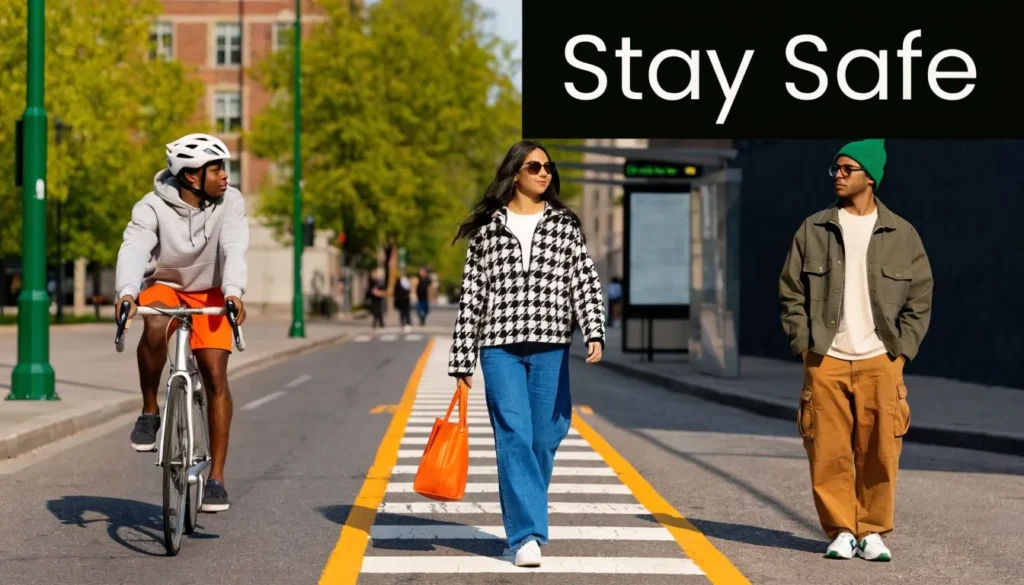
Street safety that actually helps
For walking, prioritize routes with lighting, active storefronts, and simple crossings, even if they’re slightly longer. For cycling, route quality matters more than theoretical shortest distance. A calmer street with one extra turn often beats a direct road that feels hostile.
Small gear choices matter too:
- Visible clothing: Especially at dawn, dusk, and in rain
- Good bags: A stable backpack or pannier is safer than juggling loose items
- Charged phone: Necessary for rerouting, pickup, and emergency contact
- Weather layers: Discomfort causes bad decisions faster than people admit
If a route consistently feels sketchy, treat that as valid information. Don’t moralize your way through it. Change the route, change the time, or change the mode.
Reliable travel is travel you’re willing to repeat next week.
Accessibility needs direct strategy
Accessibility is where generic advice breaks down fastest. In the U.S., only 4% of public transit agencies fully comply with ADA standards for paratransit wait times, and UberWAV serves just 0.5% of trips for wheelchair users, according to this review of car-free commuting alternatives and accessibility gaps. That means disabled travelers often face weak backups exactly where mainstream advice assumes flexibility.
If you have mobility limitations, or you’re planning for a family member who does, a stronger approach looks like this:
Build an accessibility-first route set
Don’t keep searching every trip from scratch. Save a shortlist of routes and destinations you know work with elevators, curb cuts, station staffing, or reliable boarding conditions. Familiarity reduces fatigue.
Call before high-stakes trips
For medical appointments, interviews, airport runs, and events with strict timing, confirm accessibility details directly when possible. Elevator outages, stop relocations, and pickup rules can ruin an otherwise workable plan.
Use hybrid solutions without guilt
A trip that combines paratransit, a short ride from a friend, and a fixed-route vehicle is still a valid car-free strategy. Purity is not the goal. Reliability is.
Ask institutions for specifics
Hospitals, colleges, event venues, and workplaces often publish vague accessibility language. Ask concrete questions. Which entrance is step-free? Where does paratransit unload? Is there staff assistance between curb and desk? General reassurance isn’t enough.
People who need more support are often told to “plan ahead” as if that solves the system. Sometimes it helps. Sometimes the system is the problem. Name that clearly, then build the most dependable portfolio available around it.
If you enjoy practical, grounded writing on travel, mobility, and everyday systems, maxijournal.com is worth a look. It publishes approachable commentary across travel and many other subjects, and it’s also a useful place for readers and prospective contributors who want fresh independent web publishing.
Discover more from Maxi Journal
Subscribe to get the latest posts sent to your email.