Spaying is the sterilization surgery for female pets, removing the ovaries and usually the uterus, while neutering is the sterilization surgery for male pets, removing the testicles. Both prevent reproduction, but spaying is usually more invasive, with 30 to 90 minutes of surgery and 7 to 14 days of recovery, while neutering often takes under 20 minutes with 3 to 5 days of recovery.
If you’re reading this with a young kitten asleep on your lap, or a puppy who just started acting very interested in the outside world, you’re probably trying to answer a practical question, not a vocabulary question. You want to know what these procedures mean, when to schedule them, and whether timing should change based on your pet’s age, sex, or breed.
That confusion is normal. People often use “spay and neuter” as if they mean the same thing. They don’t. The difference between spay and neuter matters because the surgery, recovery, and health effects are not identical.
A good decision usually comes down to four things: your pet’s sex, age, breed or body size, and your goals. For some families, the main goal is preventing an accidental litter. For others, it’s reducing roaming, spraying, or heat cycles. Some owners also want to ask about hormone-sparing alternatives before choosing the standard surgery.
Your Guide to Spaying and Neutering
If you’re a first-time pet owner, this choice can feel bigger than it sounds. The appointment itself may be routine for a veterinary team, but for you, it can feel like a decision about your pet’s long-term health, comfort, and personality.
That’s why it helps to strip the question down to plain language. Spaying is for females. Neutering is for males. Both are done under general anesthesia, both prevent reproduction, and both can improve health and behavior in important ways. Where owners get stuck is the next question: when should my pet have it done, and why that timing?
The answer isn’t always one-size-fits-all. Cats often mature earlier than many owners expect. Small dogs and large dogs may not have the same ideal discussion with the same timing. A toy-breed puppy and a giant-breed puppy may need different conversations with the vet, even if both are healthy.
If you’re still learning the basics of caring for a new feline, this guide for first-time cat owners can help you build the bigger picture around feeding, behavior, and routine veterinary care too.
Practical rule: Ask your veterinarian two separate questions, not one. First, “Should my pet be sterilized?” Then, “What is the best timing for my individual pet?”
That second question matters. A female cat heading toward her first heat, a male cat starting to spray, a medium-breed dog, and a large-breed dog may all lead to slightly different conversations. Good veterinary advice isn’t just about the procedure name. It’s about matching the procedure to the patient in front of you.
What Is Spaying Versus Neutering
The simplest way to understand the difference between spay and neuter is to think about which reproductive organs are removed.
For a female dog or cat, a spay is the surgery that removes the ovaries and usually the uterus. The medical term commonly used is ovariohysterectomy. Once that tissue is removed, your pet can no longer become pregnant, and she no longer goes through heat cycles.
For a male dog or cat, neutering removes the testicles. The medical term is orchiectomy. That prevents reproduction and lowers hormone-driven behaviors tied to breeding.

What each surgery is trying to do
Both procedures have the same broad purpose. They stop breeding. But they do it in different anatomical ways.
A helpful analogy is this: both surgeries turn off the possibility of reproduction, but they work on different parts of the system. In females, the surgery removes the organs that produce eggs and support pregnancy. In males, the surgery removes the organs that produce sperm and testosterone.
That difference is why the procedures don’t feel identical from a medical standpoint. A spay is an abdominal surgery. A neuter is a smaller surgery near the scrotum. That affects recovery, incision care, and what owners should expect in the first week.
Why veterinarians recommend them
The health reasons are substantial. The American Veterinary Medical Association notes that altered pets live longer on average due to disease prevention, and it also highlights the population impact: one unspayed cat pair can yield 420,000 offspring in seven years, and one dog pair can produce 67,000 in six years according to the AVMA’s guidance on spaying and neutering pets.
Those numbers sound shocking until you think about how quickly accidental litters multiply. One missed heat cycle, one escaped backyard dog, one unneutered male roaming the neighborhood, and suddenly the issue isn’t theoretical anymore.
If you’ve ever wondered whether female cats have “periods” in the human sense, this explainer on whether cats have periods helps clarify what heat cycles look like.
A lot of owner confusion starts with language. “Fixing” a pet sounds like one thing, but medically it means two different surgeries with two different recovery experiences.
The Surgical Procedures A Side-by-Side Look
The surgical difference between spay and neuter becomes much clearer when you compare them directly. Owners often hear, “They’re both routine surgeries,” which is true, but it can hide the fact that one is usually a bigger operation than the other.
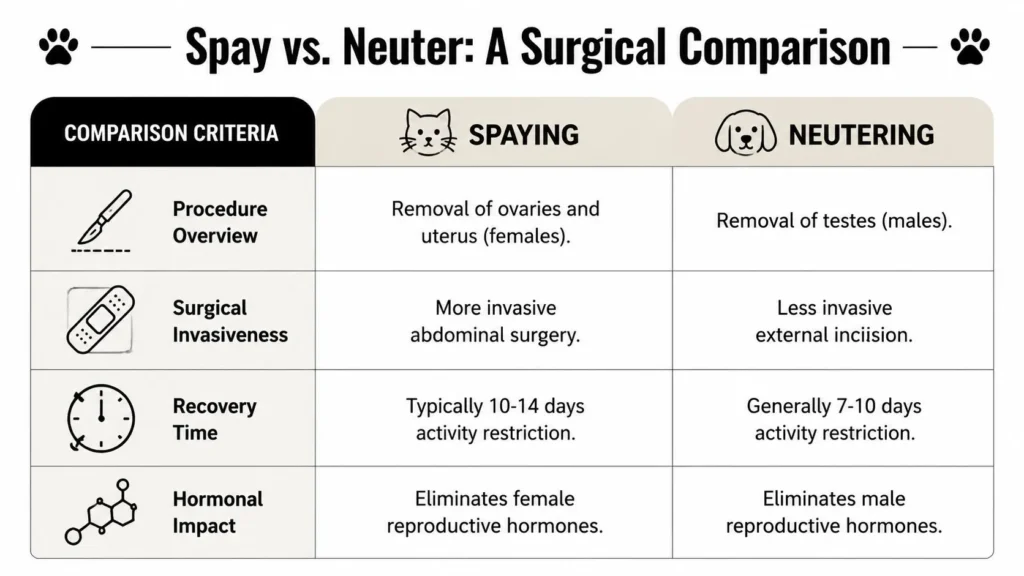
Spay vs. Neuter At a Glance
| Attribute | Spay (Female) | Neuter (Male) |
|---|---|---|
| Main purpose | Prevent pregnancy by removing ovaries and usually uterus | Prevent reproduction by removing testicles |
| Surgical area | Abdomen | Near the scrotum |
| Invasiveness | More invasive | Less invasive |
| Typical procedure time | 30 to 90 minutes | Under 20 minutes |
| Typical recovery | 7 to 14 days | 3 to 5 days |
| Hormonal effect | Removes female reproductive hormones | Removes male reproductive hormones |
What happens during a spay
A traditional spay is an abdominal surgery. The veterinarian makes an incision, enters the abdomen, and removes the reproductive organs. Because the surgeon works inside the abdominal cavity, this is generally the more invasive procedure.
That’s why owners usually notice stricter activity restrictions afterward. Jumping on couches, roughhousing, stairs, and zoomies matter more after abdominal surgery than after a simpler external incision.
What happens during a neuter
A neuter is usually quicker and less invasive. The incision is smaller, and the surgeon removes the testicles through that opening. In many routine cases, recovery is smoother and shorter than after a spay.
That doesn’t mean neutering is “nothing.” Your pet still has anesthesia, still needs pain control, and still needs incision monitoring. But from a practical standpoint, most owners find male pets bounce back faster.
Timing, anesthesia, and modern options
Both procedures are done under general anesthesia. Your veterinary team will usually examine your pet first, review any needed pre-op testing, and give you fasting instructions for the night before surgery.
Traditional timing and recovery benchmarks are well described by Ross University’s veterinary overview of why pets are spayed and neutered: spaying takes 30 to 90 minutes and usually needs 7 to 14 days of recovery, while neutering takes under 20 minutes with 3 to 5 days of recovery. The same source notes that laparoscopic spay options can reduce pain scores by 40 to 50 percent and shorten recovery to 3 to 5 days.
That last point matters for owners with active dogs. If your clinic offers laparoscopic spay, it may be worth asking about, especially if you’re trying to minimize post-op discomfort and shorten downtime.
Question to ask your vet: “Is this a traditional spay or a laparoscopic spay, and how would that change recovery for my pet?”
When age and breed change the conversation
Determining the ideal timing often becomes more personal. For many cats, pediatric spay or neuter at 4 to 6 months is commonly discussed, and early scheduling helps prevent the first heat cycle and early reproduction. For dogs, timing may be more individualized, especially in larger breeds where growth and orthopedic concerns can affect the conversation.
A practical framework looks like this:
- Female cat nearing maturity: Earlier timing often matters because heat cycles can begin young.
- Male cat starting to spray or roam: Neutering discussions often become more urgent once those behaviors appear.
- Small or medium dog: Many owners discuss surgery before full sexual maturity.
- Large-breed dog: Ask your veterinarian whether waiting longer makes sense for growth and joint considerations.
The procedure name gives you the definition. Your pet’s age, sex, and breed help determine the best timing.
Key Health and Behavioral Benefits for Your Pet
Owners often ask, “Is this just about preventing litters?” No. Population control matters, but the benefits are also personal and medical.
Benefits of spaying female pets
Spaying stops heat cycles and prevents pregnancy. It also removes the organs at risk for ovarian and uterine disease. According to the AVMA summary noted earlier, spaying drastically reduces risks tied to female reproductive cancers, especially when done before the first heat cycle.
Behavior can change too. Some female pets become less likely to show heat-related restlessness, roaming, or mating-related agitation once they’re spayed. For owners, that often means fewer stressful cycles of vocalizing, escape attempts, or attracting male animals to the home.
The “when” matters here. If your female dog or cat is still young, your vet may recommend surgery before the first heat or by a particular age based on species and individual factors. For many owners, this is the clearest example of why timing isn’t just a scheduling issue. It changes the health payoff.
Benefits of neutering male pets
Neutering eliminates the risk of testicular cancer and lowers the incidence of prostate disease. It also commonly reduces behaviors driven by mating instincts, such as roaming, territorial marking, and spraying.
That matters in daily life. A male cat who has started spraying inside the house or a male dog who bolts toward every scent trail isn’t being “bad.” He’s responding to reproductive hormones. Neutering often reduces the intensity of those behaviors.
This can also improve safety. Roaming pets are more likely to end up lost, injured, or involved in fights. Owners sometimes focus on the surgery itself and miss the quieter benefit: a pet who is easier to keep safe at home.
Why this matters beyond one household
A recent study of U.S. spay-neuter clinics found a post-2020 deficit of over 260,000 surgeries in 212 clinics, and when extrapolated nationally, the estimate reached 3.7 million fewer surgeries, contributing to the 6.3 million animals entering U.S. shelters annually according to the 2024 research available through PubMed Central.
That shelter impact helps explain why veterinarians talk about these surgeries with so much urgency. This isn’t only about one pet. It’s about what happens when access drops and accidental litters rise.
Here’s a helpful visual overview of the broader issue and the owner decision process:
A simple way to think about the benefits
- For female pets: Spaying is strongly tied to preventing pregnancy, ending heat cycles, and removing organs prone to serious reproductive disease.
- For male pets: Neutering is strongly tied to preventing breeding, eliminating testicular cancer risk, and reducing hormone-driven behaviors.
- For households: Both can make life calmer and more predictable.
- For communities: Both reduce the burden of unwanted litters and shelter crowding.
For many pets, the best time to spay or neuter is before unwanted behaviors or accidental breeding happen, not after.
Potential Risks and Modern Surgical Alternatives
No responsible veterinarian should talk about spay and neuter as if they have zero downsides. They are common surgeries, but they still involve anesthesia, healing, and hormonal change. Owners deserve the full picture.
Common concerns after traditional spay or neuter
One of the most common worries is weight gain. That concern isn’t imaginary. After hormone levels change, some pets become more prone to gaining weight, especially if food portions and activity stay the same. The good news is that owners can usually manage this well with diet, exercise, and routine weigh-ins.
Some dogs may have other hormone-related tradeoffs. In females, urinary incontinence can be part of the conversation. In some dogs, especially larger ones, orthopedic and cancer-risk discussions may influence timing and whether a standard procedure is the best fit.
These are not reasons to panic. They are reasons to have a more specific conversation than “Should I fix my dog?” The better question is, “What version of sterilization makes sense for this breed, body size, and age?”

Hormone-sparing options
Some owners now ask about ovary-sparing spay or vasectomy. These procedures prevent reproduction while preserving some hormone production.
That matters because hormones do more than drive reproduction. They also affect metabolism, growth, and parts of musculoskeletal health. According to Animal League Wellness, hormone-sparing alternatives are emerging to reduce risks linked to traditional sterilization, including a 2 to 3 times higher odds of cruciate ligament rupture associated in the cited discussion with traditional neutering patterns, but only 10 to 15 percent of U.S. clinics currently offer these procedures as described in their guide to responsible pet ownership and spay/neuter choices.
When to ask about alternatives
A hormone-sparing discussion may be especially useful if:
- You have a large-breed dog: Larger dogs often raise more timing and orthopedic questions.
- Your pet has breed-specific joint concerns: Some owners want to preserve hormones longer for growth-related reasons.
- You want sterilization without full hormone removal: That’s where options like vasectomy or ovary-sparing procedures come into the conversation.
- You have access to a veterinarian who performs them: Availability is still limited.
These alternatives are not automatically “better.” They are different. They may not offer all the same behavioral or disease-prevention effects as traditional spay or neuter, because the hormonal environment is different.
Balanced view: The best procedure is the one that fits your pet’s health profile, your household goals, and the skill set available at your veterinary clinic.
A practical decision framework
If you feel stuck, bring these points to your appointment:
- Your pet’s sex and age
- Breed or expected adult size
- Any current behaviors, such as spraying, marking, roaming, or heat cycles
- Whether you’re asking about traditional sterilization or hormone-sparing sterilization
- Your ability to manage recovery and activity restriction at home
That short list often leads to a much more useful discussion than asking for a generic recommendation.
Recovery Aftercare and What to Expect
Most pets recover well, but owners are often more anxious than the patient. That’s understandable. Your dog or cat comes home sleepy, maybe a little wobbly, and you’re suddenly watching every breath, every step, and every glance toward the incision.
A simple checklist helps.
The first 24 hours
Your pet may be groggy, quieter than usual, or mildly nauseated after anesthesia. Offer water and food exactly as your veterinary team advises. Some pets want dinner right away. Others need a little more time.
Check the incision before bedtime so you know what “normal” looks like from the start. Mild redness and mild swelling can happen. What you don’t want to see is active bleeding, gaping skin, discharge, or constant licking.
Days 2 through 5
This is often when pets start feeling better than they are. A neutered male may want to run before the incision is ready. A spayed female may seem almost normal while the abdominal tissue is still healing.
Use this checklist:
- Keep the cone on: If your vet sent home an e-collar, use it. Licking is one of the fastest ways to cause swelling, infection, or torn sutures.
- Restrict activity: Short leash walks for bathroom breaks are usually safer than free play. No jumping on furniture, wrestling, or sprinting through the yard.
- Give medications exactly as directed: Pain control works best when you stay on schedule.
- Look at the incision daily: You’re checking for worsening redness, swelling, discharge, odor, or missing stitches.
If your cat needs medication and you’re tempted to reach for something from your own medicine cabinet, stop first. This guide on whether you can give a cat Benadryl is a good reminder that human medications can be risky without veterinary instruction.
Call your vet if your pet seems painful despite medication, won’t eat, vomits repeatedly, or won’t leave the incision alone.
The first two weeks
For many neuters, recovery is shorter, but that doesn’t mean supervision can stop early. For many spays, the full restriction period matters because the abdominal wall needs time to heal.
A good routine looks like this:
- Morning check: Look at the incision in good light.
- Midday check: Make sure your pet hasn’t escaped the cone or become too active.
- Evening check: Confirm they’re eating, drinking, urinating, and resting comfortably.
What normal healing usually looks like
Normal healing is boring, and that’s a good thing. The incision stays closed, gradually looks less irritated, and your pet returns to normal energy in a controlled way.
If anything feels off, trust that instinct and call your clinic. Owners don’t need to diagnose the problem. They just need to notice that something changed.
Frequently Asked Questions About Spay and Neuter
Will my pet’s personality change?
Usually, no. Most pets keep the same core personality. What often changes is hormone-driven behavior, such as roaming, spraying, marking, or heat-related restlessness.
Is one surgery more serious than the other?
Yes. In general, a spay is more invasive because it’s an abdominal surgery. A neuter is usually simpler and often has a shorter recovery.
When should I ask about timing instead of accepting a standard date?
Ask when your pet is a large-breed dog, has orthopedic concerns, is already showing reproductive behaviors, or if you want to discuss hormone-sparing options.
Are cats and dogs handled the same way?
Not always. Cats often mature earlier, so timing can feel more urgent. Dogs, especially larger breeds, may need a more individualized timing discussion.
Should I ask about laparoscopic spay?
Yes, if your clinic offers it. It may mean a smaller surgical impact and an easier recovery for some female pets.
What if I’m nervous about making the wrong choice?
That’s common. Bring a written list of questions to your veterinarian. Ask about the best timing, the type of surgery, the expected recovery, and whether alternatives are appropriate for your pet.
If you enjoy clear, practical pet articles like this one, visit maxijournal.com for more approachable writing across pets, health, science, and everyday questions from an independent online magazine.
Discover more from Maxi Journal
Subscribe to get the latest posts sent to your email.