You’re watching Augusta on a Thursday afternoon, the camera cuts to a player you barely know, and the same question pops up every year: how did he get into the Masters? For star names, the answer feels obvious. For everyone else, it can seem like Augusta National keeps the rulebook in a vault.
That confusion makes sense. Qualifying for the Masters isn’t one rule. It’s a web of exemptions, rankings, tournament results, amateur titles, and a few strategic wrinkles that matter a lot more now than they used to. A win at the right event can change a career. A win at the wrong event might not.
For players, this isn’t just paperwork. It shapes scheduling, tour choices, and even how they define a successful season. A veteran with a green jacket plans differently from a rising pro chasing world ranking points. A PGA Tour regular sees one map. A LIV player sees another, with fewer roads and less room for error.
The Dream of the Green Jacket
Every Masters field looks small because it is small. That’s part of the mystique. The tournament doesn’t just invite a broad pool and sort it out later. It builds a very specific field, one category at a time.

For the 2026 Masters, the field is set at 91 players across 26 qualification categories, according to the PGA Tour’s breakdown of how the 2026 field was formed. That one fact tells you almost everything about the tournament’s philosophy. Augusta wants history in the field, but it also wants current form, global reach, and a measure of exclusivity that no other major quite matches.
That’s why a past champion can keep coming back, while another player may need one brilliant season just to get a single invitation. The Masters honors old achievements and current excellence at the same time. Those goals sometimes pull in different directions, but Augusta has always treated that tension as a feature, not a flaw.
If you follow golf coverage across different publications in the sports section at Maxi Journal, you’ll notice that fans usually ask for a simple list of categories. The harder and more interesting question is what those categories mean in practice. A one-year path pressures a player to peak quickly. A multi-year exemption gives freedom to build a schedule differently. A ranking-based route rewards consistency more than flash.
The Masters invitation is never just a reward. For many players, it’s also a planning tool.
That’s why the qualification system matters so much. It doesn’t solely decide who gets into Augusta. It influences where elite golfers play, when they play, and what kind of career risks they can afford to take.
The Three Pillars of Masters Qualification
The long official list becomes much easier to understand if you stop reading it as separate clauses and start reading it as three pillars.
Legacy and championship history
Augusta protects its own history first. Past Masters winners, other major champions, and Players Championship winners sit in the most secure part of the system. These are the players who’ve already proved they can win at the highest level.
The logic is simple. Winning the biggest events should carry lasting value, especially at an event that treats tradition as part of the competition.
Current elite performance
This is the biggest working lane for most pros. If a player hasn’t already won one of the game’s crown-jewel titles, he usually needs to earn his place through current results. That can mean world ranking position, strong PGA Tour performance, or qualifying through other high-level pathways recognized by Augusta.
This pillar is where strategy gets sharpest. Not all wins are equal. Not all schedules create the same opportunity.
Amateur and international distinction
The Masters still makes room for top amateurs and selected international achievers. That matters because Augusta has never wanted its field to be only a snapshot of the current pro money game. It wants the game’s broader ecosystem represented too.
That’s why a great amateur season can matter. It’s also why international pathways have become more visible in recent qualification changes.
Masters qualification pathways at a glance
| Qualification Category | Who Qualifies | Exemption Length |
|---|---|---|
| Past Masters champions | Former winners of the Masters | Lifetime |
| Other major champions | Winners of the U.S. Open, The Open, and PGA Championship | Five years |
| Players Championship winners | Winners of The Players Championship | Three years |
| Current performance routes | Players who qualify through rankings and approved pro performance pathways | Varies |
| Amateur routes | Leading amateur champions and select elite amateur performers | Typically tied to that invitation cycle |
| Special invitations | Selected players invited at Augusta National’s discretion | Invitational basis |
A useful way to think about qualifying for the Masters is this:
- Legacy routes reward what you’ve already done.
- Performance routes reward what you’re doing now.
- Amateur and international routes preserve what the tournament wants to represent.
Once you see the system that way, the categories stop feeling random. They start looking like a set of priorities.
Champions Path The Lifetime and Multi-Year Exemptions
The safest address in golf is a spot on the Masters invitation list that renews itself. Very few players have that kind of security, and that’s exactly the point.
The green jacket for life
If you win the Masters, Augusta keeps the door open. Masters champions retain lifetime eligibility to compete, a rule noted in the same PGA Tour field breakdown cited earlier. That lifetime status is one of the tournament’s clearest statements about identity. The event doesn’t treat its winners as temporary storylines. It treats them as permanent members of Masters history.
Scottie Scheffler, Rory McIlroy, Jon Rahm, Hideki Matsuyama, and Dustin Johnson are current examples of champions whose names carry that built-in status. Some may arrive as contenders. Others may return later in their careers more as ceremonial figures. Augusta makes room for both realities.
Why other titles still matter
Winning one of the other men’s majors also creates breathing room. Other major championship winners receive five years of Masters eligibility, while Players Championship winners receive three years, as outlined by the PGA Tour’s 2026 qualification summary cited above.
That difference tells you something important. Augusta values all elite titles, but it still puts the Masters at the top of its own internal hierarchy. A Masters win means forever. A major win elsewhere means several years. A Players win means meaningful but shorter protection.
If you enjoy comparing how prestige works differently across sports, this kind of exemption logic is part of what makes golf unique, much like career-defining milestones in pieces about legends such as Roger Federer at the Australian Open.
Practical rule: The longer the exemption, the more freedom a player has to build a schedule around majors, rest, and form instead of constant qualification pressure.
What this changes for a player’s career
A player with a lifetime Masters invitation can think long term. He doesn’t need to chase every ranking point just to get back to Augusta. He can shape his season around preparation rather than access.
A player with a five-year major exemption still has security, but it’s a countdown clock. He can afford a rough season or two, though not endless drift. A player with a three-year Players exemption has even less room to coast.
That difference matters when fans ask why one accomplished player seems relaxed about qualification while another is grinding every week. They’re not living under the same competitive deadline. The Masters rules have already divided them into different career phases.
Earning Your Spot Through Elite Performance
A player can have a strong season and still miss Augusta. That sounds strange until you see how this part of the system works.
For players who are not protected by a past Masters win or another long exemption, qualification becomes a schedule puzzle. They are not only trying to play well. They are trying to play well in the right events, at the right times, under criteria that now split the PGA Tour route from several other routes more sharply than before.
The win has to fit Augusta’s definition
Augusta National’s updated language on PGA Tour victories matters because it narrows the classic fan assumption that any PGA Tour win means a Masters invite. Under the revised rule, only “individual winners of PGA Tour events that award a full-point allocation applied to the season-ending Tour Championship” get an automatic invitation, as explained in Sports Illustrated’s report on the qualifying criteria change.
The easiest way to read that rule is to treat it like a lock with a specific key. The trophy alone is not enough. The event also has to sit inside Augusta’s preferred competitive channel.
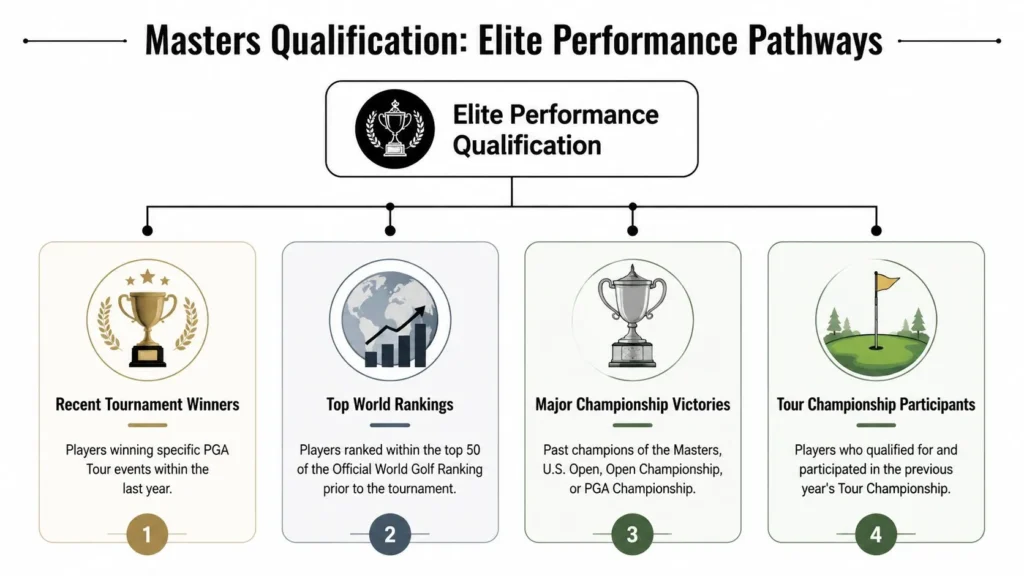
That changes player behavior. A fall win or an alternate-field win may still help a career in obvious ways, such as status, money, and confidence. It may not solve the Augusta question. So a player whose season goal includes the Masters has a reason to favor full-point events, even if another tournament would be easier to target.
That distinction also helps explain why the rule matters more in the current split professional game. A PGA Tour player can still build a direct route through approved wins and the FedEx Cup structure behind them. A LIV player, with fewer pathways tied to Augusta’s listed PGA Tour criteria, often has to rely more heavily on majors, world ranking position when available, or special consideration discussed later in the article. The same result, “play well,” does not carry the same qualification value in every league.
Why steady form can be safer than chasing one spike week
The Masters does reward winners. It also rewards players who keep showing up near the top of strong events.
That is the strategic difference between the direct-entry route and the pressure route. One hot week can solve everything. A long run of high finishes can keep a player inside the world ranking or season-long thresholds that matter just as much. For plenty of pros, especially those hovering outside the obvious exemption categories, the second path is more realistic.
A few player types illustrate the choice:
- PGA Tour regulars often chase full-point events because one win can settle the issue and strong finishes also support broader season goals.
- Top-ranked stars can be more selective. Their ranking position gives them room to skip weeks and aim their schedule at majors and signature starts.
- Fringe contenders face the hardest math. They have to decide whether to enter events where they have a better chance to contend or stronger events that offer more ranking value.
That last group feels the rules most acutely. Their calendar is not just a list of tournaments. It is a chain of qualification bets.
The new international open route matters more than it first appears
Beginning with the 2026 framework, Augusta National and The R&A added a shared route for winners of six national opens. Those events are the Scottish Open, Spanish Open, Japan Open, Hong Kong Open, Australian Open, and South African Open, as noted earlier in the article.
At first glance, that can look like a small administrative update. It is more than that. It raises the competitive value of tournaments outside the usual U.S.-centered Masters conversation and gives international players another direct path that does not depend on grinding through the PGA Tour structure week after week.
For some players, that changes season planning immediately. A European, Asian, or Australasian player can now build part of his schedule around one of those open championships with Augusta clearly in view. The event stops being only a respected national title and becomes a targeted access point to the Masters.
What elite form really looks like
Scottie Scheffler is a useful example here, not because his path is typical, but because it shows what Augusta’s performance lanes are designed to capture. He arrived at recent Masters seasons with the kind of sustained major-championship record that separates a temporary heater from a player who lives in contention, as tracked in major championship results by ESPN’s Scottie Scheffler player profile.
That is the larger point. Augusta’s elite-performance criteria reward more than a famous name or one flashy Sunday. They favor players whose results keep holding up under the strongest fields and the highest pressure.
For fans, the qualification rules can seem bureaucratic. For players, they shape career strategy. They influence which tour matters most, which events deserve priority, and whether a golfer can plan for Augusta months ahead or has to spend the season chasing one more opening.
The Amateur and International Pathways
The Masters still carries Bobby Jones in its DNA, so the amateur invitation isn’t a novelty. It’s part of the event’s self-image. Augusta wants at least a slice of the field to represent where the game is going, not just who currently dominates the professional tours.

That sounds romantic, but fans usually ask a harder question. Do amateurs have a real chance at Augusta? The honest answer is yes, but only within limits that history makes pretty clear.
What the record says about amateurs
Historically, amateurs have less than a 1% chance of winning the Masters, and none has finished in the top 10 since 1950, according to Golf Monthly’s report on the newer qualifying criteria and amateur context. That sounds grim, and if your standard is “can an amateur win the tournament,” it should.
But there’s another figure in that same discussion that matters more for understanding the experience. Amateurs make the cut at a 25% rate. That’s not dominance, but it’s far from token participation. It means the best amateur qualifiers are good enough to compete respectably on the biggest stage, even if winning remains a remote outcome.
Why this path still matters
The amateur route matters for two reasons.
- It rewards genuine excellence: Winning or contending in the world’s leading amateur events still means something at Augusta.
- It identifies future contenders early: Plenty of players arrive at the Masters as amateurs, then return later as pros with a much fuller toolkit.
That second point is where fans sometimes get mixed up. The amateur invitation isn’t designed because Augusta expects an amateur champion every few years. It exists because the tournament wants to recognize elite amateur achievement and keep a visible line between the top amateur game and the professional majors.
The amateur who makes the cut has already done something significant, even if he isn’t realistically expected to win.
A short look at the atmosphere around that journey helps explain why those invitations still feel special:
International pathways beyond the amateur ranks
The word “international” can mean two different things in Masters qualification, and fans often blend them together.
One meaning is amateur. Events outside the United States can feed elite amateurs into Augusta. The other meaning is professional and global. Augusta has shown more willingness to recognize major national open championships beyond the standard American routes, which gives strong players from different tours and regions a clearer target.
That doesn’t make the Masters easy to reach. It does make the map less narrow than many fans assume.
Special Invitations and The LIV Golf Question
No part of Masters qualification creates more confusion than LIV Golf. Fans see famous names, major winners, and strong players on that circuit, then assume Augusta must have built a direct lane for them. It hasn’t.
The missing direct pathway
There is no direct LIV Golf qualification pathway for the Masters. In 2025, only 12 LIV players qualified, mostly through previous major wins or other status they had already earned, according to Sky Sports’ reporting on the new exemptions and the LIV implication.
That fact changes the whole conversation. The issue isn’t whether LIV has talented players. It does. The issue is that Augusta’s structure doesn’t recognize LIV league standing as its own route into the field.
Why the problem keeps getting tougher
For a PGA Tour player, the route can run through approved event wins, world ranking support, and the tour structure Augusta already recognizes. For a LIV player without legacy exemptions, the road is thinner. If he isn’t already covered by a Masters title, another major title, or ranking residue from earlier results, he can run out of pathways quickly.
That’s why fans often feel there’s a contradiction. They’ll look at a player’s reputation and ask why he’s sweating qualification. The answer is structural, not personal. Augusta’s rules reward certain ecosystems of competition more directly than others.
Where special invitations fit
Special invitations matter here, but they’re often misunderstood. Augusta can use them to ensure the field remains globally representative and to include deserving international players who don’t fit neatly into standard categories. That discretion gives the club a pressure valve when the formal rules don’t capture every deserving case.
Still, special invitations are not a parallel qualification system. They’re selective and limited by design. Players can’t build a career strategy around hoping Augusta calls.
LIV players with existing champion status have a cushion. LIV players without it face a much narrower qualification game.
That’s the strategic split. Two players can compete on the same tour and live in completely different Masters realities depending on what they accomplished before joining it.
Frequently Asked Questions About Masters Qualification
If a player qualifies in more than one way, does that create an extra spot?
No. Augusta treats qualification categories like overlapping legal protections around the same player, not like separate tickets. If Scottie Scheffler qualifies as a recent Masters champion, a major champion, and a top-ranked player, Augusta still sees one entrant.
That matters because fans often assume a place will “roll down” to someone else. It does not. The categories are designed to identify who belongs in the field, not to create a chain of alternates.
Is there really a last-minute way into the Masters?
Yes. The winner of the Valero Texas Open, played the week before the Masters, gets in if he was not already exempt, as reflected in the tournament’s own event information at the Valero Texas Open on PGATOUR.com.
For players on the bubble, that route changes how the spring schedule feels. A PGA Tour player can build around it as one final, high-pressure chance. A LIV player usually cannot, because he is not competing in that event. That is a good example of how two golfers with similar talent can face very different qualification math.
One week. One tournament. One remaining door.
Are the rules fixed forever?
No. Augusta revises the criteria when it wants the field to better match the current structure of elite golf. That is why certain PGA Tour wins matter more than others, and why some international results have gained clearer recognition over time.
For players and fans, the lesson is simple. Do not treat an old explainer as permanent law. If you are trying to sort reliable information from copied summaries, it helps to use the same habits you would use with any complicated rulebook, including this guide on how to find credible sources for research.
What’s the easiest way to understand the whole system?
Start with three questions.
- Has the player already earned long-term protection? Masters champions, recent major champions, and a few other winners carry the strongest safety net.
- If not, can he force his way in through current results? PGA Tour wins, major performances, and ranking strength do most of that work.
- If those paths are thin, does he have a narrower route left? Top amateurs, international standouts, and a small number of invite candidates can still make the field, but the margin for error is much smaller.
That framework also explains the strategy split in modern golf. Players inside Augusta-recognized systems have more routes and more chances to recover from a slow stretch. Players outside those systems often need a much cleaner season, or help from achievements already banked in earlier years.
Once you sort the rules that way, the Masters field stops feeling mysterious. It looks like a carefully filtered set of doors, with some players holding several keys and others standing in front of only one.
Discover more from Maxi Journal
Subscribe to get the latest posts sent to your email.