Most “best blogs to read daily” lists make a basic mistake. They sort by topic, not by intellectual function. That leaves you with a pile of sites, but no system for deciding what to read when you want a fast scan, a technical answer, a contrarian take, or a calmer long-form reset.
That gap matters because the web is crowded. One 2026 industry roundup says there are over 600 million blogs across roughly 1.9 billion websites, with more than 7 million blog posts published every day and about 2.5 billion blog posts published each year worldwide, which makes selection more important than access for any serious reader (blogging statistics roundup). If your current routine feels noisy, the problem probably isn’t a lack of content. It’s weak filtering.
A better approach is to build a daily reading toolkit. Think of each blog as a distinct instrument: one for broad-topic discovery, one for technical depth, one for economic framing, one for cultural curation, one for reflective reading. That’s more useful than chasing whichever site publishes the most.
It also fits how people consume information now. Reading is fragmented across search, social, video, newsletters, and direct visits, which is why a smart stack often works better than a single destination. If you’re building a stronger habit, it also helps to understand content aggregation for solopreneurs, because the best daily reading systems reduce friction before they increase volume.
1. maxijournal.com

What should a daily generalist blog do for you? In a strong reading toolkit, it should widen your field of view without wasting attention. That is the role maxijournal.com fills.
Maxi Journal works as the broad-topic discovery tool in this list. Its editorial range is unusually wide for a site that still feels organized: science, technology, health, sports, business, arts, tourism, fashion, pets, entertainment, education, and gaming appear in one publication rather than scattered across separate niche properties. For a daily reader, that setup has a practical benefit. It reduces tab-switching while still exposing you to adjacent subjects that a narrower routine would miss.
The site is most useful for readers who want variety without the chaos of a pure aggregation feed. Its articles lean toward explainers, practical guides, commentary, and trend coverage. That makes the reading experience accessible, but not empty. You can scan quickly, find one or two pieces worth a longer read, and keep moving.
Its value is not specialization. It is range with enough editorial structure to stay usable every day.
Best use case
Use Maxi Journal as the first-stop tool for broad intellectual warm-up. If your reading habit tends to stall when every source demands specialist background knowledge, this site lowers the entry cost and keeps momentum high.
That role becomes clearer when you look at how the content is framed. Articles are written for comprehension first, which makes the site effective for general readers, early-stage researchers, and professionals who want a cross-disciplinary scan before shifting into narrower sources. Readers building a wider tech-and-culture routine may also find its own roundup of best tech news websites for daily reading useful as a companion resource.
Practical rule: A daily read earns repeat visits by being easy to use, current enough to matter, and varied enough to surface something you would not have searched for directly.
Posting frequency also supports its place in a daily stack. The homepage shows a steady flow of recent material, so the site functions as a live check-in point rather than a static archive. That consistency matters more than prestige for this slot in the toolkit. A generalist source only works if there is usually something new to justify opening it.
Why it works as a toolkit anchor
Maxi Journal has another advantage. It is built more like an open magazine than a closed expert publication. The visible contributor path, subscription prompts, and policy pages signal a participatory model, which broadens the range of topics and voices readers encounter over time.
Its role is easiest to judge against three criteria:
- Content focus: Broad, cross-category coverage suited to discovery rather than subject mastery.
- Posting rhythm: Frequent enough to support a real daily habit.
- Unique value: It helps readers maintain breadth, which many specialist-heavy media diets gradually lose.
The tradeoff is clear. Readers who need formal analysis, original reporting in a narrow field, or research-grade depth should pair Maxi Journal with more specialized sources. As the generalist instrument in a daily reading toolkit, though, it does its job well. It gives you a usable front door to multiple domains, and that makes it a strong anchor for a repeatable reading routine.
2. The Verge

The Verge is the fast-scan tool in this lineup. If your daily reading goal is to understand what’s happening across consumer tech, AI, gadgets, internet culture, entertainment, and policy without diving into specialist jargon every time, few sites are better tuned for that role.
Its homepage behaves like a live feed. That design matters. For a daily reader, usability is editorial quality. The Verge is built for quick triage: what deserves a full read, what can be skimmed, and what should register as part of the day’s background signal.
What makes it worth checking daily
The strongest case for The Verge isn’t just coverage breadth. It’s format diversity. News hits, reviews, explainers, videos, podcasts, and buyer’s guides all live in the same ecosystem. That makes it useful for readers who want one brand that can serve both “what happened?” and “what should I buy?” questions.
There’s also a structural reason this matters. Conventional roundups rarely sort blogs by reading mode, even though attention is split across platforms and formats rather than concentrated on direct publisher visits alone, as noted in discussion around fragmented reading behavior (analysis of the gap in blog roundups). The Verge fits modern fragmented habits because you can skim headlines now and return later for a review or podcast.
For readers building a stronger tech media stack, this pairs well with a broader list of tech news websites.
The Verge is for readers who want immediacy without living inside a specialist forum.
The downside is the same feature that makes it useful. Volume can lower signal if you don’t care about every branch of consumer tech and culture. Its ad-supported pages can also feel crowded. Still, for quick situational awareness, it’s one of the best blogs to read daily because it respects the way many people read: in bursts.
3. Ars Technica
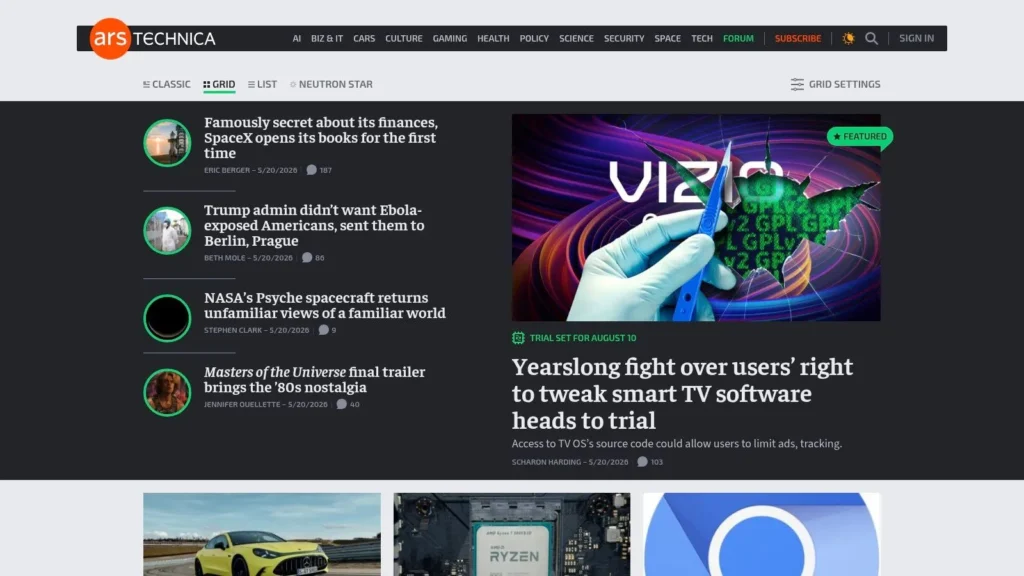
Ars Technica earns a different place in the toolkit. It’s not the site you open just to know what’s trending. It’s the site you read when you want to understand why a development matters at the system level.
That distinction is valuable because technical reading has a practical use case, not just an informational one. Tableau’s roundup of leading data-science blogs argues that enduring technical blogs work best as resource hubs, and that’s a useful lens for Ars too. In the broader analytics market, only about 25% of employees actively use BI and analytics tools on average, while 50% of data and analytics leaders say usage has increased a lot. Reported barriers include lack of training at 50%, poor data quality at 41%, budget limits at 36%, and ease-of-use issues at 33% (Tableau roundup on data-science blogs and analytics adoption).
Why technical depth matters in a daily stack
Those numbers point to a simple reading rule. Technical blogs become daily-worthy when they help readers turn information into action. Ars often does that better than general tech publications because it stays close to software, cybersecurity, operating systems, infrastructure, science, and policy details.
Its reviews and explainers usually assume more technical familiarity than mainstream sites do. That’s a strength if you want context instead of simplification. It’s a limitation if you want effortless skim-reading.
A strong daily stack usually needs one source like this. Not because every story is urgent, but because broad news without technical depth leaves you dependent on surface narratives. Ars reduces that risk.
- Best for: Engineers, analysts, IT professionals, security-aware readers, and serious tech enthusiasts
- Reading mode: Fewer casual scans, more deliberate article selection
- Distinct value: It helps readers interpret the infrastructure beneath the headline
Ars also offers optional subscription tiers, which may appeal to readers who want fewer ads. Even without that, its role is clear. It’s the “explain the machinery” tool.
4. Kottke.org
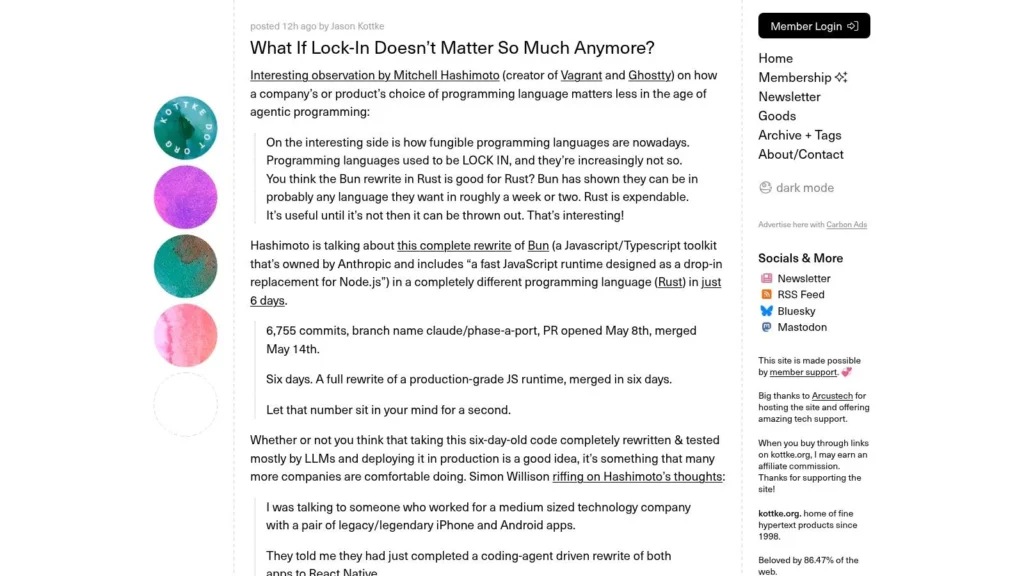
Kottke.org solves a problem most daily-reading lists ignore. Not every useful read needs to be exhaustive. Sometimes the best daily blog is the one that gives you a smart nudge toward ideas you wouldn’t have found alone.
Jason Kottke’s site has done that for years through short posts and links spanning science, art, design, history, internet culture, and odd corners of the web. It works like an intellectual coffee break. Fast, varied, and shaped by a recognizable editorial taste.
The case for curated serendipity
Most “best blogs to read daily” roundups reward scale and brand familiarity. That tends to bury independent curation. But readers looking for distinct voices often want exactly that: a selective editor who can surface interesting material before it hardens into mainstream consensus.
Kottke.org excels. It’s more curation than original reporting, but that isn’t a weakness if your goal is discovery. It’s a filter. A good one.
A daily reading stack shouldn’t only answer your current questions. It should improve the questions you ask next.
Kottke is also a useful reminder that sustainability matters. If a site can deliver short, context-rich posts consistently, it becomes easier to keep in your routine than a publication that demands long uninterrupted sessions.
Its format makes it especially compatible with RSS and email habits. That’s important for readers who want to own their intake rather than rely on platform feeds. For anyone thinking about why independent web publishing still matters, Maxi Journal’s post on how to start a blog gives useful context from the publishing side.
Kottke.org won’t replace a newsroom. It shouldn’t. Its job in the toolkit is different. It’s the “show me something smart and adjacent” tool, and few blogs perform that role with more consistency.
5. Marginal Revolution
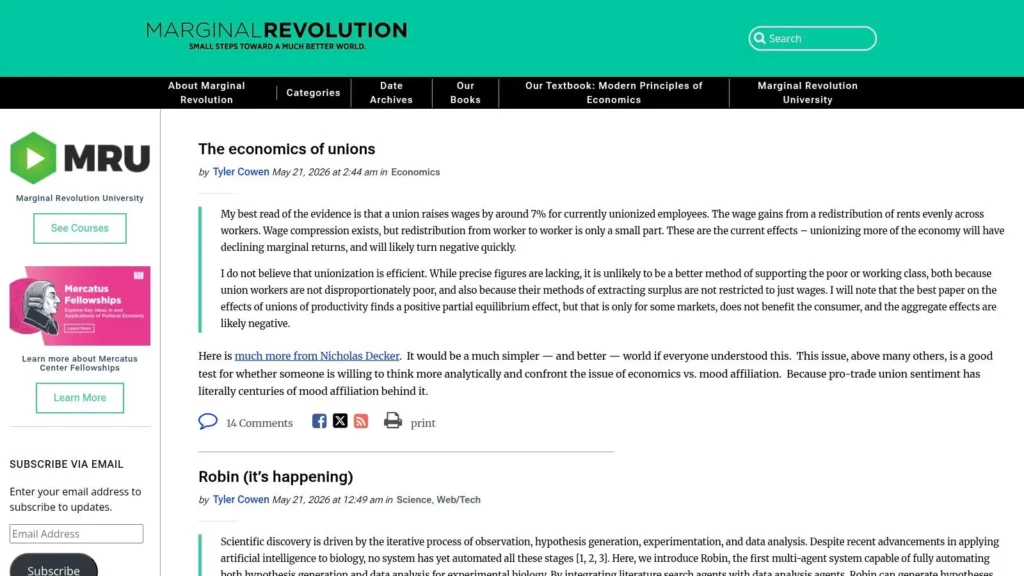
Marginal Revolution is the framework tool. When headlines feel disconnected, this is the blog that helps many readers impose structure on them through economics, incentives, markets, institutions, and long-run thinking.
Run by Tyler Cowen and Alex Tabarrok, it posts multiple times a day and mixes short curated links with commentary on policy, innovation, culture, business, and global events. Some entries are brief enough to scan in seconds. Others reward slower reading.
What it gives you that general news often doesn’t
Marginal Revolution is useful because it doesn’t just report developments. It reframes them. A policy change, a labor-market shift, a technology launch, or a cultural trend often looks different once you run it through an economics lens.
That perspective won’t fit every reader’s priors, and the posts can be terse. But the terseness is part of the utility. You can absorb a lot of intellectual signal quickly if you’re comfortable doing some interpretive work yourself.
Its comments and broader ecosystem also matter. This isn’t only a publishing outlet. It’s a long-running node in a community of readers who care about evidence, incentives, and argument.
A few reasons it earns daily-read status:
- Multiple daily updates: Good for habitual check-ins.
- Economist-led interpretation: Useful when you want more than reaction.
- Cross-domain coverage: Markets, policy, culture, and tech frequently intersect.
- Assorted links format: Efficient for readers who value discovery with framing.
If your reading habit currently gives you many facts but few models, Marginal Revolution fills that gap.
6. The Marginalian

The Marginalian plays the opposite role from a news-driven site. It is not for urgency. It is for depth, reflection, and literary-intellectual nourishment.
Maria Popova’s essays connect science, philosophy, literature, art, psychology, and biography with unusual care. If The Verge helps you keep up, The Marginalian helps you slow down without wasting your time.
Why slower reading belongs in a daily toolkit
A daily reading stack built only around novelty eventually turns thin. You know more events, but you don’t necessarily think better. The Marginalian corrects that imbalance by favoring synthesis over speed.
That’s why it belongs on a daily list even if you don’t read it every single day in the same way you scan a feed. Some blogs are daily because they update constantly. Others are daily because they improve your baseline attention whenever you return.
Read one fast site for orientation and one slow site for calibration. That combination usually beats either one alone.
The site’s ad-free, reader-supported environment also changes the reading experience. There’s less friction, less visual noise, and less pressure to bounce from item to item. Its archives deepen the value further. You can treat the site as a library, not only a publication.
The tradeoff is straightforward. If you want breaking updates, this isn’t the tool. If you want elegant, enduring essays that connect disciplines without dumbing them down, it’s one of the best blogs to read daily or near-daily.
7. Daring Fireball
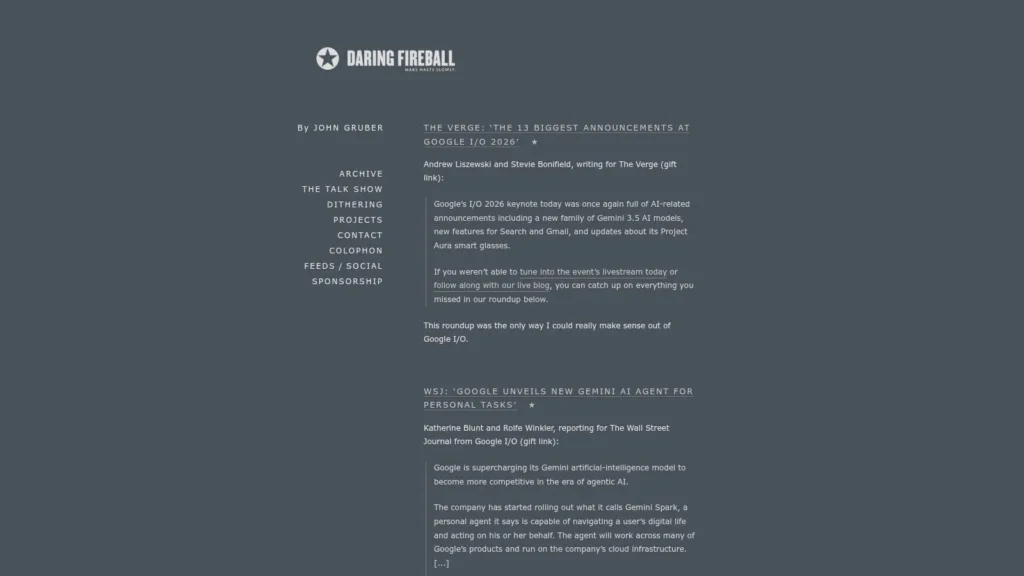
Daring Fireball is the sharp-opinion tool. John Gruber’s blog has long been a go-to for readers who want fast commentary on Apple, interface design, product decisions, media shifts, and the wider consumer-tech ecosystem.
Its appeal comes from compression. Many posts are short link-outs with a pointed sentence or two. That economy makes the site ideal for quick daily check-ins.
Why opinionated blogs still matter
Many roundup lists under-serve readers who want independent, distinctive voices instead of interchangeable publication brands. That gap has become more important as people encounter more content through platform feeds, where sameness can flatten editorial differences, as discussed in a piece on binge-worthy blogs and the need for freshness and distinctiveness (discussion of the independent-blog gap).
Daring Fireball fits the contrarian, high-signal niche better than broader newsrooms because the point of the site is not neutral completeness. It is interpretation from a durable point of view.
That creates both value and limitation:
- High signal for Apple watchers: Especially strong when product strategy and interface choices matter.
- Efficient format: Easy to scan daily.
- Recognizable editorial stance: Useful if you want perspective, not generic summary.
- Narrower scope: Less suitable if you want full-spectrum tech coverage.
It also pairs well with a companion podcast, which gives readers another intake mode. In a fragmented media environment, that flexibility matters. Daring Fireball’s job in the toolkit is simple. It gives you a seasoned, opinionated lens on a powerful part of the tech world.
Daily Reads: 7-Blog Comparison
| Publication | Implementation complexity | Resource requirements | Expected outcomes | Ideal use cases | Key advantages |
|---|---|---|---|---|---|
| maxijournal.com | Moderate, CMS + contributor onboarding | Multiple freelance contributors, editorial coordination, social channels | Frequent approachable articles, practical guides | General readers, hobbyists, guest authors seeking exposure | Broad interdisciplinary coverage, open contributor model |
| The Verge | High, large newsroom + multimedia production | Large editorial staff, video/podcast teams, ad ops | High-volume news, reviews, multimedia content | Daily tech + culture consumers, product buyers | Strong reviews, multimedia, feed-like scanning |
| Ars Technica | High, expert-driven reporting and analysis | Specialized journalists, research resources, optional subscriptions | In-depth technical explainers and analyses | Technical professionals, developers, policy watchers | Rigorous, evidence-based technical coverage |
| Kottke.org | Low, solo/editor-curated workflow | Minimal staff, curator time, RSS/email infrastructure | Quick curated links, discovery-focused posts | Readers wanting short, high-signal daily browsing | Sharp curation, fast reads, member-supported model |
| Marginal Revolution | Low–Moderate, author-driven blog | Expert authorship, engaged reader community | Frequent economic commentaries and link posts | Business, policy, and economics-interested readers | Consistent updates, economic frameworks for news |
| The Marginalian | Moderate, long-form editorial craft | Single editor/author, reader-supported funding, archival curation | Thoughtful long-form essays with timeless value | Reflective readers of literature, philosophy, art | High editorial quality, ad-free contemplative reading |
| Daring Fireball | Low–Moderate, opinion-led single-author site | Veteran author, sponsor support, RSS/podcast | Timely, opinionated takes on Apple and design | Apple enthusiasts, product designers, industry followers | Authoritative voice, concise high-signal commentary |
Curate Your Daily Dose of Insight
What makes a daily reading list useful. Volume, prestige, or fit?
The stronger test is functional coverage. A good daily reading toolkit gives you different cognitive tools for different jobs: one source for broad discovery, one for fast technology news, one for technical explanation, one for economic reasoning, one for sharp curation, one for reflective long-form reading, and one for a focused industry viewpoint. That mix produces better judgment than stacking seven sites that all publish the same kind of update.
Research cited earlier on sustained reading habits supports the broader principle. Repeated, manageable reading sessions improve retention and pattern recognition better than occasional bursts. The implication for adults is practical. A short, repeatable reading system usually outperforms an ambitious plan that collapses after a week.
That is why these seven blogs work well as a set. Maxi Journal covers wide-topic discovery across categories. The Verge helps you scan fast-moving consumer tech and internet culture. Ars Technica adds technical reporting and context when a story has engineering, security, or policy depth. Kottke.org is the tool for serendipitous discovery and quick curation. Marginal Revolution is useful for economic framing and first-principles thinking. The Marginalian supports slower, reflective reading rooted in literature, philosophy, and art. Daring Fireball offers a concise, informed view of Apple, design, and platform strategy.
The non-obvious point is that reading inputs shape decision quality. Readers who rely only on fast summaries often miss mechanism and tradeoffs. Readers who consume only long-form essays often miss timing, competitive shifts, and product signals. A balanced toolkit corrects both errors. It gives you speed where speed helps, and depth where depth changes interpretation. For readers trying to improve source evaluation and digital reading judgment, developing stronger habits for assessing online information is closely related to building a better daily reading routine.
Start with two blogs that serve different purposes. Pair a scanner with an explainer, or a curator with a specialist. Then add a third source only after the habit is stable.
If you want one publication to anchor that toolkit with approachable coverage across science, technology, health, business, travel, entertainment, pets, education, fashion, arts, sports, and games, Maxi Journal is a strong place to start. It suits readers who want range without noise, and it also appeals to writers interested in contributing to a broad-interest publication.
Discover more from Maxi Journal
Subscribe to get the latest posts sent to your email.