You’re probably here because the idea sounds perfect. A steady bike, an eager dog, a quiet path, and a workout that leaves both of you happier than a normal walk ever does.
That version is real. It’s also the polished end result of a process that starts much slower than generally expected.
Biking with a dog works best when you treat it like a skill, not a spontaneous outing. The dogs that do well aren’t just energetic. They’re physically suited for the job, comfortable around the bike, responsive on cue, and managed with the right equipment. The riders who do well aren’t just confident cyclists. They’re patient enough to build the behavior in layers and cautious enough to stop before a ride becomes a problem.
The Dream and the Reality of Biking with Your Dog
The appeal is easy to understand. Some dogs light up the second the wheels start moving. A good ride can burn off energy, sharpen focus, and turn exercise into shared work instead of a tug-of-war walk.
What usually fails is the casual version. Someone clips a regular leash to a collar, heads out on a neighborhood street, and assumes the dog will “figure it out.” That’s how you get lunging, wheel-crossing, panic, and a ride that ends before it really starts.
What actually makes it work
Biking with a dog comes down to four things:
- Readiness: Your dog has to be physically and mentally suitable for running beside a bike.
- Equipment: The setup has to protect control, breathing, and paw health.
- Training: The behavior has to be taught in stages, not tested in traffic.
- Judgment: You need to know when to cut a ride short, change terrain, or skip the ride entirely.
A lot of newer riders benefit from seeing how experienced cyclists think through these choices in practice, especially if they’re using an electric bike or planning longer outings. A solid example is this e-bike dog adventure guide, which helps frame the ride as a systems problem, not just a leash problem.
Practical rule: If your dog can’t walk calmly beside a bike, they’re not ready to run beside one.
The reward for doing it right is real. A trained dog settles into rhythm, stays in position, and treats the ride as teamwork. That’s the version worth aiming for.
Is Your Dog a Good Candidate for Biking
Some dogs are built for this. Some dogs can learn it with limits. Some should never do it beside the bike at all.
That isn’t about toughness or enthusiasm. It’s about structure, breathing, gait, heat tolerance, and impulse control. The fastest way to ruin biking with a dog is to force a dog into a job they aren’t suited for.
The green lights and red flags
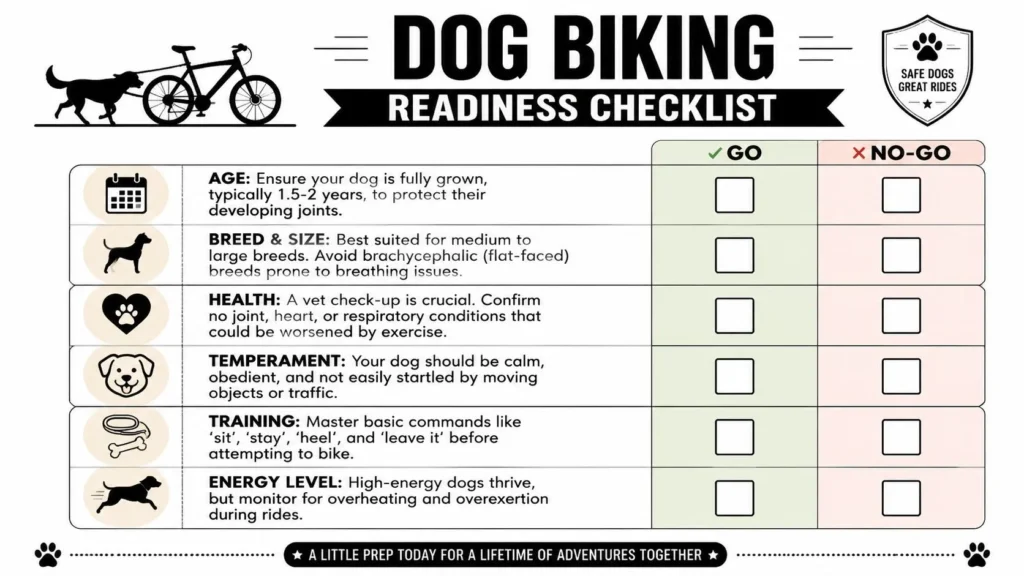
A good candidate usually has a few things going in their favor. Medium and larger athletic dogs often handle the work better than dogs with very short legs, very heavy builds, or compromised breathing. Flat-faced breeds are the clearest red flag because running and heat management are already harder for them before the bike adds speed and excitement.
Age matters just as much. A young puppy with growing joints shouldn’t be doing impact work beside a bike. At the other end, some senior dogs still love movement but do better with shorter outings or carriage options rather than sustained running.
Use this quick filter before you even think about training outdoors:
| Factor | Good sign | Red flag |
|---|---|---|
| Age | Fully developed, mature movement | Very young, growing, or frail |
| Build | Athletic, balanced stride | Flat-faced, heavy, or structurally unsound |
| Health | Cleared for exercise | Joint, heart, respiratory, or pain issues |
| Temperament | Calm, responsive, recovers quickly | Startles easily, reactive, frantic |
| Training | Reliable leash manners and recall cues | Pulling, lunging, poor focus |
Vet clearance and ground manners come first
A veterinary check matters because biking magnifies small physical problems. Mild stiffness, low exercise tolerance, or subtle breathing issues don’t stay subtle once your dog is expected to trot steadily beside a moving bike.
Ground training matters just as much. Before riding, your dog should already understand cues like sit, stay, heel, and leave it in ordinary walking situations. If your dog gets locked onto squirrels, other dogs, or passing scooters, fix that on foot first. If you need a refresher on stress signals and arousal, this guide to understanding dog body language is worth reviewing before you train near traffic.
A dog that obeys when nothing interesting is happening is still a beginner.
Heat is a go or no-go decision
On this point, many guides become too vague. “Avoid extreme heat” sounds responsible, but it doesn’t help you decide whether today’s ride is smart.
The more useful rule comes from Hill’s Pet Nutrition guidance on biking with your dog: pavement can be significantly hotter than the air, dogs cool less efficiently than humans, and if your dog is panting heavily, lagging behind, or seeking shade, the dog is already overheated. The safest call happens before the ride starts, not after your dog is struggling.
A simple decision framework works better than optimism:
- Check the surface: If the ground feels too hot to your bare skin, it’s too hot for paws.
- Check the route: Long exposed stretches are harder than shaded loops with bailout points.
- Check the dog you have: A dark-coated, thick-coated, anxious, or heavy dog may overheat faster than you expect.
- Check your alternatives: On hot days, a walk at dawn, a sniff session, or a trailer ride may be the smarter choice.
If you have to debate whether it’s too hot, that usually means conditions are already marginal.
Choosing the Right Gear for a Safe Ride
Gear won’t train your dog, but bad gear can sabotage even a well-trained one. The safest setup keeps your dog in the correct position, preserves your steering control, and reduces the chance of neck injury or wheel tangles.
The two biggest mistakes are simple. People hold a normal leash in one hand, or they clip the dog to a neck collar. Both make the ride less stable and less safe.
Leash systems compared
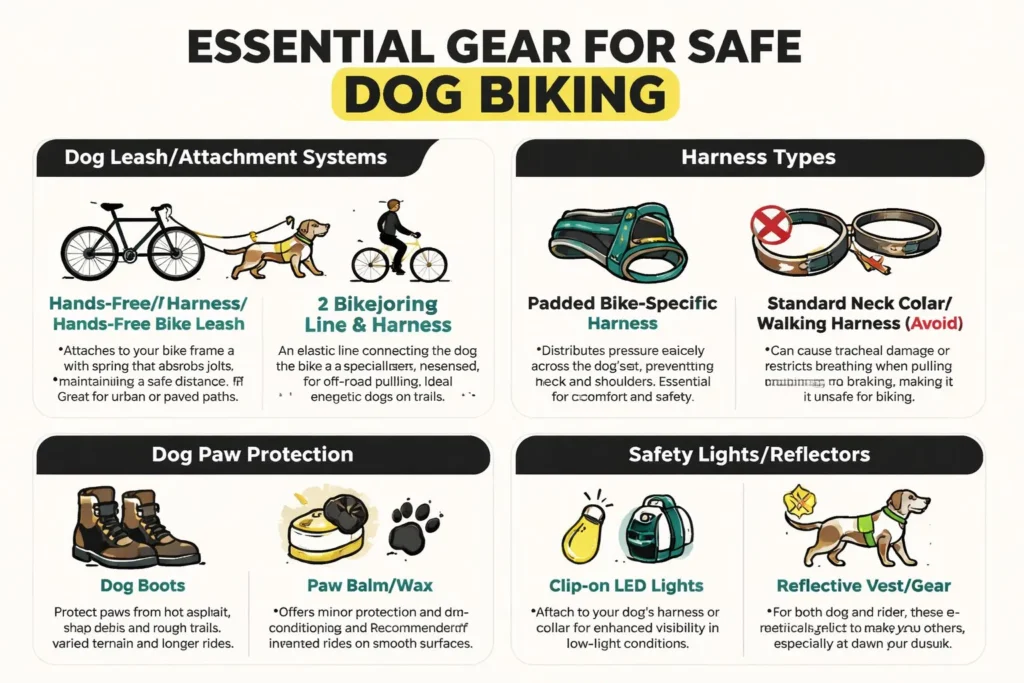
The core question is how the dog connects to the bike.
| Setup | Best use | What works | What doesn’t |
|---|---|---|---|
| Hands-free bike leash attachment | Side-running on roads or paths | Keeps both hands on handlebars, helps maintain side position | Still requires training and a steady dog |
| Flexible handheld leash | Almost never ideal for riding | Familiar to the dog | Reduces control, increases tangling risk |
| Bikejorring-style line and harness | Off-road pulling with purpose-built handling | Better for dogs trained to pull on trails | Wrong tool for casual urban riding |
The clearest safety guidance is consistent. In this video guidance on dog biking safety, experts recommend keeping the dog beside or behind the bike, never in front, using a hands-free safety leash attachment, choosing a well-fitted harness instead of a neck collar, and checking paws for heat or abrasion before, during, and after rides.
If your dog tends to surge, a frame-mounted system with some shock absorption is usually easier to manage than a loose leash in your hand. If your dog has high drive and you ride trails, a bikejorring setup only makes sense when you’re training for that specific discipline, not when you’re trying to teach polite path behavior.
Harnesses, paws, and visibility
A proper harness is essential. You want chest support and stable fit, not pressure on the throat. A walking harness can work if it fits well and doesn’t restrict movement, but a padded harness built for active use usually handles repeated trotting better.
Then there are the less glamorous pieces that often matter more on the day:
- Paw protection: Boots work for rough or hot surfaces. Balm helps only in lighter conditions.
- Water and bowl: Carry both. Don’t assume you’ll find a reliable stop.
- Reflective gear or clip-on lights: Useful when daylight is low or sightlines are poor.
- Backup leash: Handy if you need to dismount and walk home.
Small dogs, older dogs, and dogs that aren’t safe running beside the bike still have options. For short upright rides, a basket can work if it’s properly secured and the dog is calm with confinement. If you’re comparing options, it helps to shop pet bike baskets and look closely at attachment stability, cover design, and how the dog is restrained inside.
For longer rides or more fragile dogs, trailers are often the better answer because they remove impact and heat from the equation. If your dog also spends time outdoors in grass, brush, or trail margins, their general parasite protection matters too, and this overview of flea and tick collars is a useful side read before you make trail riding a routine.
Your Step-by-Step Dog Biking Training Plan
The first bad ride usually looks the same. The dog is excited, the rider is optimistic, and within two minutes the leash is tight, the bike is wobbling, and nobody is learning anything useful.
Good bike-dog teams are built in small, repeatable steps. That matters for confidence, but it also matters for injury prevention. A PubMed-indexed study on dog-related bicycle injuries found that riding with a dog is one of the recurring scenarios behind dog-related bike injuries treated in emergency departments. Training is where you reduce those avoidable mistakes before speed, traffic, heat, and distractions raise the stakes.
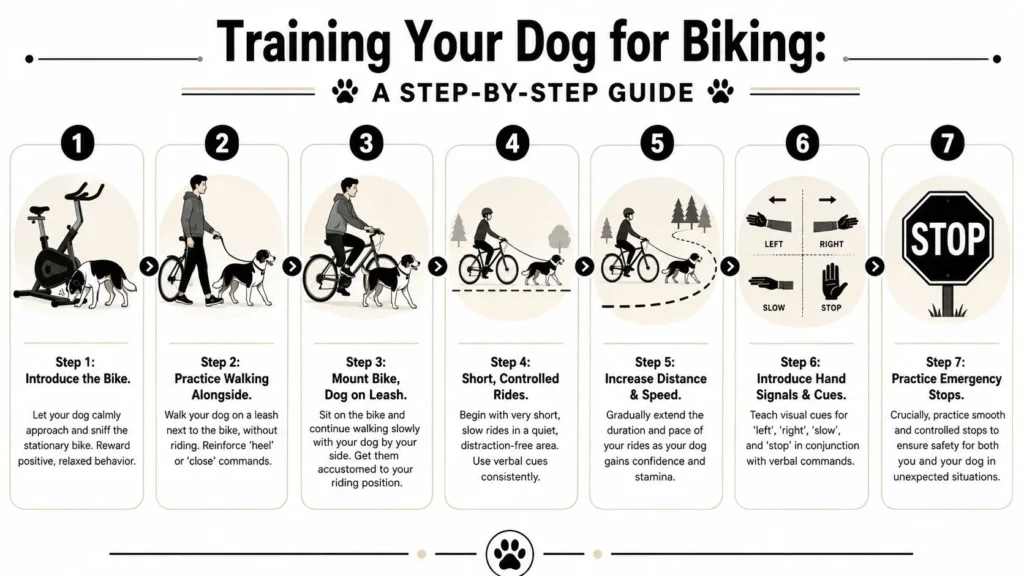
Phase one with the bike standing still
Start with the bike parked and quiet. Let your dog inspect it without pressure. Reward calm interest near the frame, wheels, and pedals, and end the session while the dog is still settled.
This stage feels simple, but it tells you a lot. A dog that startles at a pedal turning backward or a wheel bumping the ground is not ready for motion yet. Slow the session down and rebuild until the bike itself stops being a concern.
If your dog is loose on leash, crowding your legs, or ignoring basic position cues, clean that up before you add wheels. This refresher on how to train your dog for better leash manners and responsiveness fits well here because timing and repetition matter far more than fancy commands.
Phase two with the bike moving while you walk
Walk the bike. Keep both feet on the ground.
The goal is simple: your dog holds a steady position beside the bike without drifting toward the front wheel, cutting behind the rear wheel, or swinging across your path. I like to work this in short loops with frequent stops and resets. That gives the dog many chances to get the position right without building frustration.
Keep sessions brief and boring. Around 10 minutes is plenty for many dogs, especially early on. Repeat later in the day if the dog stayed focused and relaxed.
Training cue: Reward the place you want. Do not reward speed, bouncing, or frantic enthusiasm.
Phase three with you mounted and barely rolling
Once your dog can walk next to the bike calmly, get on and move at little more than walking speed in a quiet space. An empty parking lot, a calm service road, or a wide driveway works better than a busy path.
This phase is where dogs notice the full picture: your height changes, the pedals move, the wheels hum, and the bike no longer behaves like a piece of furniture. Keep the repetitions short enough that you can stop before the dog makes a bad choice three times in a row.
This is a good point to watch a demonstration if you learn visually:
If the dog forges ahead, stop. If the dog lags, lower the speed and shorten the session. If turns make the dog jump inward, make the turns wider and practice them at a crawl until the movement looks ordinary.
Phase four with short real rides
Short real rides come last, not first. Pick a flat route with good sightlines, low traffic, and no pressure to keep going if the dog is struggling.
A useful rule is to finish while the dog still looks fresh. Do not wait for obvious fatigue. By the time a dog is breaking gait, losing focus, or dragging behind, you have already gone too far for that stage of training.
Heat deserves a stricter rule than enthusiasm does. If you are undecided about the weather, do not ride. Warm pavement, direct sun, and humidity stack up fast, and dogs cannot cool themselves the way riders can. On hot days, I either go very early, cut the plan down to a few minutes of training, or skip the run and use a trailer or a walk instead.
A practical progression looks like this:
- First outings: Short, quiet, flat, and slow.
- Repeat the same route: Familiarity helps the dog settle into the job.
- Increase one variable at a time: Add a little distance or a slightly busier setting, not both on the same day.
- Proof the behavior gradually: Introduce mild distractions only after the dog can hold position consistently.
Common training mistakes that create safety problems
The biggest mistake is treating the first successful ride as proof the dog is ready for more. One decent outing only means the last step was manageable.
A few other patterns cause trouble fast:
- Building distance before position is reliable: A dog that wanders for one mile will wander for three.
- Riding at the cyclist’s natural pace: Many riders settle into a speed that pushes the dog out of a comfortable trot.
- Training in stimulating places too early: Joggers, squirrels, loose dogs, and narrow paths all raise the difficulty.
- Missing the small signs of stress: Extra panting, frequent head turns, sloppy position, and delayed responses often show up before the dog fully tires.
Patient dogs still need patient training. The right pace feels almost too easy, and that is usually how you know it is working.
Mastering On-Road Safety and Trail Etiquette
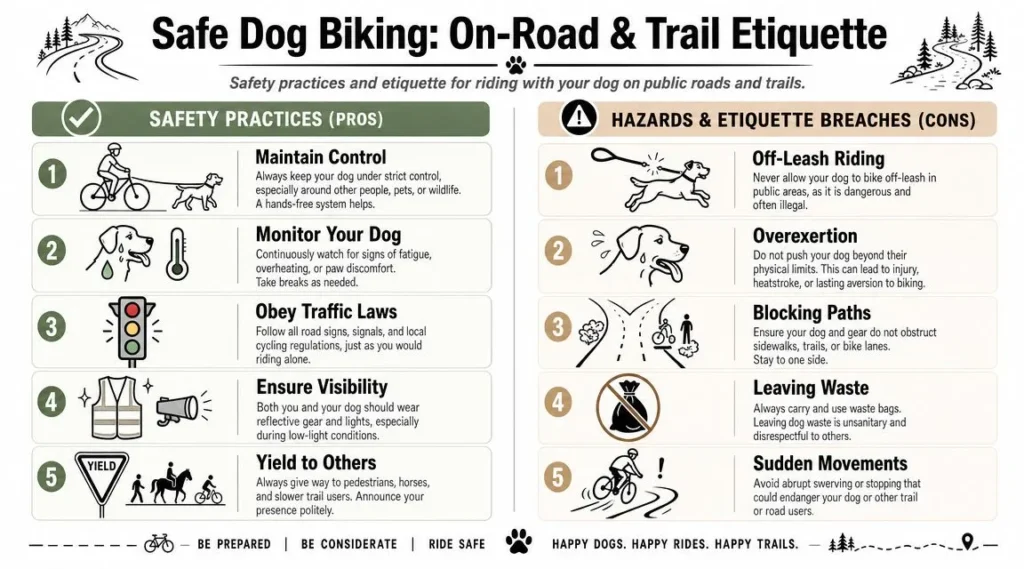
The safety rules around biking with a dog aren’t fussy etiquette invented by cautious riders. They track real accident patterns.
A PubMed-indexed study on dog-related bicycle injuries found 5,184,057 bicycle-associated emergency department injury visits overall, with 35,254 cases involving dogs, or 0.67% of those visits. The same study found that 97.5% of dog-related bicycle injuries came from four scenarios: being chased by a dog, hitting or colliding with a dog, swerving to avoid a dog, or riding with a dog. Its conclusion also states that approximately 1% of injuries to bicyclists are associated with dogs, and about one-half involved a bite.
Those numbers matter because they point to predictable failures. Dogs get in the rider’s line, riders lose control trying to avoid dogs, or a dog-bike pairing is managed badly in motion.
Position and scanning prevent most trouble
Your dog should travel beside you or slightly behind the pedal line, never crossing in front. That single rule prevents a surprising number of crashes.
The second habit is scanning well ahead. Don’t stare at the dog the whole time. Look for broken glass, loose dogs, children changing direction, squirrels, drainage grates, and parked cars with opening doors.
Riders get into trouble when they react late. Dogs get into trouble when riders assume the path will stay predictable.
A short mental checklist before every segment helps:
- Surface: Any heat, gravel, glass, salt, or sharp debris?
- Traffic: Cars, bikes, joggers, strollers, horses, off-leash dogs?
- Escape route: Can you stop and move aside quickly?
- Dog state: Focused, loose, rhythmic, and comfortable?
Trail manners matter
Even a well-trained dog-bike team can irritate everyone around them if they use the path badly.
Keep to one side. Slow early around pedestrians. Announce politely when passing. Don’t let the leash or your dog spread across the full width of the trail. And carry waste bags every time.
On mixed-use trails, your goal is to be forgettable. People should remember that you were courteous, not that your dog startled them or blocked the path.
Know when to end the ride
A smart rider quits early more often than a stubborn one. End the session if your dog loses rhythm, starts hunting shade, checks out mentally, or seems tender on the surface.
Hydration and paw checks aren’t optional habits. They’re part of riding. If you stop early and walk home, that’s not a failed ride. That’s competent handling.
Troubleshooting Common Issues and Final Thoughts
A lot of bike-dog problems show up in the first few minutes. The dog surges at the start, locks onto a squirrel, or looks flat halfway through a route that seemed easy last week. Treat those moments as information. They tell you what to change before a small issue turns into a crash, a strained muscle, or burned paws on hot pavement.
If your dog pulls
Pulling usually comes from arousal, poor pacing, or training that was advanced too quickly. The fix is usually boring, and it works. Slow the process down.
Go back to walking the bike. Pay for the position you want. Keep the first stretch short enough that your dog can stay successful, then end before excitement spills over. If the pulling only happens at the start, add a short decompression routine before you mount. I like a few minutes of loose-leash walking and a couple of simple cues, just enough to bring the dog’s brain back online.
Do not try to pedal through it. A dog that is towing the bike is not learning control.
If your dog lunges at distractions
Lunging means the environment is ahead of the dog’s skill level. That is a training issue, not stubbornness.
Drop back to on-foot work until your dog can notice another dog, bird, runner, or squirrel and disengage on cue. Then test the same skill in a quieter riding area. If your dog cannot do it on a regular leash, the bike adds speed, tension, and less room for error. That combination raises the chance of a fall fast.
Some dogs never become reliable around certain triggers at biking speed. That is a real limit, and it is better to respect it than pretend more determination will fix it.
If your dog seems afraid of the bike
Fear usually starts with noise, movement, or a first session that asked for too much. Strip the exercise down to pieces.
Set the bike still. Feed near it. Roll it a few inches. Reward calm interest. End while the dog is still relaxed. A nervous dog needs many easy repetitions with no surprises. Rushing this stage is how a mild concern becomes a lasting association.
I have had better results with three-minute confidence sessions than with one long session that drifts into avoidance.
If your dog fades halfway through
This usually points to conditioning, footing, heat, or a pace the dog cannot hold yet. Enthusiasm at the start can hide a bad match between the route and the dog’s current fitness.
The American Kennel Club’s guidance on biking with dogs recommends starting with very short distances and building gradually with praise and treats. That advice holds up in practice. Dogs that look eager will still overdo it if the rider sets the terms badly.
Check the pattern. If your dog fades on warm days, starts seeking shade, or slows sharply on blacktop, treat heat as the first suspect. Heat injury is one of the easiest biking risks to underestimate because the dog may keep moving long after good judgment would have ended the ride. Cut distance hard in warm weather, choose cooler surfaces, and be willing to turn a planned ride into a walk home. If the fade happens on every ride, lower the distance and speed for a week or two and rebuild from there.
A useful rule is simple. If your dog cannot finish the route and look normal again after a short rest, the ride was too much.
The best bike dogs are built through repetition, restraint, and honest calls about the day in front of you. Good handling often means ending early, changing the route, or deciding that this dog, on this day, should not ride at all. If you found this practitioner-focused guide helpful, you’ll find the same practical approach in our other writing at maxijournal.com, covering everything from pet health to sports science.
Discover more from Maxi Journal
Subscribe to get the latest posts sent to your email.