You’re probably watching Manchester United, glancing at the team sheet, seeing a familiar shape, and then wondering why the pitch tells a different story. The left-back is suddenly in midfield. Bruno Fernandes is between the lines one minute and chasing the ball the next. The winger has tucked inside, the striker is alone, and what looked like a simple setup now feels like moving parts with no obvious pattern.
That confusion is normal. A modern Manchester United formation isn’t a static drawing. It’s a sequence of shapes that appear and disappear depending on where the ball is, who’s available, and what problem the coach is trying to solve in that phase. If you want to understand United properly, you have to stop asking only, “What formation are they playing?” and start asking, “What shape are they in right now, and why?”
Decoding the Modern Manchester United Formation
Manchester United has always been a club shaped by adaptation. Its origins go back to 1878, when it began as Newton Heath LYR F.C., and the modern identity formally began on 24 April 1902 after a financial rescue and renaming to Manchester United F.C., beginning a journey of more than 140 years by 2026, as outlined in this club history timeline. That matters tactically because the club’s history is full of reinvention. The badge stayed. The football changed.
That’s why fans often misread what they’re seeing. They treat the lineup graphic as the truth, when it’s really just the starting point. A 4-2-3-1 on paper can become a back two in build-up, a narrow box in midfield, or a flatter defensive block without any substitution at all.
A useful way to think about it is the way coaches use magnets on a tactics board. The board gives you a clean reference. The match gives you movement, rotation, and trade-offs. If you want a simple visual way to map those changes yourself, this visual coaching tool guide is a practical reference for seeing how coaches present shape versus game-state reality.
The formation listed before kickoff tells you where players begin. It doesn’t tell you where the team will live during the match.
For United, that distinction matters more than ever. The modern side has often looked less like one fixed system and more like a set of responses. The question isn’t just whether the team plays with a back four or back three. The underlying issue is whether those shifts form a coherent identity or whether they patch over limitations in the squad.
The 4-2-3-1 Blueprint Under Erik ten Hag
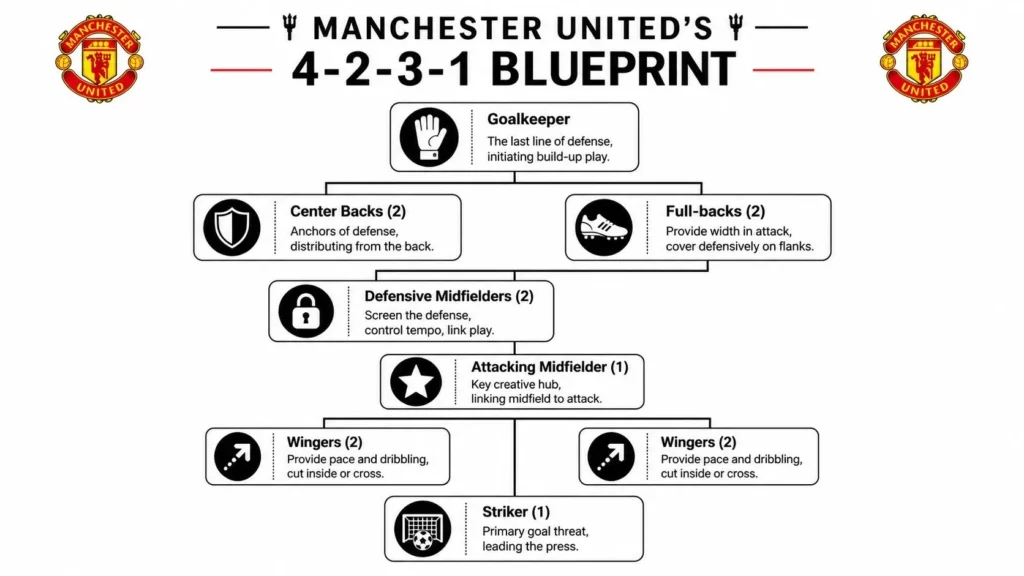
Under Erik ten Hag, Manchester United’s modern default was a 4-2-3-1, with Bruno Fernandes as a true central No. 10. In possession, that shape often expanded into a 2-5-3 build-up, while the defensive phase usually remained a compact 4-2-3-1, as detailed in this tactical analysis of ten Hag’s United.
Why the back four matters
The back four gives United something every unstable team craves. Reference points. Two center-backs can hold the base, while the full-backs choose when to step and when to stay. That sounds basic, but it changes the whole tempo of possession.
When one full-back pushes on and the other tucks, United can build with more balance. When both go high too early, the structure gets stretched and the first line of rest defense weakens. The shape works best when the defenders don’t just occupy positions, but time their movement to support the midfield line.
For coaches and analysts who want to study those first-phase mechanics in more detail, these football build up from the back drills are useful because they focus on spacing, support angles, and pressure responses rather than just passing patterns.
The double pivot is the real hinge
A lot of fans talk about the No. 10 because that role is visible. The two holding midfielders are where the shape holds together.
They have to do several jobs at once:
- Protect central space: They screen the area in front of the center-backs and stop direct access into the opposition’s most dangerous receiving zones.
- Control circulation: They give the first and second pass after regains, which decides whether United can settle or whether the game becomes chaotic.
- Balance the full-backs: If a full-back goes, one pivot often has to slide toward that side to secure the transition moment.
- Keep Bruno higher: Their discipline lets Fernandes stay between the lines rather than dropping too deep to start everything himself.
That last point is the key one. A true No. 10 is most damaging when he receives facing the opposition midfield and back line, not when he’s forced to collect the ball from center-backs with the whole match in front of him.
Practical rule: If Bruno is taking too many touches in the first phase, the 4-2-3-1 is already losing one of its main advantages.
The front four then become easier to read. The wingers can stay wide or move inside depending on where the full-backs are. The striker pins center-backs and gives the team a central reference. Bruno connects the midfield to the final line.
Later in the game model, that clean 4-2-3-1 often stretches into something more aggressive.
What the 2-5-3 really means
The phrase 2-5-3 can sound abstract, but it’s simple once you break it down.
| Line | Function | What it changes |
|---|---|---|
| Back 2 | Holds rest defense | Prevents transitions from becoming immediate emergencies |
| Middle 5 | Occupies width and half-spaces | Gives more passing lanes through and around midfield |
| Front 3 | Pins the last line | Creates room for a No. 10 or advancing midfielder |
That shape isn’t just about having numbers forward. It’s about freezing defenders. If the striker occupies both center-backs and the wingers threaten the channels, Fernandes gets the pocket he needs. If those front players don’t fix defenders in place, the whole middle becomes crowded and the system starts looking slow.
How the Formation Changes During a Match
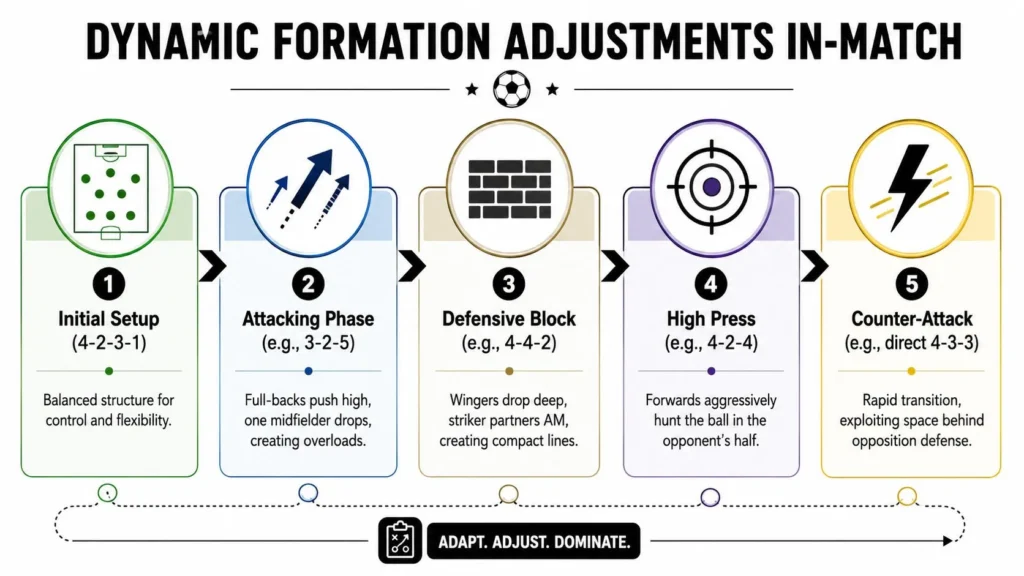
The most important thing to understand about the Manchester United formation is that it changes by phase, not by official announcement. Recent reporting around the Bournemouth draw highlighted that point clearly, noting both Ruben Amorim’s use of a 3-4-2-1 and United’s shift into a 4-1-3-2-like attacking shape, which underlines how static labels miss what happens on the pitch, as discussed in this match-based club analysis.
In possession, positions stop being literal
When United has the ball, the old line labels break down fast. A full-back can become an extra midfielder. A winger can move into the half-space like an inside forward. One midfielder may sit alone while another pushes ahead to create a staggered central lane.
That’s how a nominal back four can give way to a shape that looks much closer to a back three or even a front two behind the striker. In the Bournemouth example, the 4-1-3-2-like structure made sense because it packed central zones with more bodies and altered the passing picture for the opposition.
The point isn’t to be clever for its own sake. The point is to create one of three advantages:
- A spare man in build-up
- A free receiver between lines
- An overload near the ball
If none of those appear, the rotation is cosmetic.
Out of possession, simplicity returns
Defending is where coaches usually want clarity back. The team often drops into a more recognizable block because compactness matters more than surprise when the opposition has settled possession.
That’s why the same side can look intricate in attack and plain in defense. The block compresses distances, protects the middle, and gives each player cleaner pressing references.
If a side looks fluid with the ball but rigid without it, that isn’t a contradiction. It’s usually the plan.
A useful shorthand is this:
| Phase | Common visual effect | Tactical purpose |
|---|---|---|
| Build-up | Expanded shape | Open passing lanes and beat the first press |
| Final-third attack | Narrower occupation around the box | Combine centrally and pin defenders |
| Defensive block | More even horizontal lines | Protect central access and force play wide |
Why fans think the shape looks messy
Because rotations are easiest to notice when they fail.
When the spacing is right, a moving structure looks smooth. When timing is off, it looks like disorder. The same full-back inversion that creates central superiority can leave the flank exposed if possession is lost too early. The same attacking narrowness that creates combinations can make the team look clogged if the switch pass never comes.
So when supporters say United looks like it has “no shape,” they often mean one of two things. Either the phase change happened too slowly, or the players occupying those roles weren’t natural fits for the task.
Managerial Evolution and Alternative Systems
Manchester United’s tactical history matters because the current debate didn’t appear in a vacuum. The club’s landmark 19th league title arrived in the 2010–11 season, a benchmark noted in the club’s historical record. That title has become more than a trophy marker. It’s also a useful reference for how United once treated formations: as frameworks to maximize strengths, not as rigid identities to defend at all costs.
Ferguson’s flexibility was the real identity
The common memory of the Ferguson era is emotional. Late goals, intensity, direct wing play, pressure. Tactically, though, the deeper lesson is flexibility. United could present one structure on paper and attack through another set of relationships in practice.
That’s why older United sides often felt coherent even when their nominal shapes varied. The identity wasn’t “we always play this system.” It was closer to “we attack space quickly, we get numbers where danger is, and we adjust roles to the opponent.”
That distinction matters in today’s debates. A team can change shape often and still have a clear identity. It just needs consistent principles beneath the movement.
The post-Ferguson contrast
Many post-Ferguson versions of United have looked more system-led and less principle-led. Sometimes that produced order. Just as often, it produced a team that looked trapped between manager preference and squad reality.
Recent experiments with a back three or hybrid structures fit that pattern. They can solve one issue quickly. They may protect buildup, hide a weak flank, or create cleaner pressing roles. But they also ask whether the squad contains the profiles those systems require every week.
A useful comparison sits outside club football. Tournament sides often strip ideas down because there’s little training time and player combinations can be awkward. That’s part of why looking back at tactical snapshots such as Brazil’s 2014 World Cup team setup can be instructive. The shape on paper matters less than which compromises a coach is willing to accept.
Good managers don’t just choose formations. They choose which weaknesses they can live with.
The back-three question
A back three can offer cleaner progression and stronger cover during wide rotations. It can also expose a squad that lacks natural wing-backs or midfielders comfortable covering long spaces.
That’s the current tension at United. Alternative systems aren’t automatically more modern or more intelligent. They’re only better if the player pool supports their demands. Otherwise, the new shape only relocates the problem.
Key Player Roles and Responsibilities
A formation only works when the roles match the players. That’s why debates about the Manchester United formation often become debates about specific profiles rather than positions.

The double pivot
The term sounds technical, but the job is concrete. The two midfielders behind the No. 10 must read danger early, offer constant support angles, and know when one goes while the other stays.
One should usually be thinking about security. The other can think a touch more aggressively. If both chase the same pass or both vacate the same zone, the team breaks in half.
The wingers and half-space players
Wide attackers in modern football rarely stay glued to the touchline. They often start wide to stretch the back line, then arrive inside to receive nearer goal.
That creates two demands at once:
- Dribbling in tight areas, because the inside lane is crowded
- Timing off the ball, because arriving too early closes the space
That combination is why one-versus-one ability still matters so much. Players who can eliminate a defender without a perfect passing sequence change what the formation can become. If you want to study those details from a player-development angle, this guide to soccer dribbling techniques is useful because it links body shape and touch selection to game situations.
The No. 10 and the striker
The No. 10 in this setup carries a strange burden. He has to be creative enough to break a block, disciplined enough to defend central lanes, and intelligent enough to choose when to roam and when to stay available.
The striker’s work is just as misunderstood. Fans judge him by shots and goals. Coaches judge him by what his movement does to center-backs.
Consider the striker’s checklist:
- Pin defenders: He must stop the back line from stepping comfortably into midfield.
- Set pressing cues: His angle often decides where the opposition can play next.
- Link under pressure: If the attack goes direct, he has to secure or redirect the first contact.
- Open lanes for runners: Sometimes his best action is the run that creates someone else’s shot.
A lone striker can look isolated and still be performing his role well. The real question is whether the rest of the structure is using the space he creates.
Analyzing Tactical Strengths and Weaknesses
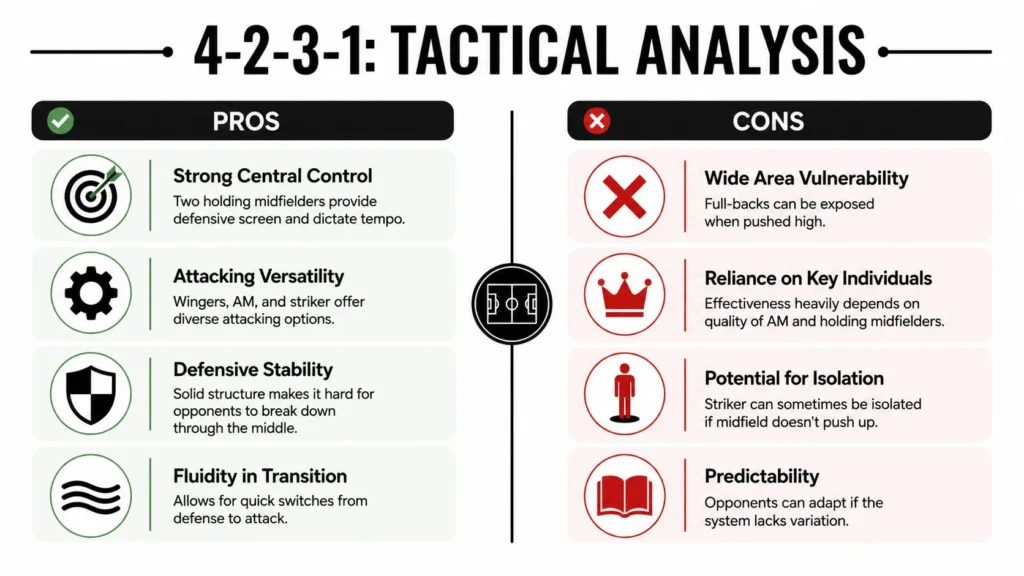
The strongest argument in favor of United’s recent setup is that it creates central clarity. The strongest argument against it is that clarity can depend too heavily on having exactly the right players in exactly the right roles. Recent analysis has framed that tension directly, suggesting the formation often looks built around specific players rather than standing as a self-sustaining identity, in this discussion of system fit and player profiles.
Where the system helps United
The first strength is central occupation. A 4-2-3-1 or its close variants can keep the middle of the pitch populated in both attack and defense. That matters because modern matches are often decided by who controls the zones just ahead of both penalty areas.
The second strength is role separation. The shape can keep creators high, protect the center-backs, and give wide players clear starting points. When the distances are right, transitions become cleaner because each player already knows the nearest recovery or support space.
A third strength is adaptability. The same personnel can support a deeper block, a front-foot press, or a more patient buildup with small positional tweaks rather than wholesale substitutions.
Where it starts to crack
The main weakness isn’t the formation diagram. It’s the dependence on specialist behavior.
If the pivot players can’t cover space and distribute calmly, the No. 10 drops too deep. If the full-backs push without good rest defense behind them, the wide channels open. If the striker can’t hold central defenders, Bruno and the wingers receive with too much pressure arriving from behind.
That’s why I’d frame the issue this way:
| Tactical question | What it reveals |
|---|---|
| Does the shape survive missing one key profile? | Whether it’s a true identity or a narrow solution |
| Can multiple players perform each specialist role? | Whether squad building matches tactical ambition |
| Do phase changes look rehearsed or improvised? | Whether the system is embedded or temporary |
The injury question belongs here too. A system that asks for highly specific running, receiving, and covering patterns becomes fragile when player availability drops. That’s not unique to United. It’s a structural issue across elite football, and it’s one reason broader conditioning and load management matter so much, especially in discussions around how to prevent sports injuries.
United’s biggest tactical problem may not be choosing the wrong formation. It may be asking one formation to solve squad-building problems it can only disguise.
That’s the conclusion many fans miss. The debate shouldn’t be “4-2-3-1 or 3-4-2-1?” It should be “Which shape asks the fewest impossible things from the available players?”
Frequently Asked Questions About Uniteds Formation
Why does United look different with and without the ball
Because the listed formation is only the starting reference. In possession, players spread or rotate to create better passing lanes and overloads. Out of possession, they compress space and return to cleaner defensive references.
Is Bruno Fernandes better as a No. 10 than deeper in midfield
In structural terms, yes. A higher role lets him receive between lines and connect attacks near the danger zone. When he drops too deep for long stretches, the team often loses a key link between midfield and the front line.
Why do some matches make the shape look much more aggressive
Because opponent behavior changes the picture. If the opposition sits deep, United often commits more players into advanced lanes and may look like it has an extra attacker. If the opposition presses high, United may keep more security behind the ball.
Would a back three automatically fix United’s problems
No. A back three can improve certain buildup patterns and transition cover, but only if the squad has the right wing, midfield, and defensive profiles to support it. Otherwise, the change shifts pressure onto different players.
What does double pivot mean in simple terms
It means two midfielders sit behind the attacking midfielder and share responsibility for protection, passing, and balance. One may step higher at times, but together they stabilize the team.
Is the current system an identity or a compromise
Right now, it often looks like both. There are visible ideas behind it, especially around central structure and phase-based movement. But the shape also seems sensitive to player availability, which suggests the tactical model still depends heavily on who’s fit and who can perform specialist roles.
If you enjoy clear, approachable sports analysis alongside writing on science, tech, health, culture, and more, maxijournal.com is worth exploring. It’s an independent online magazine with fresh commentary across a wide range of subjects, and it’s also a useful place for readers and prospective contributors who like sharp, readable publishing without the usual clutter.
Discover more from Maxi Journal
Subscribe to get the latest posts sent to your email.