You’ve probably seen a photo of Alexa Chung and stopped for a second, because her hair always looks finished without looking pushed. It sits in that sweet spot between polished and slightly undone, the kind of shape that makes you wonder whether it took five minutes or a very good stylist and a mirror full of patience.
That’s the appeal of Alexa Chung hair. It’s not one single haircut or one single wave pattern, it’s a recognizable styling language built around a few repeatable choices, and those choices have been discussed for years across fashion media and Chung’s own beauty content. Her birth in 1983 and long public presence as an English model and television personality helped make her image widely visible, but the reason her hair stuck is simpler, it kept reading as wearable, not remote. In a 2016 tutorial on her own YouTube channel, she showed the method directly, which made the look feel less like a red-carpet accident and more like something you could learn. Alexa Chung’s own hair tutorial and public style background
Why Alexa Chung Hair Became a Beauty Reference
The reason people keep returning to Alexa Chung’s hair is that it behaves like a reference point, not a fleeting moment. You can scroll past one of her photos and understand the whole idea immediately, there’s shape, movement, and enough softness that the style never looks overbuilt. That balance is hard to fake, and fashion editors have treated it as a point of comparison for years because it helps readers name a look they can’t quite describe on their own.
Why the image stuck
Chung’s public image has always been tied to hair as much as clothes. The verified record says her hair has been widely discussed as part of her long-running public profile, and by the mid-2010s that identity was strong enough to support branded beauty content centered on her own styling method. That matters because it shows the look had moved beyond admiration into repeatable instruction. Her YouTube tutorial and the documented styling steps
The other reason it stayed visible is that her changes are treated like style events. A Grazia feature on a lighter reddish shade, described as “Ginger Chocolate,” noted that she hadn’t brought back her iconic fringe at that moment, which tells you how closely people track even small shifts. When a fringe or color adjustment gets that much attention, the style has become part of the cultural vocabulary around beauty, not just a personal grooming choice. Grazia’s coverage of her “Ginger Chocolate” shade
Practical rule: If a hairstyle still reads well when the fringe changes, the color shifts, or the length grows out a little, that’s usually a sign it has become a durable reference, not a trend that only works in one exact photo.
Why readers still search for it
Search behavior tends to follow recognizability. People type Alexa Chung hair because they want a haircut they can describe to a stylist, not a costume they can only admire. The appeal sits in the gap between editorial and everyday, which is why tutorials, salon round-ups, and hair inspiration boards keep circling the same ideas instead of replacing them.
That durability also explains why the look feels familiar even when it changes. The fringe may disappear for a season, the tone may warm up, and the length may drift, but the overall message stays constant, relaxed polish with intent. That’s why the phrase still works as a search term, it names both a person and a style logic.
The Three Pillars of Her Signature Look
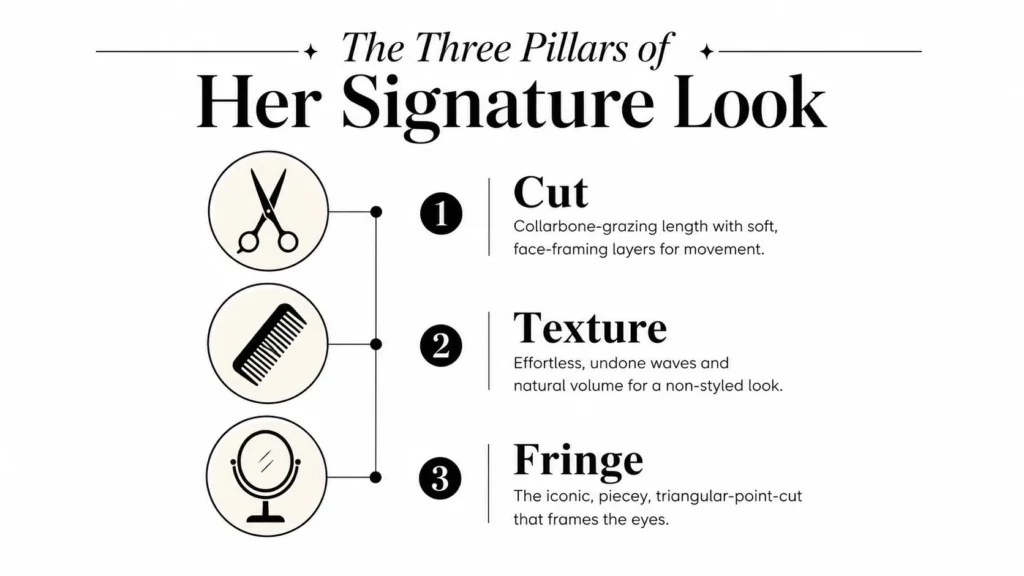
A useful way to read Alexa Chung hair is to separate it into three working parts. The haircut sets the frame, the texture gives it movement, and the color softens the whole effect. If one piece drifts too far, the result starts to feel like a different style entirely.
Cut, texture, and color each do a separate job
The cut is usually a collarbone-length shape with face-framing pieces, which leaves enough length for movement while keeping the hair close to the face. That length matters because it lets the waves open up instead of collapsing into a heavy shape. The face-framing pieces matter too, because they soften the outline and keep the style from reading as blunt.
The texture is the part people usually try to copy first, but it only works because the cut supports it. Chung’s waves are brushed out and loose, not neat spirals, so the finish reads as lived-in rather than event-ready. If you want to explain the texture to a stylist, say soft, undone waves with volume at the roots and a brushed finish at the ends.
Color is the quietest pillar, but it changes the mood of the entire look. Her shades have moved through brunette territory with warmer and lighter variations, including the reddish tone highlighted by Grazia, and that warmth keeps the style from feeling flat. A one-note brown can make the cut feel severe, while a softer tone keeps it approachable.
For a wider length and layering reference, this guide to best haircuts for women can help you match the overall shape to your face shape.
Quick translation: If you want the look in one sentence, ask for collarbone length, soft face-framing layers, and a finish that’s meant to look brushed out, not set.
How to tell the parts apart
The three pillars get mixed together because they usually show up as one finished look. The haircut can work without the exact wave pattern, the wave can work on a different cut, and the color can shift while the silhouette still feels recognizable. That matters, because you do not have to copy every part at once to get close to the mood.
A stylist conversation goes better when you separate the elements before you sit down. Start with the shape, then decide whether you want the fringe, then talk about tone. That order keeps the request clear and avoids the vague “make me look like Alexa Chung” problem.
Decoding the Fringe She Made Famous
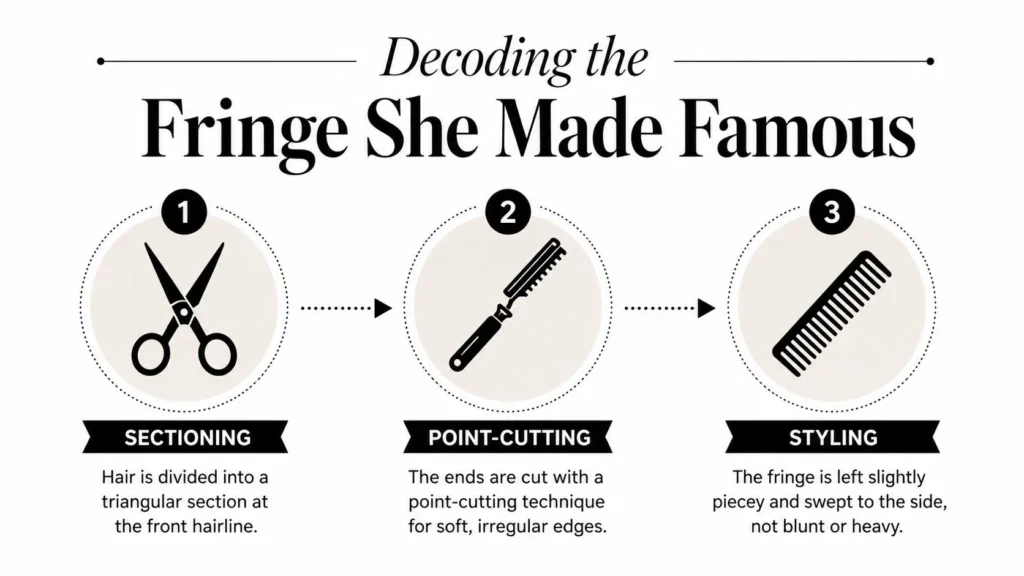
The fringe is the part of the look that gets copied most often, and it’s also the part most likely to go wrong if it’s cut as a blunt line. Chung’s own trim method uses a sectioned triangular-point-cut approach, which is much softer than a straight-across fringe. The shape is built from the center outward, so the shortest point lands in the middle and the outer pieces stay longer.
Why the geometry matters
That triangle shape changes how the fringe sits on the face. Instead of creating a hard horizontal edge, the perimeter opens outward like a curtain that’s pulled wider at the sides than in the middle. The result is a fringe that blends into the face-framing layers instead of sitting on top of them like a separate block.
The practical payoff is grow-out. Because the edge is graduated, the fringe doesn’t announce itself as loudly when it starts to lengthen, and that makes maintenance feel less punishing. The same source also describes combing the fringe forward and trimming uneven bits only after all the sections are joined, which is a sensible symmetry check before you call it done. The detailed fringe-cutting method
For readers comparing fringe shapes, this guide to bangs for thin hair is useful because it shows why density and shape need to be matched carefully.
The smartest fringe is rarely the straightest one. Soft graduation usually grows out better and blends more naturally with the rest of the haircut.
What to ask for at the salon
Say you want a fringe that’s piecey, not heavy, and that connects to the front layers. Mention that you want the center to sit slightly shorter than the sides. That language tells the stylist you’re after movement, not a solid curtain.
If you’re trimming at home, resist the urge to cut a full blunt line across the front. The point-cut finish gives the fringe its softness, and the join between sections is what keeps the shape balanced. That’s why the method feels more editorial than DIY in the casual sense, it’s simple in theory, but the small angles matter.
The Waving Technique Step by Step
The wave is where the look becomes unmistakably Alexa Chung. Her documented method is precise, and the precision is what stops the hair from tipping into tight curl territory. She tongs the hair away from the face, leaves both the root and the ends out, then pulls it straight immediately after curling so the bend stays loose instead of turning into a spiral. Chung’s tutorial showing the waved-hair method
How the shape actually forms
Think of the tool as bending a ribbon rather than rolling it into a spiral. If the tong wraps the entire strand, you get a cylindrical curl with a round perimeter. If the root and ends stay out, the strand keeps more of its straight line, so the finished wave reads softer and more editorial.
That detail matters technically because leaving both ends unheated reduces the curl’s full symmetry. The wave doesn’t close into a perfect tube, which is exactly why the finish feels easier and more modern. Chung also says heat protection should be used when tonging frequently, and that’s sensible if you’re revisiting the style often. Her instruction on heat protection and tong direction
Common wave mistakes and how to fix them
| Mistake | Why It Happens | Fix from Chung’s Method |
|---|---|---|
| Tight ringlets | The hair is wrapped too fully around the tong | Leave the root and ends out, then pull the curl straight |
| Waves that flip toward the face | The tong direction changes around the head | Tong consistently away from the face |
| Flat mid-lengths | The bend is placed too close to the scalp or only at the tips | Keep the root out, then work through the middle section |
| Ends that look too curly | The ends were heated all the way through | Leave the ends out so the perimeter stays softer |
| A stiff finish | The curl was left in its round shape | Brush or pull it open right after release |
A lot of readers get stuck because they try to make every section identical. That’s not the point here. The style gets its character from variation, so the wave can look slightly imperfect as long as the direction stays consistent.
Product Picks That Match the Method
The best products for this look are the ones that support the shape without announcing themselves. You’re not building a glossy blowout or a shellacked curl set, you’re creating movement that lasts through brushing and wear. That means shopping by function, not by a celebrity bottle label.
What each product needs to do
A heat protection spray comes first because frequent tonging needs a barrier before you add heat. Choose one that disappears into the hair fast and doesn’t leave a sticky film, since residue can make the wave collapse unevenly. A texturising spray or sea-salt spray can then go through the mid-lengths to help the brushed-out bend hold some grit.
For the ends, use a lightweight conditioning treatment rather than a heavy oil if the hair tends to get weighed down. The ends are left out of the tong, so they still need softness, but they don’t need to be smothered. If you want a deeper cleansing routine on wash days, this article on safe use of ACV shampoo is a useful complement because it explains how clarifying care can fit into a broader hair reset without making the routine overly heavy.
What to avoid
Heavy oils can flatten the shape before the wave has a chance to settle. Hard-hold hairsprays can make the finish look stiff and crunchy, which works against the whole aesthetic. Silicone-heavy serums can also make the hair too slippery, and then the waves slide apart instead of staying piecey.
For a nourishing oil option, this piece on argan hair oil is useful if you’re trying to understand how much shine the ends need.
Shopping rule: Buy for the job, not the promise. If a product adds weight, shine, or stiffness faster than it adds separation, it’s probably wrong for this look.
A simple function-based lineup
- Before heat: a light heat protector that sprays evenly and dries quickly.
- For grip: a texture spray that adds separation without matte chalkiness.
- For the ends: a small amount of conditioner or treatment that keeps them soft.
- To finish: a flexible spray that holds the brushed shape without locking it.
That lineup is enough for most hair types trying to recreate the mood at home. You can refine later, but the starting point should always be lightness.
Maintenance Habits That Keep the Look Lived In
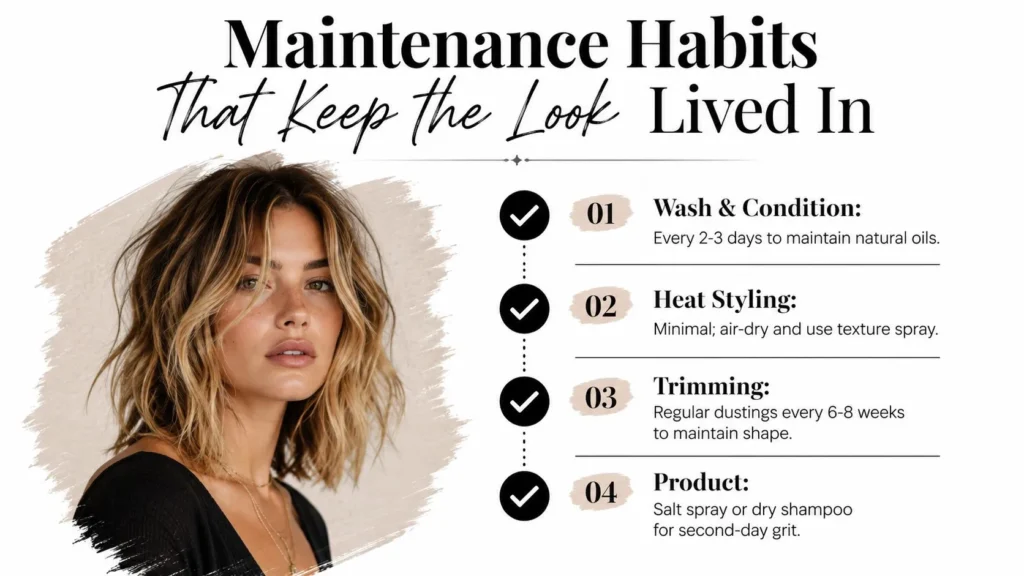
Chung’s own maintenance habits make the style make sense. She has said she washes and conditions her hair every day, conditions from below the ears to avoid a greasy top area, and never towel-dries, preferring to towel pat instead. That tells you the look isn’t only about the styling tool, it’s also about how she handles the hair between styling sessions. Her maintenance details in Women’s Health
What those habits are doing
Conditioning from below the ears is a smart way to protect the top from getting weighed down. It’s like moisturizing the driest part of a sweater instead of coating the whole garment, the area that needs help gets it, and the crown stays lighter. Towel-patting does the same kind of work, it removes water without roughing up the cuticle or puffing the hair into a frizzy shape.
Her note about being pescatarian for years also matters as a lifestyle signal. It doesn’t prove one beauty outcome on its own, but it does show that her hair story has always been tied to a broader daily routine rather than salon visits alone. That’s a useful reminder for readers who think the look lives or dies in the hands of a stylist.
If you’re trying to make the texture softer without starting over, this guide to discover best curl cream techniques is a helpful reference because it shows how to support waves without overdefining them.
A realistic weekly rhythm
A workable version of this routine is simple. Wash and condition as needed, focus conditioner from mid-length down, and let the hair dry with as little rough handling as possible. If your waves droop during the week, refresh only the pieces that need it instead of re-tonging the whole head.
That approach keeps the hair in the right lane, soft, a little imperfect, and still intentional. It also makes the style feel lived in rather than reset every single morning, which is part of why the look has lasted.
Is the Alexa Chung Look Still a Current Trend
A salon chair can make the question feel surprisingly practical. If you ask for Alexa Chung hair, you are usually not asking for a copy of one fixed photo, you are asking for a shape that still reads modern because it balances softness, movement, and a little attitude.
Why the look keeps resurfacing
Fashion coverage keeps returning to her hair because it still gives editors something to talk about. The shift to a lighter Ginger Chocolate shade mattered, and so did the note that the iconic fringe was not part of that moment. That combination shows how the look stays visible even when it changes, which is exactly why it remains useful reference material. Grazia’s note on the color shift and fringe absence
Its staying power comes from how easily the elements can be adjusted. The length can sit a little longer or shorter, the fringe can be worn or left out, and the texture can be pushed more tousled or kept a touch smoother. What does not change is the overall impression of relaxed polish, a quality that works far beyond a single haircut or a single season.
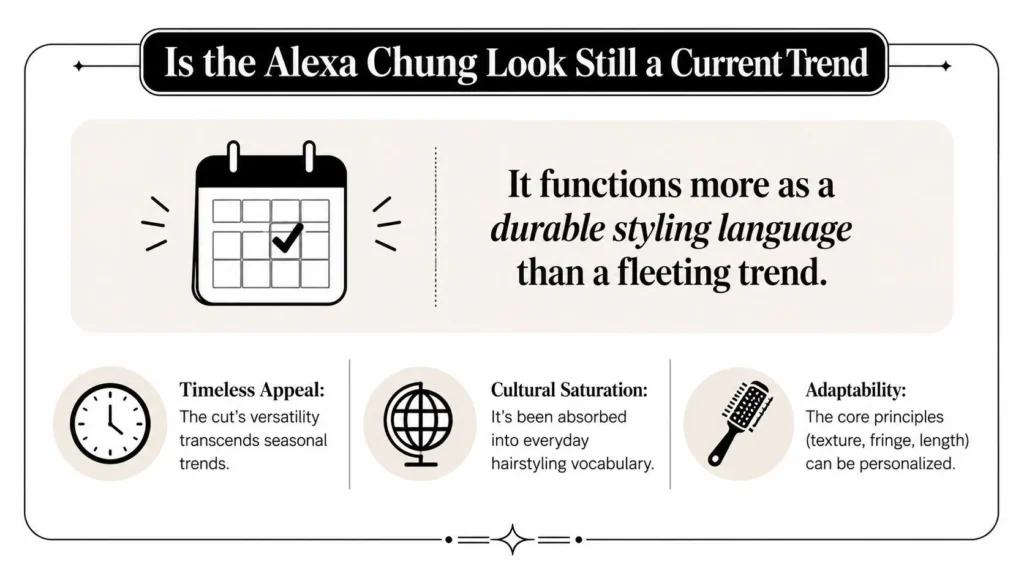
Bottom line: It behaves less like a temporary cut and more like a styling shorthand that salons can read clearly without making the result feel dated.
What that means for real-world styling
At home, the repeatable part is the structure, not the celebrity finish. Start with the same building blocks, texture, fringe, and length, then adjust them to your own face and daily routine. That is why the look still feels current, because it is flexible enough to be translated instead of copied.
The most helpful way to approach it is to separate what can be done easily from what usually comes from editorial styling. A good cut and a workable wave pattern are realistic for many, while the extra lift, shine control, and perfectly placed bend in a campaign image usually come from a pro’s hand and a lot of shaping. If you keep that distinction in mind, the style stops feeling mysterious and starts feeling achievable.
So the phrase still gets used like a trend term, but the idea itself behaves more like a classic. That is the part worth remembering in the salon chair. You are not asking for a museum piece, you are asking for a familiar shape that still has movement and still feels alive.
Your First Week With the Alexa Chung Look
Start with language, not tools. If you book a consultation, describe the cut, texture, and color separately so the stylist can build the shape without guessing what you mean. Then choose one styling session, ideally on a wash day, and practice the tonging method when you have time to redo a section if needed.
Your one product swap should be practical, not dramatic. Add heat protection if you’re curling often, or add a light texturising spray if the waves need more grip, but don’t replace your whole cabinet in one trip. The goal for the first week is softer waves, a fringe or front shape that moves naturally, and a finish that looks a little relaxed on purpose.
Keep the standard humble. If one side falls flatter than the other, or the ends don’t curve perfectly, that still fits the look. The style was built on brushed-out movement, not exact symmetry.
maxijournal.com offers approachable fashion and beauty writing that makes styles like Alexa Chung’s easier to understand and recreate at home. If you want more clear, practical guides that turn editorial looks into real routines, visit maxijournal.com and keep exploring.
Discover more from Maxi Journal
Subscribe to get the latest posts sent to your email.