You smile at a photo someone just took, zoom in, and there it is. A little puffiness or folding under the eyes that you swear wasn’t there a second ago when your face was relaxed.
That moment can be oddly unsettling. People often assume they’re seeing “bags,” aging, or a problem that needs fixing. Sometimes it is a true under-eye bag. But very often, what shows up only when you smile is the normal mechanics of the lower eyelid and cheek moving together.
The useful question isn’t “How do I get rid of this immediately?” It’s “What exactly am I looking at?” Once you know that, the rest gets much easier. You can stop lumping every under-eye change into one category, and you can choose care that matches the cause.
That Moment You Notice Bags Under Your Eyes When You Smile
A common scene goes like this. You’re laughing in good light, feeling fine, then a mirror or phone camera catches you mid-smile. Suddenly the area under your eyes looks fuller, puffier, or shadowed. At rest, maybe you barely notice it. When you grin, it seems to pop.
That difference matters.
If the under-eye area changes mainly with expression, you may be seeing a dynamic smile-related bulge, not a fixed bag. If it’s there all day, even when your face is neutral, that points more toward a structural issue such as fat prominence, skin laxity, or fluid-related puffiness. People mix these up all the time because both can look similar in photos.
A second layer of confusion is lifestyle. A bad night of sleep, allergies, dehydration, or a salty dinner can make the same smile look puffier the next day. That’s one reason readers who are also trying to improve rest often benefit from broader habits that support recovery, such as these practical ideas for better sleep quality.
Many people who worry about bags under eyes when they smile are looking at a normal facial movement, not a defect.
That doesn’t mean you have to love what you see. It means you deserve a more accurate explanation than “you have eye bags.” The skin, muscle, fat, and cheek all play different roles here, and each one creates a different kind of under-eye look.
The Anatomy of a Smile Why It Accentuates Under-Eye Bags
A smile pulls on more than the corners of the mouth. It also changes the lower eyelid, the upper cheek, and the thin layer of skin between them.
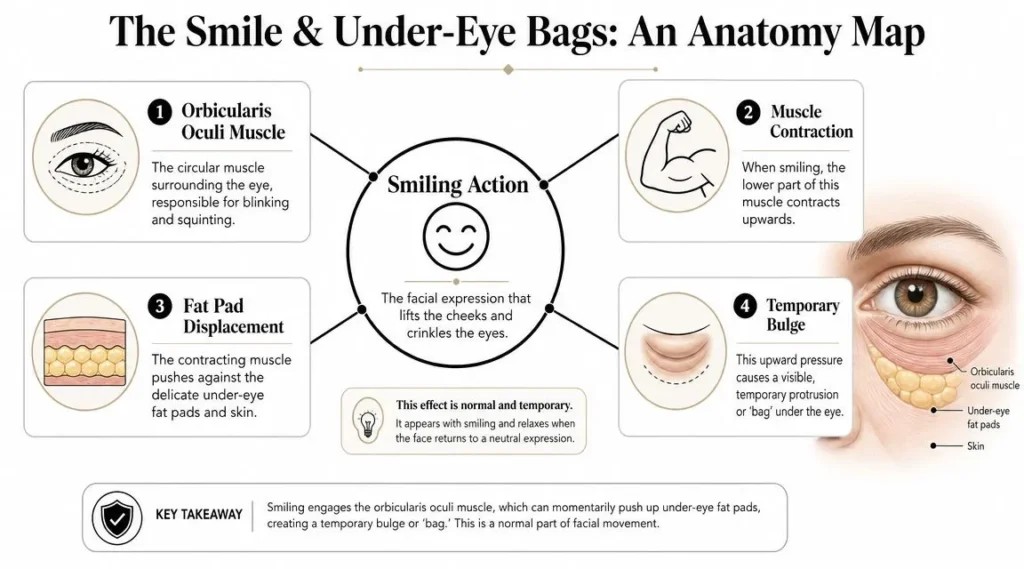
That is why a fuller look under the eyes during smiling is often normal anatomy in motion, not automatically a sign of damage or aging. The main structure involved is the orbicularis oculi muscle, a circular muscle that wraps around the eye like a soft drawstring. When it contracts during a genuine smile, it shortens and bunches the tissue above it. In some faces, that creates a small roll or ridge just beneath the lashes.
The easiest way to picture it is with fabric. If you gently tighten a drawstring around cloth, the material gathers into a fold. The lower eyelid can behave in a similar way. The muscle tightens, the overlying skin creases, and the nearby fat and cheek tissue shift upward a little. What you see in the mirror is the surface effect of that coordinated movement.
A normal smile-related bulge usually has a few clues. It appears with smiling, laughing, or squinting. It softens when the face is relaxed. It often sits high, close to the lash line, rather than hanging lower on the cheek.
That pattern is different from a constant bag caused by fat prominence or looser support in the lower lid. If you want a helpful overview for understanding under eye bags, it helps to compare what shows up only with expression versus what stays visible at rest.
Why this often looks worse than it is
The under-eye area is a small zone with thin skin, curved surfaces, and strong shadows. Tiny changes register quickly there. A mild ridge can cast a darker line beneath it, and the eye reads that contrast as extra puffiness.
Phone cameras and bathroom lighting add to the confusion. Overhead light can deepen the shadow under a smile bulge. Flash can flatten one area and darken the edge next to it. A raised cheek can also press upward into the lower lid, making the contour look fuller for a moment.
Patients often notice three separate things at once:
- Muscle bunching creates a roll near the lashes.
- Cheek lift compresses the lower lid from below.
- Shadowing makes a shallow contour look deeper or puffier.
A simple rule helps. If the fullness shows up mainly during smiling and fades in a neutral face, the anatomy of expression is probably doing most of the work.
That matters because treatment decisions depend on the cause. A smile-only bulge is often a normal feature of facial movement. It usually calls for realistic expectations and a measured approach, rather than assuming every under-eye change is a fixed bag that needs correction.
Differentiating the Types of Under-Eye Concerns
Not every under-eye issue is the same problem wearing a different outfit. Some are caused by muscle action. Others come from fat position, fluid, or loss of support in the area.
A major age-related mechanism behind under-eye bags is laxity of the eyelid support system. The tissue structures and muscles weaken, the skin sags, and the fat that normally supports the eye can move forward into the lower lid. The Mayo Clinic also notes that fluid can collect there, and puffiness can be amplified by sleep loss, salty meals, allergies, smoking, and fluid retention, as explained in this Mayo Clinic overview of bags under eyes.
Identifying Your Under-Eye Concern
| Concern | Primary Cause | Appearance Characteristic |
|---|---|---|
| Normal smile bulge | Orbicularis oculi muscle contraction | Shows up mainly when smiling or squinting |
| True fat-pad bag | Forward movement of lower-lid fat with weakened support | Visible at rest and often more constant |
| Fluid puffiness | Temporary swelling from retention, allergies, sleep changes, irritation | Can vary by day and often feels softer or puffier |
| Tear trough hollow | Volume loss and contour change that creates shadowing | Looks like darkness or a groove more than a soft pouch |
Four patterns people commonly confuse
The normal muscle bulge sits closest to the lash line and usually appears with expression. Patients often describe it as “my eyes get puffy when I grin,” even though the tissue may look fine when their face is still.
True fat prominence behaves differently. It’s there in a neutral face. Smiling can make it more noticeable, but the bag itself doesn’t depend on the smile to exist.
Then there’s fluid-related puffiness. This one fluctuates. You may wake up with it, notice it after a salty meal, or have it worsen during allergy season. It often improves when the trigger settles down.
Finally, tear trough hollowing tricks people because it can mimic puffiness. The issue may not be extra volume at all. It may be a dip that creates shadow beside or beneath mild fullness, making the whole under-eye area look tired.
A useful self-check is to compare your face in two moments: relaxed in the mirror, then smiling in the same light. The difference often tells you more than a heavily filtered photo.
If you want another patient-friendly read on causes and terminology, this guide on understanding under eye bags adds helpful context without overcomplicating the topic.
Practical At-Home Care and Prevention Strategies
If the puffiness shows up mostly when you smile, home care works best as a way to calm the tissue around the eye, not to change the shape you were born with. That distinction matters. A smile-activated bulge often reflects normal anatomy, while extra fluid, irritation, poor sleep, and sun damage can make the same area look heavier.
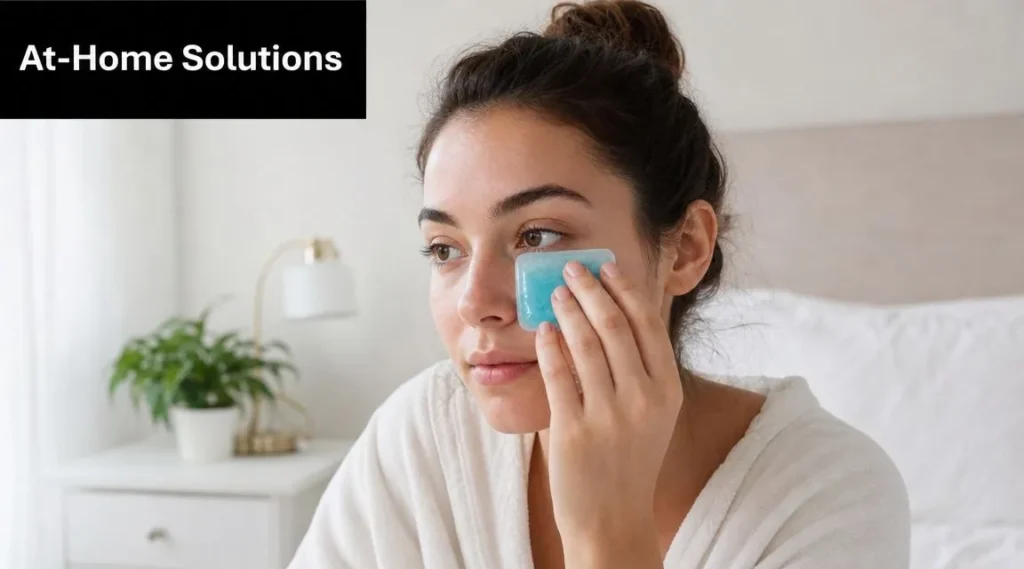
I usually tell patients to treat this area the way they would treat a thin, mobile fabric. The under-eye skin folds, stretches, and reflects light with every expression. If that fabric is dry, swollen, or irritated, every smile line and every little mound stands out more.
Start with the basics because they change the variables you can control. Better sleep, cooler compresses, less evening salt if you wake up puffy, steady hydration, and daily sunscreen can all make the lower lid look less swollen or crepey. None of these steps remove under-eye fat or reshape the muscle that lifts when you smile, but they can reduce the add-on factors that make the area look more tired.
What helps most at home
- Cold compresses: Cooling can temporarily reduce swelling and make the area look less full.
- Sleep habits: A rough night often makes fluid retention and shadowing more noticeable the next day.
- Less salt late in the day: Some people collect more fluid under the eyes by morning.
- Hydration: Well-hydrated skin tends to look less dull and less crinkled.
- Sun protection: Sun exposure gradually weakens collagen, which can make laxity and fine lines easier to see.
Keep the routine simple enough to repeat.
A gel mask from the fridge for a few minutes in the morning is often enough. Follow with a bland moisturizer, then sunscreen around the orbital bone. If a product stings, causes watering, or leaves the skin red, stop using it. Irritated under-eye skin often looks puffier, not better.
Skincare can improve the surface
Creams and serums mainly help the skin quality sitting over the anatomy. That means they may soften dryness, reduce a puffy morning look, or help makeup sit more smoothly. They do not erase a structural bulge that appears when the cheek rises and the muscle tightens during a smile.
Caffeine can be useful for temporary morning puffiness. Retinoid-based formulas may improve texture over time, but the lower eyelid is easy to overdo, so go slowly and buffer with moisturizer if needed. If you are comparing options, this guide to the best anti-aging eye cream gives a helpful overview of the main product types and what they realistically can do.
A short demonstration can also help if you’re more visual about technique and depuffing habits:
The goal at home is improvement, not structural correction. If your under-eye area looks calmer, smoother, and less swollen, the anatomy usually reads as softer too.
How to Camouflage Under-Eye Bags with Makeup
Makeup works best here when you stop trying to paint over the whole area.
If you cover the entire puff with a thick concealer, the bulge can look larger. Light hits a raised surface. More product on that raised surface often draws attention to it. The smarter move is to target the shadow, not the mound.
Better placement beats more product
Start with a thin moisturizer so the skin moves smoothly when you smile. Then look straight into a mirror and find the darkest part of the under-eye shadow. That’s usually the hollow just below the puff or along the inner trough.
Use a peach or peach-yellow corrector if the darkness looks blue, purple, or gray. After that, tap a small amount of concealer only where the shadow sits. Keep the raised area itself lighter on product.
- For bluish darkness: Peach tones usually neutralize better than a skin-tone concealer alone.
- For mild brown discoloration: A slightly warm concealer may be enough.
- For smile lines: Thin layers crease less than full-coverage masks.
How to keep it from creasing when you smile
Let the concealer settle for a moment, then tap out any line with a fingertip or sponge. Use only a tiny amount of finely milled translucent powder, and place it where makeup tends to gather rather than dusting the whole lower lid heavily.
A few practical rules help:
- Choose flexible formulas: Creamy, lightweight products move better with expression.
- Skip heavy baking: Thick powder under smiling eyes often looks dry and textured.
- Brighten strategically: Inner-corner brightness can lift the whole area without overloading the bag itself.
The goal isn’t to erase every fold. It’s to reduce contrast so the eye notices your expression first, not the shadow beneath it.
Professional Treatments and When to See a Doctor
A lot of people reach this point after a very specific moment. They smile in a bright mirror, see a puff under the eyes, and wonder whether it is normal anatomy in motion or something that needs treatment.
That distinction matters because the treatment plan depends on what is creating the shape. A smile-activated bulge can come from the muscle bunching upward and the cheek pushing into the lower lid. A persistent bag, by contrast, is more likely tied to lower-lid fat prominence, skin laxity, or support changes in the tissues around the eye. Doctors try to sort out which of those is present before recommending anything.
What doctors may consider
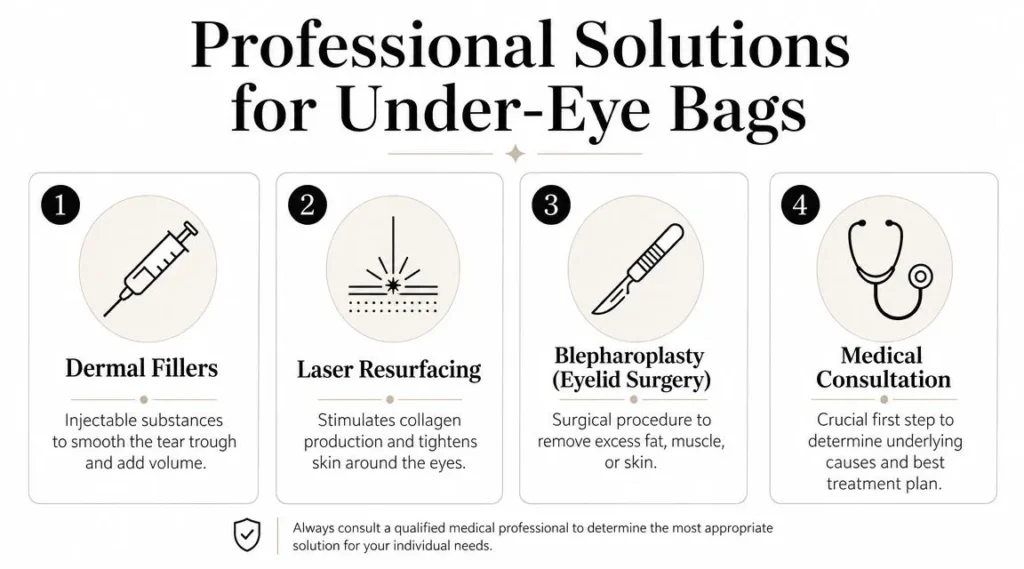
If the main issue is a hollow or a shadow below a small mound, a clinician may discuss fillers. Fillers can soften the contour difference between the lid and cheek. They do not remove true fat bags, and the under-eye area is one of the places where careful patient selection matters most.
If the skin itself is a big part of the problem, laser resurfacing or other skin-tightening treatments may help with fine lines and crepey texture. People comparing office treatments with home devices sometimes also read about infrared light therapy for fine lines. That kind of approach fits better into supportive skin care than into correction of a structural bag.
For bags that sit there even when the face is relaxed, lower blepharoplasty is the procedure doctors commonly consider for more definitive correction. It works on the actual anatomy by removing or repositioning fat and, in some cases, tightening support structures. In simple terms, makeup and skin care can reduce contrast, while surgery changes the contour itself.
When it’s time to get evaluated
A professional exam makes sense if the area looks puffy even when you are not smiling, if one side is clearly different from the other, or if the change has become more noticeable over time.
You should also book an evaluation if the area is irritated, tender, suddenly swollen, or associated with watering, redness, or vision-area discomfort. Those signs point away from ordinary smile anatomy and toward something that deserves medical attention.
A dermatologist can help when skin quality, pigment, or swelling patterns are the main issue. A facial plastic surgeon or oculoplastic surgeon may be the better fit when the concern looks structural. The exam is often less dramatic than people expect. The doctor is usually studying how the lower lid, cheek, muscle, fat pads, and tear trough fit together, much like checking which part of a cushion is overstuffed and which part has lost support.
If you’re comparing treatment categories more broadly, including regenerative ideas that show up in marketing, a primer on what stem cell therapy is can help you sort early-stage concepts from established options.
The reassuring part is simple. Not every under-eye bulge that appears with a smile is a problem. Once you understand whether you are seeing normal movement, shadow from a hollow, fluid swelling, or a true structural bag, it becomes much easier to choose between reassurance, camouflage, skin-focused care, or a medical consultation.
Discover more from Maxi Journal
Subscribe to get the latest posts sent to your email.