You hear it from across the room. Your dog is resting, gets excited, or comes back from a walk, and suddenly there’s a thin, high sound when they breathe. It’s not quite a cough. It’s not a bark. It sounds wrong.
If your first thought is “my dog is wheezing”, you’re not overreacting. A wheezing dog isn’t usually just making an odd noise. Veterinary guidance describes wheezing as a high-pitched whistling sound, often heard on exhalation, and it commonly reflects airflow obstruction somewhere in the airways, from irritation and inflammation to a foreign object or a mass, as explained by PetMD’s guide to dog wheezing causes and treatment.
The hard part is that owners often use the word wheezing for several very different sounds. That matters, because a noisy inhale can suggest a different problem than a whistle on the exhale. A brief snorting episode may sound dramatic but mean something else entirely.
This guide is built for the moment you’re in right now. You need to know what sound you’re hearing, what details to watch for, and when to stay calm versus when to leave for the vet immediately.
That Frightening Sound A Guide for Worried Pet Owners
A common scene goes like this. Your dog has been fine all day. Then after zooming around the house, pulling on the leash, or waking up from a nap, they make a high, tight breathing sound that stops you cold. You lean closer, listen again, and wonder if this is something minor or the start of an emergency.

Most worried owners do the same few things. They look at the chest. They watch the mouth. They try to decide whether the dog is breathing in trouble or just making a weird sound. That confusion is normal.
Start with observation, not panic
When you hear an unusual breathing noise, your first job is to observe clearly. Try to answer these questions:
- When does it happen: Is the sound on the inhale, the exhale, or both?
- What triggered it: Rest, exercise, heat, barking, eating, or pressure from a collar?
- How long does it last: A few seconds, a few minutes, or does it keep going?
- What is your dog doing otherwise: Acting normal, anxious, tired, or struggling to get air?
A short phone video can help more than a perfect description. Dogs often stop making the sound once they arrive at the clinic, so recording an episode can give your veterinarian useful context.
Practical rule: Don’t chase your dog around to inspect them. Keep them quiet, reduce excitement, and watch their breathing pattern from a short distance first.
What matters most right away
A strange breathing sound by itself deserves attention. A strange breathing sound plus visible breathing effort deserves much more.
Look at your dog’s posture. A comfortable dog may settle, swallow, and relax. A dog having genuine trouble may stand stiffly, stretch the neck, flare the body with each breath, or refuse to lie down.
That’s why this topic needs a calm, step-by-step approach. Before you jump to causes, it helps to identify the sound accurately.
Is It Wheezing or Something Else
Not every noisy breath is true wheezing. Owners often group together wheezing, stridor, stertor, coughing, and reverse sneezing, but they don’t mean the same thing.
Medical guidance notes that true wheezing usually suggests lower-airway narrowing, while stridor, a sound heard on inhalation, points more toward the larynx or trachea. Being able to describe the sound and when it happens gives a veterinarian much better information, as outlined in Trudell Animal Health’s discussion of why dogs wheeze.
What true wheezing usually sounds like
A true wheeze is usually a high-pitched whistling sound. Many owners notice it most on the exhale. Think of air moving through a narrowed tube.
That tends to suggest narrowing deeper in the breathing system rather than a problem only in the nose or throat. The distinction isn’t perfect at home, but it’s still useful.
Dog breathing sounds compared
| Sound | Description | When It Happens | Likely Location |
|---|---|---|---|
| Wheezing | High-pitched whistling sound | Often on exhale | Lower airways |
| Stridor | Harsh, squeaky, tight sound | More often on inhale | Larynx or trachea |
| Stertor | Snoring, snorting, congested sound | Can happen during normal breathing | Nose, nasal passages, or throat |
| Reverse sneeze | Rapid inward snorting episode | Sudden bursts, often brief | Area behind the nose and soft palate |
A simple way to tell them apart
Use this quick listening framework:
Listen for pitch
A whistle-like noise fits wheezing better. A harsher squeak or rasp fits stridor more closely.Watch the timing
If the sound is strongest when your dog breathes out, wheezing moves higher on the list. If it’s strongest when breathing in, think more about upper-airway noise.Notice the body language
Reverse sneezing often looks dramatic, but many dogs recover quickly and go back to normal. A dog with ongoing airway trouble may stay tense or continue making the sound.Describe what else is happening
Is there coughing, gagging, exercise intolerance, or a recent episode after chewing something? Those details matter.
If your dog also has a cough, it can help to compare what you’re hearing with other respiratory patterns, including dog coughing up white foam, because owners often mix cough sounds and wheeze sounds together.
When owners can tell the vet, “It’s a whistle on the exhale after running,” that’s far more useful than saying, “He’s making a weird noise.”
Why owners get confused
The confusion usually comes from the throat and chest sounding similar from a few feet away. Dogs also don’t read the textbook. One dog may wheeze and cough. Another may have stridor and gagging. A short-nosed dog may be noisy at baseline, which makes changes harder to spot.
If you aren’t sure what sound you heard, that’s okay. Focus on three details: what it sounded like, when it happened, and whether your dog looked comfortable or distressed.
Common and Less Urgent Causes of Wheezing
Not every case means disaster. Some dogs wheeze because the airways are irritated, inflamed, or temporarily narrowed. The key is to avoid dismissing it just because the episode passed.
Environmental irritation and mild inflammation
Dogs can develop noisy breathing after exposure to things that bother the airways. Dust, smoke, strong fragrances, and outdoor allergens can all irritate sensitive breathing passages. In some dogs, that irritation stays mild. In others, it reveals an underlying problem that was already there.
A mild respiratory infection can also play a role. Some dogs start with a cough or throat irritation and later develop a whistling or noisy component when active or excited.
Situational wheezing matters
This is one of the most overlooked patterns. If your dog only seems to wheeze during exercise, heat, or excitement, it still deserves attention. Emergency veterinary guidance notes that situational wheezing can signal a narrowed airway that becomes more obvious under stress, and it may reflect problems such as airway inflammation or a collapsing trachea, as described by VEG’s article on dog wheezing.
That means a dog who sounds normal while resting may still have a meaningful airway issue. Stress raises airflow demand. A narrower airway that seems “fine” at rest can become noisy when the dog pants, pulls, or gets overheated.
Common real-life trigger patterns
- After a leash pull: Neck pressure can irritate an already sensitive airway.
- During hot weather: Panting increases airflow demand and can expose a hidden weakness.
- When guests arrive: Excitement leads to faster breathing, barking, and airway strain.
- After play: Heavy breathing can make even mild airway narrowing obvious.
If you’re unsure how much concern is appropriate, a practical overview of seeking vet care for dog breathing can help you frame what deserves prompt evaluation.
Dogs at higher risk for noisy breathing
Some dogs are more likely to make breathing sounds because of their anatomy.
- Small breeds: They may be more prone to airway narrowing patterns such as tracheal problems.
- Flat-faced breeds: Pugs, Bulldogs, and similar dogs often have naturally narrower upper-airway structures.
- Dogs exposed to irritants: Smoke, aerosols, and strong scents can make symptoms more noticeable.
- Dogs who pull on collars: Repeated neck pressure can aggravate breathing noise.
A related household question is whether strong outdoor or insect-repelling scents may irritate sensitive dogs. If that’s a concern in your home, you may also want to read about whether citronella is safe for dogs.
A pattern that only shows up “sometimes” can still be medically important. Intermittent symptoms often mean the airway problem is exposed by stress rather than absent at rest.
When “less urgent” still means “make an appointment”
Make a routine vet visit soon if the wheezing:
- Keeps recurring: Even if episodes are brief
- Has a clear trigger: Exercise, heat, excitement, or collar pressure
- Comes with coughing: Especially if the cough is new
- Seems to be getting easier to trigger: Less activity causes more noise
That’s not panic. It’s good triage.
Serious Conditions That Require a Vet Visit
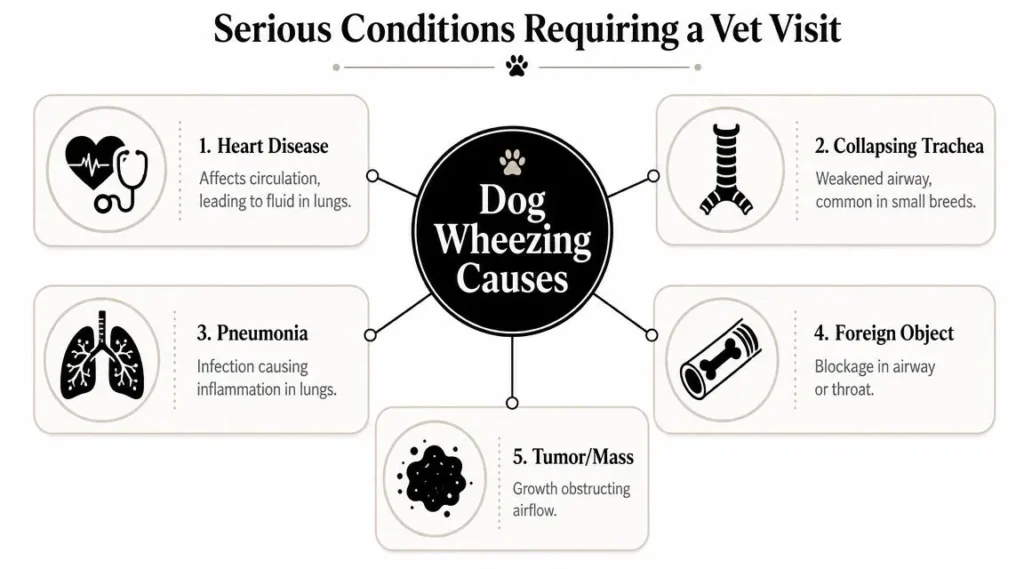
Once you have a reasonable sense that the sound is true wheezing, not a reverse sneeze or a harsh upper-airway noise, the next question is what could be causing it. Some problems affect the small breathing tubes deep in the chest. Others narrow the airway higher up, more like a pinched straw than an irritated lung. Those details matter because two dogs can sound similar at home while having very different problems.
Lower-airway disease
Lower-airway disease involves the smaller passages inside the lungs.
Chronic bronchitis can inflame those passages and leave less room for air to move. Dogs often start with a cough. Later, owners may notice a whistling sound, especially on exhale.
Bronchospasm means the airway muscles tighten suddenly. The effect is similar to squeezing a soft tube. Air still moves, but with more resistance and more noise.
Pneumonia or other lower respiratory infections can also lead to wheezing-like sounds. In these cases, inflammation and mucus change how air passes through the lungs, and the dog may seem tired or less interested in activity.
Structural airway problems
Some dogs have a physical narrowing in the airway itself.
Tracheal collapse is a common example, especially in small breeds. The windpipe loses some of its normal rigidity, so the passage can flatten more easily during breathing. That helps explain why the sound may appear during excitement, pulling on a collar, or exercise rather than all day long.
Laryngeal or other upper-airway disorders can be confusing because owners often call every noisy breath “wheezing.” In reality, a noise from the throat may be harsher, louder on inhale, or easier to hear without putting your ear near the chest. That distinction is one reason your observations about timing and sound quality are so useful to your vet.
Obstruction and masses
Sometimes the problem is that something is taking up space where air should be moving.
A foreign object such as grass, food, or toy material can partially block airflow. A mass or tumor can slowly narrow the airway. Swelling from inflammation can do the same thing more quickly.
Context helps here. A sound that starts right after chewing, eating, or running through brush deserves prompt veterinary attention, even if your dog settles down for the moment.
Heart-related breathing problems
Heart disease can also change the way a dog breathes. If the heart is not handling circulation well, fluid can build up in or around the lungs, and owners may hear noisy breathing that sounds like wheezing. This is one reason it is risky to assume every whistling sound comes from the airways alone.
Why a vet visit matters
At home, you are listening to the sound. Your veterinarian is trying to locate the source.
That is an important difference. One dog may have inflamed lower airways. Another may have a collapsing trachea. Another may have a throat problem, a partial blockage, or a heart condition affecting the lungs. If the noise keeps returning, lasts more than a brief episode, or seems tied to less and less activity, it deserves an exam rather than more guessing.
Emergency Warning Signs You Must Act On Now
Some combinations of symptoms mean you should stop monitoring and go. Cornell’s veterinary guidance is direct on this point: respiratory distress is a medical emergency. Immediate transport is needed if wheezing comes with rapid open-mouth breathing, bluish or gray gums, abdominal effort to breathe, weakness, collapse, or a dog extending the head and neck to maximize airflow, according to Cornell’s guidance on recognizing and responding to canine respiratory distress.
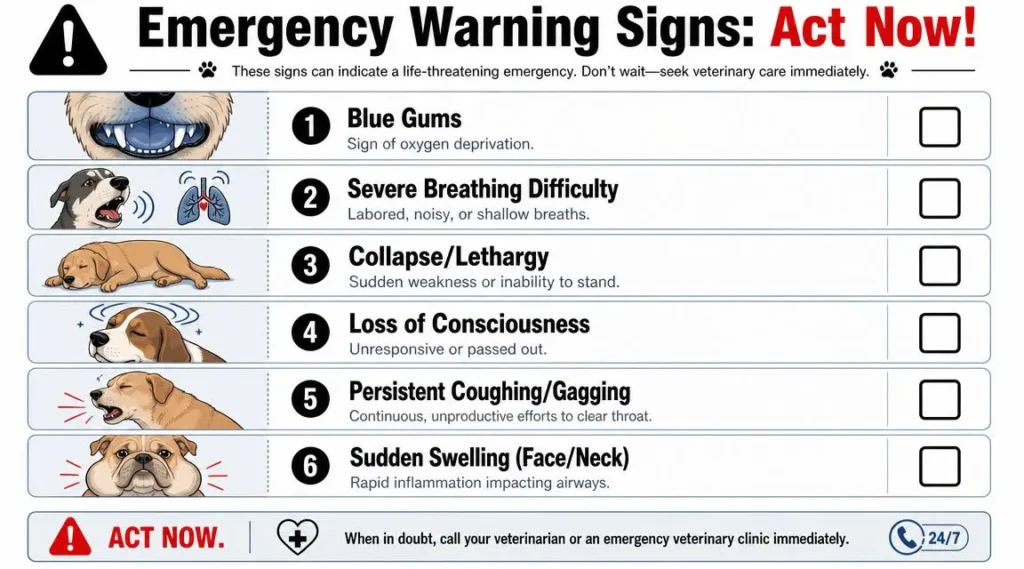
Go now if you see any of these
- Blue, gray, or dusky gums: This can mean oxygen delivery is failing.
- Open-mouth breathing at rest: Especially if your dog looks panicked or can’t settle.
- Heavy belly effort: If the abdomen is working hard to move air, that’s a red flag.
- Weakness or collapse: Don’t wait for another episode.
- Neck stretched forward to breathe: Dogs do this when they’re trying to improve airflow.
- Sudden worsening: A previously mild sound becomes constant or distressing.
Here’s a visual overview that may help you recognize distress signs quickly:
What to do on the way
Keep your dog as calm and cool as possible. Cornell advises cooling the car with air conditioning during transport because heat-driven panting can increase oxygen demand and make the situation worse.
Do these simple things:
- Carry if possible: Avoid making your dog walk if breathing is hard.
- Keep the environment cool: Use air conditioning rather than warm air.
- Avoid food or water forcing: Don’t try to make them eat or drink.
- Call ahead: Let the clinic know you’re coming with a dog in respiratory distress.
If your dog is struggling to breathe, your job isn’t to diagnose the exact cause at home. Your job is to get them to care safely and quickly.
How Vets Diagnose the Cause of Wheezing
The exam usually starts with a detailed history. Your veterinarian will want to know when the sound started, whether it happens on inhale or exhale, what triggers it, and whether there are other signs such as coughing, gagging, fatigue, or heat sensitivity.
The first few minutes at the clinic
If your dog arrives actively struggling, stabilizing breathing comes first. In a less urgent case, the vet may begin with:
- Listening to the chest and airway: Heart, lungs, and upper-airway sounds can offer clues
- Watching the breathing pattern: Fast, shallow, noisy, or effortful breathing each suggests different possibilities
- Checking gum color and comfort: These help assess oxygenation and urgency
- Reviewing your video: A home recording can be more useful than memory alone
Tests your vet may recommend
The exact plan depends on how your dog looks and what the exam suggests, but common diagnostics include:
| Test | What it helps assess |
|---|---|
| Chest X-rays | Lungs, heart size, trachea, and general chest structures |
| Blood work | Infection, inflammation, and overall health status |
| Airway exam | Problems in the throat, larynx, or trachea |
| Additional imaging | Cases where more detail is needed |
Why the details you notice matter
Your observations shape the workup. If the sound only appears after exercise, that points the vet one way. If it began suddenly after chewing on a toy, that points another. If it’s an expiratory whistle with a cough, that creates a different list.
Bring notes if you can. Helpful details include:
- Trigger pattern: Exercise, eating, heat, excitement, sleep
- Sound timing: Inhale, exhale, or unclear
- Episode length: Brief, repeated, or constant
- Behavior change: Normal between episodes or not
The clearer your description, the faster your vet can narrow the possibilities.
Common Treatments and Prevention Tips
Treatment works best when it matches the type of noise and the reason behind it. A true lower-airway wheeze is handled differently from an upper-airway problem, a reverse sneeze, or a cough that only sounds like wheezing. That is why the first goal is not to guess a medicine. It is to match the sound, the trigger, and your dog’s breathing effort to the right next step.
A simple way to sort this out at home is to ask three questions. What does the sound resemble. When does it happen. How does your dog look during it. A soft whistle on exhale after exercise points in a different direction than a harsh sound on inhale during excitement, or a snorting burst that stops on its own.
Common treatment directions
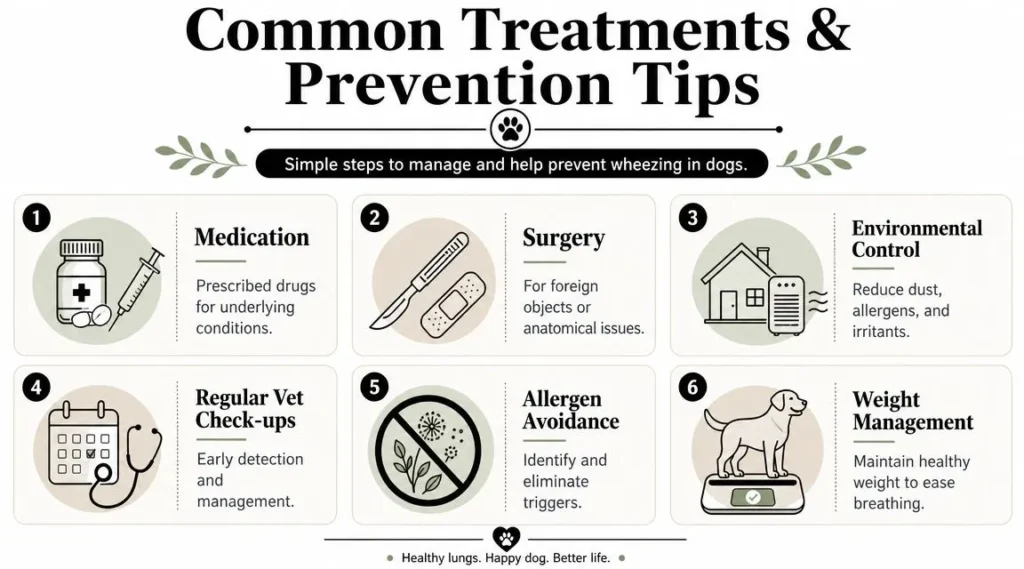
Your veterinarian may recommend one or more of these approaches:
- Medication: To reduce inflammation, relax narrowed airways, or treat infection
- Environmental change: Reducing smoke, sprays, dust, and other irritants
- Weight management: Excess body weight can make breathing work harder
- Harness use: This reduces pressure on the neck in dogs prone to airway irritation
- Procedures or surgery: Needed when there’s an obstruction or structural issue
Some dogs also need changes based on their trigger pattern. If episodes show up during hot weather, the plan may focus on cooling, shorter walks, and calmer activity. If the sound starts with leash pressure, a harness often helps more than owners expect. If your dog has a condition such as tracheal collapse and you’re exploring supportive care questions alongside veterinary treatment, some owners also review resources like Drake Dog Cancer Foundation’s CBD guide. It should not replace your vet’s plan, but it may help you ask better questions.
What helps at home long term
Prevention is mostly about reducing airway irritation and avoiding the situations that set your dog off.
- Keep your dog lean: Extra weight makes each breath take more effort.
- Switch from collar to harness: This is especially helpful if noisy breathing follows pulling or neck pressure.
- Avoid irritants: Smoke, aerosols, strong cleaners, and heavy fragrances can worsen airway sensitivity.
- Limit heat and overexcitement: Some dogs stay quiet at rest but get noisy once they are overheated or worked up.
- Schedule rechecks: Repeated episodes deserve follow-up, even if your dog seems normal afterward.
One caution about home medication
Home medication is an area where owners can get into trouble quickly. Dogs with noisy breathing do not all have the same problem, and a drug that seems harmless can blur symptoms or be unsafe for that dog’s condition.
Do not give over-the-counter products unless your veterinarian says they fit your dog’s situation. If you have questions about antihistamines, how much Benadryl for dog can be useful background reading, but breathing changes still call for direct veterinary advice.
The best prevention plan fits your dog’s pattern. A dog that gets noisy after heat exposure needs a different routine from one that struggles after leash pressure or intense excitement.
If the sound happens again, record it. Note what your dog was doing right before it started, whether it happened on inhale or exhale, and how quickly it stopped. Those details often help more than a general description like “he was wheezing.”
Discover more from Maxi Journal
Subscribe to get the latest posts sent to your email.