You’re probably here because brushing has become a negotiation. You want a clean mouth, but the moment the bristles touch a cold-exposed spot near the gumline, you get that sharp, electric sting. So you brush less firmly, or you avoid certain teeth, or you rush through the session just to get it over with.
That’s exactly why choosing the best electric toothbrush for sensitive teeth isn’t really about buying the most advanced model. It’s about finding a brush that cleans thoroughly without adding more mechanical stress to enamel, exposed dentin, or irritated gums. The right brush helps, but only if its design matches the reason your teeth hurt in the first place.
Why Brushing Sensitive Teeth Can Be a Challenge
Sensitive teeth create a contradiction. You need plaque removed well, especially around the gumline, but the very act of brushing can feel abrasive when enamel is worn, gums have receded, or inflamed tissue is already tender.
That tension matters because backing off too much can also make sensitivity worse. Plaque buildup and gum inflammation can increase discomfort over time, so “being gentle” can’t mean “not cleaning.” It has to mean controlling force while still cleaning effectively.
A useful reason powered brushes come up so often in this conversation is their measurable cleaning advantage. A 2014 Cochrane review of 56 studies found that powered toothbrushes reduced plaque by about 11% after 1 to 3 months and about 21% after 3 months or more, while gingivitis fell by about 6% after 1 to 3 months and 11% after 3 months or more compared with manual brushes, as summarized by Consumer Reports’ review of electric toothbrush evidence.
Why that matters for sensitivity
For people with sensitive teeth, this isn’t just a plaque statistic. It changes how you should think about brush selection.
If plaque and gingivitis contribute to tenderness, the ideal brush has to do two jobs at once:
- Clean better than a rushed manual routine so plaque doesn’t linger near already-sensitive areas
- Prevent overbrushing so the cleaning process itself doesn’t increase enamel wear or gum irritation
That’s why the best electric toothbrush for sensitive teeth isn’t just the strongest or fastest model. It’s the model that gives you effective cleaning with guardrails.
Sensitive brushing is a control problem more than a power problem.
The real buying mistake most people make
Many shoppers assume sensitivity means they should pick the softest-looking brush and stop there. That misses the bigger issue. People often develop sensitivity because of a mix of plaque, gum irritation, and brushing technique. A soft brush head helps, but if the handle gives poor feedback or encourages forceful brushing, the softness won’t fully protect you.
A better approach is to ask one question first: What is this toothbrush doing to reduce force at the tooth surface? That question leads to much better choices than comparing motor claims.
Key Features for Brushing Without Pain
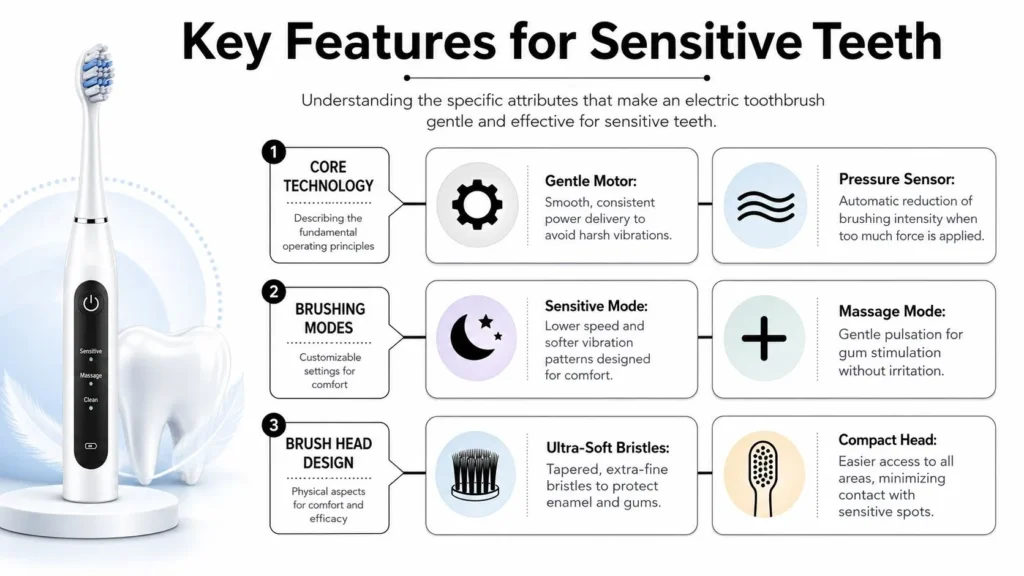
The most important shift in modern electric toothbrush design is simple. Manufacturers no longer compete only on cleaning intensity. They increasingly focus on controlling brushing force, which matters because excessive pressure can aggravate enamel wear and gum irritation, as reflected in recent guidance highlighting pressure sensors and ultra-soft sensitive heads.
Pressure sensors come first
If you tend to press harder when trying to “feel clean,” a pressure sensor is the most protective feature on the brush. It interrupts the habit that often goes unnoticed until the gums feel sore or the bristles start splaying early.
For sensitive teeth, the best pressure warning is one you can’t ignore. A visible alert is usually easier to respond to than a subtle vibration alone. Good pressure feedback turns the toothbrush into a behavior-correction tool, not just a motorized brush.
Soft and ultra-soft bristles reduce mechanical irritation
Sensitive areas don’t need aggressive contact. They need consistent plaque disruption with less scraping sensation against the surface.
That’s why sensitive brush heads with soft or ultra-soft bristles are baseline features, not luxury upgrades. Philips explicitly describes its S Sensitive heads as ultra-soft for people with sensitive teeth and gums, while Oral-B tends to frame the decision around matching the right head and brushing mode to the user. In practice, both approaches point to the same conclusion. The brush head matters as much as the handle.
If you want a practical look at how softer Sonicare-compatible heads differ, DentalHealth.com’s brush head guide is useful because it focuses on head design rather than vague comfort claims.
Sensitive modes should offer real control
A dedicated sensitive mode matters because it lowers the intensity of the brushing feel. But one gentle mode alone isn’t always enough.
Look for a brush with 2 or more intensity settings if your teeth vary from day to day. Someone with mild gum tenderness may tolerate a higher setting on most teeth but need a lower one near recession or recent irritation. Extra control makes the brush easier to live with long term.
Head size and shape affect comfort
A compact head often makes brushing more comfortable because it gives you more precision around sore spots. Less brush head touching adjacent tissue can mean less accidental irritation.
A smaller head also encourages slower, more deliberate movement. That’s often better for sensitivity than using a larger head that bumps into several surfaces at once.
What actually belongs on your checklist
Don’t get distracted by premium add-ons before you confirm the essentials.
- Pressure alert system: Choose a brush with feedback that’s visible or otherwise hard to miss.
- Dedicated sensitive head: The handle is only half the system. You need a compatible head built for gentler contact.
- Multiple intensity options: More control usually matters more than more power.
- Compact brushing profile: Smaller heads are easier to guide around tender gumlines.
- Comfortable handle grip: A relaxed grip helps reduce force. Even outside oral care, control and surface feel often matter more than people expect, which is a useful reminder when comparing everyday hygiene tools like glycerin soap and skin-friendly cleansing products.
Practical rule: If a toothbrush lacks both a strong pressure warning and an appropriate sensitive head, it’s hard to recommend for ongoing sensitivity, no matter how premium it looks.
The 2026 Top Models for Sensitive Teeth
Most readers don’t need a giant list. They need a short list of models that make sense when sensitivity is the priority. The most useful comparison points aren’t abstract motor claims. They’re pressure management, gentle mode availability, brush-head options, and whether the overall setup encourages lighter brushing.
2026 Electric Toothbrush Comparison for Sensitive Teeth
| Model | Pressure Sensor | Sensitive Modes | Recommended Head | Price Range |
|---|---|---|---|---|
| Philips Sonicare ProtectiveClean 4100 | Yes | Limited, simpler control set | Philips S Sensitive or other compatible sensitive head | Mid-range |
| Philips Sonicare DiamondClean Smart 9700 | Yes | Multiple intensity and cleaning options | Philips S Sensitive | Premium |
| Oral-B Pro 1000 | Yes | Simpler mode structure | Oral-B Sensitive head | Budget to mid-range |
| Oral-B iO Series | Yes | Multiple settings on many models | Oral-B Sensitive head | Premium |
| Colgate Hum | Yes on selected smart-oriented setups and feedback-led designs | Includes a sensitive-focused option | Compatible soft or sensitive head | Mid-range |
Philips Sonicare ProtectiveClean 4100
This is the model I’d point many sensitivity-focused shoppers toward first. Not because it’s the flashiest, but because it usually gets the fundamentals right without pushing buyers into premium pricing.
Its appeal is practical. You can pair it with a sensitive head, it includes pressure feedback, and the sonic brushing feel is often experienced as smooth rather than scrubby. For someone moving from a manual brush and trying to stop pressing so hard, that combination is often enough.
Philips Sonicare DiamondClean Smart 9700
This sits at the higher end and makes sense for people who want more control over the brushing experience. The main advantage for sensitivity isn’t status. It’s the ability to fine-tune intensity and pair the brush with ultra-soft sensitive heads.
That can help users whose comfort changes from day to day. If one side of the mouth feels fine but another area near the gumline is reactive, having more adjustable settings can make the difference between using the brush consistently and avoiding it.
Oral-B Pro 1000
This is the stripped-down recommendation that still makes sense. It doesn’t need to be luxurious if the goal is safer brushing.
With a compatible sensitive head and pressure control, it covers the core functions many people need. The round Oral-B format can also help users focus on one tooth at a time, which some people find easier to control near sensitive gum margins.
Oral-B iO Series
The iO line is often attractive to shoppers who want stronger on-handle feedback and a more refined feel. For sensitivity, the reason to consider it is not extra power. It’s the quality of the user feedback and the ease of pairing it with dedicated sensitive heads.
That matters because the best brushes for sensitive teeth differ less by raw movement and more by feedback quality and head availability. Philips and Oral-B both emphasize replaceable sensitive heads, and Philips explicitly describes its S Sensitive heads as ultra-soft. Philips’ own buying guidance also points to a more actionable benchmark than speed: a dedicated sensitive head plus a pressure warning that’s visible or otherwise hard to ignore. It further suggests that a mid-range model with these controls is often more defensible than a premium model without them, which you can see in Philips’ electric toothbrush buying guidance.
Colgate Hum
This one suits people who respond well to coaching and reminders. Some users don’t need more motor sophistication. They need a brush that helps them notice habits, especially speed and pressure.
That’s a useful distinction. If your sensitivity is tied to brushing behavior, a brush that makes your mistakes more visible may be more helpful than a more expensive brush that feels powerful.
How to choose among them
If you’re deciding between these models, use this order of priority:
Buy for control first
Start with pressure feedback and sensitive-head compatibility.Choose your preferred brushing feel
Some people prefer the hum of sonic brushing. Others like the more tooth-by-tooth feel of a round oscillating head.Only then consider premium extras
App coaching, charging accessories, and luxury finishes come last.
A well-chosen mid-range brush can be the better clinical decision when it prevents forceful brushing more reliably than a premium model with weaker feedback.
Sonic vs Oscillating Technology for Sensitivity
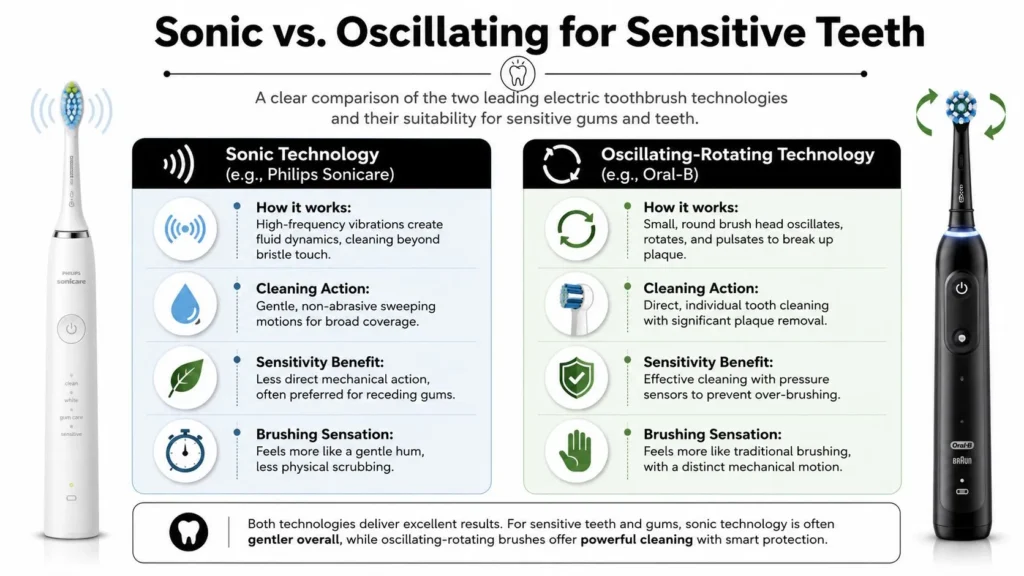
This is the comparison that dominates most buying guides, but it’s often framed the wrong way. People ask which technology is “better” for sensitive teeth as if the motor type alone decides comfort. Usually, it doesn’t.
What matters more is how the brush delivers force to the tooth and whether it helps you keep that force under control.
How sonic brushes usually feel
Sonic brushes tend to create a broad, sweeping brushing sensation. Many users describe that as gentler, especially when they’re transitioning from manual brushing and don’t want a head that feels like it’s scrubbing each tooth individually.
That can be helpful for people with generalized gum tenderness. The brushing experience often feels smooth across a wider area, and some users find that less provoking around recession.
How oscillating brushes usually feel
Oscillating-rotating brushes usually create a more direct, localized brushing sensation. The small round head can be useful because it lets you focus on one tooth at a time.
For some people with sensitivity, that precision feels better. For others, the more mechanical sensation feels harsher at first. The difference is personal, which is why broad claims about one technology always being superior for sensitive teeth tend to mislead.
The better benchmark
The more useful expert benchmark is this: don’t judge sensitive-teeth performance by speed claims. Judge it by whether the brush has a dedicated sensitive head and a pressure warning that’s visible or otherwise hard to ignore. Guidance from Philips also notes that a mid-range model with these controls is often more defensible than a premium model without them in the context of sensitive brushing choices, as outlined in its consumer toothbrush selection advice.
That last link isn’t a toothbrush guide, but it does point to a broader lesson about battery-powered devices. Internal technology matters, yet user-facing control is what determines whether the device behaves safely and predictably in daily use.
Which one should you choose
A simple decision framework works well here:
- Pick sonic if you like a smoother overall feel and want broad coverage with a softer sensation.
- Pick oscillating if you want more targeted placement and like cleaning one tooth at a time.
- Pick neither if the model lacks control features. In sensitivity care, missing safeguards can outweigh any advantage of the cleaning technology itself.
If two brushes differ in motor style but only one has a strong pressure alert and an easy-to-find sensitive head, that’s usually the safer buy.
How to Use Your Electric Toothbrush Correctly
Even the best electric toothbrush for sensitive teeth can make things worse if you use it like a manual brush. The common mistake is scrubbing with the powered head as if more hand motion means a better clean. For sensitive teeth, that usually increases irritation.
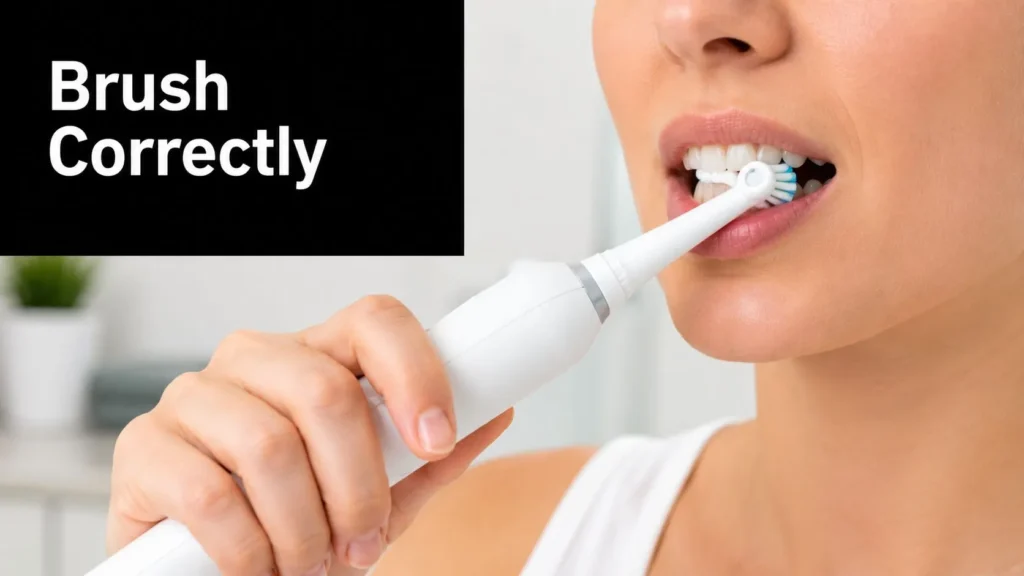
Guide it, don’t scrub
Place the brush head gently against the tooth and gumline, then let the brush do the work. Move it slowly from tooth to tooth instead of sawing it back and forth.
A light touch matters more than perfect confidence on day one. If you hear the handle warning you, or if the bristles flatten out against the tooth, you’re pushing too hard.
A simple routine that protects sore areas
Use this sequence when sensitivity is active:
Start on a lower setting
If your brush has multiple intensities, begin with the gentlest one for the first several sessions.Angle toward the gumline
A slight angle helps clean where plaque tends to collect without forcing the bristles straight into tender tissue.Pause briefly on each tooth group
Don’t rush the head across the arch. Give it time to clean, especially near the gum margin.Treat sensitive zones last
That gives you time to settle into a lighter hand before reaching the area that usually stings.
Don’t confuse thoroughness with pressure
People with sensitive teeth often overcompensate in one of two ways. They either brush too hard because they want a very clean feeling, or they barely touch the sore areas because they’re afraid of pain.
Both habits create problems. A better goal is consistent contact with minimal force. If you want a visual walkthrough of that technique, how to use an electric toothbrush properly offers a helpful demonstration-oriented explanation.
A video can also make the motion clearer than text alone:
Signs your technique needs adjustment
Watch for these clues that your brushing method is still too aggressive:
- Persistent soreness after brushing: The routine itself may be provoking the tissue.
- Bristles that wear out quickly: Fast splaying usually means excess pressure.
- You avoid certain teeth: That often signals the brush setup or technique still isn’t comfortable enough.
- A “scrubbing” wrist motion: With electric brushes, extra hand motion usually adds friction without adding cleaning value.
The powered brush should reduce your workload. If your wrist is doing most of the action, you’re probably using it like a manual brush.
Maintaining Your Brush for Optimal Gentleness
A brush can start out gentle and become rough over time. That change is easy to miss because it happens gradually. For sensitive teeth, though, a worn head can shift the brushing experience from controlled cleaning to scratchier contact.
Replace the head before comfort drops
Frayed bristles don’t contact the tooth surface evenly. They become less predictable, and that matters more when the gumline is already tender.
Sensitive users should pay close attention to brush-head condition. If the head looks spread out, feels harsher than it did at the start, or no longer glides smoothly, replace it. Waiting too long often means you’re brushing with a head that no longer behaves the way it was designed to.
Use the right replacement head
Not every compatible head is a good fit for sensitivity. If your handle supports several types, stay with the one made for soft or sensitive cleaning unless your dentist has told you otherwise.
That’s a small decision with outsized consequences. Many people upgrade the handle correctly, then undo the benefit by buying a firmer replacement head later because it’s more available.
Keep the handle and head clean
Regular cleaning doesn’t just help hygiene. It also preserves the feel of the device.
- Rinse the head thoroughly: Toothpaste residue can stiffen around the bristle base.
- Dry it in the open air: A damp enclosed cap can leave the head feeling less fresh.
- Wipe the handle regularly: Build-up around seams and buttons makes any device less pleasant to use.
- Store replacement heads cleanly: Hygiene practice matters across many health tools, whether you’re considering home devices or larger sterilization topics like ethylene oxide sterilization methods.
Frequently Asked Questions About Sensitive Brushing
Can an electric toothbrush make sensitivity worse?
Yes, it can if you use the wrong head, push too hard, or treat it like a manual brush. The device itself isn’t automatically gentler. Its value comes from helping you control force and clean more consistently.
That’s why pressure feedback and a true sensitive head matter more than premium branding.
Is a more expensive brush always better for sensitive teeth?
No. For sensitivity, expensive features are only worthwhile if they improve comfort and force control.
A less expensive brush with a clear pressure warning and a dedicated sensitive head can be the more rational choice than a premium model that lacks strong pressure management.
Should I choose sonic or oscillating if my gums are receding?
There isn’t one universal winner. Some people with recession prefer the smoother feel of sonic brushing. Others like the precision of a small round oscillating head.
If you’re unsure, prioritize the brush that gives you the best pressure control and easiest access to soft replacement heads.
What if a new toothbrush doesn’t solve the problem?
This is the question more buying guides should take seriously. The “best” brush may not solve sensitivity if the underlying issue is overbrushing, exposed dentin, or gum disease, which is why a better approach separates toothbrush features from underlying causes and includes warning signs that require professional care, as discussed in ALIGNERCO’s overview of sensitive-tooth brush selection.
A toothbrush helps when the problem is partly behavioral or plaque-related. It won’t fix decay, recession, or structural enamel loss by itself.
When should you see a dentist instead of trying another brush?
Make the appointment if sensitivity is persistent, localized to one area, worsening, or accompanied by visible gum changes. Also get checked if pain lingers after brushing or shows up strongly with hot, cold, or sweet foods.
Those patterns can point to something deeper than brush choice. A better toothbrush can reduce aggravation. It can’t diagnose the reason the tooth hurts.
If you like evidence-based guides that explain the science behind everyday choices without the jargon, explore more practical health and science writing at maxijournal.com. It’s a good place to find clear, independent articles that help you make better decisions before marketing claims do it for you.
Discover more from Maxi Journal
Subscribe to get the latest posts sent to your email.