Why do some contemporary artworks look like paintings, while others involve instructions, bodies, screens, communities, or objects from a supermarket? The confusion often begins with a mistaken assumption: that contemporary art is one recognizable style. It isn’t. Contemporary art movements are better understood as connected attempts to answer changing cultural questions, from “What can a painting express?” to “Who decides what counts as art?”
What Counts as Contemporary Art and Why It Confuses Everyone
You’re standing in a museum, looking at a gleaming pile of candy arranged on the floor. Nearby, a blank canvas hangs under careful lighting. Someone whispers, “I could make that,” and the room suddenly feels less like a place of discovery than a test you haven’t studied for.
Start with the word itself. Contemporary art generally refers to art made from the postwar period onward, although museums and historians don’t agree on one starting date. Some begin around 1945, after the Second World War reshaped political life and cultural institutions. Others use the 1960s or 1970s, when artists increasingly challenged painting, sculpture, authorship, and the gallery as a neutral space.
That disagreement matters because “contemporary” describes a period, not a visual formula. Modern art usually refers to the movements that developed from the late nineteenth century through the first half of the twentieth century, including Cubism, Surrealism, and Abstract Expressionism. Contemporary art follows and overlaps with that history, but it also questions the categories modernism treated as stable.
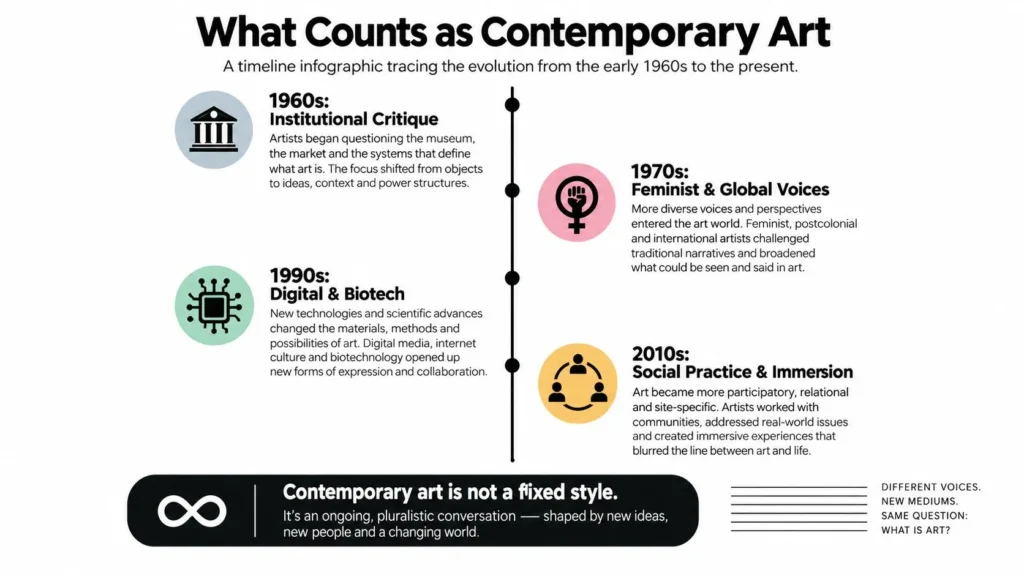
A useful way to read the timeline
Rather than asking whether a work “looks contemporary,” ask four practical questions:
- What is the material? Paint, steel, video, food, sound, text, software, or social interaction may all function as artistic material.
- What is the artist questioning? The work may address identity, power, consumer culture, technology, memory, or institutional authority.
- How does the viewer participate? You might look, walk, touch, listen, read, perform, or interpret.
- Where does the work exist? A gallery object, public action, website, archive, or community project can each be the artwork’s setting.
This is why contemporary art feels difficult at first. It asks you to interpret both the thing in front of you and the conditions that made it art. The movements below become easier once you connect each one to the cultural problem it tried to solve.
The Major Movements from Postwar to the 2000s
The postwar story doesn’t move in a neat line from one style to the next. Artists often worked simultaneously, argued with one another, and borrowed earlier strategies. Still, chronology gives beginners a useful route through the terrain.
From gesture to the ordinary
Abstract Expressionism treated painting as an arena for action, emotion, and scale. Jackson Pollock’s drip paintings, made by moving around a canvas and letting paint fall, turn the record of bodily movement into the subject. Willem de Kooning’s turbulent figures similarly make emotion visible through aggressive brushwork and unstable forms. For a clearer introduction to the movement’s ideas and visual language, understanding Abstract Expressionism art provides a helpful companion.
Minimalism then asked whether art could abandon expressive gesture altogether. Donald Judd’s industrial boxes use repeated forms, manufactured surfaces, and precise spacing to make the viewer notice object, room, and perception. The work’s question is direct: can a thing be present without pretending to represent something else?
Pop Art answered a different problem. Andy Warhol’s Campbell’s Soup Cans brought commercial packaging into the gallery, challenging the boundary between popular imagery and supposedly high culture. Roy Lichtenstein’s comic-book dots made mechanical reproduction part of the painting’s visible surface.
From object to idea and event
Conceptual Art placed the idea ahead of the handmade object. Joseph Kosuth’s One and Three Chairs presents a physical chair, a photograph of it, and a dictionary definition. The work asks whether meaning comes from the object, its image, its language, or the institutional setting that presents all three.
Performance and Process art shifted attention toward actions, duration, materials, and change. Artists used bodies, instructions, repetition, chance, fire, gravity, and decay to make works that might resist being reduced to permanent objects.
Postmodernism challenged the belief that art history moves toward a single, pure form. Sherrie Levine’s re-photographs of Walker Evans question originality, ownership, and the authority attached to an established image. By the late 1990s, identity-driven practices, installations, video, networked imagery, and digital tools had widened the field again.
| Movement | Years, approximate | Core idea in one line |
|---|---|---|
| Abstract Expressionism | 1940s to 1950s | Painting can record gesture, emotion, and individual action. |
| Minimalism | 1960s | The object and the viewer’s experience can be enough. |
| Pop Art | 1950s to 1960s | Mass media and consumer goods belong inside art’s subject matter. |
| Conceptual Art | 1960s to 1970s | An idea or system may matter more than a unique object. |
| Performance and Process Art | 1960s onward | Action, time, and material change can constitute the work. |
| Postmodernism | 1970s to 1990s | Images, styles, and histories can be quoted, remixed, and contested. |
| Digital and identity-driven practices | 1990s onward | Art can address networks, representation, embodiment, and social systems. |
Artists and Works That Define Each Movement
A movement becomes memorable when you can picture a decision made by an artist. Pollock’s canvas is not merely abstract. It preserves the path of a body moving around a surface, with poured and flicked paint replacing the conventional brushstroke. De Kooning’s figures feel different, but they share the conviction that a painting can carry psychological pressure through color, distortion, and physical handling.
Warhol takes the opposite route. His Marilyn images repeat a famous face until celebrity becomes a pattern, a product, and a fragile surface at once. Lichtenstein’s Benday dots imitate commercial printing, so the viewer sees both the comic image and the machinery that produced its visual appeal. Pop Art’s argument lives in that double vision.
Minimalism makes a quieter demand. Donald Judd’s boxes don’t invite you to search for a hidden story. Their size, spacing, metal, and placement make you aware of how your own body moves through the room. Agnes Martin’s delicate grids offer another kind of restraint. Nearly imperceptible lines and pale fields turn attention toward duration, patience, and small shifts in perception.
On Kawara’s date paintings reduce a day to a painted inscription of its calendar date. Hanne Darboven’s numerical systems transform writing, counting, and repetition into an extended record of time. These works make Conceptual Art tangible because their central choices are procedural. The artist establishes a rule, then lets the rule organize thought.
Postmodern artists treated images as materials with histories. Cindy Sherman’s Untitled Film Stills places the artist in staged roles that resemble scenes from imaginary films, exposing how visual culture teaches viewers to recognize femininity. Jeff Koons’s polished sculptures and kitsch references turn desire, commerce, and spectacle into deliberately seductive surfaces.
Identity-focused practices made representation itself a site of struggle. Faith Ringgold’s painted story quilts combine narrative, family memory, race, gender, and textile tradition. Howardena Pindell’s layered surfaces and fragmented marks confront visibility, erasure, and the politics of looking. If you’re learning how physical decisions create meaning, this guide to essential painting techniques for beginners offers useful practical grounding.
How Contemporary Movements Borrow from Each Other
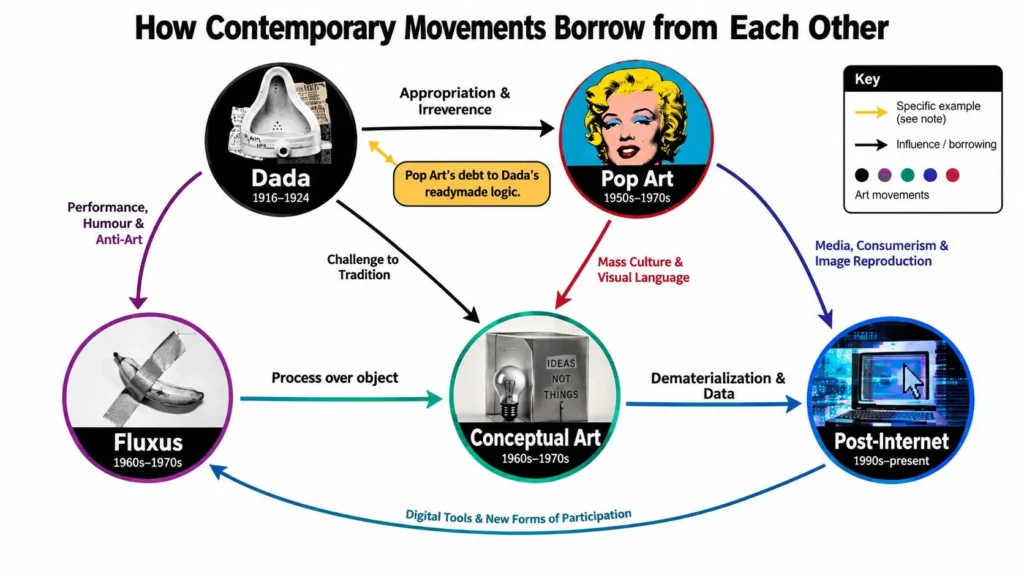
The history of contemporary art makes more sense as a web than as a staircase. Artists rarely discard the past completely. They take an earlier strategy, alter its setting, and expose a new problem.
Pop Art’s debt to Dada is especially clear. Marcel Duchamp’s readymades had already challenged the idea that artistic skill must produce a unique object. Warhol’s Brillo Boxes extends that provocation into the world of advertising, packaging, and repetition. The question changes from “Can an ordinary object be art?” to “How does mass culture manufacture desire and recognition?”
Minimalism’s reduced forms created another kind of opening. Once sculpture could consist of industrial units arranged in space, later artists could treat the whole environment as material. Post-Minimalist practices brought in softness, gravity, bodily movement, and unstable substances. Installation art developed that spatial logic further, asking viewers to enter situations rather than stand before autonomous objects.
Postmodernism made quotation more explicit. Levine’s rephotographed Evans image doesn’t just copy an earlier photograph. It tests the systems of authorship, museum authority, and ownership that make one version “original” and another “secondary.” Koons similarly borrows the language of readymades and commercial display, but turns it toward glamour, consumption, and spectacle.
Fluxus and late-1960s Conceptual Art also left a strong inheritance. Event scores, instructions, participation, and everyday actions moved artistic attention away from the precious object. Later socially engaged practices use that inheritance to organize conversations, collaborations, workshops, and public encounters. The artwork may be distributed across relationships rather than contained in one thing.
Digital and post-internet artists continue the question-first approach. A screen image, database, algorithm, or online circulation pattern can function as material, while appropriation becomes almost unavoidable in a culture built from copying and remixing.
This short video can help reinforce the idea that movements overlap rather than replace one another.
The Debates Shaping Contemporary Art Right Now
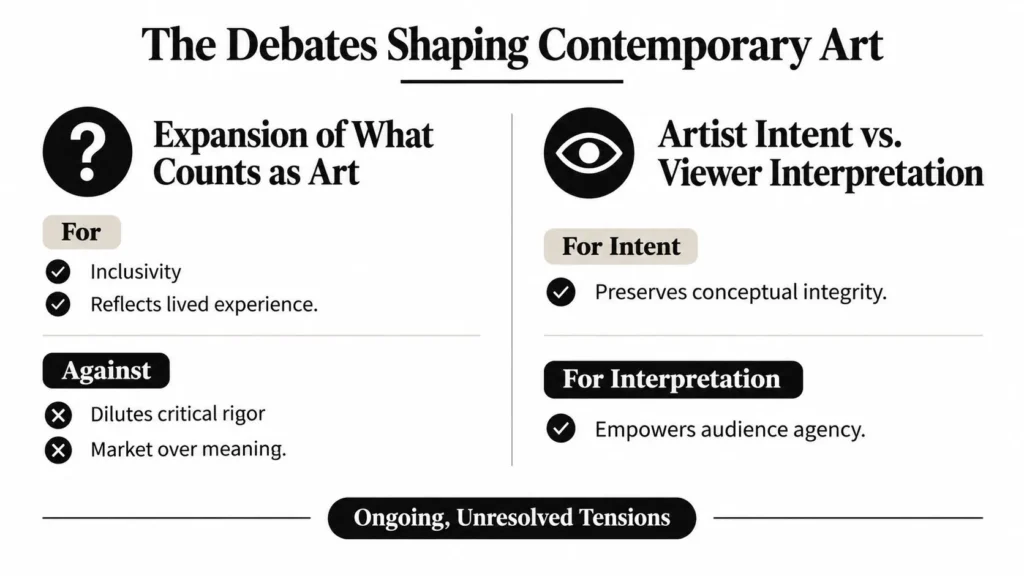
Contemporary art stays alive because people disagree about its boundaries. One argument welcomes expanded materials and methods. If artists can address lived experience through food, archives, code, performance, craft, or collective activity, the category becomes more inclusive and better reflects how people live. The opposing concern is that “anything can be art” may weaken standards, especially when market attention substitutes for sustained thought.
AI-generated imagery has sharpened the question of authorship. Who made an image when a person selects prompts, a model draws on training data, and the final result resembles existing styles? Supporters may view the system as a new tool or collaborative process. Critics ask whether consent, attribution, labor, and originality have been properly addressed.
A useful test: Don’t ask only whether the image looks impressive. Ask who supplied the material, who made the decisions, and what the work asks you to notice.
The market creates another fault line. Contemporary art has moved from a niche category into a major force in auction culture. Artprice’s contemporary art report records auction turnover rising from less than $92 million in 2000 to about $1.888 billion in 2023/24, a roughly 1,800% increase, while the category’s share of the global art market rose from about 3% to around 18% over the same broad period. The report also counts 33,072 contemporary artists with at least one auction sale in 2023/24, compared with 5,400 in 2000.
That expansion can fund ambitious studios and bring artists to wider audiences. It can also encourage speculation, rapid price chasing, and attention to easily marketable images. The Art Basel and UBS Art Market Report 2026 estimates global art sales at $59.6 billion in 2025, with postwar and contemporary art representing 45% of global sales value and 54% of volume in the fine-art auction market. Yet the accompanying correction complicates any simple success story: recent reporting on the report notes that younger contemporary art fell 39.1% in 2025, while sales of living artists declined 10% year over year.
Museums also debate cultural ownership and repatriation. Returning objects to source communities can correct histories of extraction and restore authority to people connected to those works. Others worry about access, conservation, and the practical responsibilities of institutions. For accessible coverage of these wider questions, explore arts and culture news sources alongside museum statements and community perspectives.
Where to See and Study These Movements in Person
Begin with one institution, not an exhausting museum marathon. The Museum of Modern Art in New York offers a strong route through postwar painting, Minimalism, Pop, Conceptual practices, and newer media. London’s Tate Modern is useful for seeing how international modern and contemporary collections are organized together. The Centre Pompidou in Paris, the Museum of Contemporary Art in Los Angeles, and the Whitney Museum of American Art each provide different perspectives on postwar and living artists.
Look for survey exhibitions, because they reveal relationships that a single-object display can hide. Biennials and recurring exhibitions such as Venice, Documenta, and the Whitney Biennial present current practices as debates in progress. They’re especially valuable for installation, performance, socially engaged work, and artists whose methods don’t fit a familiar medium.
Practical rule: Choose one movement, find one work in person, and return to the same institution later. Familiarity makes difficult art less theatrical and more legible.
Regional museums, university galleries, and artist-run spaces often provide an intimate entry point. A small exhibition may give you more time with an artist’s process than a blockbuster show allows. Read the wall text, but don’t let it replace looking. Notice scale, materials, sound, movement, and the route the exhibition gives your body.
You can also study from home. MoMA’s digital collection, the Getty Research Institute, and Google Arts & Culture provide accessible ways to compare works, read collection notes, and follow artists across institutions. The best museums in Paris can help if you’re planning a visit, but the method works anywhere. Pick one museum, one movement, and one recurring visit. Treat the calendar as a slow course rather than a checklist.
Further Reading and Resources for Curious Readers
A good resource should answer the question you have. Casual readers don’t need to begin with dense theory, while students need more than short captions and entertaining videos.
For a first comfortable pass
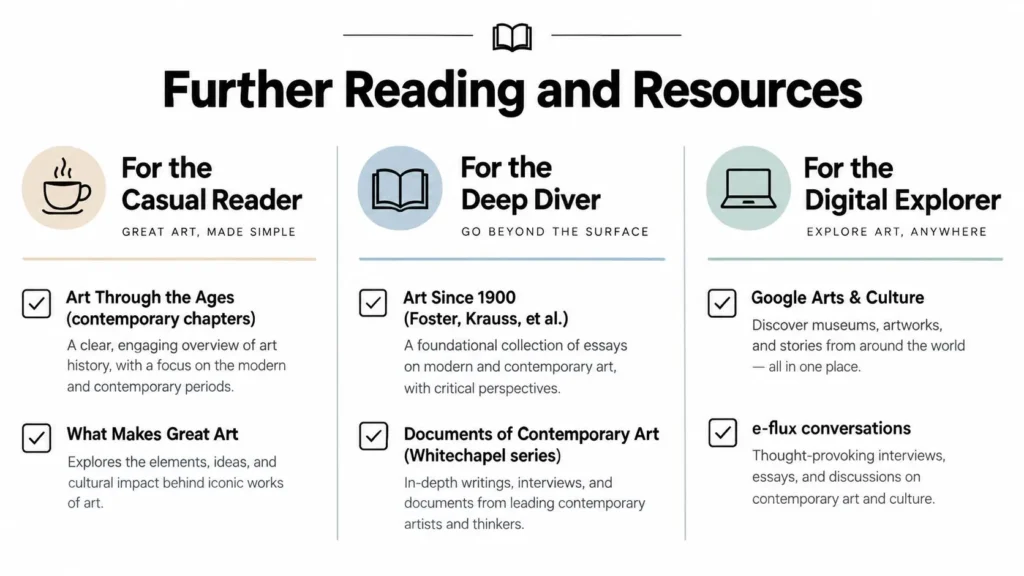
Gardner’s Art Through the Ages gives contemporary art a broad historical setting, while Thames & Hudson’s What Makes Great Art is useful for readers who want to think about judgment, context, and visual choices without entering specialized theory immediately. The Art Assignment offers approachable video-based discussion, and museum channels from Tate and MoMA provide artist interviews, collection explanations, and exhibition context.
The Online College of Art & Design is another useful stop for readers who want to connect art history with studio practice. Its value lies in treating historical knowledge as something artists can use, not merely memorize.
For deeper study
Students can turn to Hal Foster’s The Return of the Real for critical writing about avant-garde practices and the politics of representation. Alexander Alberro’s Conceptual Art and the Politics of Publicity helps explain how Conceptual Art operated through ideas, language, institutions, and public circulation.
Art Since 1900, by Hal Foster, Rosalind Krauss, Yve-Alain Bois, Benjamin H. D. Buchloh, and David Joselit, offers a demanding reference structure for comparing movements and arguments. The Whitechapel Documents of Contemporary Art series is particularly helpful because each volume gathers primary statements and critical responses around a theme.
For digital exploration
Oxford Art Online is valuable for checking terminology and locating concise scholarly entries. JSTOR can support longer research through articles and digitized collections, while Google Arts & Culture helps beginners compare works visually across institutions. For current debates about technology, markets, and exhibitions, read museum publications alongside independent criticism rather than relying on one voice.
Why Contemporary Art Keeps Changing the Question
The movements in this guide aren’t a collection of unrelated labels. They form an unfinished conversation. Abstract Expressionism asks how a painting might carry individual experience after catastrophe. Pop Art asks what happens when advertising, celebrity, and ordinary products dominate visual life. Conceptual Art asks whether an idea can outrank an object. Performance asks whether an action can be the work.
Later artists inherit those questions and redirect them toward identity, institutions, networks, ecology, and artificial intelligence. The materials change, but the pressure remains familiar. Artists still ask what counts as art, who counts as an artist, who gets to decide, and what viewers are expected to do.
That’s why contemporary art can feel both remote and strangely close. A blank canvas, a repeated image, a room-sized installation, or an AI-generated picture may seem disconnected from daily life until you identify the system it reflects. The work might be about labor, attention, ownership, memory, power, or the flood of images surrounding you.
Visit a gallery with one question rather than a checklist. If you dislike a work, explain why. If you’re fascinated, identify the choice that produced that feeling. Disagreement isn’t a failure to understand contemporary art. It’s participation in the conversation these movements keep reopening.
Maxi Journal publishes approachable arts and culture coverage alongside writing about science, technology, education, travel, and other subjects. Visit maxijournal.com to find further commentary on the movements and creators shaping the modern art world, and to explore fresh independent writing across its wider magazine.
Discover more from Maxi Journal
Subscribe to get the latest posts sent to your email.