The popular advice says the best dresses for work should look as formal as possible. That’s backwards for most modern offices. A dress that only works with pumps, a blazer, and a tightly controlled corporate setting won’t earn its place in a hybrid wardrobe. The better purchase is a polished dress that can handle a client meeting, a quiet desk day, a commute, a video call, and an evening appointment without looking like it belongs to another person’s job.
Workwear has moved a long way from mandatory skirts. As late as 1973, the White House still had to relax its rules before female staff could wear trousers, and the U.S. Congress didn’t fully allow women to wear pants to work until the mid-1990s, as documented by this history of women’s office dress codes. Today, dresses compete with suits, trousers, and softer separates in a workplace where adaptability matters more than ceremony.
Why the Most Formal Dress Is Rarely the Best One
The dress that looks most formal on a hanger is rarely the one that works hardest in an actual wardrobe. It may be right for a board presentation, yet feel severe on an ordinary team day, awkward with commuting shoes, and too polished for a casual video call. A dress with one narrow purpose will stay in the closet.
Choose a work dress that performs across settings. It needs enough shape to look intentional without a blazer, enough ease for sitting and walking, and enough restraint to take different shoes and layers. A navy sheath, substantial shirt dress, or clean structured midi will usually earn more wear than a style built around a dramatic sleeve, bold cutout, or fussy detail.
Adaptability as the dress code
The UK workwear market shows why rigid corporate dressing is no longer the default. Only 7% of employees were reported to still wear the classic suit-and-tie look, while 4.3% of employers enforced a strict dress code, according to Raconteur’s reporting on changing workwear. Yet 87% of women still believed “dressing the part” remained important in a flexible working world. The practical conclusion is straightforward: credibility still matters, but it now depends on polish, comfort, and good judgment rather than maximum formality.
I test every dress with three questions:
- Can it become more formal? It should sit neatly beneath a blazer, work with a structured bag, and support polished shoes.
- Can it become less formal? A cardigan, loafers, or clean sneakers should soften the outfit without making it look careless.
- Can it survive a full day? You should be able to sit, walk, reach, commute, and eat lunch without constant adjustments.
A dress that passes all three tests has a longer working life. It also gives you more outfits without requiring a crowded wardrobe.
Stylist’s rule: Buy the dress you can style three ways, not the dress that looks perfect in one photograph.
Formality should come from the whole outfit
A simple dress can look authoritative with a sharp blazer, leather loafers, and a structured tote. Add a fine cardigan, low-profile flats, and smaller jewelry, and the same dress becomes more approachable. The dress remains a reliable base instead of turning into a costume.
For a hybrid office, choose a moderately structured, layer-friendly silhouette in navy, charcoal, deep green, burgundy, or a controlled print. Look for fabric that resists wrinkling and a cut that stays comfortable when seated. Avoid a dress so plain that it needs constant accessorizing, or so distinctive that colleagues remember it more than the person wearing it.
Matching Dresses to Your Office Dress Code
Start with the office you attend, not the office you imagine you might enter someday. Observe what senior colleagues wear for ordinary days, then note what changes for client meetings, presentations, or leadership events. A dress that fits your weekly reality will be more useful than one bought for an occasional formal moment.
Use the dress code as a buying filter
Business formal calls for the most controlled version of a dress. Choose a knee-length or restrained midi sheath, a structured midi, or a well-shaped fit-and-flare in wool gabardine, lined crepe, or another substantial fabric. Keep the neckline close to the collarbone, the shoulders clean, and the print quiet. Solid navy, black, charcoal, and deep neutrals are the safest choices, while subtle checks or restrained geometric patterns can work when the rest of the outfit stays quiet.
Business professional gives you more room while keeping a polished appearance. A sheath, wrap dress with a secure closure, or polished shirt dress can work well at or just below the knee, or at a conventional midi length. Choose a defined waist, an opaque fabric, and a neckline that stays in place when you lean forward. Small prints, narrow stripes, and refined abstract patterns add personality without dominating a meeting.
Business casual is where the adaptable dress earns its keep. A knee-length or midi shirt dress, knit sheath, A-line dress, or softly structured wrap dress can work with loafers, flats, a cardigan, or a blazer. Cotton shirting, ponte, stable knit, and matte crepe are useful because they look finished without feeling ceremonial. Prints can be more expressive, but balance a noticeable print with simple shoes and restrained accessories.
Creative or casual offices allow the most individual interpretation. You can use a stronger color, an artistic print, an architectural sleeve, or a relaxed shirt dress, provided the garment remains opaque, clean, and comfortable to move in. A creative dress still needs a deliberate line. Oversized volume, thin jersey, and weekend-level informality can make you look unprepared rather than expressive.
| Dress Code | Hemline | Structure | Acceptable Fabrics | Prints |
|---|---|---|---|---|
| Business formal | Knee length or controlled midi | Tailored and defined | Wool gabardine, lined crepe, substantial suiting blends | Solid colors, quiet checks |
| Business professional | Knee length or midi | Shaped waist, clean shoulders | Ponte, crepe, structured cotton, quality knits | Narrow stripes, small patterns |
| Business casual | Knee length or midi | Moderate structure, comfortable movement | Cotton shirting, ponte, matte crepe, stable knit | Subtle florals, abstract prints |
| Creative or casual | Knee length, midi, or relaxed longer length | Relaxed but intentional | Cotton poplin, textured knits, breathable blends | Expressive colors and artistic prints |
The safest strategy is to buy for the strictest setting you regularly face, then style down for ordinary days. Don’t buy a casual dress and hope a blazer will rescue it for an important client meeting. A blazer can add structure, but it can’t fix a transparent skirt, unstable neckline, or fabric that has collapsed by lunchtime.
Silhouettes That Earn Their Place in a Work Rotation
The most formal dress is rarely the hardest-working one. A useful rotation covers authority, movement, and flexibility across boardrooms, client meetings, commuting, and hybrid days. Choose the silhouette for the workday it must handle, then judge every option by fit and fabric performance.
The core shapes
The sheath dress earns its place for presentations, client lunches, and formal offices. Its vertical line sits neatly under a blazer and gives the outfit a clear finish. Check the armholes and fabric recovery before buying. Limited stretch or tight armholes can make commuting and long meetings uncomfortable.
The shirt dress is the strongest choice for hybrid schedules. A collar adds polish, buttons provide styling control, and a belt can define the waist without restricting movement. Wear it loose with loafers on a relaxed day, or add a blazer and structured shoes for a client appointment. Skip flimsy shirting and any button placket that pulls across the bust.
The wrap dress adjusts easily and creates a diagonal line that often suits a fuller bust. It also accommodates changing comfort needs during a long day. Test the overlap while walking and sitting. A hidden snap or interior tie keeps the front secure and prevents constant readjustment.
For fuller hips and pear shapes, the A-line dress provides room to move while balancing the body. Select a controlled flare. Excessive volume can make the dress look bulky or too casual for a professional setting.
A knit sheath handles travel, commuting, and video-heavy weeks well. Dense knit with strong recovery smooths the line and holds its shape. Thin knit exposes every layer underneath and loses polish quickly. In stricter offices, pair this silhouette with a blazer or refined cardigan.
The structured midi bridges business professional and business casual dressing. It gives more movement than a narrow sheath while carrying more authority than a loose smock dress. A defined shoulder, clean waist seam, or pressed pleat keeps the shape intentional.
Use fashion trends for women for color and styling ideas, not as a reason to replace a dependable silhouette. A trend belongs in the rotation only when the cut, coverage, and comfort suit your actual workweek.
Build the rotation around three jobs: authority, movement, and flexibility. The sheath handles authority, while the shirt dress and structured midi cover the other two with fewer compromises.
Fabric Choices That Actually Perform at Work
A work dress can have the right silhouette and still fail because the fabric traps heat, wrinkles at the waist, or turns transparent under office lighting. Fiber labels alone won’t tell you enough. Thickness, density, air movement, moisture behavior, lining, and recovery determine whether a dress remains comfortable after a commute and several hours of sitting.
Research on office clothing found that undershirt fit and shirt raw material affect dry thermal resistance, while undershirt properties also change evaporative heat loss across body regions such as the back and chest, as shown in research on clothing thermal performance. The practical lesson is straightforward. A smooth, less bulky base layer under a work dress usually manages heat better than a tight, dense combination that traps air and moisture.
A second workplace study found that air permeability rises as fabric thickness and density decrease. That doesn’t mean the thinnest dress is best. You want enough substance for opacity and shape, with enough openness to let heat move away from the body.
A useful fabric hierarchy
Wool gabardine is the strongest choice for formal offices. It holds a structured line, resists casual collapse, and gives a dress visual authority. Ponte is more forgiving and travel-friendly, especially when you need stretch and a smooth surface, though heavy ponte can feel warm indoors.
Matte crepe drapes well and usually looks polished without excessive shine. Cotton shirting performs nicely in warm conditions when it’s not too thin, but it may require more pressing. High-quality knits are comfortable and versatile when they recover after sitting and don’t cling to undergarment lines.
One textile study measured air permeability from about 700 to 1200 mm/s in engineered knit fabrics and moisture-management values around 0.5 to 0.7, illustrating the transport performance associated with cooler, drier wear. Another apparel test measured 58.4 mm/s for an 80/20 cotton-polyester fabric and judged that ratio the most desirable for thermal comfort among the tested cotton-polyester fabrics, as reported in the textile performance study. Treat those figures as benchmarks, not promises for every retail dress.
| Fabric | Breathability | Wrinkle Resistance | Opacity | Care | Best For |
|---|---|---|---|---|---|
| Wool gabardine | Moderate | Strong | Strong | Professional cleaning or careful care | Business formal |
| Ponte | Moderate | Strong | Usually strong | Gentle washing when permitted | Travel and commuting |
| Matte crepe | Moderate | Good | Varies by weight and lining | Often careful washing or cleaning | Client meetings |
| Cotton shirting | Good when lightweight | Moderate | Varies by weave | Washing and pressing | Warm offices and business casual |
| Quality knit | Varies by density | Moderate to good | Check under bright light | Gentle washing | Hybrid days and layering |
Limit thin polyester, rayon that loses its shape during the day, and any dry-clean-only garment you realistically won’t maintain. Check a dress in-store by scrunching a small section, releasing it, and inspecting recovery. Hold the fabric toward strong light, sit down, raise your arms, and look for shine or pulling across the hips.
For a broader perspective on evaluating materials and production choices, this overview of what sustainable fashion means can help you think beyond the fiber label.
Fit, Body Shape, and What to Tailor
Professionalism starts with fit, not size. A dress looks expensive when the shoulder seam lands correctly, the waist sits where your torso needs it, and the fabric follows your body without fighting it. Women also report being judged more harshly in workwear contexts. One survey found that 82% of respondents said women are judged more than men, according to workwear market reporting. That makes comfort and secure fit practical confidence tools, not vanity details.
Check the points that change the line
The shoulder seam should sit at the end of your shoulder, not slide toward the upper arm. The sleeve cap needs enough depth for movement without collapsing into wrinkles. A waist seam should sit at your natural waist unless you’re deliberately choosing an empire or dropped-waist shape.
For petites, a midi that lands at an awkward mid-calf point can shorten the leg line. Hem it to just below the knee or choose a shorter midi with a clean vertical line. Tall frames often need more skirt length, deeper bodices, and sleeves that don’t stop too high on the forearm.
Apple shapes usually benefit from a higher waist placement, controlled drape, or a structured A-line that skims the middle. Pear shapes can use stronger shoulders, open necklines, and skirts that fall cleanly from the waist. Hourglass figures need enough room at both bust and hip, while straight shapes often look sharper when a boxy shift is lightly tapered at the waist.
The most valuable alterations are usually simple:
- Hem the skirt: This can immediately correct proportion.
- Take in the side seams: A modest adjustment can remove excess fabric without changing the dress’s design.
- Adjust straps or shoulder placement: This helps a neckline sit correctly and prevents armhole gaping.
- Add a hidden snap: Particularly useful for wrap dresses and button fronts.
Avoid paying to radically reshape a neckline or let out lined seams with little available fabric. Those alterations can cost more than the garment deserves and still produce an imperfect result.
Try it like you’ll wear it
Sit, walk, reach forward, lift your arms, and twist gently. Check whether the hem climbs, the bust pulls, the wrap opens, or the armholes expose your bra. If online sizing leaves you uncertain, Robosize fit technology for ecommerce offers useful context on how digital fit tools can help shoppers compare garment measurements with their own proportions.
Styling Dresses for Seasons and Hybrid Weeks
One adaptable dress can look like several outfits when the layers change intelligently. The trick is to keep the dress simple enough to support different levels of formality, then use shoes, bags, and outer layers to set the tone.
A sleeveless sheath is especially useful in climate-controlled offices. Wear it over a fine merino or smooth long-sleeve layer when the commute and office feel cold, then remove the layer for a meeting under a well-fitted blazer. Choose a base layer with a clean neckline and minimal bulk so the dress still lies flat.
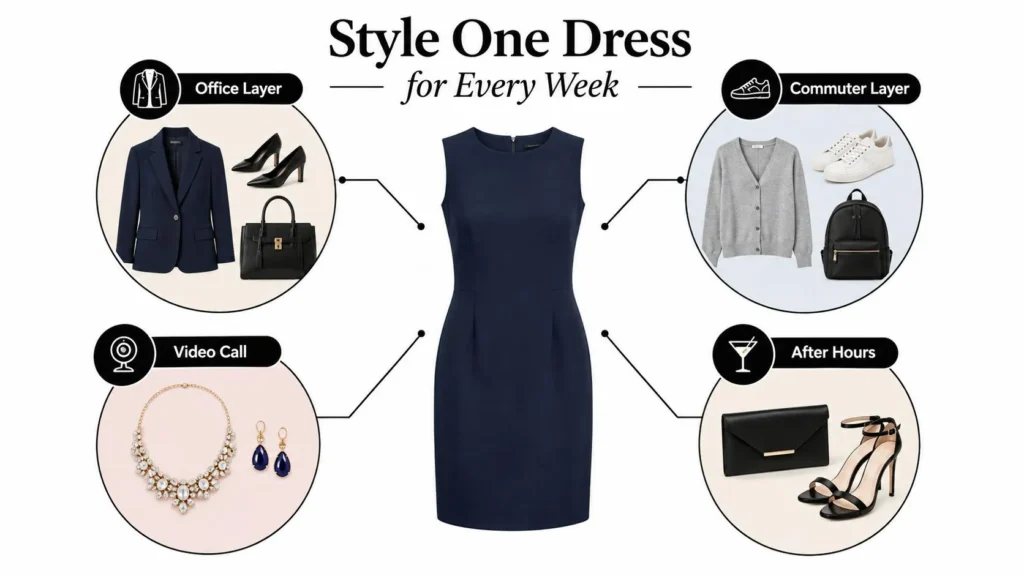
A knit dress can carry a video-call day with a blazer visible from the waist up, then lose the blazer for a more relaxed in-person afternoon. Add a statement necklace and earrings when the camera is the main audience. For commuting, use a refined cardigan, clean sneakers, and a practical backpack, then change into loafers at the office if the setting requires more polish.
A long-sleeve midi earns winter wear with tall boots and opaque hosiery. In transitional weather, swap to loafers and a lightweight trench. A belt can sharpen a loose shirt dress, while a structured bag makes a soft knit appear more deliberate. For an evening event, replace the work tote with a compact clutch, add heeled sandals, and remove the cardigan rather than changing the entire dress.
Packing formula: One dress, one blazer, one soft layer, two pairs of shoes, and one structured bag can cover several office days without creating a heavy suitcase.
Choose accessories that work across weeks, not just one outfit. A slim belt, neutral loafers, compact earrings, a simple watch, and a structured tote will adjust formality without adding visual clutter. If you’re packing for two or three office days, wear the heaviest shoes during the commute and keep the lighter layer folded over the dress.
Use this practical visual guide to see how one navy dress can shift from commuting to meetings and after-hours plans. Embed the styling video after you’ve considered the layering formula, not as a replacement for it.
Smart Shopping and Care Strategies That Stretch Your Budget
A work dress is a wardrobe investment only if you’ll wear and maintain it. Don’t confuse a high price with quality, but don’t expect a very cheap dress to provide dense fabric, careful seam finishing, full lining, and durable recovery at the same time.
Buy according to construction
An entry-level dress can be useful for experimenting with a silhouette or filling a relaxed-office gap. Inspect the seams, zipper, buttons, and transparency before buying. Mid-tier pieces generally offer more dependable fabric weight, cleaner finishing, and better lining, making them the most practical place to build a regular rotation.
Premium dresses should earn their price through exceptional fabric, tailoring potential, construction, and long-term versatility. Look for seam allowances that support alteration, a lining that moves with the outer fabric, and closures that sit flat. Secondhand and resale channels can make premium construction more accessible, especially when you know your measurements and preferred silhouettes.
| Tier | Typical Price Range | Construction to Expect | Expected Lifespan |
|---|---|---|---|
| Entry | Varies by retailer | Basic seams, limited lining, simpler closures | Useful with careful selection and care |
| Mid | Varies by retailer | Better fabric weight, stronger finishing, improved lining | Suitable for regular rotation |
| Premium | Varies by retailer | Superior materials, tailoring potential, refined construction | Long-term wardrobe piece when maintained |
I’m deliberately not assigning dollar bands to these categories because retail pricing varies sharply by market and label. Instead, compare what the garment delivers. A dress that costs more but remains wearable across formal and casual settings can be better value than several disposable replacements.
Alterations can multiply that value. Pay for hemming, side-seam shaping, sleeve adjustment, or a hidden snap when the base garment is strong. Don’t spend heavily trying to reconstruct a neckline or release a lined seam that has no usable allowance.
Care is part of the purchase
Steam between wears instead of ironing aggressively over delicate surfaces. Wash washable dresses cold in a mesh bag, use padded hangers, and rotate shoes so one pair doesn’t repeatedly damage the same hem area. Follow the care label, and use a specialist service for garments that need controlled cleaning. In Singapore, quality garment care from Tumble Laundry is a useful option when a work dress needs professional attention.
A compact wardrobe system also helps you buy with discipline. Use this guide on how to start a capsule wardrobe to build around repeatable pieces rather than accumulating dresses that solve the same styling problem.
A Practical Dress Code for Choosing Your Next Work Dress
Take this checklist into the fitting room. A dress is worth buying only when it passes the workplace test and the body test.
- Code match: Does the hemline, neckline, sleeve, opacity, and structure suit the strictest setting you regularly attend?
- Silhouette: Does the shape support your proportions while allowing you to sit, walk, reach, and commute?
- Fabric: Does it feel breathable, recover after movement, resist immediate wrinkling, and remain opaque under strong light?
- Fit: Do the shoulders, bust, waist, hips, armholes, sleeves, and hem sit correctly without constant adjustment?
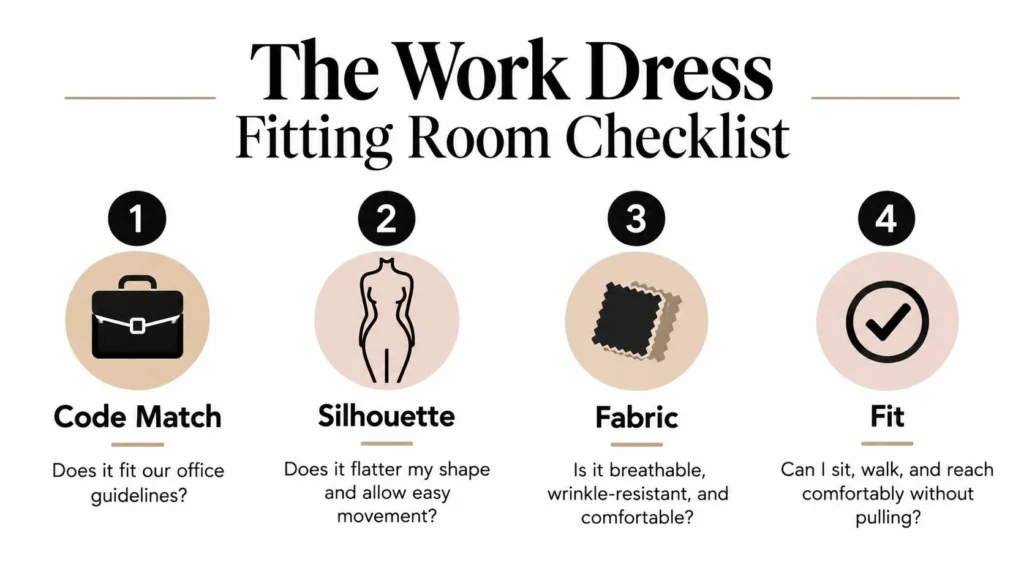
Use the tie-breakers after those four checks. The dress should layer under a blazer, survive your commute without becoming rumpled, and transition into an early evening meeting without requiring a complete change. If you want more examples while refining your rotation, this guide to work wardrobe dresses provides another useful point of comparison.
Walk away immediately if the bust pulls, the hips strain, the armholes gape, or the hem lands at an unflattering point that alterations won’t easily correct. Don’t buy a dress because the hanger version looks elegant. Buy the one that fits your actual body, your actual office, and your actual week.
If it doesn’t solve a real work problem, it isn’t the right dress.
maxijournal.com brings together approachable writing across fashion, business, health, technology, travel, arts, and more. Visit maxijournal.com for practical commentary and fresh ideas that help you make smarter choices, including a work wardrobe built around adaptable pieces rather than short-lived trends.
Discover more from Maxi Journal
Subscribe to get the latest posts sent to your email.