Yes, squids have a true centralized brain, and it contains more than 500 million neurons, more than the roughly 200 million neurons in a rat. That brain isn’t a simple lump of tissue, either. It’s a ring-shaped control center wrapped around the esophagus, supported by distributed neural clusters and specialized pathways that help a squid see, learn, move, and escape danger.
That answer challenges a familiar assumption about intelligence. Many people picture a brain as a compact organ protected inside a skull, with nerves branching outward like wires from a computer. Squids follow a different design. Their nervous system combines a central brain with peripheral processing centers, including neural tissue in the arms and mantle.
The result is an animal whose anatomy looks strange by human standards but works with remarkable precision. Squid brains process visual information, coordinate movement, control respiration, support learning and memory, and trigger rapid jet-propelled escapes. Understanding that arrangement also changes how we talk about brains in animals that evolved along a completely different branch of life.
Why the Answer Is More Interesting Than Yes or No
Yes, squids have brains, and modern squid-related cephalopods have been reported to possess more than 500 million neurons. That figure exceeds the approximately 200 million neurons reported for a rat, although the comparison does not mean squids and rats think alike. It shows why neuron count cannot, by itself, explain intelligence, behavior, or what qualifies as a brain. The figures are also discussed in ScienceAlert’s overview of squid brains.
The unusual design becomes clearer from the brain’s shape. Squid neural tissue forms a ring around the esophagus, the tube through which food passes. The nervous tissue therefore encircles part of the digestive pathway, placing the brain’s architecture within the animal’s head and feeding system rather than copying the compact layout familiar from mammals.
A central brain with local control
The squid’s central brain does not handle every response by itself. Neural clusters in the arms and mantle help manage local movement and rapid body functions, while central regions combine sensory information and coordinate broader behavior. The arrangement works like a company with a planning office and specialized local teams. Central regions can coordinate an action, while local networks respond quickly to conditions in nearby body parts.
A squid’s giant nerve fibers make this system even more distinctive. Its unusually large axons carry electrical signals rapidly through pathways involved in mantle contraction and jet propulsion. Scientists used these axons to uncover principles that continue to shape modern neuroscience, making the squid both an animal for study and a biological tool.
Why the question matters
A yes-or-no answer leaves out the main scientific lesson. Squids show that a brain can integrate information, coordinate flexible behavior, and support complex sensory processing without following a mammalian layout. Their nervous system also demonstrates why explanations should connect a clear answer with the anatomy and evidence behind it. Good science communication makes that connection understandable without treating human anatomy as the only model.
Squid brains therefore open a wider investigation, from their internal divisions and classic nerve experiments to comparisons with rats, octopuses, and other molluscs. They also raise a practical question: how might changing oceans affect these complex biological systems?
What Counts as a Brain
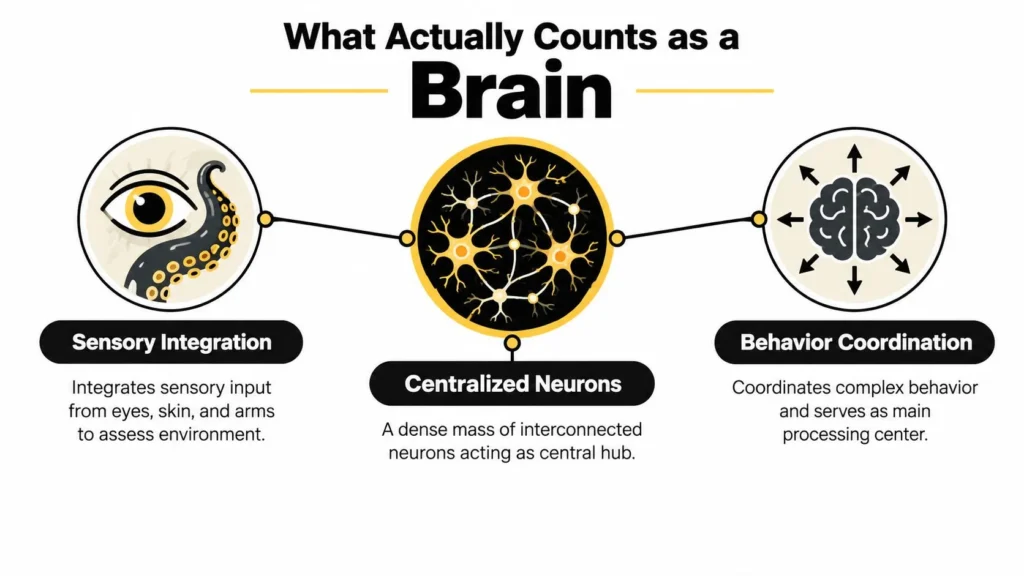
Biologists usually identify a brain through its organization and functions. It is a centralized mass of neurons that combines sensory information, coordinates behavior, and acts as a major processing hub. It does not need to resemble a human brain, sit inside a skull, or contain a layered cerebral cortex.
A squid fits this definition. Its central brain receives information from the eyes, skin, arms, and internal organs, then helps coordinate navigation, hunting, changes in direction, mantle control, and responses to threats. The important test is integration, not appearance.
Anatomy in Detail: The Esophageal Ring
The squid’s brain forms a ring of nervous tissue around the esophagus. Food passes through the center, while neural tissue surrounds it. This arrangement is unusual, yet it shows why brain anatomy cannot be judged by resemblance to a human organ.
Within the ring, distinct regions connect through neural pathways. Signals move between these regions and travel outward to the body. Smaller ganglia, or clusters of nerve cells, extend the nervous system into the arms and mantle, where they support movement and rapid local responses.
Brain, Nerve Net, or Ganglia
Comparisons with simpler molluscs make the distinction clearer. A clam has a nervous system organized around relatively small ganglia rather than one large, specialized processing structure. Jellyfish use a diffuse nerve net that can coordinate basic responses without a centralized brain.
Squids have a more integrated arrangement. Their central brain receives sensory input, processes it through specialized divisions, and sends commands along dedicated motor pathways. Peripheral ganglia do not cancel out the central brain. They show that squid nervous systems combine central coordination with local control, much like a main office working with nearby teams that can respond without waiting for every instruction.
Practical rule: A distributed nervous system can still contain a genuine brain. The key question is whether a centralized neural structure integrates information and coordinates behavior.
The squid qualifies because of what its brain does and how its parts are organized. Its ring-shaped structure, esophagus passing through it, and distributed connections broaden the meaning of a brain beyond the familiar vertebrate template.
The Four Major Divisions of the Squid Brain
A squid brain is a ring-shaped control center with four major functional divisions. The esophagus passes through the ring, while neural pathways connect specialized regions and carry signals to the rest of the body. MRI-based mapping of a reef squid brain confirmed 281 known connections and identified 145 previously undescribed pathways, revealing a network more intricate than older diagrams suggested. (MRI-based squid brain mapping)
These divisions do not form a mammalian-style cortex. They work more like terminals in an airport: each handles a different kind of traffic, yet coordinated movement depends on routes connecting the terminals.
The divisions and their jobs
| Brain Division | Primary Function |
|---|---|
| Vertical lobe complex | Learning and memory |
| Paired optic lobes | Visual processing |
| Supraoesophageal mass | Higher motor control |
| Suboesophageal mass | Lower motor control, mantle activity, and respiratory functions |
The vertical lobe complex helps explain why squid behavior is more flexible than a set of fixed reflexes. Its role in learning and memory allows past experience to influence later responses. A squid can adjust what it does instead of repeating one automatic reaction every time.
The paired optic lobes process much of the animal’s visual information. Squids rely on vision to hunt, avoid predators, and control movement in three-dimensional water. Dedicated visual regions give incoming signals somewhere to be analyzed before they guide a response.
From perception to movement
The supraoesophageal mass contributes to higher motor control. It helps turn processed information into an organized action. Detecting a shape may require simultaneous adjustments of the arms, mantle, funnel, eyes, and body orientation, rather than movement from one isolated muscle.
The suboesophageal mass handles lower motor functions and internal activities, including mantle and respiratory control. Its role resembles the muscle-control side of walking: one system helps determine the action, while another coordinates the body processes that carry it out. The two levels connect, but they perform different jobs.
The mapped pathways show how these divisions communicate. Visual input can influence learning, learning can affect motor planning, and automatic control can keep the mantle working while the squid responds. The brain therefore combines centralized processing with tightly linked specialized regions.
This architecture demonstrates anatomical specialization without mammalian layering. A squid does not require a human-like cortex to organize complex behavior. Its ring-shaped, esophagus-threaded brain reaches flexibility through a different arrangement, one suited to a soft-bodied marine animal with a very different body plan.
The Giant Axon Discoveries That Built Modern Neuroscience
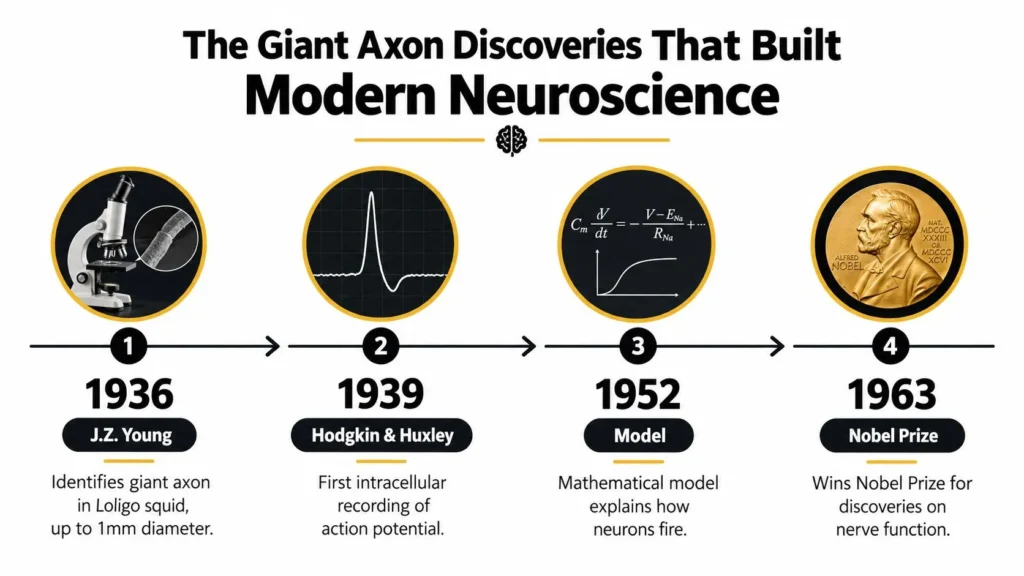
Squids helped neuroscientists solve a problem that ordinary laboratory animals couldn’t. Their giant axons are hundreds of times larger than the largest human axons, making them unusually accessible for experiments on electrical signaling. (National Geographic’s history of squid neuroscience)
In the 1930s, researchers recognized the importance of squid giant fibers. Their large diameter made it possible to study nerve signals directly, including experiments that would have been extremely difficult or impossible with the much thinner axons of mammals.
Why a squid needs a giant axon
A squid’s giant fibers form part of an emergency motor system. When the animal detects danger, signals must reach the mantle muscles quickly enough to produce a powerful jet of water. Large-diameter axons reduce internal resistance, allowing rapid signal conduction for a life-preserving escape response. (Oxford Research Encyclopedia’s account of squid giant fibers)
That biological solution became a scientific advantage. Researchers could place recording equipment into a squid axon and observe how electrical impulses changed across the cell membrane. The experiments connected ion movement with the rise and fall of a nerve impulse.
Hodgkin, Huxley, and the electrical language of neurons
In the early 1950s, Alan Hodgkin and Andrew Huxley used squid nerve tissue to explain how electrical impulses travel through neurons. Their work helped establish the modern ion-channel model of nerve signaling, linking changes in membrane voltage to the movement of charged particles through specialized channels.
The importance of that work extends far beyond squid biology. Scientists use the principles derived from squid axons to understand how neurons communicate throughout animal nervous systems, including the human brain. The squid became a bridge between visible biological structure and the invisible electrical activity that produces movement and perception.
The historical lesson is easy to miss. Researchers weren’t studying a brain that looked familiar. They were using an unusual feature of squid anatomy to uncover a general rule of nervous systems. A specialized escape pathway in a marine invertebrate helped provide a mechanistic picture of how thoughts, sensations, and commands begin with electrical events in neurons.
The giant axon therefore answers two questions at once. It shows why squids can escape with extraordinary speed, and it explains why squid nervous tissue became foundational to neuroscience.
How Squid Brains Compare to Rats, Octopuses, and Other Molluscs
Neuron counts offer a useful starting point, but they do not settle intelligence. Squids have more than 500 million neurons, while rats have roughly 200 million, according to the comparison cited earlier. Those figures are striking, yet the animals differ in body plan, senses, habitat, behavior, and neural organization.
| Species | Approx. Neurons | Architecture |
|---|---|---|
| Squid | More than 500 million | Central ring-shaped brain with distributed ganglia and giant-fiber pathways |
| Rat | About 200 million | Centralized vertebrate brain with specialized regions and layered structures |
| Sea hare (Aplysia) | Approximately 20,000 | Simpler nervous system organized into smaller ganglia |
A squid’s nervous system supports rapid visual and motor coordination. A rat’s brain serves a vertebrate body with a different sensory profile and movement system. Comparing neuron counts is informative, but calling one animal “smarter” would ignore how each nervous system is organized for its own ecological demands.
Squid and octopus architecture
Squids and octopuses are both cephalopods, but their nervous systems emphasize different physical problems. Squids combine a central brain with fast pathways for mantle-powered propulsion. Octopuses have extensive neural processing in their arms, supporting independent manipulation and exploration.
Readers interested in seeing these animals in the wild can use this guide to spot an octopus at Captain Cook. Both animals challenge the assumption that intelligence requires a vertebrate body or one strictly centralized command center.
Why structure matters more than a leaderboard
A rat’s brain is centralized in the familiar vertebrate pattern. A squid’s brain is also centralized, but its control system works alongside peripheral ganglia and specialized pathways for rapid movement. The sea hare’s smaller, simpler ganglia provide a useful contrast, showing that “mollusc” covers a broad range of nervous-system organization.
Neuron number indicates substantial neural investment. It does not show how neurons connect or which problems they evolved to solve. Squid brains are especially revealing because their ring-shaped central structure accommodates the esophagus, while control is partly distributed through the body. That combination makes the squid neither a small rat nor a typical mollusc. It represents another solution to coordinating sensation, movement, and behavior in a soft-bodied swimmer.
Distributed Ganglia and the Giant Fiber Escape System
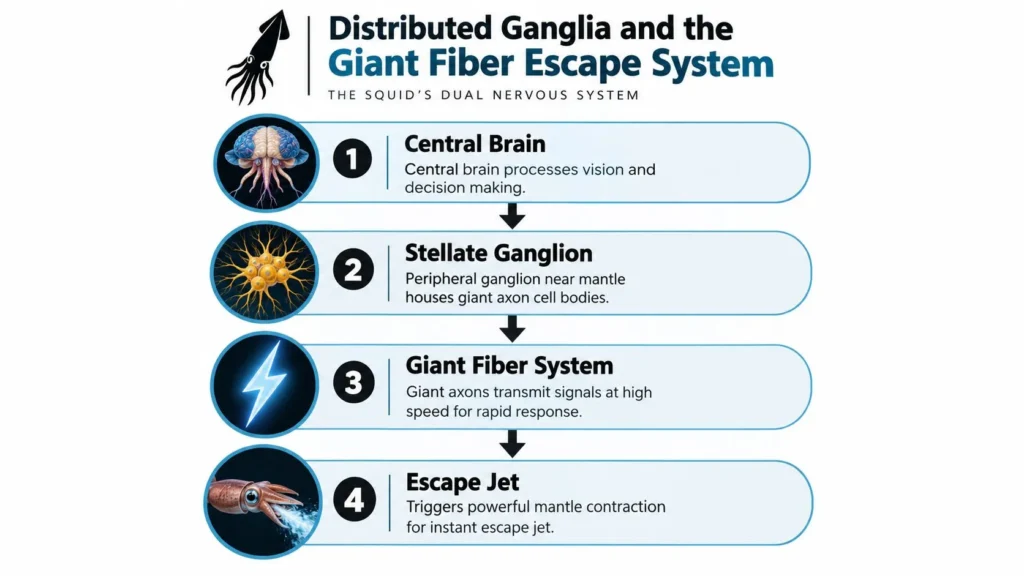
A squid’s nervous system combines a central brain with fast local control. The brain interprets sensory information and helps select a response. Peripheral ganglia and giant neurons can then carry out urgent movements with very little delay. This arrangement makes the squid’s “brain” more than one command center. It is a central structure connected to specialized circuits throughout the body.
The clearest example is the stellate ganglion, positioned near the mantle. It contains the cell bodies linked to giant motor neurons that trigger mantle contraction. Placing this circuitry close to the muscles shortens the route an emergency signal must travel, much like locating an emergency switch beside the machine it controls.
Two sets of three giant neurons
The squid’s giant fibers are arranged in tandem as two sets of three giant neurons. Together, they support the sequence behind jet propulsion and escape. One part activates mantle contraction, while related pathways coordinate the funnel and the direction of the water jet. Oxford Research Encyclopedia’s explanation of the giant-fiber arrangement
Their speed comes partly from axon size. A larger axon offers less internal resistance, allowing an electrical signal to travel quickly. That advantage matters when the animal must turn danger detection into a sudden burst of movement.
Central decision, local execution
The central brain still handles the wider problem. It receives information from the eyes and other senses, helps determine an appropriate response, and coordinates behavior that extends beyond one reflex. Once escape is selected, the giant-fiber pathway can send a powerful motor signal through a specialized route.
The division resembles emergency braking in a vehicle. A driver decides to stop, while the braking system transfers force rapidly to the wheels. In a squid, the brain contributes assessment and choice, while ganglia and giant fibers handle immediate execution.
A brain doesn’t have to control every muscle through a single slow chain of commands. Distributed circuits can make behavior faster, not less intelligent.
This organization explains why squid nervous systems are described as partly distributed. The squid has a central brain, yet that brain does not direct every movement detail. Local circuits manage fast, specialized tasks, leaving the central system to coordinate broader sensory and behavioral priorities. The result is a nervous system built around both interpretation and rapid response.
What Climate Change Could Be Doing to Squid Brains
Changing seawater chemistry may alter how squid brains develop. A 2026 report described preliminary findings in which bigfin reef squid raised under increased carbon dioxide conditions showed an average 49% reduction in brain volume, with the strongest volume reductions in visual-processing regions. The report on ocean acidification and squid brains did not publish exact cubic-millimetre figures for the comparison.
Visual processing supports far more than detecting an image. Squids use vision to locate prey, respond to predators, control body position, and adjust behavior as their surroundings change. If visual regions develop differently, several parts of daily life could be affected at once, like a camera system that also helps guide movement and decisions.
What the preliminary evidence suggests
The reported work connected carbon dioxide exposure with changes in brain development and feeding behavior. Because the findings were preliminary, they should not be treated as a final verdict for every squid species or every future ocean condition.
The proposed mechanism involves disruption of GABA-A receptor function during neurodevelopment, according to the report. GABA-A receptors help regulate neural signaling. Interfering with that process during development could affect how nervous tissue is built and organized, rather than causing only a short-lived response in adult animals.
The study reported the strongest volume reductions in visual-processing regions, although the preliminary report did not provide exact control and high-carbon-dioxide volumes. Its documented result was an average reduction in total brain volume, alongside especially strong effects in visual areas.
Why exposure won’t affect every squid equally
Species that develop in coastal waters may encounter different chemical conditions from animals living farther offshore or in deeper environments. Effects may also depend on developmental timing, exposure duration, and the sensitivity of particular brain regions. Two squids exposed to the same water conditions could therefore show different outcomes if their life stages or habitats differ.
The question is more complicated than asking whether climate change will make squids less intelligent. Researchers need to examine feeding, camouflage, movement, escape behavior, and development together. An accessible explanation of what climate change means places ocean acidification within the wider environmental situation.
The concern extends beyond individual squid. If altered brain development changes how these animals hunt or avoid predators, their effects could spread through food webs and coastal fisheries. Ocean chemistry can become a question about behavior, survival, and ecosystem balance. That connection also shows why brain volume alone cannot describe intelligence or predict an animal’s future performance. Researchers must connect anatomical changes with what squid do.
What Squid Brains Reveal About Evolution and Intelligence
Squids show that complex nervous systems can evolve without copying the vertebrate plan. Their brains centralize enough sensory processing to coordinate behavior, while peripheral circuits control specialized movements. Intelligence therefore resembles a collection of solutions to ecological demands, rather than one fixed design.
The squid brain is ring-shaped. Neural tissue surrounds the esophagus, much like a crowded control center built around a passageway. This arrangement differs from the compact brain many readers picture. The phrase “three-brain” can also mislead. It refers to the central brain and major peripheral structures, including the large stellate ganglia in the mantle, not three separate human-style brains.
Intelligence has more than one architecture
Each neural region contributes a different function. Visual areas analyze incoming information, learning-related regions support memory, motor divisions coordinate movement, and peripheral pathways can deliver urgent commands. The giant escape fibers illustrate the same principle: a specialized circuit can prioritize speed when survival depends on a rapid response.
A squid’s nervous system also shows why intelligence is difficult to trace through deep time. Soft neural tissue rarely fossilizes like shells or bones, so the fossil record is incomplete for reconstructing brain evolution. Researchers must compare anatomy, behavior, living species, and development to infer how these systems changed.
The broader lesson reaches beyond squids. A brain can be highly capable while remaining vulnerable to environmental conditions, and brain size alone cannot capture its performance. Squids connect cognition with body design, development, behavior, and ecological pressure. Their ring-shaped, partly distributed brains broaden the question from “Do squids have brains?” to a more useful one: how many different nervous-system designs can support intelligent behavior?
Discover more from Maxi Journal
Subscribe to get the latest posts sent to your email.