A field crew splits open a slab of stone, and for a moment the whole hillside becomes a time machine. Then the thrill fades into a harder truth. For every fossil they find, countless ancient lives left no trace at all.
Darwin’s Dilemma and the Great Fossil Puzzle
Charles Darwin knew he had a problem.
If evolution happened through gradual change, where were all the in-between forms? Why didn’t the rocks seem packed with endless transitions from one kind of organism to another? Long before internet debates turned fossils into talking points, Darwin wrestled with the missing pieces himself. That honesty is one reason the question still matters. The puzzle wasn’t invented by critics of evolution. It was built into the science from the beginning.
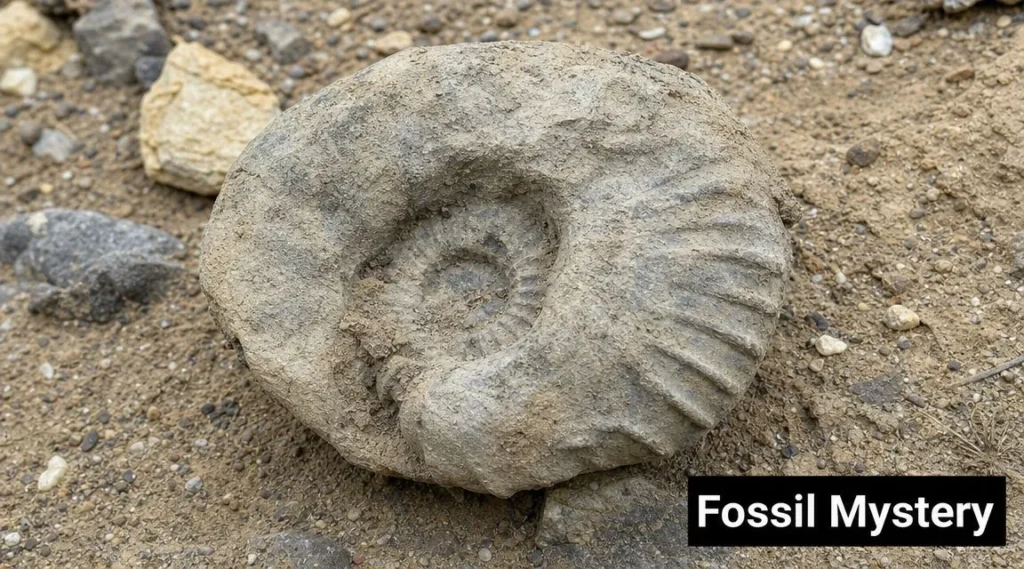
A museum drawer full of fossils can fool you. Shells, bones, teeth, leaf impressions. It looks abundant. It looks orderly. But paleontologists don’t work with a complete archive. They work with fragments, survivors, and clues that made it through an astonishing chain of accidents.
A detective story in stone
The easiest way to understand why the fossil record is incomplete is to stop thinking of it as a full documentary and start thinking of it as a crime scene. The event happened long ago. Weather erased footprints. Important objects are missing. Witnesses are gone. Yet investigators can still reconstruct what happened because the remaining evidence has patterns.
That turns a seeming weakness into the heart of paleontology.
The fossil record isn’t a perfect replay of the past. It’s a damaged archive that still preserves enough structure for scientists to test ideas about ancient life.
Readers often get stuck on one mistaken expectation. They assume that if evolution is real, every generation should be fossilized somewhere, waiting to be picked up like pages in a complete family album. But nature doesn’t preserve history that way. Fossils form rarely, survive unevenly, and get discovered selectively.
The puzzle that sharpened the science
That means missing fossils aren’t an embarrassment hidden in a back room. They’re the reason paleontology became such a careful science. Researchers had to learn how decay works, how sediments bury remains, how rocks survive, and how human search habits shape what gets found.
Three broad filters do most of the damage:
- Preservation filter: Many bodies decay before they can fossilize.
- Geological filter: Even preserved fossils can be destroyed when rocks erode, heat up, or disappear.
- Human filter: Scientists can only study places and specimens they can reach and recognize.
By the end of this detective story, the gaps look less like failure and more like the shape of the investigation itself. Earth hasn’t handed us a neat shelf of labeled volumes. It has handed us torn pages, scattered evidence, and just enough clues to build a remarkable history.
The Great Fossil Lottery Why Most Life Vanishes
Most organisms never become fossils. Not because life was rare, but because fossilization is picky.
A dead animal or plant enters a brutal sorting process. Scavengers tear it apart. Microbes digest soft tissue. Rain, rivers, waves, and roots disturb the remains. If the body sits exposed on a forest floor, it usually returns to the ecosystem quickly. That’s excellent for life. It’s terrible for future paleontologists.
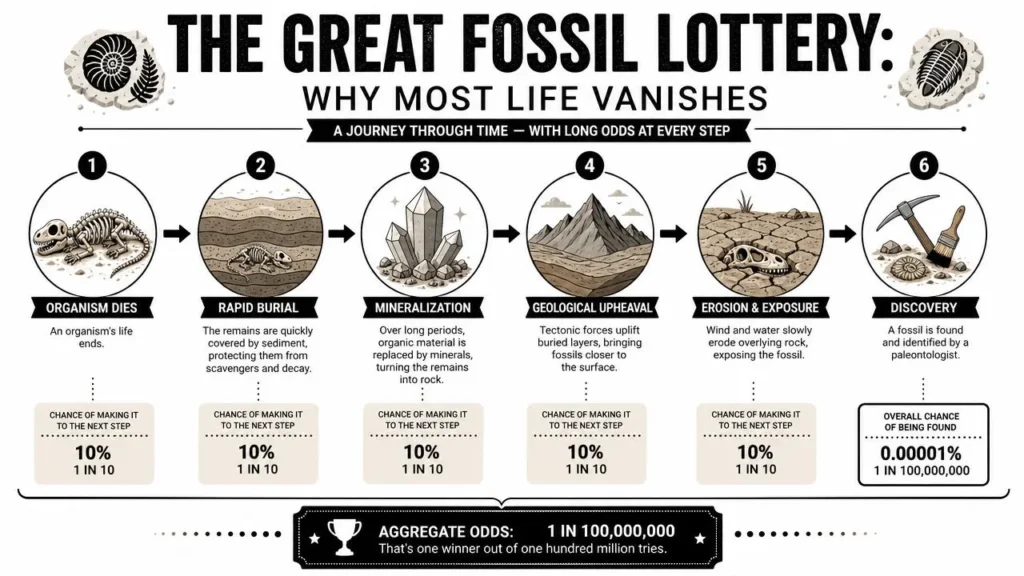
A useful way to think about this is as a fossil lottery with multiple rounds. Winning one round doesn’t guarantee the next.
Round one has hard rules
The first bias is built into the body itself. The fossil record is incomplete because preservation is strongly taphonomically biased. Organisms with hard parts fossilize far more readily than soft-bodied organisms, and rapid burial environments preserve remains better than settings where decay or transport destroys them. That means fossils are not a random sample of past life, but a filtered dataset shaped by body composition, depositional setting, and post-burial loss, as explained by the Digital Atlas of Ancient Life overview of fossil record completeness.
If you’ve ever wondered why shells and bones seem to dominate museum cases, that’s a big part of the answer. Hard parts are better at surviving the first rounds of destruction.
The path from death to discovery
An organism has to pass through a chain of unlikely events:
- It must die in a favorable place. A lake bottom, river delta, or seafloor can help because sediment arrives there.
- It must be buried quickly. Burial shields remains from scavengers, currents, and oxygen-rich decay.
- Its remains must persist chemically. Minerals may replace or preserve structure over long spans of time.
- Its rock layer must later return near the surface. Fossils buried far down don’t help if nobody can access them.
- Erosion must expose it without destroying it first.
- A human has to notice it and understand what it is.
That sequence explains why fossilization feels less like ordinary preservation and more like a long relay race in which most runners drop the baton.
To see a simple origin-of-life idea that often gets discussed alongside early Earth environments, you might also enjoy this plain-language piece on the primordial soup hypothesis. It helps place fossils within the longer story of how life and environments interact.
Why soft bodies disappear so easily
The idea of an ‘incomplete fossil record’ often confuses readers. They hear it and picture carelessness or lack of searching. But incompleteness begins before any scientist arrives. It starts minutes after death.
A jellyfish, worm, or skin-covered creature is like a note written on wet tissue paper. Leave it outside, and the message dissolves. A clam shell or dinosaur tooth is more like a ceramic tile. It can still break, but it has a fighting chance.
Practical rule: Fossils favor durability and fast burial. If a living thing lacks hard parts and dies in a place where decay is active, its odds drop sharply.
Later, paleontologists may recover tracks, burrows, bite marks, or coprolites that reveal the presence of organisms whose bodies didn’t preserve well. But the original body often vanishes. That’s why a fossil bed is never a full cast list. It’s the partial attendance sheet from a vanished world.
A short visual explainer helps make that chain concrete:
Lost Chapters in Earths Geologic Library
Suppose an organism beats the fossil lottery. It gets buried, mineralized, and locked inside sedimentary rock. You might think the case is closed.
It isn’t. Now the fossil has to survive Earth itself.
The rock record works like a giant library in which many shelves are missing, some books were never printed, and others were burned, soaked, or ground into dust. Paleontologists don’t browse a continuous collection. They work with surviving volumes from scattered rooms.
Stone archives are uneven
A second major cause of incompleteness is the heterogeneous rock record itself. The amount of sedimentary rock available to preserve fossils changes over geologic time, and many fossil-bearing rocks are later eroded, metamorphosed, or otherwise removed. As a result, the geological archive preserves only scattered intervals, creating time gaps that can distort estimates unless those gaps are modeled carefully, as described in this report on research about major fossil gaps and the rock record.
That sentence carries a huge implication. Even perfect fossilization doesn’t guarantee long-term survival. The archive that stores fossils is unstable.
For a broad, accessible look at Earth’s early physical story, this article on Earth in the beginning gives useful background for the environments that later shaped preservation.
How Earth deletes evidence
Several geological processes erase history in different ways:
- Erosion removes pages: Wind, rain, rivers, ice, and waves wear away rock layers. A fossil can sit safely underground for ages, then vanish once exposure becomes too intense.
- Heat rewrites the text: When rocks undergo metamorphism, pressure and heat can distort or destroy fossil structures.
- Tectonics carries archives away: Rock layers can be folded, faulted, buried, or recycled into parts of the crust where fossils don’t remain recognizable.
- Deposition is patchy: Some intervals leave thick sedimentary packages. Others leave little local record at all.
Time gaps aren’t empty stories
A gap in the rocks doesn’t mean nothing happened then. It means the chapter wasn’t preserved in that place, or it didn’t survive to reach us. That’s a major distinction.
Readers sometimes ask, “If there are missing layers, how can scientists say anything with confidence?” The answer is that paleontologists compare many outcrops, many basins, and many kinds of evidence. One site may have a missing chapter that another site partly preserves. A layer erased in one region may survive beautifully in another.
A broken library can still tell a coherent story if enough volumes overlap.
That overlap is one reason the fossil record remains scientifically powerful even when any single cliff face or quarry looks frustratingly incomplete. Paleontologists don’t expect one outcrop to contain all of Earth history. They assemble the story from distributed evidence, the way historians combine letters, records, ruins, and maps from different places to rebuild a lost civilization.
The Human Factor in Fossil Discovery
Nature creates most of the gaps, but people shape the view too.
Fossils don’t walk into museums. Researchers choose field sites. Institutions fund certain projects. Collectors notice some specimens and overlook others. Political borders, weather, roads, quarry access, and local expertise all influence where discoveries happen. So the fossil record we know isn’t only filtered by death and geology. It’s also filtered by attention.
Where people look matters
Paleontologists tend to work where sedimentary rocks are exposed and accessible. Badlands, deserts, road cuts, quarries, and sea cliffs often reveal fossils clearly. Dense forests, severely weathered tropical regions, urbanized terrain, or ice-covered regions can hide them.
That creates a sampling bias. Some ancient environments get studied repeatedly because they are visible and logistically manageable. Others remain under-sampled, not because they were unimportant, but because searching there is difficult.
Collection history matters too. Dramatic skulls, giant bones, and spectacular predators often attract early interest. Tiny teeth, pollen grains, fish fragments, burrows, and microfossils may receive less public attention even though they can answer major ecological questions.
Four key biases that make the fossil record incomplete
| Bias Type | Cause | Consequence |
|---|---|---|
| Preservation bias | Some organisms and environments preserve better than others | The record overrepresents durable bodies and favorable burial settings |
| Rock record bias | Some time intervals and rock layers survive better than others | Earth history appears patchy, with missing spans |
| Sampling bias | Researchers search more in accessible or well-known places | Certain regions and habitats become better documented than others |
| Collection bias | People often favor large, striking, or familiar specimens | Small or less charismatic organisms can be overlooked |
For a reminder that small aquatic discoveries can matter just as much as giant skeletons, browse stories about new species of fishes. They show how much biodiversity can hide in plain sight when people start looking carefully.
Discovery is not the same as existence
This distinction matters. An organism’s absence from a museum cabinet doesn’t prove it was absent from ancient ecosystems. It may mean nobody has found it yet, recognized it, or preserved it in a collection.
Here’s how the human factor changes the picture:
- Field access shapes knowledge: Remote, unstable, or protected regions may remain lightly studied.
- Training affects recognition: A weathered fragment may look like ordinary rock unless a specialist spots diagnostic features.
- Research priorities steer effort: Teams often follow questions that current methods can answer, which leaves some fossil groups less explored.
- Storage and curation matter: A specimen can sit unstudied in a drawer until a later researcher realizes its importance.
The fossil record people talk about is partly a natural archive and partly a map of where human curiosity has landed.
That doesn’t make paleontology unreliable. It makes it self-aware. Good paleontologists ask not just “What did we find?” but also “Why did we find this, here, in this form, and what might we be missing?”
How Scientists Read Between the Lines
An incomplete record doesn’t stop science. It changes the kind of science researchers do.
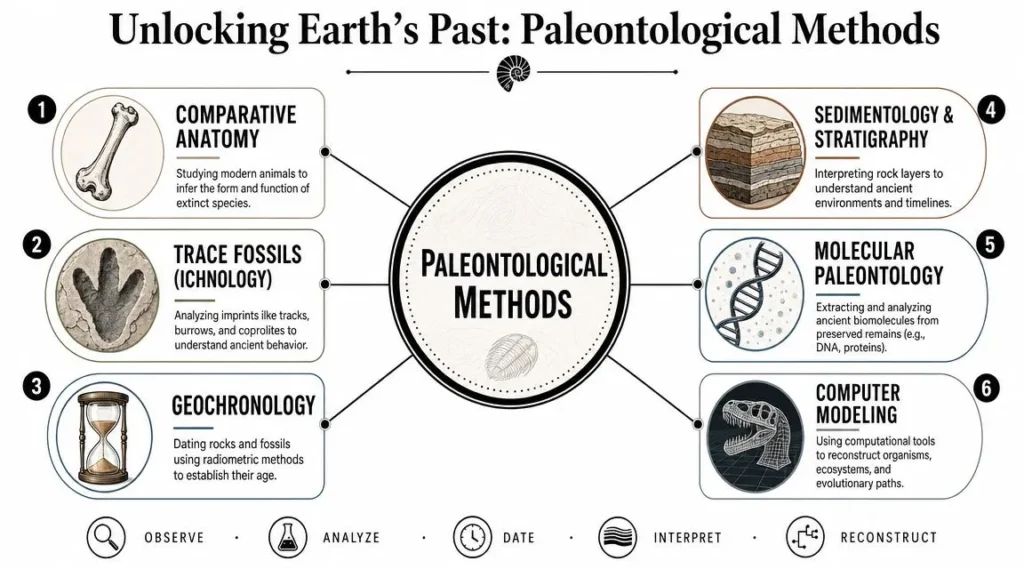
Paleontologists rarely get the luxury of a full skeleton, a full ecosystem, or a continuous timeline in one place. So they borrow methods from anatomy, geology, chemistry, and computing. They cross-check clues. They treat each fossil not as a final answer but as one line in a larger argument.
Clues from relatives and rock layers
One classic tactic is comparative anatomy. If scientists know the anatomy of related organisms, they can infer likely structures or functions in a more fragmentary fossil. A single limb bone, tooth, or joint surface may reveal posture, diet, or motion because it can be compared with better-known species.
Another approach is phylogenetic bracketing. If a trait appears in close relatives on the evolutionary tree, researchers can test whether an extinct species probably shared it. This isn’t guesswork in the casual sense. It’s structured inference based on relationships, anatomy, and consistency across lineages.
Rock context matters just as much as bones. Stratigraphy and sedimentology help scientists read the setting around a fossil. Grain size, layering, ripple marks, mud cracks, and associated fossils can reveal whether an animal lived in a river, floodplain, shallow sea, or dune environment.
Evidence that isn’t a body fossil
Some of the richest clues come from evidence left behind rather than bodies themselves.
- Tracks and trackways can show speed, gait, group movement, or the fact that an animal passed through a habitat where no skeleton was preserved.
- Burrows reveal behavior and sediment conditions.
- Coprolites preserve diet clues.
- Tooth marks and bone damage expose predator-prey interactions.
- Nests, eggshell fragments, and bite traces can document life stages and behavior.
This is one reason the detective-story framing fits so well. A footprint at a crime scene may tell you more about motion and timing than a still photograph would. Trace fossils do the same for ancient life.
Missing bodies don’t mean missing evidence. Ancient organisms often left signatures in motion, feeding, nesting, and digging.
Technology opens sealed evidence
Modern tools let scientists extract more from less. CT scanning can reveal structures hidden inside rock without breaking rare specimens apart. Digital reconstruction software can correct distortion or test how bones fit together. Computer models can compare alternative evolutionary scenarios and estimate how lineages may have changed across gaps.
Researchers also use dating methods and broader analytical frameworks to fit fossils into timelines more carefully. They don’t pretend the gaps aren’t there. They account for them.
If you’re interested in how researchers build strong explanations from scattered evidence, this overview of Contesimal’s guide to content research methods is surprisingly relevant. Its discussion of systematic review logic mirrors a core paleontological habit: gather fragmentary evidence, evaluate quality, compare patterns, and avoid overclaiming.
Confidence comes from convergence
The strongest paleontological conclusions don’t rest on a single dramatic find. They emerge when different lines of evidence point in the same direction.
A typical reconstruction may combine:
| Method | What it helps answer |
|---|---|
| Comparative anatomy | What the organism’s body likely did |
| Trace fossils | How it moved or behaved |
| Stratigraphy | When and where it lived |
| Imaging tools | Hidden internal details |
| Computer modeling | Which reconstructions best fit the evidence |
That convergence is the key. One clue may be ambiguous. Several independent clues that agree become powerful.
So when people ask why fossil record is incomplete, the deeper answer is this: because preservation is selective, rocks are uneven, and discovery is biased. But paleontologists don’t surrender to that. They build methods that turn partial evidence into testable history.
An Incomplete Record A Remarkably Rich Story
The fossil record is incomplete for good reasons, not mysterious ones. Bodies decay. Burial is selective. Rock archives are patchy. Human search patterns are uneven. Once you see those filters clearly, the gaps stop looking like fatal flaws and start looking like expected features of a deep-time archive.
That matters because some readers treat incompleteness as if it cancels the whole enterprise. It doesn’t. Historians don’t throw out ancient history because some scrolls burned. Detectives don’t abandon a case because one witness is missing. They work harder with what remains. Paleontology does the same.
Why the gaps are productive
The missing pieces have forced scientists to become more inventive, more quantitative, and more careful about uncertainty. They compare sites, test competing explanations, and revise reconstructions when new fossils appear. That’s not weakness. That’s science behaving properly.
The result is impressive. From broken shells, scattered bones, footprints, burrows, teeth, and rock layers, researchers have reconstructed ecosystems, behaviors, environments, and long evolutionary patterns with remarkable depth.
Takeaway: The wonder of paleontology isn’t that the record is perfect. It’s that so much can be learned from evidence that is fragmentary, filtered, and ancient.
If you want a tactile reminder that fossils are real objects from real organisms, not just illustrations in textbooks, looking closely at a genuine Megalodon shark tooth can be surprisingly powerful. A single fossil object makes the whole subject feel less abstract. It also hints at the larger truth. Every fossil is both a discovery and a survivor.
The story of life on Earth isn’t finished. New outcrops erode open. Old museum drawers get reexamined. New methods reveal details that earlier generations couldn’t see. Somewhere, another tiny fossil is waiting to add a sentence, or maybe a whole paragraph, to the history of life.
If you enjoy approachable science writing, curious deep dives, and cross-disciplinary stories, explore maxijournal.com for more articles and fresh commentary across education, science, technology, health, arts, travel, and beyond.
Discover more from Maxi Journal
Subscribe to get the latest posts sent to your email.