Worms don’t have ears. But that simple answer hides a much stranger truth: some worms don’t just feel vibrations through the ground, and one roundworm studied in 2021 can detect airborne sound with its entire body.
That’s what makes the question “do worms have ears?” so interesting. If you only look for ear holes, eardrums, or anything like a tiny version of a human ear, the answer is no. But if you ask how worms sense movement, danger, and even sound-like signals in their environment, biology gets much more fascinating.
A worm lives in a world of touch, pressure, moisture, light, and movement. For an earthworm, the tremble of soil can matter more than a bird call would. For a microscopic roundworm, the body itself can act a bit like a drum skin. That doesn’t mean all worms sense the world in the same way. It means evolution found different solutions for different kinds of worms.
That’s also why good biology writing matters. Clear, careful explanation helps turn odd facts into real understanding, which is exactly what thoughtful science communication does.
The Short Answer and the Surprising Truth
The short answer is still no. Worms do not have ears like humans, dogs, birds, or many other animals. They don’t have outer ears, middle ears, or eardrums in the usual sense.
What they do have are other ways to detect their surroundings. Instead of “hearing” the way we do, many worms are built to sense movement through soil, pressure on the body, and changes in light or touch. In plain language, they often feel their world more than they hear it.
That’s where readers often get confused. We use the word hearing for a very specific human experience. Biology uses a broader question: can an animal detect vibrations or sound waves and turn them into a useful signal? If the answer is yes, then the animal may be sensing sound even without ears.
Simple rule: No ears doesn’t mean no sound detection.
That distinction matters because “worm” is a broad label. Earthworms, microscopic roundworms, and marine bristle worms don’t all use the same sensory toolkit. Some mainly detect ground vibration. Some rely heavily on touch and chemical cues. And one famous roundworm, C. elegans, changed how scientists think about sound sensing in simple animals.
A helpful analogy is this: if you stand near a loud speaker, you may feel the bass through the floor before you focus on the song. For many worms, that kind of body-level detection is closer to their sensory life than anything we’d call listening.
How Earthworms Feel Their World
The common image of a worm is an earthworm. It lives in soil, moves through narrow spaces, and doesn’t need ears to survive there.
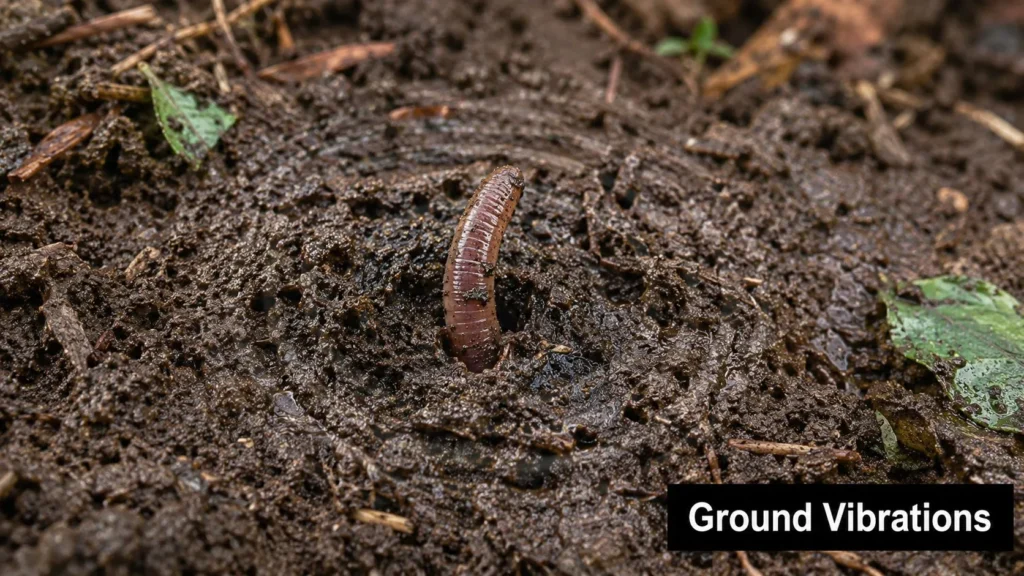
According to a discussion summarizing established biological facts from sources including the Iowa Department of Natural Resources, earthworms have no ears, use the prostomium and skin receptors to feel vibrations, and can sense light intensity. So if you clap near an earthworm, it isn’t hearing the clap the way you do. If the ground shakes, though, that’s a different story.
The prostomium and skin sensors
The prostomium is the lobe above the mouth. It helps the worm probe its surroundings as it moves through soil. Think of it as part nose, part touch guide, though it isn’t a nose in the human sense.
Earthworms also have many sensory receptors in the skin. Those receptors let them detect pressure, contact, and vibration. Their bodies are in constant contact with the soil, so they’re positioned perfectly to notice when the ground changes.
That’s why the simplest way to picture an earthworm’s “hearing” is this: it’s like feeling heavy bass through floorboards. You may not identify a melody, but you know something is happening nearby.
Why vibrations matter underground
For an earthworm, vibrations can signal trouble. A digging predator, a moving animal overhead, or disturbed soil can all create patterns the worm can detect through its body.
This is one reason worms often retreat, pause, or change direction when the ground is disturbed. The soil isn’t just where they live. It’s also the medium that carries useful information to them.
To see the basic idea in action, this short video gives a helpful visual sense of worm movement and response:
What earthworms don’t do
It helps to be precise here:
- They don’t hear airborne sound like humans do. A voice traveling through air isn’t the same as a vibration moving through soil.
- They don’t have ears to collect sound waves. There’s no ear opening waiting to catch noise.
- They do respond to physical disturbance. That’s often what people mistake for hearing.
If an earthworm reacts when you stomp nearby, the key signal is usually the vibration, not the sound in the air.
When a Worm’s Whole Body Is an Ear
The biggest surprise in this topic comes from a very different worm. Not an earthworm, but the tiny laboratory roundworm C. elegans.
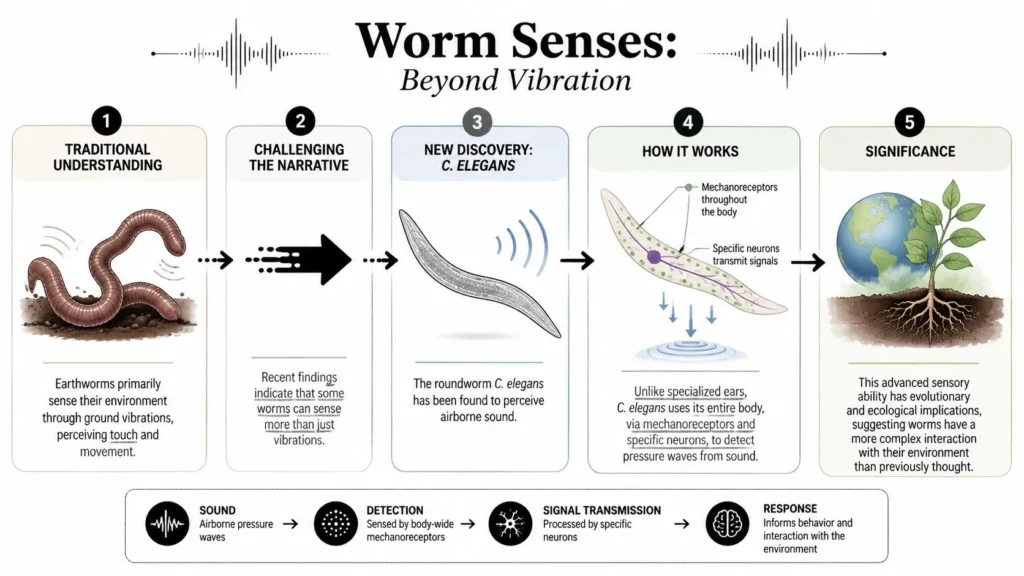
A 2021 study reported in Neuron found that C. elegans can detect airborne sound with its whole body, and worms lacking specific nicotinic acetylcholine receptors showed zero reaction to airborne sound. That finding was striking because C. elegans has no dedicated auditory organs such as ears or an eardrum.
How that works in plain language
Here’s the easiest way to picture it. A normal ear uses a membrane to catch sound vibrations and pass that information into the nervous system. In C. elegans, the body surface itself plays a similar role.
The study found that nicotinic acetylcholine receptors are located across the worm’s skin and respond directly to sound waves. In effect, the worm’s skin behaves like a distributed sound-sensing membrane. Rather than funneling sound into one ear, the animal detects it across the body.
That’s why people sometimes describe it with a simple analogy: the whole worm acts a bit like a tiny living drum skin.
Why scientists found this so important
This discovery mattered for two reasons.
First, it showed that an animal can detect airborne sound without traditional ears. Second, it expanded the idea of what hearing can be. Hearing doesn’t always require a head with a pair of sound organs attached. In some bodies, sensing can be spread out.
A useful takeaway: Nature often solves the same problem with very different anatomy.
The result also gave scientists a new model for studying how nervous systems turn mechanical force into perception. That’s valuable because simple animals often reveal basic biological principles very clearly.
A careful distinction
This doesn’t mean every worm hears airborne sound. It means one well-studied roundworm species does, and it does so in a way that challenged older assumptions.
That’s important because people often jump from “earthworms feel vibrations” to “all worms work the same way.” They don’t. Worm groups are diverse, and their sensory biology can differ a lot.
A Tour of Worm Sensory Abilities
“Worm” sounds like a single category, but it covers very different animals. If you compare a garden earthworm, a tiny nematode, and a marine bristle worm, you’re looking at very different lifestyles and sensory demands.
An earthworm moves through packed soil. A nematode may live in water films, soil, or lab dishes. A polychaete, often called a bristle worm, may live in the sea, where water movement changes the whole sensory environment.
Worm Sensory Methods Compared
| Worm Group | Primary Environment | Key Sensory Mechanism | Detects |
|---|---|---|---|
| Earthworms | Soil | Prostomium, skin receptors, body contact with soil | Vibrations, touch, light intensity |
| Roundworms such as C. elegans | Soil films, moist environments, laboratory settings | Whole-body sound-sensitive skin in C. elegans | Airborne sound, mechanical disturbance |
| Polychaetes | Marine habitats | Touch-sensitive structures, chemical sensing, and in some species more specialized organs for orientation such as statocysts | Water movement, contact, chemicals, orientation |
Earthworms are vibration specialists
Earthworms are built for a close-contact world. Their bodies stay pressed against soil, so vibration sensing is practical and efficient. They don’t need to detect a bird song traveling through open air if what matters most is the tremor of footsteps or digging.
That makes their sensory system seem simple, but it’s really well matched to their environment. Evolution doesn’t aim for fancy. It aims for useful.
Roundworms can surprise us
Roundworms, or nematodes, are a huge group. The famous example here is C. elegans, which showed that some worm-like animals can detect airborne sound in a way that goes beyond the older “worms only feel ground vibration” story.
That matters when we compare animal senses more broadly. Human senses are often taught as neat categories, but biology is messier and more interesting than that. If you enjoy that bigger question, this overview of how many senses humans have is a nice reminder that even our own sensory system is more layered than the old school list suggests.
Polychaetes live in a different sensory world
Marine polychaetes add another twist. These bristle worms live in water, where motion, pressure, and dissolved chemicals carry information differently than they do in soil or air.
Some polychaetes have more elaborate sensory structures than one might expect from a “worm.” A commonly mentioned example is the statocyst, an organ involved in balance and orientation. That’s not an ear, but it shows how some worm groups develop specialized tools when their habitat demands it.
In water, orientation and flow can matter as much as sound.
The big lesson from comparison
If you ask, “Do worms have ears?” the best teacher’s answer is: No, but different worms solve the problem of sensing in different ways.
That is the modern view. Earthworms are not tiny deaf humans. Roundworms are not just simplified earthworms. Polychaetes are not sea versions of garden worms. Each group carries a sensory toolkit shaped by where it lives.
Why a Worm’s Senses Matter
It’s easy to treat this as trivia, but worm senses matter for both ecology and science.
For ecology, sensory ability is part of survival. A worm that detects ground disturbance early has a better chance of avoiding danger. A worm that senses light can move away from exposed conditions. A marine worm that tracks water movement can stay oriented in a shifting environment.

Why scientists care about simple animals
Simple animals often make excellent research models because their bodies are easier to study than those of larger animals. When scientists found that C. elegans could sense airborne sound through the body surface, they gained a new way to think about how cells convert physical forces into nerve signals.
That broader question shows up in many fields of biology. Genes, receptors, and signaling pathways can help researchers understand how sensing works at a basic level. Readers who want a friendly genetics example may like this explainer on how CRISPR works, because it shows how scientists use simple systems to ask deep biological questions.
A practical way to think about it
For gardeners, naturalists, and teachers, worm senses explain everyday observations. Why does a worm retreat when soil shakes? Why does it avoid light? Why doesn’t shouting at the ground do much?
Those aren’t random behaviors. They reflect what information the animal can detect.
- In the garden: Soil disturbance matters more than airborne noise.
- In the lab: A tiny worm can reveal unexpected sensory biology.
- In the classroom: Worms are a perfect example of why “sense” is broader than “ear.”
Your Questions Answered and a Simple Experiment
Can you scare a worm by shouting
Probably not in the way people mean. A shouting voice mostly creates airborne sound, and earthworms aren’t known for hearing airborne sound like we do. If your steps shake the ground while you shout, the worm may react to the vibration instead.
Can worms feel pain
That question is more complex than it sounds. Worms clearly respond to harmful or disturbing stimuli, but translating that into human-style pain experience is difficult. The safest classroom answer is to avoid projecting human feelings onto a very different nervous system.
Why do worms come up after the ground is disturbed
Because disturbance can carry useful information. Vibrations may suggest danger, movement, or changing conditions in the soil.
Try not to think in terms of “Can a worm hear like me?” Ask, “What signals can its body detect?”
A simple and harmless observation activity
You can try a gentle version of worm charming in a damp garden area.
- Pick moist soil. Worms are easier to observe when the ground isn’t dry.
- Use a stick or garden fork handle. Press it into the soil carefully without digging up worms.
- Rub or wiggle it gently. The goal is to create steady ground vibration, not to jab or churn the soil.
- Watch the surface. If worms appear, you’re seeing a response to vibration in the ground.
- Handle them minimally. If you do touch one, use wet hands and return it to the soil promptly.
This isn’t a magic trick, and it won’t work every time. But it’s a memorable way to see the basic principle: earthworms are tuned to movement in the ground far more than noise in the air.
If you enjoy clear, curious explanations like this one, visit maxijournal.com for more approachable writing on science, health, education, technology, pets, and everyday questions that get more interesting the closer you look.
Discover more from Maxi Journal
Subscribe to get the latest posts sent to your email.