SpaceX is not a publicly traded company. As of 2026, it remained privately held and could not be bought on public exchanges like the NASDAQ or NYSE.
That simple answer hides the more interesting one. When people ask, “is SpaceX publicly traded,” they’re usually really asking why one of the most ambitious companies of the modern era has stayed outside the stock market for so long, and what that says about how Elon Musk wants to run it.
A normal growth company goes public to widen access to capital and give early investors liquidity. SpaceX has pursued a different logic. Its core mission isn’t just selling launch services or satellites. It is tied to a long-horizon vision that includes making humanity multiplanetary. That kind of project doesn’t fit neatly into the rhythm of quarterly earnings calls, analyst expectations, and day-to-day stock volatility.
The Short Answer and the Deeper Question
The short answer is still no. SpaceX isn’t publicly traded, so you can’t open a regular brokerage account and buy its shares the way you’d buy Tesla, Boeing, or any other listed stock.
The deeper question is why that matters. A private company is not a public company that hasn’t filled out paperwork yet. It operates under a different set of incentives, disclosure rules, and ownership constraints. For SpaceX, those differences aren’t incidental. They shape how the company funds itself, how much it reveals, and how tightly leadership can hold the wheel.
Core idea: Private status gives SpaceX more room to pursue goals that may take years to validate and even longer to monetize.
That distinction is especially important in aerospace. Building rockets, launch systems, and orbital infrastructure involves technical risk, regulatory friction, and long development cycles. A public market can finance that kind of work, but it also tends to demand a story that translates into near-term metrics. SpaceX’s story is much larger than that.
So when readers ask whether SpaceX is public, the useful answer isn’t just “no.” It’s that the company’s private status is part of its strategy. The ownership structure helps preserve control over timing, messaging, and decision-making while the company pursues a mission most public boards would struggle to defend quarter after quarter.
Inside the Private World of SpaceX Ownership
SpaceX has been privately held since its founding in 2002 by Elon Musk, and as of 2026 it still had no listing on major public exchanges such as the NASDAQ or NYSE, according to Hiive’s SpaceX private market overview. That same source notes that access to private shares is generally limited, and private-market estimates cited by intermediaries have placed SpaceX at roughly $1.53 trillion in recent years.
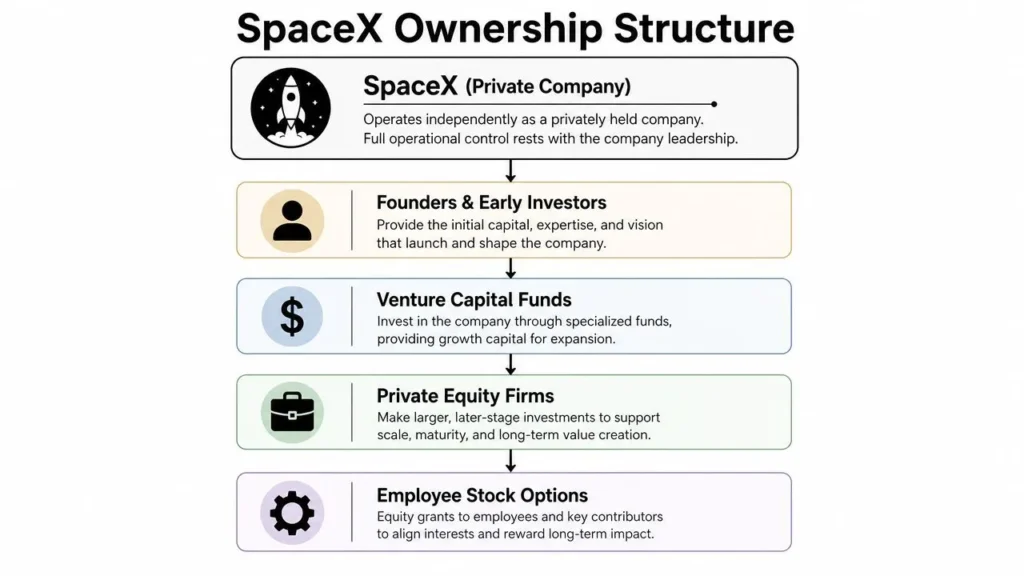
What private ownership actually means
A public company is like a city park. Anyone can enter, prices are visible, and the rules are standardized. A private company is closer to a members-only club. Ownership exists, value exists, and shares can change hands, but access is restricted and the gatekeepers matter.
For SpaceX, that means several things at once:
- No public ticker: There’s no continuous stock-market quote because the company isn’t listed.
- No open access: Most ordinary investors can’t buy shares on demand.
- No routine public filings: SpaceX doesn’t have the same ongoing disclosure burden as a listed corporation.
That last point often gets overlooked. Investors asking “is SpaceX publicly traded” usually think about availability. Analysts think about governance. Public companies live in a glass box. Private companies can keep more of their operational, financial, and strategic detail out of view.
Why the valuation can be huge without a stock price
People often confuse a private valuation with a public market capitalization. They’re related, but they’re not the same thing.
A public company’s value is refreshed all day by active trading. A private company’s value is inferred from negotiated transactions, tender offers, and secondary sales. That’s why a business can be described as enormously valuable and still have no stock chart in the usual sense.
SpaceX’s reported valuation reflects what private buyers and sellers appear willing to accept in limited transactions. It is not the same as a continuously traded market price.
If you want a useful primer on the capital pools that typically support companies before they list, this guide for entrepreneurs on funding options helps clarify how venture capital, private equity, and related funding paths differ.
Why ownership concentration matters
Private ownership doesn’t just keep the public out. It also keeps decision-making concentrated. That concentration can be uncomfortable to investors who prefer checks and balances. But for a founder-led company with a difficult technical mission, concentration can be a feature, not a bug.
SpaceX can raise money without turning every strategic choice into a public referendum. It can negotiate with a narrower set of experienced investors. And it can keep a tighter link between mission and control than most listed companies manage once their shareholder base becomes broad and noisy.
Why SpaceX Deliberately Avoids the Stock Market
The usual summary is that Elon Musk wants control. That’s true, but it’s incomplete. The more precise point is that control is operationally valuable when a company is pursuing a long-term, high-risk mission whose payoff may arrive unevenly.
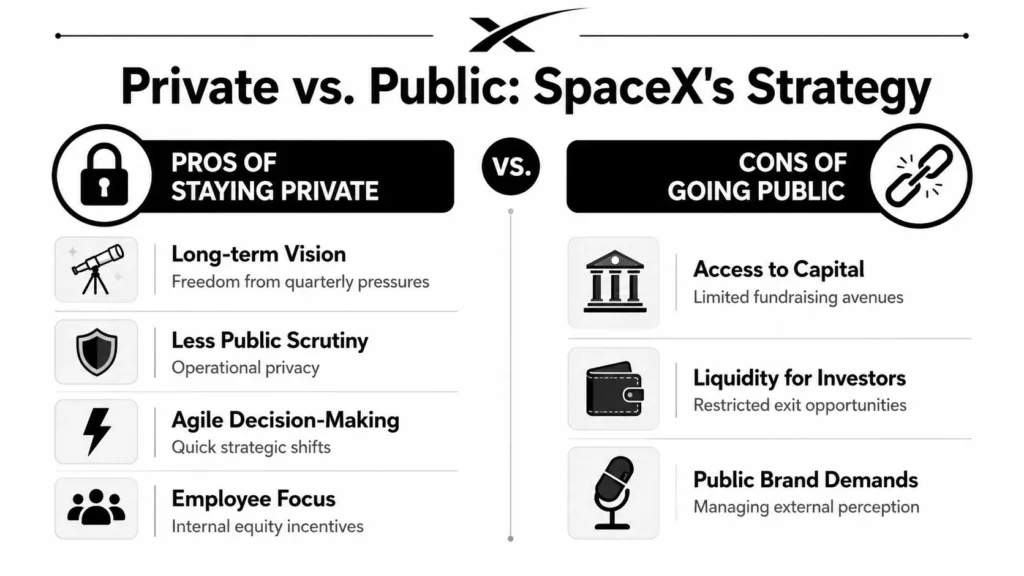
Public markets reward clarity. SpaceX often runs on uncertainty
Public investors usually tolerate risk when they can model it. They’re less patient with projects that combine engineering uncertainty, political dependency, long development cycles, and mission language that sounds more civilizational than commercial.
That’s the heart of the issue. SpaceX is building businesses, but it’s also building infrastructure for a broader ambition that Elon Musk has framed around the future of human settlement beyond Earth. A public board can approve bold spending. It has a harder time defending years of uneven progress if shareholders decide the company should optimize for nearer-term returns instead.
A listed SpaceX would face recurring pressure to explain not just what it built, but why each large bet deserves capital now rather than later. Investors would ask whether resources should favor more predictable operations over speculative ones. That tension is normal in public markets. It’s also exactly the kind of tension Musk appears to prefer avoiding.
Privacy protects strategic freedom
Private status gives leadership more room in several practical ways:
- Longer timelines: Management can pursue programs whose economic payoff is distant or hard to forecast.
- Less forced disclosure: Competitors, suppliers, and counterparties get a narrower window into internal priorities.
- Faster decisions: A concentrated ownership base can move without the theatre of public shareholder management.
- Mission consistency: Leadership can defend a vision that may look irrational if judged only through short-term profitability.
A Mars-focused company doesn’t just need capital. It needs permission to stay weird for a very long time.
This is also where macro conditions matter. When rates are high and inflation is sticky, public markets often become less forgiving of long-duration bets. That dynamic helps explain why some founder-led firms resist listing until they believe conditions support their story. For readers who want a broader market lens, this piece on interest rates and inflation gives useful context for how financing conditions shape investor behavior.
The hidden trade-off
There is a cost to staying private. Liquidity is tighter. Access is narrower. Price discovery is messier.
But SpaceX appears to have judged that those costs are smaller than the strategic cost of letting the public market sit in the cockpit. For a company trying to reinvent launch economics while keeping a far larger interplanetary mission alive, that isn’t just founder preference. It’s a governance model aligned with a difficult objective.
The Potential 2026 IPO and the Starlink Factor
The clearest sign that the public-trading question may be changing is that SpaceX was widely reported as preparing for an IPO in 2026, and one source states that it filed for an initial public offering on May 20, 2026, with plans to list on Nasdaq under the ticker SPCX, according to Wikipedia’s SpaceX entry. Even so, before any actual listing, market commentary still described SpaceX as private because a filing is only one stage in the process.
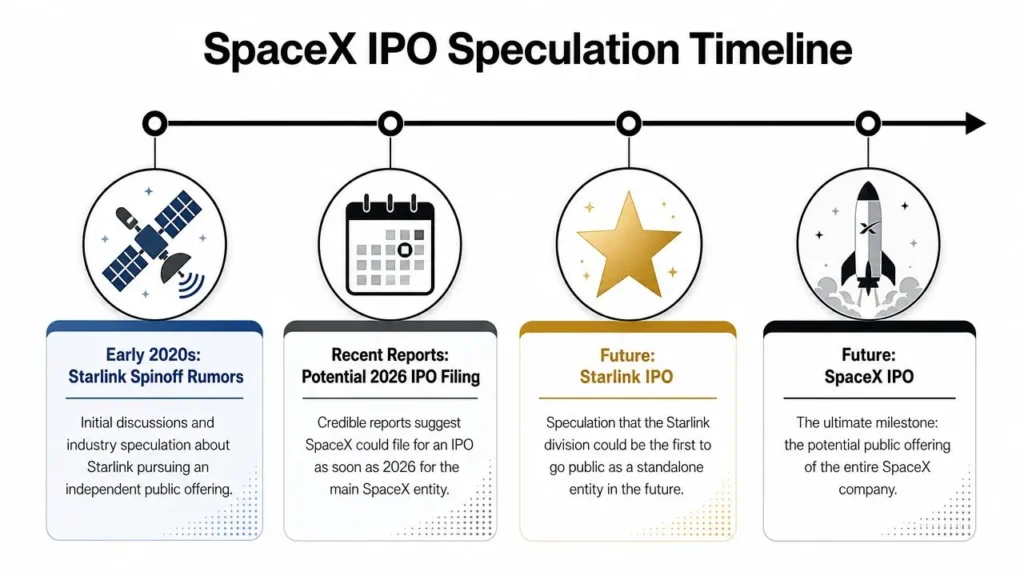
A filing is a threshold, not the finish line
Many headlines confuse readers. Filing for an IPO and becoming a publicly traded company are not the same event. The filing opens the formal path toward a listing. It doesn’t create immediately tradable shares for the public.
If you want a plain-English definition of that process, Finzer’s explanation of the Finance term Initial Public Offering is a useful reference.
Until an IPO is priced, approved, and listed, ordinary investors still can’t buy the shares on an exchange.
That distinction matters because it separates announcement risk from actual market access. A company can be “on the road” to public ownership while still functioning as a private security in practice.
A short explainer can help frame the investor conversation:
Why Starlink changes the logic
The most interesting strategic possibility isn’t only a full SpaceX IPO. It’s the idea that a more mature operating unit such as Starlink could become the public-facing vehicle for capital raising while the parent company preserves tighter control over the most speculative parts of the mission.
That structure would make sense. A connectivity business can often tell a simpler public-market story than a company trying to balance launch operations, deep-tech development, and a planet-scale long-term ambition. Public investors generally prefer businesses they can model with familiar frameworks.
A Starlink-focused offering, if it ever happened, would do something clever. It could let the market fund a commercially legible segment while shielding the broader mission from some of the scrutiny that comes with being fully public. It would separate the cash engine from the moonshot, even if both remain strategically linked.
What the filing really signals
The filing, if completed and advanced to a listing, wouldn’t just mark a financing event. It would mark a governance shift. SpaceX would be inviting a new audience into its story, including investors who care less about Mars and more about margins, disclosure, and execution cadence.
That is why the public-trading question matters so much. The issue isn’t only whether shares become available. It’s whether the company can absorb public ownership without diluting the very control structure that made its long-range mission possible.
For anyone following launch technology more broadly, it also helps to compare SpaceX’s ambitions with the performance race in modern rocketry, including what is the world’s fastest rocket.
How Investors Might Gain Exposure to SpaceX Today
For most readers, the practical answer is frustrating. If you’re asking whether you can buy SpaceX the same way you buy a public stock, the answer is still no. But there are limited paths for certain investors to seek exposure.

According to Nasdaq Private Market’s SpaceX company page, SpaceX is treated as a private security, trading generally requires accredited-investor status, shares may be bought through the company or secondary marketplaces, and there is no ticker symbol assigned. Nasdaq Private Market also notes that execution depends on counterparties, transfer restrictions, and company approval processes, which makes liquidity much lower than in public markets.
What access looks like in practice
Private investing is less like clicking “buy” and more like applying for entry.
A typical path can involve:
- Qualification first: The investor has to meet accredited-investor rules.
- Platform or broker access: The investor works through a private marketplace or specialist intermediary.
- Share availability: Someone on the other side has to be willing and allowed to sell.
- Company constraints: Transfer approvals or restrictions can affect whether a deal closes.
That’s why quoted private prices should be treated cautiously. A posted indication is not the same thing as deep, instant market liquidity.
Public vs. Private Investment at a Glance
| Feature | Publicly Traded Stock (e.g., Tesla) | Private SpaceX Shares |
|---|---|---|
| Access | Widely available through standard brokerages | Generally limited to accredited or institutional buyers |
| Ticker symbol | Yes | No |
| Pricing | Continuous exchange trading | Indicative and transaction-dependent |
| Liquidity | Usually much higher | Materially lower |
| Disclosure | Regular public filings | More limited company disclosure |
| Trade execution | Immediate in normal market conditions | Depends on counterparties and approvals |
What investors should keep in mind
- Barriers are real: SpaceX exposure through direct private shares isn’t built for ordinary retail investors.
- Liquidity can disappear: You may be able to buy, but selling isn’t guaranteed on your preferred timeline.
- Price transparency is weaker: A posted value can be informative without being actionable.
Practical rule: If you need daily liquidity, private-company shares are the wrong instrument.
For newer investors, it helps to understand the difference between public-market convenience and private-market friction before chasing a famous name. This beginner-friendly guide on how to start investing money gives a useful baseline for that distinction.
The larger point is simple. SpaceX may be one of the most discussed companies in finance and technology, but direct ownership still sits behind legal, structural, and logistical gates.
Common Misconceptions About SpaceX Stock
Is there a SpaceX stock ticker right now
No. As a private company, SpaceX doesn’t have a public-market ticker that ordinary investors can trade on an exchange.
If SpaceX has an IPO filing, doesn’t that mean it’s already public
No. A filing signals intent and starts a formal process. It does not by itself create exchange-traded shares. Public trading begins only after the offering is completed and the stock is listed.
Can I buy Tesla to get SpaceX exposure
No, not in any direct legal ownership sense. Tesla and SpaceX share Elon Musk as a central figure, but they are separate companies. Buying Tesla stock does not mean you own SpaceX equity.
If private marketplaces show a price, can I treat that like a stock quote
Not really. A private-market indication is closer to an asking conversation than a live public quote. The existence of a posted number doesn’t guarantee that you can transact at that level, in that size, on that timeline.
Does staying private mean SpaceX is avoiding accountability
Not exactly. It means the company is choosing a different accountability structure. Private investors, boards, counterparties, and regulators still matter. What changes is the audience and cadence. Public shareholders don’t get a daily seat at the table.
Why do people keep getting confused about whether SpaceX is publicly traded
Because SpaceX sits in an unusual category. It’s private, but it is discussed like a public giant. It has immense visibility, global operations, and constant speculation around an IPO. That combination makes people assume access exists when it often doesn’t.
The most useful takeaway is this: when you ask whether SpaceX is publicly traded, you’re not just asking about where to buy a stock. You’re asking how a company protects control while pursuing a mission that doesn’t fit neatly inside the incentives of the stock market.
If you like clear, evidence-based explainers on business, science, technology, and the ideas shaping modern industries, visit maxijournal.com for more approachable analysis and fresh commentary.
Discover more from Maxi Journal
Subscribe to get the latest posts sent to your email.