You’re probably doing what almost every thoughtful dog buyer does. You’ve seen the soft face, the round eyes, the cuddly coat, and the promise of a dog that’s affectionate, manageable, and easy to live with. A king charles spaniel mix often looks like the answer.
That appeal makes sense. The Cavalier side brings warmth and companionship. The other parent breed may add a lower-shedding coat, a different energy level, or a sturdier build. On paper, it can sound like the ideal combination.
But designer dogs aren’t recipes. They’re living combinations of genetics, health history, temperament, and breeder choices. If you want a dog you’ll share your life with for years, the cute photo matters less than the dog behind it.
The Allure of the Perfect Companion Dog
Many people start with the same wish list. They want a dog that’s small enough for everyday life, gentle with family, friendly with guests, and content to cuddle after a walk. That’s exactly why the Cavalier King Charles Spaniel has become so popular.
Its rise hasn’t been subtle. The breed climbed from 56th in the American Kennel Club rankings in 1998 to 14th in 2022, and that demand has helped fuel interest in mixes such as the Cavapoo, which has become one of Australia’s most sought-after breeds since appearing in the 1990s, according to this review of Cavalier crossbreeding history.
Why people fall for these mixes
A king charles spaniel mix often promises a very specific dream:
- Companion-focused temperament that stays close to people
- Convenient size for apartments, townhomes, or smaller yards
- A softer coat story if the other parent is a Poodle or similar breed
- A friendlier public image than some more intense working breeds
That’s a powerful package. For first-time owners, it can feel safer and easier than choosing a high-drive herding or sporting dog.
Still, there’s a point where many buyers get confused. They start looking at one mix name, then another, and soon every breeder page sounds the same. “Great with kids.” “Low-shedding.” “Sweet nature.” “Best of both breeds.” Those phrases aren’t always wrong, but they’re often incomplete.
A dog can be adorable, popular, and still be the wrong fit for your home.
Temperament also gets misunderstood. A sweet-looking puppy can still become clingy, vocal, chase-prone, or difficult to groom if those traits come through from one or both parents. If you’re still learning how dogs signal stress, excitement, or discomfort, it helps to get familiar with dog body language basics before you choose a breed mix that will depend on you to read it well.
The question worth asking first
Don’t ask only, “Which mix is cutest?”
Ask these instead:
- Why was this cross bred in the first place
- What health risks come from the Cavalier side
- What traits are predictable, and which aren’t
- Who bred this litter, and how carefully
Those questions matter more than the marketing name.
Understanding the Genetics of a Designer Dog
A king charles spaniel mix is often sold as a blend of the best parts of two breeds. Genetics doesn’t work that neatly. A better mental picture is mixing two paint colors. Sometimes you get a smooth new shade. Sometimes you get streaks. Sometimes one color dominates in unexpected places.

What hybrid vigor can and can’t do
You’ll often hear the phrase hybrid vigor. In plain language, that means crossing dogs from different genetic backgrounds can sometimes reduce the impact of concentrated inherited problems.
That idea became especially important with Cavaliers because the breed has a serious diversity problem. The Cavalier King Charles Spaniel has inbreeding rates that often exceed 25 to 40 percent, and that low diversity worsens inherited conditions such as mitral valve disease and Chiari-like malformation, as described by the Institute of Canine Biology’s review of the breed’s genetic status.
Crossbreeding can help. It does not erase risk.
A mixed puppy doesn’t magically become free of disease because it has a trendy name. It may inherit fewer problems, or different problems, or some of the same ones in milder or less predictable ways.
Why the Cavalier background matters so much
The Cavalier is central to many popular mixes because people love its personality. That part is understandable. The difficult truth is that the breed’s health burden is not a side issue. It’s part of the package.
When breeders cross a Cavalier with a Poodle, Cocker Spaniel, Havanese, or another breed, they aren’t just blending appearance and temperament. They are blending two genetic histories.
That means each puppy is a small genetic lottery involving things like:
- Heart risk from the Cavalier side
- Skull and brain structure concerns linked to Cavalier lines
- Coat type from either parent, or an in-between version
- Energy and trainability that may lean more strongly one way than expected
If you want a simple primer on how inherited traits are edited and expressed at the biological level, how CRISPR works offers a useful non-dog-specific way to think about genes as instructions rather than guarantees.
Practical rule: Choose a breeder who talks about family health history before color, fluffiness, or “teddy bear” looks.
The genetic lottery in daily life
Two puppies from the same litter can look and behave quite differently. One may have a curlier coat and brisker mind. Another may have the softer, more velcro-like temperament of the Cavalier. Both can be lovely dogs. Neither is more “authentic.”
That’s why responsible breeders talk in ranges and probabilities, not promises.
A Spectrum of Personalities and Appearances
There isn’t one standard king charles spaniel mix look. There isn’t one standard personality either. That surprises many buyers, especially if they’ve only seen polished breeder photos online.

What people expect and what actually happens
A common expectation goes like this. “I want the Cavalier’s sweetness with a low-shedding coat and no health issues.” That’s understandable. It just isn’t a guaranteed outcome.
A mix may inherit:
- a silky coat that mats easily
- a wavy coat that needs clipping
- a curlier coat that catches debris and tangles
- a moderate shedder’s coat that surprises allergy-prone owners
Temperament follows the same pattern. Some dogs become classic lap companions. Others are busier, more playful, or more vocal. A spaniel cross may be very social but still chase birds in the yard. A Poodle cross may be cuddly and also much quicker to notice every sound in the hallway.
Size and feel can vary a lot
Some mixes stay quite petite. Others are sturdier and more athletic.
A Cavalier parent usually contributes a soft expression, a people-focused nature, and an easy carry size. The second parent changes the outline. With a Cocker Spaniel, the result may feel more sporting. With a Havanese, the dog may feel lighter and more portable. With a Poodle, the frame and coat texture can shift a great deal.
That’s why it helps to meet both parents when possible. Photos of puppies don’t tell you how the adult dog will move, greet strangers, or settle in the home.
A better way to predict the puppy in front of you
Don’t focus only on the mix name. Focus on these real-world clues:
- Parent temperaments matter more than the label
- Coat maintenance should be discussed in detail, not vaguely
- Recovery from novelty tells you a lot about confidence
- Human interest should be balanced, not frantic or fearful
The best puppy for your home isn’t the one that photographs best. It’s the one whose temperament, body, and care needs match your daily life.
If you work long hours, a clingier puppy may struggle. If you dislike grooming, a curly coated mix may frustrate you. If you want a calm café companion, a higher-drive cross may disappoint you unless you enjoy training.
Profiles of Popular King Charles Spaniel Mixes
Names like Cavapoo and Cockalier can make these dogs sound standardized. They aren’t. Still, some broad patterns are useful if you’re comparing lifestyles, coat care, and day-to-day expectations.
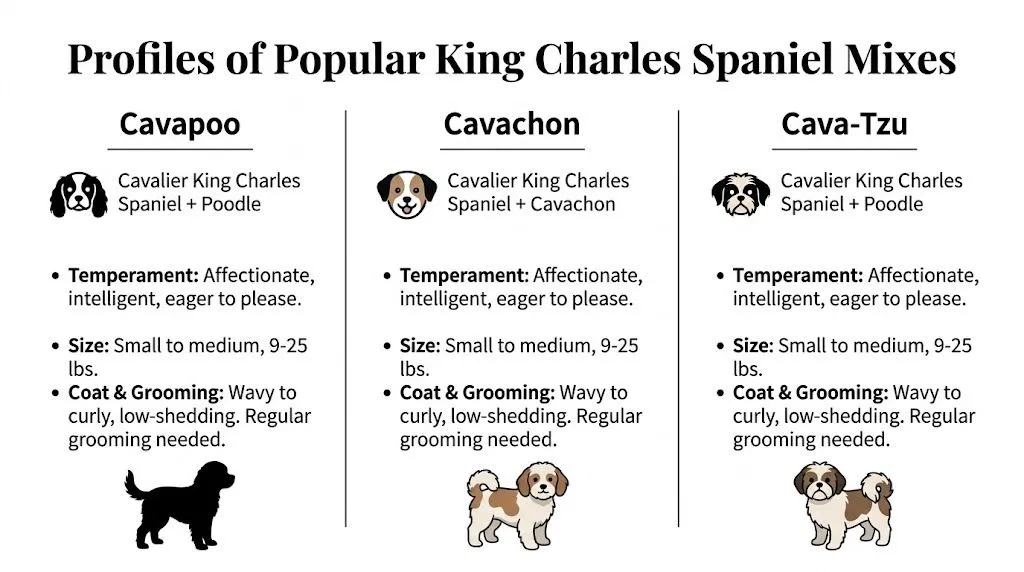
Quick comparison
| Mix Name | Parent Breeds | Avg. Size (lbs) | Grooming Needs | Energy Level |
|---|---|---|---|---|
| Cavapoo | Cavalier King Charles Spaniel × Poodle | Small to medium | Regular brushing and coat maintenance | Moderate |
| Cavachon | Cavalier King Charles Spaniel × Bichon Frise | Small | Frequent brushing, soft coat care | Moderate |
| Cockalier | Cocker Spaniel × Cavalier King Charles Spaniel | 18-25 | Feathered coat, bi-weekly brushing often helps | Moderate to active |
| Cavanese | Havanese × Cavalier King Charles Spaniel | Small | Regular brushing, coat varies | Moderate |
Cavapoo
The Cavapoo is probably the best known king charles spaniel mix. People often choose it because they want Cavalier softness with the Poodle’s coat traits and trainability.
The coat is the big draw, but it’s also where confusion starts. “Low-shedding” doesn’t mean “no grooming.” Many Cavapoos need steady brushing and regular clipping. If the coat grows in a soft, dense wave, mats can build quickly around the ears, chest, legs, and tail.
Behaviorally, these dogs often suit homes that want both affection and some engagement. They tend to enjoy learning and staying near people.
Cavachon
A Cavachon combines the Cavalier with a Bichon Frise. These dogs are often marketed as cheerful, compact companions with a plush look.
In real life, many are charming house dogs that enjoy routines and close contact with family. Their coats can be deceptively high maintenance because soft, fluffy textures trap tangles. People sometimes underestimate that because the dog appears naturally tidy.
A Cavachon may fit owners who want a smaller, social dog without quite as much busy intensity as some other small companion breeds.
Cockalier
The Cockalier often brings a more sporting feel. It combines the warmth of the Cavalier with the Cocker Spaniel’s stronger working heritage.
This is one of the few mixes in which we have a more concrete performance note from the provided data. Cockaliers are listed at 18 to 25 pounds, and they may show stronger trainability, outperforming pure Cavaliers by up to 25 percent in certain agility tasks, according to the hybrid overview cited here.
That doesn’t mean every Cockalier is a little athlete. It does mean many buyers should expect a dog that may want more structured activity than the typical lap-dog stereotype suggests.
Cavanese
The Cavanese combines a Havanese with a Cavalier. In many homes, this mix appeals to people who want a sociable small dog that can adapt well to family life.
The same source notes that crossbreeding in some well-socialized mixes can reduce separation anxiety from 30 percent in some pure CKCS lines to as low as 10 percent, and it specifically describes the Cavanese as a mix that may adapt well to apartment living when its social and play needs are met through interaction and puzzle toys in the home.
If a breeder says a mix is “perfect for everyone,” treat that as a warning sign. Good breeders describe tradeoffs.
Which homes tend to match best
- Apartment owners often do well with dogs that settle nicely indoors and don’t need heavy sporting outlets.
- Active households may prefer a Cockalier or a more energetic Cavapoo.
- People who dislike grooming should think carefully before choosing any fluffy or curly coated mix.
- First-time owners usually benefit most from calm parent dogs and a breeder who matches puppies thoughtfully instead of letting buyers pick by color.
Inherited Health and Lifespan Realities
Many buyers assume a mixed dog is automatically healthier than a purebred. Sometimes that’s partly true. Sometimes it isn’t.
The honest answer is more nuanced. A king charles spaniel mix may gain benefits from broader genetic input, but it can still inherit major problems from the Cavalier side, the other parent breed, or both.
The two health conversations you need to have
With Cavalier-based mixes, the first conversation is about the Cavalier’s known inherited burden. The second is about the partner breed’s inherited issues.
For the Cavalier side, the most concerning topics usually include:
- Mitral valve disease, a serious heart problem strongly associated with the breed
- Chiari-like malformation, which relates to skull shape and can contribute to neurologic suffering
- Eye issues and orthopedic concerns, depending on the line
A mixed puppy may have lower risk than a poorly bred pure Cavalier. It may also inherit enough liability that health testing still matters enormously.
Why “healthier because mixed” is too simple
If one parent carries a heart disease risk and the other parent carries a different inherited weakness, the puppy doesn’t get a free pass. It gets a combination of possibilities.
That’s why I encourage buyers to replace hope with documentation. A breeder should be able to explain what they tested, why they tested it, and what the family history looks like. If they can only talk about temperament and coat color, they are not doing the hard part of breeding.
Ask these questions directly
- What health screening was done on the Cavalier parent?
- What screening was done on the other parent breed?
- Have close relatives shown early heart disease or neurologic signs?
- Can I see records rather than summaries?
- If this puppy develops a serious inherited issue, what support do you offer?
A responsible breeder welcomes health questions. An irresponsible one treats them like an annoyance.
Lifespan needs context
Some popular mixes may have a longer expected lifespan than the pure Cavalier, especially when the cross reduces the concentration of breed-specific risk. But lifespan isn’t just about genes. It also depends on body condition, dental care, exercise, early diagnosis, and whether the dog came from a carefully bred background at all.
In such cases, buyers often get misled by marketing. A healthy-looking puppy can still come from a line with preventable inherited suffering. A mixed coat and cute name don’t protect the heart or nervous system.
Daily Grooming Diet and Exercise Needs
Daily care with a king charles spaniel mix depends less on the mix name than on the actual dog in front of you. Coat texture, appetite, stamina, and stress tolerance all matter.
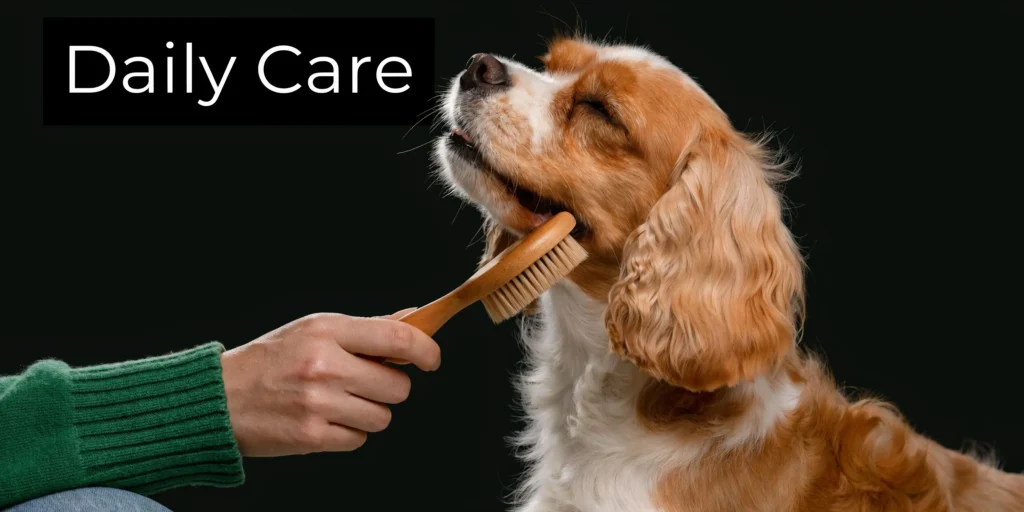
Grooming that matches the coat you got
A silky spaniel coat needs one kind of care. A curly or wavy coat needs another.
Brush the dog you have, not the dog you hoped for.
- Silky coats often need frequent brushing around ears, feathering, and tail.
- Wavy coats can hide mats close to the skin.
- Curly coats may need regular clipping plus line brushing at home.
If you miss even a week or two with a dense soft coat, tangles can tighten fast. That’s why a grooming budget matters before you bring the puppy home.
Food and body condition
These dogs are often talented at asking for snacks. Don’t let charm shape the feeding plan.
Choose a complete diet, monitor stool quality, watch body condition, and keep treats under control. If you’re comparing commercial options, vet-recommended dog food brands can give you a practical starting point for discussing choices with your veterinarian.
A lean dog usually moves better, breathes easier, and places less strain on joints and heart. That matters throughout life.
Exercise and mental work
Some king charles spaniel mix dogs are happy with walks, sniffing time, and gentle play. Others need more training games, retrieval, scent work, or problem-solving.
A simple daily rhythm often works best:
- a morning walk
- short play or training in the afternoon
- a calmer evening outing or enrichment activity
Here’s a practical visual guide that can help you think about home care habits and handling.
Watch for mismatch early
If your dog starts chewing, pacing, barking, or shadowing you constantly, don’t assume it’s “bad behavior.” It may be under-exercised, over-tired, under-trained, or overwhelmed.
The best routine is the one that the dog can settle after. A calm dog isn’t a dog that’s done nothing. It’s a dog whose physical and social needs were met well enough to rest.
How to Find Your Companion Ethically
This is the part many cute breed roundups skip. The popularity of Cavalier-based dogs creates a strong incentive for careless breeding.
The purebred Cavalier has been heavily targeted by puppy farmers and irresponsible breeders focused on profit, often neglecting health and welfare, and that same exploitation creates clear risk for popular mixes, as noted in this warning about sourcing Cavaliers responsibly.
Red flags that should stop you
Walk away if you see any of these:
- No health records and only verbal reassurance
- Multiple litters always available
- Reluctance to show where the dogs live
- Pressure to send a deposit quickly
- Focus on rare colors or coat styles over health
- No questions for you about your home or schedule
A good breeder screens buyers. They don’t just sell puppies.
Green flags that matter more than marketing
Look for breeders or rescues that do the less glamorous work well.
- Transparent records for parent health testing
- Clear explanations of strengths and risks in the cross
- Puppies raised in a lived-in environment, not hidden from visitors
- Lifetime responsibility, including taking the dog back if needed
- Temperament matching, not first-come first-served picking
Adoption is also worth serious consideration. Breed-specific rescue groups and small-dog rescues sometimes have Cavalier mixes whose personalities are already easier to assess than those of very young puppies.
Think beyond the purchase
The cost of a dog doesn’t end when you bring it home. Budget for grooming, routine veterinary care, training classes, dental care, insurance if you choose it, and treatment if inherited problems appear later.
That financial planning is part of ethical ownership. If a breeder sells a puppy cheaply but can’t prove health work, the “deal” may become expensive in every way that matters.
The right dog comes from the right source, not the fastest source.
When you slow down, ask harder questions, and prioritize health and welfare over trendiness, you give yourself the best chance of bringing home a good companion.
If you enjoy practical, clear-eyed guides like this one, visit maxijournal.com for more approachable writing on pets, health, science, and everyday decisions that deserve better information.
Discover more from Maxi Journal
Subscribe to get the latest posts sent to your email.