The most popular advice on raw feeding is also the least useful. One side says raw food is the natural answer to almost every canine problem. The other says it’s too risky to consider at all.
Most owners don’t need another argument. They need a way to decide what makes sense for their own dog, kitchen, budget, and family.
That’s where the raw diet debate becomes more practical. Raw diet for dogs benefits are real in some areas, especially digestibility and stool quality, but the risks are real too, especially food safety and diet balance. The right question isn’t “Is raw good or bad?” It’s “What are the likely gains, what are the likely hazards, and can I manage them responsibly?”
Navigating the Raw Food Debate
Raw feeding attracts strong opinions because people often judge it by philosophy first and details second. Some owners like the idea of feeding a dog in a more ancestral, less processed way. Some veterinarians focus first on contamination risk and nutritional mistakes. Both concerns make sense.
The problem starts when either side becomes absolute. A raw diet isn’t automatically superior because it’s less processed. Kibble isn’t automatically inferior because it’s processed. Dogs do well on many feeding approaches when the food is complete, the dog tolerates it well, and the owner can follow through consistently.
Why owners get confused
A lot of raw-feeding content mixes together three very different ideas:
- Fresh food means ingredients that are less processed.
- Homemade food means the owner prepares the meals.
- Raw food means the food is uncooked.
Those aren’t interchangeable. A carefully formulated fresh-cooked diet is not the same as a raw diet. A homemade diet isn’t automatically balanced. A raw diet can be balanced, but only if someone designed it that way.
Bottom line: A good diet is one that is nutritionally complete, safe to handle, and realistic for the household that has to prepare it every day.
A better way to assess raw feeding
When I talk to concerned owners, I usually narrow the decision to three questions:
| Question | Why it matters |
|---|---|
| Can your dog benefit from a diet change? | Some dogs with ongoing stool issues or poor appetite may respond noticeably to a different food format. |
| Can your household manage the safety demands? | Raw food changes your cleaning routine, storage habits, and handling standards. |
| Can you keep the diet balanced long term? | A diet that looks good in a bowl can still be deficient over time. |
That’s the lens worth using. Not hype. Not fear. Just a sober look at what feeding raw involves.
What a Raw Dog Food Diet Actually Is
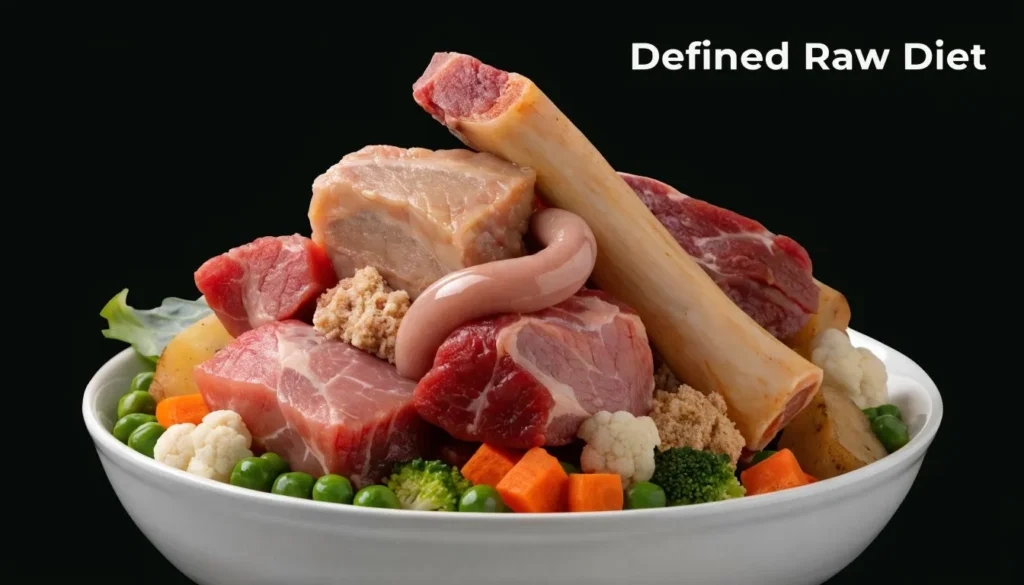
A raw diet is more than a tray of uncooked meat. If it’s done properly, it’s a full feeding plan built to provide protein, fat, minerals, vitamins, and enough variety to avoid obvious gaps.
The basic building blocks
Think of a raw diet like assembling a balanced plate. Each part has a job.
- Muscle meat provides most of the protein and a large share of the calories.
- Organs add concentrated nutrients. Liver is the classic example owners hear about first.
- Raw edible bone contributes minerals, especially calcium and phosphorus.
- Optional plant ingredients may appear in some plans, usually in small amounts.
What it shouldn’t be is random supermarket meat tossed into a bowl. That may be raw, but it isn’t a complete feeding strategy.
Two common raw-feeding models
Owners often run into two labels.
BARF
BARF usually stands for biologically appropriate raw food or bones and raw food, depending on who’s using the term. This model often includes animal ingredients plus some fruits or vegetables. The idea is to mimic a whole-food pattern rather than just feeding meat alone.
PMR
PMR, or prey model raw, leans more heavily on animal parts and tries to imitate the rough composition of prey. In practice, many owners use a modified version rather than a strict one.
Neither label guarantees quality. A BARF plan can be thoughtfully balanced or poorly designed. A PMR plan can be carefully built or nutritionally shaky. The label tells you the philosophy, not whether the bowl is complete.
Feeding raw scraps is not the same as feeding a formulated raw diet.
What a complete raw plan tries to accomplish
A sound raw plan should answer practical questions, not just ideological ones:
- What provides the calcium?
- How are organ meats used without overdoing them?
- Who verified that the diet covers essential nutrients?
- Is the food a commercial complete product or a DIY recipe from a veterinary nutrition professional?
That’s the key distinction many owners miss. Raw feeding isn’t one thing. It ranges from carefully prepared commercial formulas to improvised meals that can create problems over time.
The Evidence on Raw Diet Benefits
If you strip away the hype, the best-supported benefits of raw feeding are fairly specific. Research has not shown that raw diets reliably improve every aspect of health. What studies do suggest is that some dogs digest certain raw diets very efficiently, and owners may notice practical changes such as stool quality and chewing-related dental effects.
That narrower view is useful for decision-making. If you are weighing raw feeding for your own dog, the question is less “Is raw better?” and more “Which benefits are realistic for my dog, and are they worth the trade-offs in my home?”
Digestibility has the strongest direct support
A 2025 review of raw meat-based diets in dogs summarized feeding trials in which raw diets showed higher apparent digestibility than some dry extruded diets. In one comparison, a raw beef diet increased apparent digestibility of dry matter to 93.8% versus 79.6%, protein digestibility to 99.3% versus 79.5%, and fat digestibility to 99.6% versus 91.0%. The same review described another study in which the food digestibility coefficient was 95.7% after switching from an extruded dry diet to a raw meat diet, compared with 57.1% before the switch.
Digestibility matters, but it is easy to overread it. A diet can be highly digestible and still be inappropriate for a given dog if it is unbalanced, too rich, or impractical for the household. Digestibility is one piece of the puzzle, not the whole picture.
Stool changes are common, and they make sense biologically
Owners often notice the litter-box version of nutrition science first. Less indigestible material going in can mean less waste coming out. Some small studies summarized in a Frontiers in Veterinary Science review of raw meat-based diets reported smaller, firmer stools and shifts in the gut microbiome in raw-fed dogs.
Those findings are interesting, but they need context. A different microbiome is not automatically a healthier one, and smaller studies can only tell us so much. The fairest conclusion is practical. Some dogs on raw diets produce smaller, firmer stools, but that does not prove broad health superiority.
Dental claims are partly plausible, but often overstated
Dental benefits are one of the most repeated raw-feeding claims. The plausible part is mechanical. Chewing certain raw meaty items can scrape some material from the tooth surface, much like a textured chew can. The weak part is the leap from “more chewing” to “raw diets protect dental health.”
The 2025 review noted owner-reported improvements in dental cleanliness in survey data, but owner surveys are a low level of evidence. They reflect observation, not controlled proof. Raw bones also introduce their own risks, including tooth fractures and gastrointestinal injury, so “better teeth” is not a free benefit.
If your main goal is oral health, compare raw feeding against proven tools such as brushing, veterinary dental care, and accepted dental chews. If your question is specifically about whether dogs can eat raw chicken safely, the answer depends as much on safe handling and the individual dog as it does on any hoped-for benefit.
A practical way to sort stronger claims from weaker ones
| Claim | What the evidence currently supports |
|---|---|
| Improved digestibility | Supported by measured comparisons in some feeding studies |
| Smaller, firmer stools | Supported by limited short-term studies and consistent owner observation |
| Cleaner teeth | Plausible in some cases, but supported mainly by owner report and chewing mechanics, not strong clinical proof |
| Better immunity, behavior, longevity, or whole-body health | Not established |
A useful way to judge raw feeding is to focus on outcomes you can monitor. Body condition. Stool quality. Appetite. Skin and coat. Tolerance of the diet. Bloodwork when your veterinarian recommends it.
That approach keeps the discussion grounded. Raw diets may offer real benefits for some dogs, but the evidence supports a modest, specific set of advantages rather than a cure-all.
Understanding the Real Risks and Nutritional Pitfalls
The easiest mistake in this debate is treating safety concerns as overblown. They aren’t. Raw feeding can be done carefully, but it comes with two fundamental challenges. Pathogen exposure and nutritional balance.
The household risk is not just about the dog
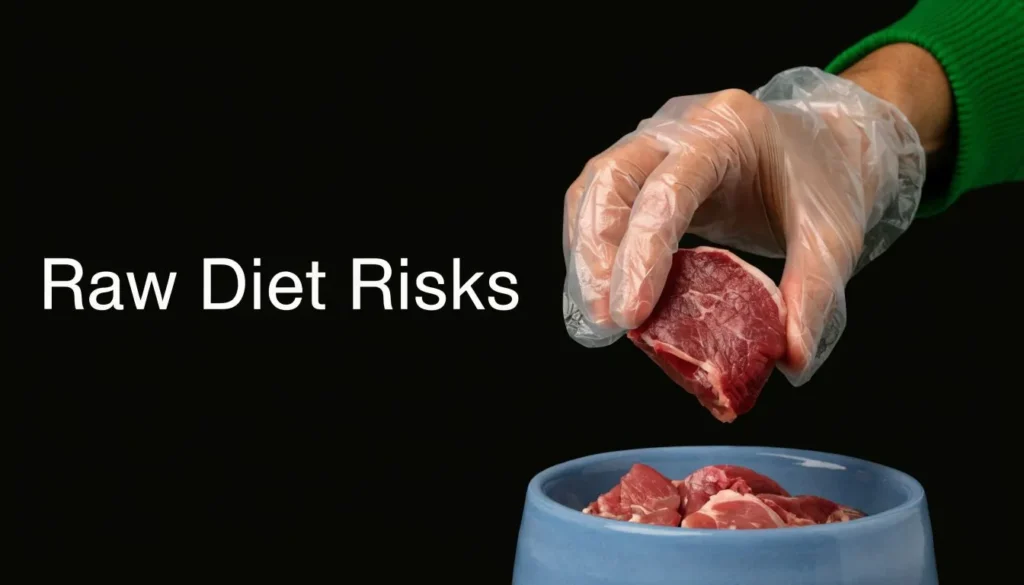
A dog may handle bacterial exposure better than a person in the home, but that doesn’t make the food safe by default. A Canadian veterinary association raw food handout warns that up to 50% of dogs on raw diets may shed salmonella in their feces.
That changes the conversation. The risk isn’t limited to what’s in the bowl. It extends to saliva after meals, stool in the yard, food bowls in the sink, and hands that touched thawed meat.
The highest-risk homes include:
- Young children who touch floors, bowls, and dogs without reliable handwashing
- Older adults who may be more vulnerable to infection
- Immunocompromised people whose risk tolerance has to be much lower
- Busy households where careful cleanup is unlikely to happen every time
If you’re weighing whether dogs can eat raw chicken safely, this is the practical issue to start with. The question isn’t only what the dog can digest. It’s what the household can safely manage.
Nutritional mistakes are quieter but just as serious
Bacteria get the headlines because they feel immediate. Imbalance is often slower and easier to miss.
A homemade raw plan has to provide the right broad nutrient profile over time. Owners often focus on meat quality and forget that balance depends on the whole formula, not on one appealing ingredient. Raw edible bone, organ use, and overall formulation matter a lot. If those pieces are off, the dog can look fine for a while before problems become obvious.
Practical rule: If a DIY raw diet wasn’t formulated by someone trained in veterinary nutrition, assume it may have gaps until proven otherwise.
Hype versus real-world responsibility
The common pro-raw message is that “natural” equals safe. In real life, natural foods can still carry pathogens, and natural-looking meals can still be incomplete.
That doesn’t mean every raw diet is reckless. It means the owner has to take on a level of food-handling and planning that many people underestimate.
Comparing Dog Food Philosophies Raw vs Kibble
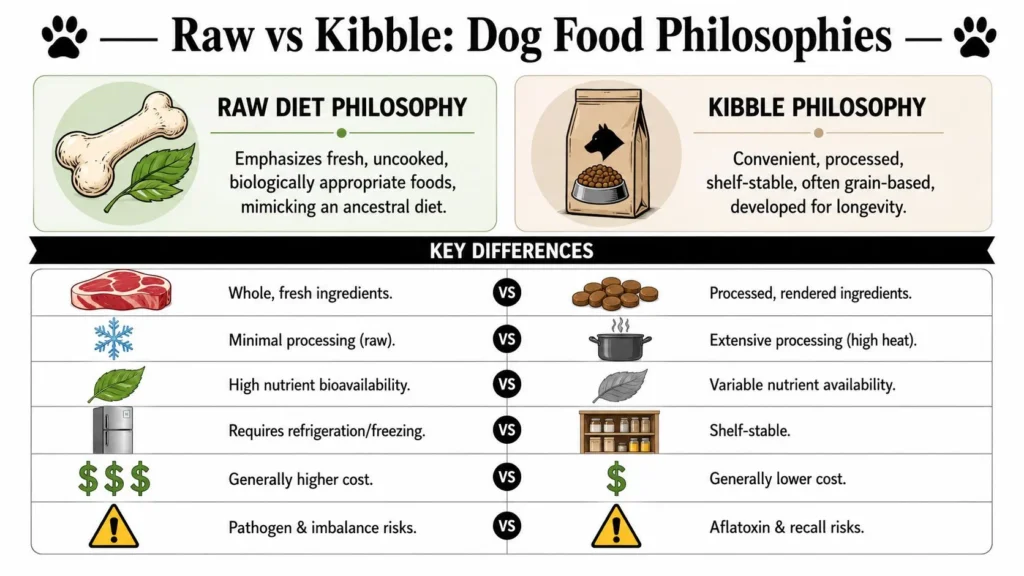
The raw versus kibble debate usually gets framed as ingredient quality versus processing. That’s part of the picture, but not the whole thing. What owners are really choosing between are different feeding philosophies.
What each approach is trying to optimize
Raw feeding usually prioritizes minimal processing and whole-food ingredients. Kibble prioritizes convenience, shelf stability, and standardized formulation. Fresh-cooked diets often sit in the middle. They aim for less processing than kibble without the microbiological risk of uncooked meat.
Here’s the practical comparison:
| Feeding style | Main strength | Main tradeoff |
|---|---|---|
| Raw | Minimal processing and strong owner control over ingredients | Higher food-safety burden and greater risk of imbalance if DIY |
| Kibble | Convenience and ease of storage | More processing and less resemblance to whole-food feeding |
| Fresh-cooked | Whole-food feel with cooking-based risk reduction | Still requires good formulation and usually costs more than kibble |
What the longevity discussion really says
A commonly cited long-term comparison followed 522 dogs for five years and reported that diet was the most important determinant of life expectancy. In that comparison, dogs eating homemade food made with fresh ingredients lived more than 32 months longer than dogs fed industrially produced canned food, as discussed in this review of the historical lifespan finding.
That’s an interesting signal, but it shouldn’t be stretched too far. The comparison involved homemade food with fresh ingredients, not proof that every raw diet is superior to every kibble or canned diet. It does support a narrower idea. Less processed feeding may have advantages in some contexts.
Which philosophy fits which owner
The debate gets easier.
- Choose raw if you value minimal processing, you’re comfortable handling raw meat, and you’re willing to verify diet balance carefully.
- Choose kibble if you need consistency, speed, simple storage, and lower day-to-day preparation demands. If you’re reviewing vet-recommended dog food brands, completeness and practicality are often the main priorities.
- Choose fresh-cooked if you like whole ingredients but don’t want the same pathogen burden that comes with raw handling.
No single philosophy wins on every category. The best one is the one you can execute safely and consistently.
How to Implement a Raw Diet Safely
A safe raw diet starts long before the first meal hits the bowl. The hard part is not buying meat. It is building a plan that stays balanced, hygienic, and realistic on an ordinary Tuesday when you are busy and tired.
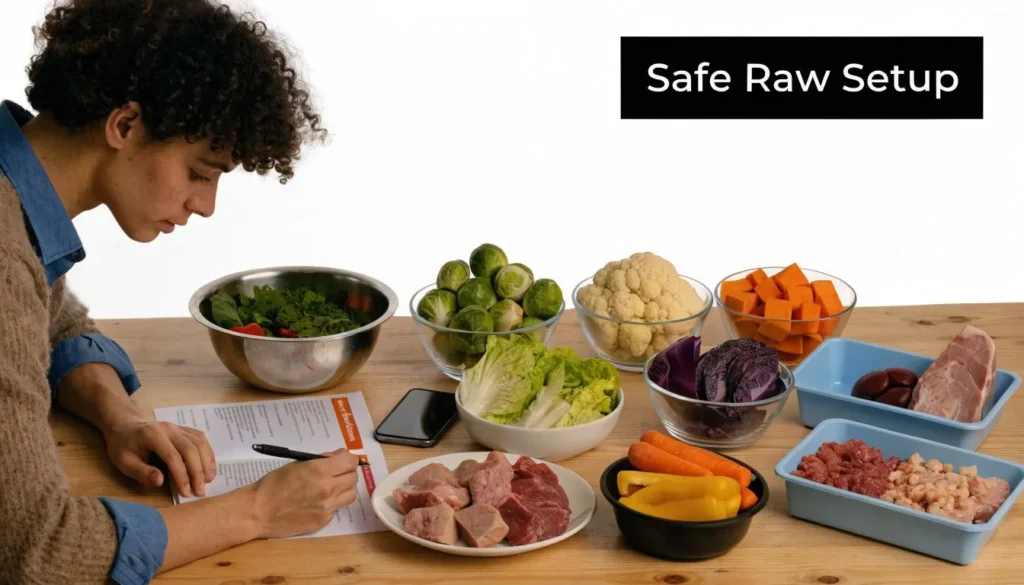
Start with the right kind of help
Begin with your veterinarian. If your dog is a puppy, senior, pregnant, underweight, or dealing with kidney disease, pancreatitis, allergies, or chronic digestive trouble, ask whether a board-certified veterinary nutritionist should design the diet.
This step matters because raw feeding has less room for guesswork than many owners expect. A bowl can look wholesome and still miss calcium, trace minerals, or the right organ-to-muscle-meat balance. Raw recipes work like home-built formulas. If one part is off, the problem may stay hidden for months before it shows up in stool quality, body condition, or lab work.
For many households, a complete commercial raw diet is simpler than homemade raw. Homemade can be done well, but only if the recipe is professionally formulated and followed closely. Swapping ingredients casually can change the nutrient profile more than it seems. Even common add-ins need context. Foods that sound healthy for people are not automatically useful or safe for dogs, which is why practical ingredient references such as this guide on whether dogs can eat potatoes are best used alongside veterinary instructions, not instead of them.
Transition slowly and watch the dog in front of you
Even a healthy dog may need time to adjust to a new food. The goal is not to prove your dog is enthusiastic. The goal is to see whether the diet is tolerated.
A gradual transition gives you a clearer read on what is happening. If stool becomes loose, your dog vomits, starts licking paws, or seems uncomfortable after meals, you can identify the likely trigger more easily when the diet change has been controlled.
A practical transition usually looks like this:
- Choose the diet first. Confirm that the recipe or product is complete and appropriate before buying in bulk.
- Start with one formula or one protein. Variety is useful later. At the beginning, it can hide problems.
- Increase the new food in stages. Watch stool quality, appetite, energy, and any skin or ear changes.
- Slow down if signs appear. Diarrhea, vomiting, constipation, or refusal to eat means the pace may be too fast, or the diet may not be a good fit.
- Keep extras boring. New treats, table scraps, and chews make it harder to judge the main food.
Some dogs switch easily. Others do better with a slower timeline. That does not prove the diet is good or bad. It just means the digestive system, like any other body system, has its own tolerance for change.
This walkthrough can help owners visualize the process:
Safe handling is part of feeding, not an optional extra
Raw feeding also creates a food safety job for the owner. The bowl is only one part of the system. Your fridge, counter, sink, hands, dog’s saliva, and the stool in the yard are all part of it too.
Use the same caution you would use with raw chicken for your family. Keep food frozen or refrigerated as directed. Thaw it in a controlled way, not on the counter. Wash bowls, utensils, prep surfaces, and hands after contact. Clean up leftovers promptly. Pick up stool quickly, especially if children share the yard or your dog visits public spaces.
Be honest about your routine. If careful storage and cleanup are likely to slip on busy days, that is not a minor detail. It is part of deciding whether raw feeding fits your home. A diet is only as safe as the habits that surround it.
Final Verdict Is a Raw Diet Right for Your Dog
A raw diet can make sense for some dogs and some homes. It isn’t a universal upgrade, and it isn’t automatically a bad idea either. The quality of the decision depends on how objectively you weigh the likely benefits against the demands.
If you want a simple decision filter, use this checklist:
- Your dog’s health: Does your dog have digestive sensitivity, a complex medical condition, or a history that makes diet changes risky?
- Your household: Are there children, older adults, or immunocompromised people in close contact with the dog?
- Your habits: Will you really follow careful thawing, cleanup, bowl washing, and stool hygiene every day?
- Your budget and time: Can you afford the food and the extra preparation without cutting corners later?
- Your formulation plan: Are you using a complete commercial raw product or a professionally designed recipe?
If several of those answers are shaky, a fresh-cooked or well-chosen commercial diet may be a better fit. If the answers are solid, and your veterinarian agrees the diet is appropriate, raw feeding may be a reasonable option to trial and monitor.
The most sensible goal isn’t to join a feeding camp. It’s to choose a diet your dog can tolerate, your family can handle safely, and you can maintain without guesswork.
If you want more plain-English pet nutrition explainers, practical feeding comparisons, and everyday health articles, visit maxijournal.com. It’s an independent online magazine that publishes approachable content across pets, health, science, and other reader-friendly topics.
Discover more from Maxi Journal
Subscribe to get the latest posts sent to your email.