You’re standing in the sunscreen aisle, holding two bottles that look almost identical. One says SPF 30. The other says SPF 50. Then you spot SPF 100 nearby, and suddenly the simple task of protecting your skin feels weirdly mathematical.
That confusion is normal. Sunscreen labels look straightforward, but they hide a lot of nuance. Many people assume the highest number must always be the smartest choice, even though the bigger story is about broad-spectrum coverage, enough product, and reapplying on time.
If you’ve been trying to make more health-conscious sun cream choices, SPF 50 is a useful place to pause and learn. It sits in the middle of a common consumer tension. It’s higher than the minimum many people use daily, but it also exposes an important truth: after a certain point, chasing bigger SPF numbers gives you smaller gains.
Understanding SPF 50 Sunscreen
A good way to think about 50 SPF sunscreen is to picture a long summer Saturday. You put sunscreen on before a beach walk, sit outside for lunch, then head home feeling confident because the bottle had a high number on it. Later, your shoulders are pink anyway, and you’re left wondering whether SPF 50 failed or whether sunscreen is harder to use correctly than labels suggest.
Usually, it’s the second one.
SPF 50 stands out because people read it as “strong protection,” and in many situations that’s fair. It’s commonly recommended for longer outdoor exposure. But the number alone doesn’t tell the whole story. A sunscreen can have a high SPF and still disappoint if you use too little, skip reapplication, or choose one that doesn’t protect broadly across the UV range.
Why people fixate on the number
Most shoppers want one easy shortcut. The SPF number looks like that shortcut. Bigger number, better protection. That’s the logic.
But sunscreen doesn’t work like a phone battery where a larger number automatically gives a dramatically longer result in real life. It works more like a carefully built shield. The shield only performs as expected if you apply enough of it, spread it evenly, and refresh it after time, sweat, or water exposure.
Practical rule: SPF 50 matters, but the label only helps if your habits match the label.
Why SPF 50 is worth learning about
SPF 50 sits at a useful educational sweet spot. It’s high enough to be relevant for beach days, hikes, sports, and family outings. It’s also the point where the idea of diminishing returns becomes very clear.
That’s why this topic matters. Once you understand SPF 50, you stop shopping by number alone and start looking for what provides effective skin protection.
How SPF Ratings Work Science and Protection Percentage
SPF stands for Sun Protection Factor, and the number is tied to protection against UVB rays, the rays most associated with sunburn. The number also refers to a theoretical time multiplier. According to Coppertone’s SPF explainer, SPF 50 blocks about 98% of UVB rays, compared with 96.7% for SPF 30, and the SPF value indicates the theoretical amount of time a person can stay in the sun before burning compared with bare skin. In that model, SPF 50 means 50 times longer than unprotected skin, assuming correct application and no breakdown from sweat or water.
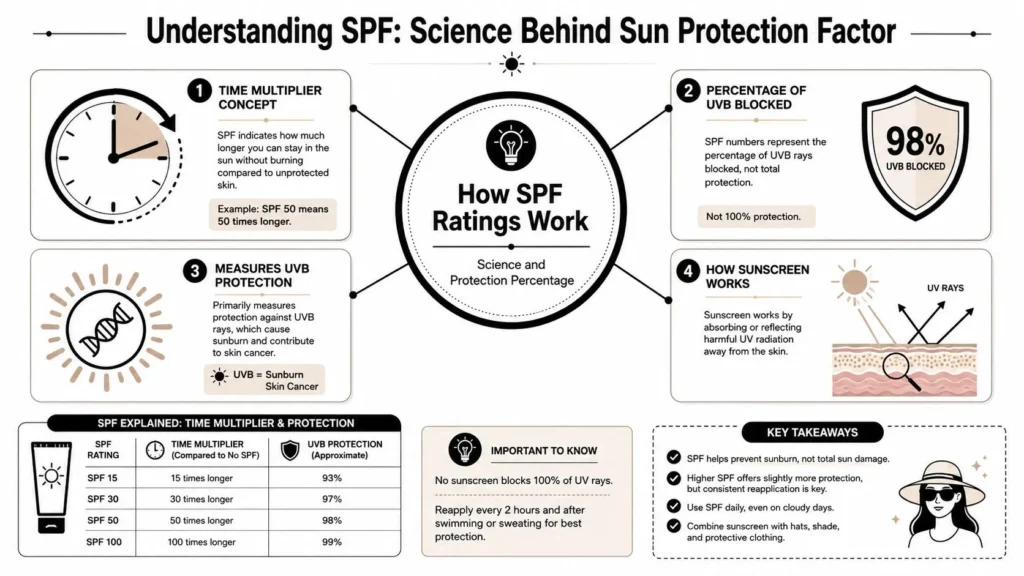
That “50 times longer” part is where readers often get tripped up. It doesn’t mean you can apply sunscreen once in the morning and forget about it. It’s a lab-based estimate, not a promise for a sweaty hike, a windy beach, or a humid commute.
Think of SPF like a filter, not armor
A simple analogy helps. Imagine sunlight passing through a screen door.
- No sunscreen: the door is wide open.
- SPF 30: most UVB is filtered out.
- SPF 50: a little more gets filtered.
- SPF 100: even more is filtered, but the gap between 50 and 100 is small.
The same source notes that SPF 100 blocks 99% of UVB rays, which shows why protection rises in a curve rather than a straight line. You get more protection as SPF goes up, but each jump buys less extra filtering than people expect.
What changes in real life
Real-world sunscreen use is messier than lab testing.
Three reasons protection drops
Too little product
Sunscreen is frequently applied too thinly. This lowers the level of protection you receive.Sweat and water
Even good formulas don’t stay perfectly intact through swimming, exercise, or heat.Time in the sun
Sunscreen films wear down. Rubbing your face, toweling off, and general movement all matter.
Sunscreen labels describe tested protection under controlled conditions. Your skin lives in uncontrolled ones.
The same Coppertone reference also notes that major health groups recommend at least SPF 30 for daily use, while the Skin Cancer Foundation recommends SPF 50 or higher for extended outdoor activity. That makes SPF 50 useful not because it’s magical, but because it gives a stronger buffer when real life gets imperfect.
Comparing SPF 50 to Lower SPFs Protection Differences
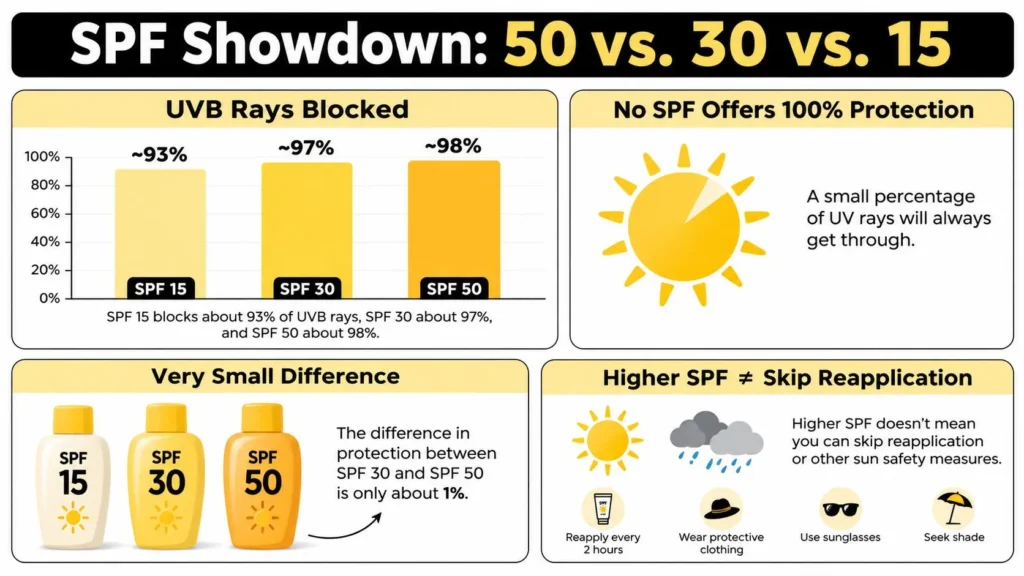
The most eye-opening part of sunscreen science is how small the numerical gaps can be once you move above basic protection levels. According to Standard Procedure’s broad-spectrum SPF discussion, SPF 50 blocks about 98% of UVB radiation, while SPF 30 blocks about 97%, and the difference is only about 1% in filtration. That’s a real difference, but it’s not the dramatic leap many shoppers imagine.
Side-by-side view
| SPF level | UVB blocked |
|---|---|
| SPF 15 | about 93% |
| SPF 30 | about 97% |
| SPF 50 | about 98% |
This is why I tell beginners to stop thinking in terms of “double the SPF means double the protection.” It doesn’t.
So why choose SPF 50 at all
Because that extra margin can still matter.
If you burn easily, take medications that increase photosensitivity, spend long stretches outdoors, or live somewhere with intense UV conditions, a smaller gain in filtration can still be meaningful. SPF 50 also gives you more room for human error. And humans are very error-prone with sunscreen.
What this comparison should change in your shopping habits
- Don’t assume SPF 100 is a giant upgrade. The gains get smaller as numbers rise.
- Don’t dismiss SPF 50 either. A small increase can still be useful in higher-risk situations.
- Don’t judge a bottle by the SPF alone. UVA protection still requires a separate check.
That last point is the one many shoppers miss. SPF tells you about UVB performance. It does not, by itself, tell you how well a sunscreen covers UVA.
Broad Spectrum Protection and Regulatory Standards
A bottle can say SPF 50 and still leave an important question unanswered: does it also protect against UVA?
That distinction matters because SPF testing measures UVB protection, not UVA protection. UVB is the part people notice because it’s tied to burning. UVA is easier to ignore because you don’t always see the damage immediately.
According to PBS NewsHour’s sunscreen Q and A, 40% of consumers incorrectly believe higher SPF means better UVA protection. It doesn’t. The article highlights the key point clearly: broad spectrum is the label that signals UVA coverage, not the SPF number.
What broad spectrum actually means
Think of sunlight as having two troublemakers you care about here:
- UVB is the burner.
- UVA is strongly associated with skin aging and long-term damage.
A high SPF without broad-spectrum coverage is like locking your front door while leaving the back door open. One problem is addressed. Another still gets in.
What to look for on the label
When you pick up a sunscreen, train your eyes to scan in this order:
- Broad Spectrum
- SPF number
- Water resistance if needed for your activity
That order surprises some people, but it’s the right one. If you care about daily skin health, visible aging, and more complete sun defense, broad-spectrum wording is essential.
A broad-spectrum SPF 30 can be a smarter choice than a non-broad-spectrum SPF 50.
Where regulation helps
Regulatory standards matter because they stop brands from turning sunscreen into pure marketing language. Broad-spectrum claims are tied to testing requirements, and that gives shoppers something firmer than front-label hype.
For beginners, the takeaway is simple. Don’t ask only, “How high is the SPF?” Ask, “Does this product clearly state broad spectrum?” That one habit can instantly improve your sunscreen choices.
Mineral vs Chemical SPF 50 Formulas and Ingredients
Once you’ve decided you want a broad-spectrum SPF 50, the next question is usually texture. Not science. Texture.
People don’t skip sunscreen because they hate UV theory. They skip it because the product pills under makeup, stings their eyes, leaves a cast, or feels greasy by noon. That’s where the mineral versus chemical discussion becomes practical.
Mineral formulas
Mineral sunscreens commonly use zinc oxide and titanium dioxide. These formulas are popular with people who want a straightforward ingredient profile or who find many sunscreens irritating.
They’re often a solid fit for sensitive skin. The tradeoff is cosmetic elegance. Some mineral SPF 50 products can leave a visible cast, especially on deeper skin tones, and some feel thicker than fluid chemical formulas.
Chemical formulas
Chemical sunscreens often use filters such as avobenzone and octocrylene. These formulas tend to feel lighter, spread more easily, and disappear better on the skin.
That can make them easier to wear every day, especially under makeup or during hot weather. The downside is that some people notice stinging, especially around the eyes or on reactive skin.
How to choose between them
A useful way to decide is to match the formula to your routine, not to internet arguments.
Choose mineral if
- Your skin reacts easily
- You want a simpler-feeling routine
- You don’t mind spending more time blending
Choose chemical if
- You want a lightweight finish
- You wear makeup daily
- You’re more likely to use sunscreen consistently when it feels invisible
Choose based on the situation
A beach day, school run, outdoor workout, and office commute don’t all require the same texture preferences. Many people end up using more than one sunscreen category for that reason.
The best SPF 50 formula is the one you’ll apply generously and use again later. A technically impressive sunscreen that you avoid wearing isn’t helping your skin.
Application Reapplication and Real-World Use Cases
Sunscreen’s efficacy hinges on it becoming a consistent habit, not merely a product label. You can buy the smartest broad-spectrum SPF 50 on the shelf and still underprotect your skin if you use too little or apply it too late.
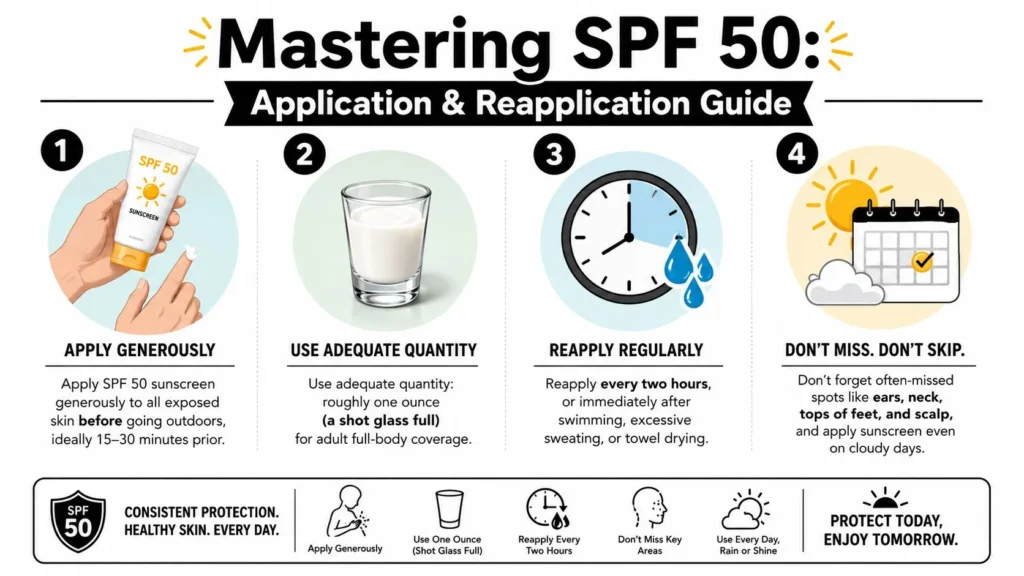
According to the Cancer Council Australia sunscreen fact sheet, SPF 50 and SPF 50+ labeling instructions should tell users to apply at least 35 ml, or seven teaspoons, for a full adult body application, 20 minutes before sun exposure, and to reapply every 2 hours, or immediately after swimming, sweating, or toweling. The same source also notes that the UK’s NHS advises that infants over six months and children should use at least SPF 50.
A routine that works in real life
The biggest mistake isn’t choosing SPF 30 instead of SPF 50. It’s applying sunscreen like moisturizer. Sunscreen needs enough volume to form an even film.
Use this sequence
Apply before you go out
Give it time to settle. The Cancer Council guidance above specifies 20 minutes before exposure.Cover all exposed skin
Ears, neck, scalp part, tops of feet, and hands are easy to miss.Reapply on schedule
Don’t wait until you feel hot or see redness.Restart after swimming or sweat-heavy activity
Water-resistant doesn’t mean permanent.
Later in the day, this video gives a helpful visual reminder on sunscreen habits and common trouble spots:
Matching SPF 50 to your day
A beach day calls for a different strategy than a city commute.
- For pool days and sports: choose a water-resistant broad-spectrum SPF 50 and reapply promptly after time in the water or heavy sweat.
- For office days: a comfortable facial sunscreen matters more than a thick body formula you’ll resent using.
- For makeup wearers: keep a reapplication option you’ll use, such as a stick, fluid, or powder format over your base.
If cost is what keeps you inconsistent, it helps to browse roundups of top budget-friendly facial SPF so sunscreen feels sustainable, not like a product you ration. And if your skin is reactive, pairing sunscreen with a barrier-friendly routine matters too. Readers dealing with irritation often benefit from choosing a gentle moisturizer first, such as the options discussed in this guide to moisturizer for acne-prone sensitive skin.
The best sunscreen routine is the one that survives your actual schedule.
Common Myths and FAQs About SPF 50 Sunscreen
Sunscreen myths usually sound reasonable at first. That’s why they spread.
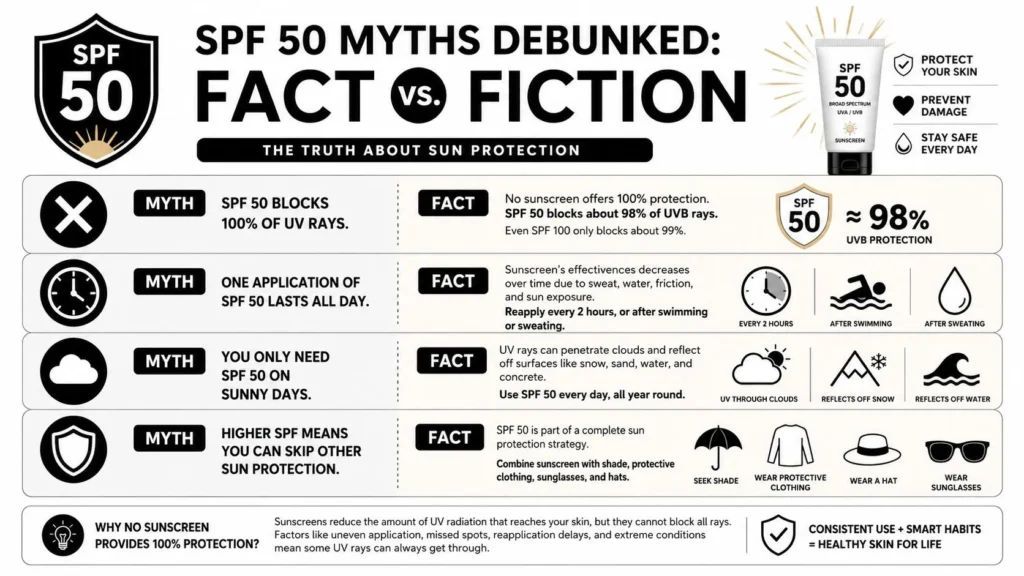
According to EWG’s SPF questions article, SPF 50 blocks 98% of UVB rays, compared with 97% for SPF 30, and SPF 100 blocks 99%. The same source stresses that the practical difference often matters less than using enough sunscreen and reapplying every 2 hours.
Myth versus fact
Myth: SPF 50 blocks everything
Fact: No commercial sunscreen blocks all UVB radiation. Some rays still get through.Myth: Higher SPF means one morning application lasts all day
Fact: Time, sweat, water, and friction reduce performance.Myth: SPF 100 makes technique less important
Fact: The higher number doesn’t rescue poor application habits.
Quick FAQs people often forget to ask
Can children use SPF 50
Yes. The Cancer Council source cited earlier notes that the UK’s NHS advises at least SPF 50 for infants over six months and children.
What about lips, hairlines, and ears
These areas burn easily because people miss them. Lip balm with sun protection, a hat, and careful mirror-checking help.
Does skincare make sunscreen unnecessary
No. Exfoliants, acids, and brightening products can make sun protection feel even more important in a routine. If you use active products, it’s smart to understand how they affect your barrier and sensitivity. A related read on glycolic acid can help if your routine includes stronger resurfacing steps.
Conclusion Best Practices with SPF 50
The smartest lesson from SPF 50 isn’t “always buy the biggest number.” It’s that good sunscreen use beats sunscreen marketing.
SPF 50 matters because it offers strong protection for people who spend more time outdoors, burn easily, or want extra margin for error. But the bigger win comes from knowing what to prioritize. Broad spectrum matters. Applying enough matters. Reapplying matters. Choosing a formula you’ll consistently wear matters.
A simple SPF 50 checklist
- Pick broad spectrum first
- Choose SPF 50 for longer outdoor exposure
- Match the texture to your skin and routine
- Apply generously before going outside
- Reapply on schedule and after water, sweat, or towel drying
- Use hats, shade, and clothing along with sunscreen
If you’ll be in the water, snorkeling, or traveling somewhere with marine ecosystems, local guidance can be useful too. This practical guide to eco-friendly sunscreen for Big Island is a good example of how environment and sunscreen choice can overlap.
Healthy skin habits rarely depend on one hero product. They come from repeatable choices, including support for the skin barrier. If that’s an area you’re exploring, this overview of beta glucan for skin is a helpful companion read.
If you enjoy clear, approachable guides like this one, visit maxijournal.com for more practical reading on health, science, beauty, travel, and everyday questions explained without the jargon.
Discover more from Maxi Journal
Subscribe to get the latest posts sent to your email.