You’re probably here because your skin looks tired even when you’re doing “all the right things.” Maybe your face feels rough around the cheeks, your post-breakout marks won’t fade, or the little bumps on your upper arms keep coming back no matter how much body lotion you use. That’s usually the moment people start looking for the best glycolic acid.
The interest makes sense. Glycolic acid has moved far beyond a niche treatment. The global glycolic acid products market was valued at $457 million in 2025 and is projected to grow at a 6.4% CAGR from 2025 through 2033, according to Data Insights Market. People keep buying it because, when it’s formulated well and used carefully, it can make skin look smoother, brighter, and more even.
Still, “best” doesn’t mean strongest. It means the right format, the right strength, and the right routine for your skin. If your barrier is easily irritated, your best glycolic acid won’t be the same as someone treating rough elbows or keratosis pilaris. And if you also use Vitamin C, salicylic acid, or retinoids, the wrong combination can make a good product feel awful.
Your Guide to a Brighter Complexion
A common skincare spiral goes like this: you notice dullness, buy a scrub, use it too often, then wonder why your skin feels tight and looks angrier than before. Or you focus only on your face while ignoring body concerns like underarm discoloration, rough knees, and those stubborn tiny bumps on the backs of your arms.
Glycolic acid often enters the picture right there. It has a reputation for helping with texture, uneven tone, and that flat, lackluster look that makes skin seem older or more tired than it is. It also reflects how many people shop now. Products with this ingredient span the full range from affordable staples to prestige skincare, and if you’re also interested in barrier support, pairing exfoliation with ingredients discussed in this beta-glucan skin guide can help you think more comprehensively about recovery and hydration.
Why so many people keep coming back to it
The draw is simple. Glycolic acid can help loosen the buildup that makes skin feel rough and look uneven. Used well, it doesn’t need to be dramatic to be effective.
Practical rule: The best glycolic acid is the one your skin can tolerate consistently, not the one with the highest percentage on the label.
There’s also a gap in a lot of advice online. Many guides stop at facial glow and never explain how to use glycolic acid for body issues, or how to schedule it around other active ingredients without turning your routine into a chemistry experiment. That’s where most confusion starts.
What Is Glycolic Acid and How Does It Work
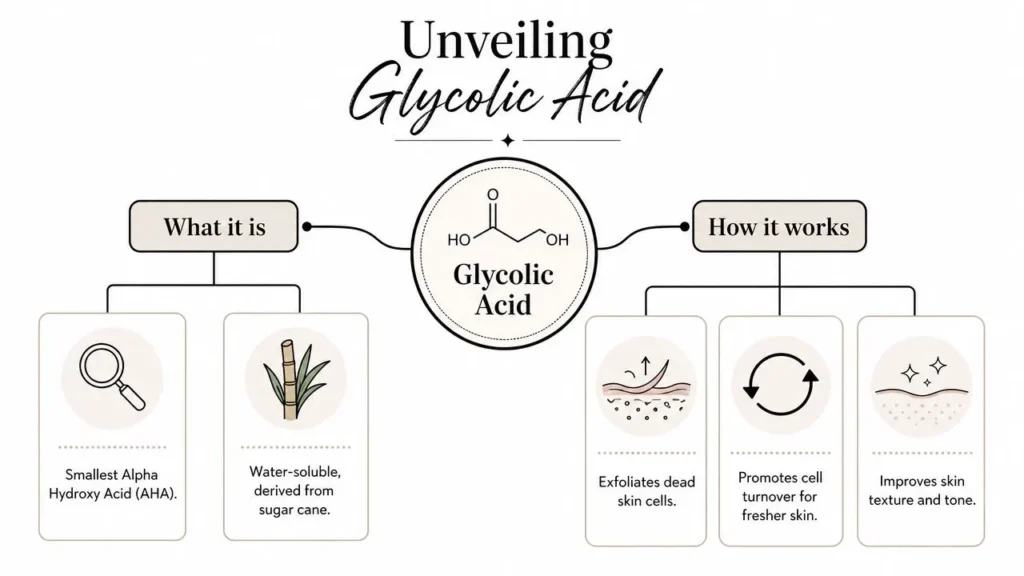
Glycolic acid is an alpha hydroxy acid, often called an AHA. It’s known as the smallest one in that family, which matters because small molecules can move through the skin’s surface more easily than larger ones. In plain language, it’s a very efficient chemical exfoliant.
Think of it as loosening the glue
Your skin naturally sheds old cells, but that process doesn’t always happen evenly. Dead cells can cling to the surface and create roughness, dullness, and a patchy look. Glycolic acid helps dissolve the “glue” holding those old cells together so fresher skin can come through.
That’s why people often use it for:
- Rough texture
- Dullness
- Uneven-looking tone
- Marks left behind after breakouts
- Body buildup on areas like elbows, knees, and upper arms
If you want a simple companion explainer on how glycolic acid helps skin, that Mesoderm RX article is a useful quick read alongside this guide.
Why pH matters more than marketing
A glycolic product can say all the right things on the bottle and still underperform if the formula isn’t sitting in the right pH range. According to INCI Decoder’s glycolic acid ingredient reference, the optimal pH range for at-home glycolic acid efficacy is between 3.0 and 4.0. Above pH 4.0, exfoliation drops off because the acid becomes less able to penetrate the stratum corneum.
That’s one of the most important details to understand when looking for the best glycolic acid. Percentage matters, but pH helps decide whether that percentage will behave like an exfoliant.
A glycolic acid formula with the wrong pH can act far gentler than you expect, or far harsher than your skin can handle.
The same source notes that glycolic acid has a molecular weight of 60.05 g/mol, and that its activity is highly pH-dependent. At pH 3.5, it’s about 90% in its active, undissociated form. At pH 5.0, the active fraction drops to under 30%. That’s why two products with similar-looking labels can feel completely different on skin.
What good glycolic acid should feel like
A well-formulated product shouldn’t feel like your face is being stripped. You may notice a brief tingle. You shouldn’t feel persistent stinging, rawness, or heat that keeps building. The best glycolic acid usually feels controlled, not chaotic.
Choosing Your Format Toners Serums and Peels
Not every glycolic acid product is trying to do the same job. A toner, a serum, and a peel can all contain glycolic acid, but they create very different user experiences. If you choose the wrong format, you might think glycolic acid “isn’t for you” when the actual issue is just product design.
Glycolic Acid Formats Compared
| Format | Typical Concentration | Frequency of Use | Best For |
|---|---|---|---|
| Toner | Lower to moderate | Regular maintenance use, depending on tolerance | People who want a simple sweep-on exfoliant for overall brightness and texture |
| Serum | Moderate to stronger targeted treatment | Less often than a gentle toner, depending on skin response | People focused on specific concerns like uneven tone or rough patches |
| Peel | Intensive treatment | Occasional use only | Experienced users who want a stronger resurfacing step |
Toners feel easiest for most beginners
A glycolic toner is often the least intimidating place to start. It spreads quickly, usually layers easily, and can fit into an evening routine without much fuss. If your main goals are mild dullness and a smoother feel, this format often makes the most sense.
For oily or congestion-prone skin, texture-friendly formulas can slot into a broader routine strategy like the one in this guide to serums for oily skin.
Serums are more focused
Serums usually feel more deliberate. People often reach for them when they want a treatment step rather than a general swipe-and-go product. If your skin already tolerates exfoliation and you want a more concentrated feel, this category may suit you better.
That said, stronger isn’t always smarter. Formula quality matters just as much as strength.
Peels need more respect
At-home peels can deliver a bigger reset, but they also leave less room for sloppy use. If you’re curious about where home products stop and in-office options begin, this overview of professional skin peels gives useful context.
What to check first: Don’t judge a glycolic product by percentage alone. A stable formula matters because unstable exfoliants can behave unpredictably on skin.
A useful benchmark from Alibaba’s buyer guide on glycolic acid powder quality is that a quality, stable formulation should maintain a therapeutic pH without significant drift. The same source links high-purity ingredients to better stability and more consistent performance.
If you’re evaluating raw ingredient quality for formulation work, that source gets quite technical. It notes that a strong batch-specific CoA should verify at least 99.5% assay via GC-MS, with residual solvents like methanol below 50 ppm, heavy metals such as lead, arsenic, and mercury under 1 ppm, and pH drift of 0.1 units or less after 1 hour in aqueous solution at 22°C. It also specifies that dissolving 5 g in 50 mL distilled water at 22°C should result in full dissolution within 2 minutes with zero residue.
Most shoppers won’t test that at home, but the takeaway is clear. Reliable glycolic acid depends on good chemistry, not hype.
Finding the Right Concentration for Your Skin
The percentage on a bottle gets a lot of attention because it’s easy to compare. But choosing the best glycolic acid isn’t about chasing the highest number. It’s about matching strength to the part of the body you’re treating, your experience level, and how reactive your skin is.
A simple way to think about strength
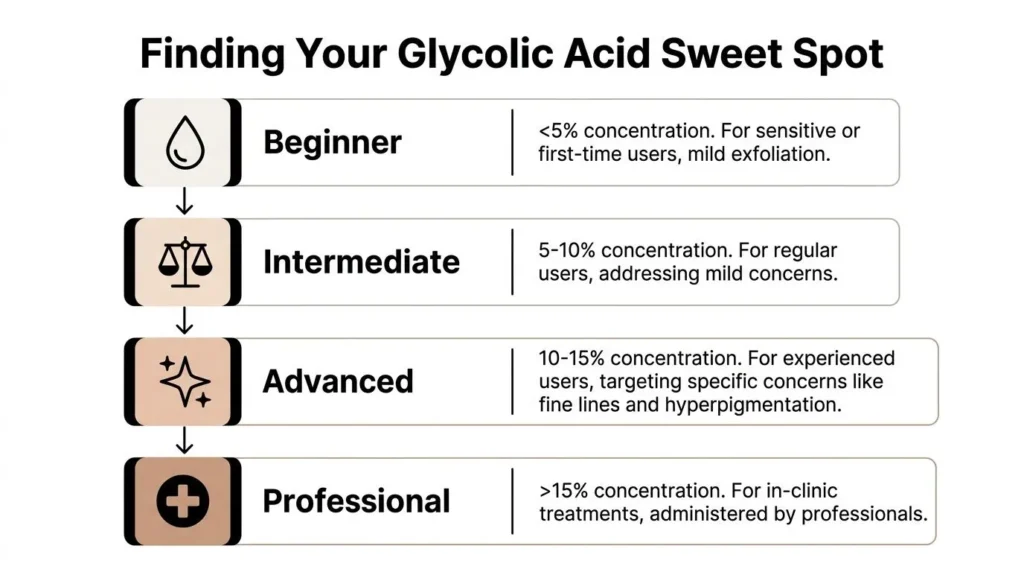
For face use, beginners usually do best with a low-strength product and a short ingredient list. Intermediate users may tolerate moderate strengths well. Advanced users may choose stronger formulas, but only if they already know their skin handles exfoliation without tipping into redness and peeling.
A practical way to frame it:
Beginner range
Best for first-time users, dry skin, or easily irritated skin. Look for a gentle introduction rather than an aggressive glow.Intermediate range
Good for people who’ve already used acids without trouble and want more visible smoothing or brightening.Advanced range
Better reserved for experienced users who understand their limits and don’t stack too many actives.
Body skin can handle more than facial skin
Many guides fall short on this point. The skin on your elbows, knees, and some areas affected by keratosis pilaris is usually more resilient than the skin on your face. That changes what “best glycolic acid” means.
According to Dr. Idriss’s guidance discussed in this video reference, most content centers on facial use in the 5% to 8% range, while resilient body areas like elbows and knees may tolerate up to 10%, and thicker skin conditions such as keratosis pilaris can sometimes be treated up to 4 to 5 times weekly.
That doesn’t mean everyone should jump there. It means body care deserves its own logic.
For rough upper arms, knees, or elbows, the best glycolic acid may be stronger than what you’d ever enjoy using on your face.
Matching the concern to the area
If you’re trying to smooth keratosis pilaris on the arms, a body product can make more sense than repurposing a facial toner. If your issue is underarm discoloration or scalp buildup, go especially slowly and pay attention to irritation because those zones can be more reactive even if they’re not facial skin.
Use this rough decision guide:
Face with mild dullness or texture
Start low. Use less than you think you need.Upper arms with keratosis pilaris
A body-focused formula may be more practical, especially if facial-strength products aren’t doing much.Elbows, knees, and rough heels
These areas often tolerate stronger exfoliation than the face.Post-inflammatory marks on the body
Consistency matters more than intensity. Slow, regular use beats one harsh session.
How to Safely Use Glycolic Acid in Your Routine
The difference between a product that helps and a product that wrecks your barrier usually comes down to routine design. Most glycolic acid mistakes aren’t about bad ingredients. They happen because people overdo frequency, mix too many actives, or apply acids to already stressed skin.
A safe routine starts with patience.
Your first month should feel boring
That’s a good sign. You want your skin to adapt gently.
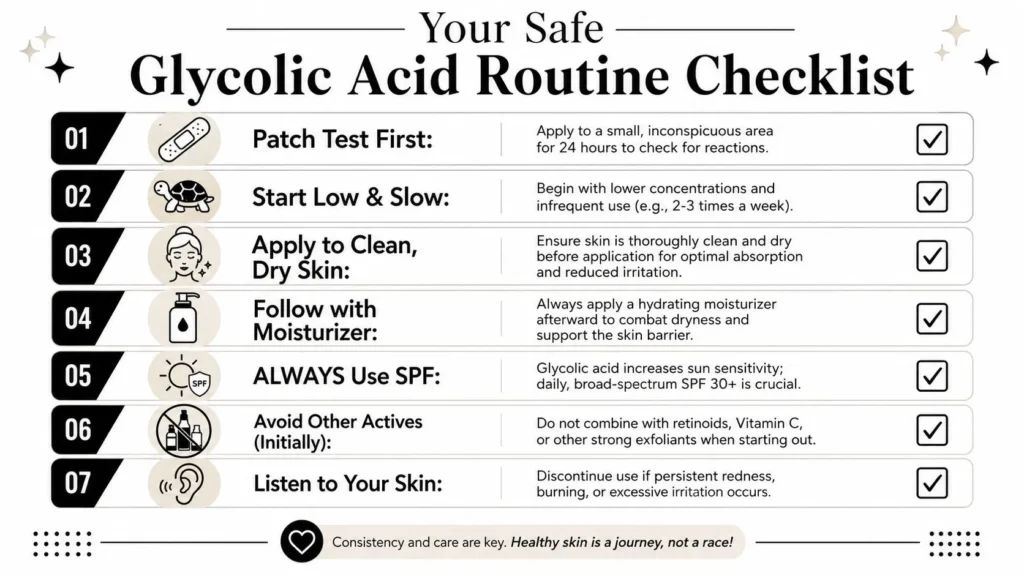
Start with these basics:
- Patch test first. Use a small area before you put it all over your face or body.
- Apply at night. Exfoliants and sun exposure are a bad combo.
- Use clean, dry skin. Damp skin can make acids feel stronger.
- Follow with moisturizer. If your barrier is touchy, the moisturizer-first buffering approach can make glycolic acid easier to tolerate.
- Keep the rest of the routine plain. This is not the night to experiment with three other actives.
If your skin tends to react to everything, a barrier-supportive moisturizer matters as much as the acid itself. This roundup on moisturizer for acne-prone sensitive skin can help you choose the “boring but useful” kind of product that pairs well with exfoliants.
For a broader refresher on safe facial exfoliation techniques, that guide from Lumina Skin Sanctuary lines up well with a gentle approach.
A quick visual walkthrough can also help:
What not to layer in the same routine
This is one of the biggest questions people ask. They want faster results, so they stack acids with Vitamin C or use multiple exfoliants in the same sitting. That often backfires.
According to Health’s glycolic acid guide, glycolic acid can deactivate Vitamin C and can also increase irritation when combined with salicylic acid or lactic acid in the same routine. The safer strategy is to separate them, such as Vitamin C in the morning and glycolic acid at night.
Use your strongest actives like guests at a small dinner table. If too many show up at once, the whole evening goes badly.
A simple layering schedule
Try this if you’re unsure:
Morning
Gentle cleanse, Vitamin C if you use it and tolerate it, moisturizer, sunscreen.Night with glycolic acid
Cleanse, glycolic acid, moisturizer.Night without glycolic acid
Keep it simple, or use another active on a different night if your skin already tolerates that pattern.
If burning lingers, your skin feels waxy-tight, or everything starts to sting, pull back immediately.
Who Should and Should Not Use Glycolic Acid
Glycolic acid tends to make the most sense for people dealing with dullness, uneven texture, visible roughness, and lingering discoloration. It can also be a smart pick for body concerns when the skin feels bumpy or built up rather than inflamed.
Good candidates
You may do well with glycolic acid if:
- Your skin looks flat or tired and you want more radiance.
- You have rough-feeling texture on the face or body.
- You’re trying to fade marks left after breakouts or friction.
- You want a non-scrub exfoliant that doesn’t rely on gritty particles.
People who should be cautious
Glycolic acid is not the best choice for everyone, especially at the start.
Use caution or talk with a professional first if:
- You have very sensitive skin that reacts easily to new products.
- Your skin barrier is already compromised, meaning it’s burning, flaky, or tight.
- You have active rosacea, eczema, or inflamed dermatitis.
- You’re using prescription-strength retinoids or other strong treatments and don’t know how to schedule them safely.
- You’ve recently over-exfoliated and your skin still hasn’t settled down.
If plain moisturizer stings, glycolic acid is not your next step. Repair first, exfoliate later.
A lot of people blame the ingredient when the timing was the actual problem. Even the best glycolic acid won’t work well on skin that’s already irritated.
Frequently Asked Questions About Glycolic Acid
How long does it take to notice a difference
Some people notice smoother-feeling skin fairly quickly, especially with texture. Brightness and the look of surface roughness may improve before discoloration does. Darker marks and stubborn body concerns usually need patience and steady use.
Don’t judge a glycolic acid product after one dramatic night. Judge it by whether your skin looks gradually clearer, smoother, and more even without becoming irritated along the way.
Is purging normal
Sometimes people use “purging” to describe any bad reaction, but they’re not the same. A true purge usually means clogged skin is coming to the surface faster. It should look like your usual kind of breakout in your usual problem areas.
If instead you get widespread redness, burning, itchiness, shiny tight skin, or soreness in places where you don’t normally break out, that’s more likely irritation than purging.
What does over-exfoliation look like
Over-exfoliation often shows up as:
- Redness that hangs around
- Stinging when you apply basic products
- Peeling that feels raw rather than flaky
- A tight, glossy, over-processed look
- New sensitivity to products that used to feel fine
If that happens, stop glycolic acid and stop other actives too. Go back to a gentle cleanser, a plain moisturizer, and sunscreen. Let your skin calm down before you even think about restarting.
The best glycolic acid routine is the one that leaves your skin looking better over time, not the one that gives you the strongest immediate sensation.
If you enjoy clear, practical guides like this, MaxiJournal publishes approachable writing across health, science, technology, fashion, travel, entertainment, and more. It’s a good place to keep reading if you like expert topics explained in plain English.
Discover more from Maxi Journal
Subscribe to get the latest posts sent to your email.