You probably know the feeling. You wake up, glance at your watch, and see heart rate, steps, sleep, maybe a stress score you didn’t ask for. Before coffee, you’ve already gotten a tiny report on your body, and that ritual now feels normal.
That small moment sits inside a much larger change. Health monitoring devices have moved from novelty gadgets into part of everyday care, with home health monitoring systems growing from $12.3 billion in 2020 to a projected $29.1 billion by 2025, a path that implies 18.8% CAGR over that period, according to BCC Research. A broader patient monitoring forecast places the market at $54.33 billion in 2025 and $118.21 billion by 2033, with 10.5% CAGR from 2026 to 2033, also through BCC Research. The point isn’t just that more people are buying gadgets, it’s that monitoring has become part of the infrastructure of chronic care, aging care, and home-based follow-up.
If you want a quick way to compare consumer-facing options before we dig into the technical details, a curated list like validated health monitoring tools can be useful as a starting point. The harder job, though, is understanding what those numbers on the screen mean.
A Morning Check-In and the Bigger Shift Behind It
A watch buzzes during a commute, a phone fills with overnight sleep data, and a parent checks a blood pressure cuff before breakfast. None of that feels dramatic on its own. Put those moments together, and you get a new habit, health data arriving outside the clinic, on the patient’s schedule.
From curiosity to routine
That routine became mainstream because wearables scaled quickly. In one analysis of connected wearables, global shipments rose from 325 million in 2016 to 722 million in 2019, more than doubling in three years, according to Market.us wearable medical device statistics. The same source notes a 2024 estimate of the wearable medical devices market at over $91 billion, with 580 million wearable devices shipped globally that year, which shows how far the category has moved beyond basic step counting.
The deeper change is that the wrist device is now one node in a wider system. Some devices stay in the consumer lane, tracking activity and sleep for personal awareness. Others feed remote patient monitoring programs, hospital workflows, clinical trials, and home care programs where the data changes decisions.
Practical rule: if a device only helps you notice a pattern, it’s a wellness tool. If it can change a care plan, it needs a much higher bar for evidence, accuracy, and data handling.
That’s why a good explainer can’t stop at “what it tracks.” It has to map the device to the care setting, the sensor underneath, and the level of trust the number deserves. Without that map, a sleep score, a SpO2 reading, and a doctor-managed remote monitor can start to look more similar than they really are.
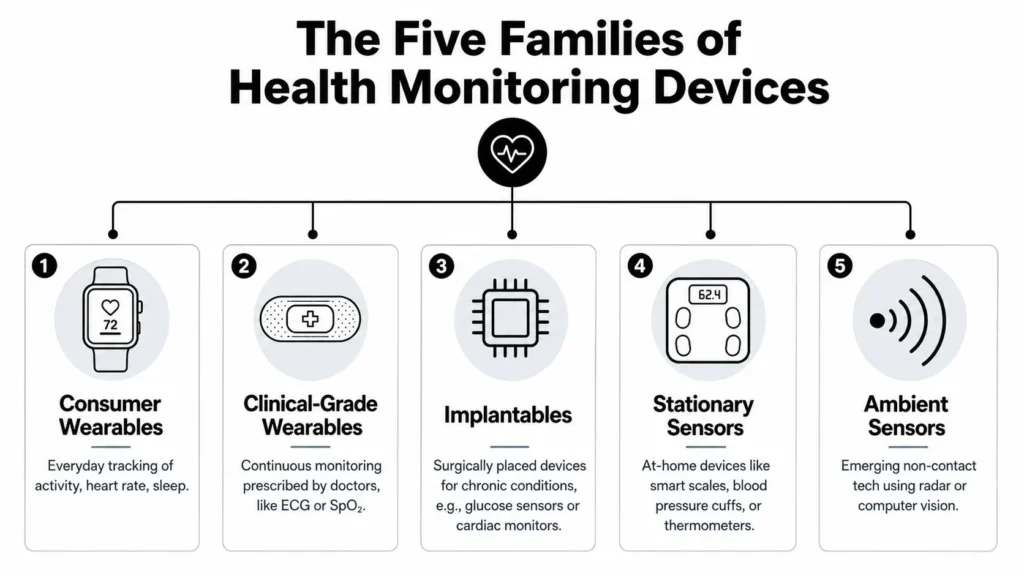
The Five Families of Health Monitoring Devices
Health monitoring devices aren’t one product category, they’re a family of categories with very different jobs. Once you sort them into groups, the market gets easier to understand and the marketing gets easier to ignore.
Consumer wearables
These are the devices most often pictured first, smartwatches and fitness bands that sit on the wrist and track activity, heart rate, sleep, and sometimes blood oxygen or temperature trends. They usually rely on optical sensors, motion sensors, and software models that estimate what’s happening in the body rather than measuring every physiological signal directly.
Clinical-grade wearables
This group includes patches and prescribed remote monitors used in hospital-at-home or remote patient monitoring programs. They’re designed to transmit data to clinicians, not just to the user’s app, and they usually cover a narrower but more medically relevant set of measures like ECG, respiration, SpO2, posture, and fall events. A clinical wearable can look simple on the outside while doing much more careful work on the inside.
Implantables and ingestibles
These devices go under the skin or into the body, so they’re reserved for specific medical use cases. Continuous glucose sensors are the most familiar example, and cardiac monitors are another. They’re not everyday lifestyle accessories, and that’s the point, they’re meant for conditions where continuous or long-term monitoring matters enough to justify that level of intrusion.
Home and ambient sensors
These include smart scales, blood pressure cuffs, thermometers, bed sensors, and newer contactless systems that sit in a room or under a mattress. They’re important because they reduce the burden on the user. You don’t have to remember to wear them all day, and in some cases you don’t have to touch them at all.
Dedicated medical devices
This group covers tools many households already know, like glucometers, blood pressure cuffs, pulse oximeters, and thermometers. These are often the clearest bridge between consumer convenience and clinical relevance because they measure a specific signal directly and have a familiar role in care.
The wearable side of the market shows how fast the whole field scaled. If the first wave was about counting steps, the current wave is about continuous sensing across much more of the body.
What These Devices Track and How Trustworthy the Numbers Are
A dashboard can present a clean number, but the body does not work in clean numbers. Every metric comes from a sensor, an algorithm, or a mix of both, and the trust you can place in it depends on where the device is used, how it is worn, and what question you are asking.
The sensor behind the metric
Heart rate usually comes from optical photoplethysmography, or PPG, which detects changes in blood volume in tissue with light. ECG captures the heart’s electrical activity directly, which is why it is better suited to rhythm questions than a casual wrist estimate. Blood oxygen depends on light absorption patterns, blood pressure often combines a cuff or pressure-based method with inference, respiration can come from motion, impedance, or waveform patterns, and sleep is usually inferred from movement plus heart or breathing trends.
That distinction matters because the device often measures one thing and infers another. A smartwatch does not see your sleep stages the way a sleep lab would, it estimates them from patterns.
The practical yardstick comes from WHO-aligned technical requirements. Those requirements call for heart rate from 30 to 250 bpm with accuracy better than ±5 bpm and 1 bpm resolution, SpO2 from 70 to 99% with better than ±3% accuracy and 1% resolution, and blood pressure from 30 to 300 mmHg with 1 mmHg gradation, according to WHO-aligned technical requirements. That frame helps separate clinically useful monitoring from attractive but loose estimates.
Practical rule: the same metric can be useful in one context and misleading in another. A trend line is not the same thing as a diagnosis.
Accuracy also depends on the person, the setting, and the contact between skin and sensor. Consumer readings are often best treated as directional, while clinical-grade systems are designed for higher-stakes use. For a useful consumer perspective on another common home metric, trust smart scale trends is a helpful reminder that body weight data should be read as a trend, not as a verdict.
The same sensor can look trustworthy in one scenario and shaky in another. Motion, sweat, loose fit, and poor placement can all distort the signal before the app ever turns it into a number.
| Metric | Typical Sensor | Clinical-Grade Accuracy | Consumer-Grade Reality |
|---|---|---|---|
| Heart rate | PPG or ECG | WHO-aligned range is 30 to 250 bpm with better than ±5 bpm accuracy and 1 bpm resolution | Often useful for trends, less reliable during motion |
| SpO2 | Optical light absorption | WHO-aligned range is 70 to 99% with better than ±3% accuracy and 1% resolution | Good for broad screening, weaker when hands move or contact is poor |
| Blood pressure | Cuff-based pressure measurement | WHO-aligned range is 30 to 300 mmHg with 1 mmHg gradation | Home cuffs can be helpful, but fit and technique matter a lot |
| Sleep | Motion plus heart and breathing patterns | Depends on device validation and use case | Usually a rough estimate of rest, not a sleep-lab equivalent |
| Glucose | Finger-stick strip or continuous sensor | Depends on device and indication | CGMs are powerful for diabetes care, but not every use case is proven |
| ECG | Electrical skin signals | Diagnostic when validated and interpreted correctly | Many consumer devices capture rhythm clues, not a full diagnosis |
The simplest way to read these numbers is this. Consumer-grade readings are directional, and clinical-grade readings are diagnostic. That line is not about prestige, it is about what the number is allowed to mean. And when a device is built for medical use, even the way it is manufactured and sterilized can affect trust, which is why technical discussions often extend beyond the sensor itself to processes such as ethylene oxide sterilization in medical device production.
Clinical vs Consumer Use and Where the Line Actually Sits
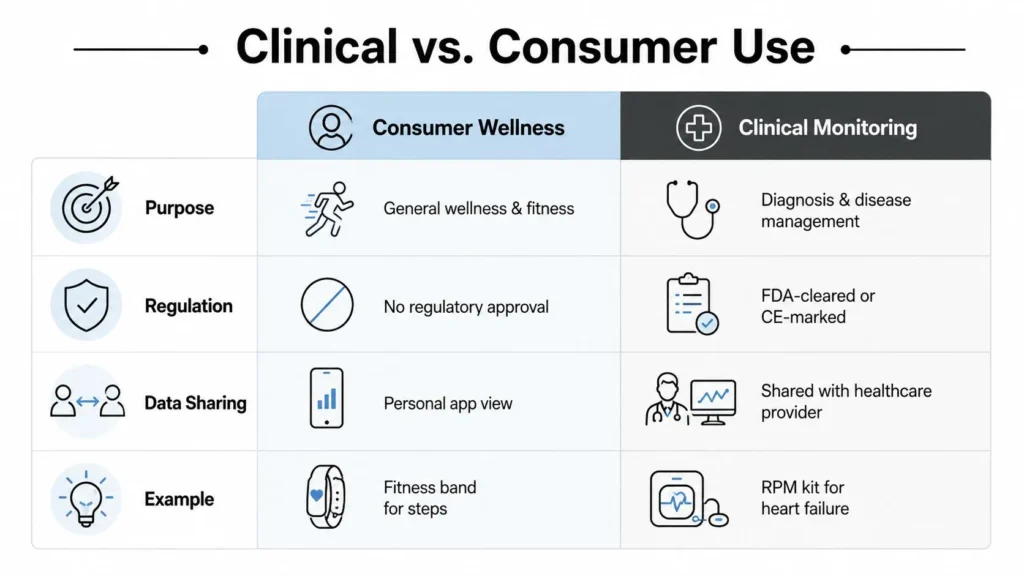
The gap between a wellness device and a medical monitor isn’t just about packaging. It’s about intended use, validation, data handling, and the consequences of being wrong.
What clinical systems do differently
A hospital remote monitoring setup needs more than a sensor that looks good in an app. A modular wearable sensor can report ECG, heart rate, respiration rate, SpO2, temperature, posture, falls, arrhythmia detection, and non-invasive blood pressure while transmitting over Bluetooth Low Energy plus integrated Wi‑Fi, and it may sample SpO2, pulse rate, and respiration every 30 seconds, according to the clinical sensor example in peer-reviewed sensor documentation. Earlier versions were described with 12 hours of battery life, while newer models extend to up to 96 hours, showing the trade-off between continuous sensing and power use in real workflows.
A fitness band can estimate some of the same signals, but it usually isn’t built for the same consequences. Clinical systems need redundancy, better workflow integration, and tighter technical expectations because nurses and physicians may act on the readings. That’s why regulatory marks matter, even if they’re easy to overread.
What regulatory marks do and don’t mean
A FDA-cleared or CE-marked device has gone through a formal pathway for its intended medical use. That does not mean it’s perfect, and it doesn’t mean every reading is clinically decisive. It does mean the manufacturer has crossed a higher bar than a general wellness product.
By contrast, a consumer wellness label usually means the company is making a lifestyle claim, not a diagnostic one. That can still be useful. It just shouldn’t be confused with a monitor built to support treatment decisions.
For a real-world look at how medical devices are made and handled in connected systems, the discussion of ethylene oxide sterilization is a useful adjacent read because device safety isn’t only about software, it’s also about the physical product lifecycle.
The clearest dividing line is workflow. Consumer wearables answer, “What’s happening to me today?” Clinical monitors answer, “What does the care team need to know, and how reliably can we act on it?”
How to Evaluate and Choose the Right Device for Your Situation
A good device choice starts with the question the device is supposed to answer. A hypertension patient, a runner, and a caregiver monitoring an older parent are not buying the same thing, even if the screen looks similar.
Five buckets worth checking
- Clinical validity. Look for peer-reviewed evidence, regulatory clearance where it matters, and a device whose intended use matches your reason for buying it.
- Accuracy and reliability. Ask what standard it was tested against, and whether it performs well during movement, at home, and on your body type.
- Usability. If it’s uncomfortable, confusing, or constantly dead, the best sensor in the world won’t help you.
- Data ownership and integration. Decide who sees the data, whether you can export it, and whether it reaches your clinician in a usable form.
- Total cost over time. Think beyond the sticker price. Charging, subscriptions, replacement parts, strips, patches, and clinician review fees all matter.
Practical rule: the right device is the one you’ll still use three months from now, not the one with the most features on launch day.
A person managing hypertension usually cares most about cuff accuracy, repeatability, and whether the readings can be shared with a clinician. An athlete may care more about comfort, overnight wear, and trend consistency than medical labeling. A caregiver often weights simplicity, alerts, and data sharing higher than raw feature count.
For a more structured buying checklist, best health monitoring devices can be helpful when you want to compare categories rather than chase a single brand promise.
A screenshot-worthy checklist
- Validation first: Does the device have evidence for the exact metric I need?
- Right setting: Is it meant for wellness, or for medical monitoring?
- Simple enough to keep using: Will I wear, charge, or calibrate it?
- Clear data path: Can the data reach me, my caregiver, or my clinician?
- Cost I can sustain: Will I still afford it after the novelty wears off?
The strongest devices make less work for the user and less guesswork for the clinician. That combination is rare enough that it should be part of your purchase decision, not an afterthought.
Data Privacy, Equity, and the People These Devices Often Miss
The privacy story starts the moment a device collects data. Readings move from the sensor to the phone, then often to cloud storage, then sometimes to third parties, and at each step the user loses a little control if the product terms are vague.
That matters because health data is not just personal, it’s contextual. A stress score, a sleep trend, or a glucose pattern can reveal routines, habits, and vulnerabilities that don’t belong in the hands of advertisers or other buyers by default. If a device depends on a heavy app ecosystem, the privacy question isn’t optional, it’s part of the product.
Equity is the bigger blind spot. A 2024 study on remote patient monitoring, medical apps, and wearables found persistent access and utilization gaps in underserved communities, and earlier evidence in low-income groups pointed to barriers like limited health literacy, low app fluency, lack of agency, and mistrust of healthcare systems, according to PubMed 39323052. In plain language, some people don’t skip monitoring because they don’t care. They skip it because the device assumes too much access, confidence, or time.
Recent literature also points to contactless and cellular remote monitoring as a response to smartphone and Wi‑Fi dependency, especially for older adults and rural patients, as discussed in JMIR mHealth and UHealth. That doesn’t solve the whole problem, but it does show that inclusive design starts with removing friction, not piling on another app.
If you’re judging a device or program for inclusiveness, look for language support, offline or low-connectivity modes, caregiver dashboards, and cost transparency. Those details tell you more about real-world access than a glossy sensor list ever will.
Where Health Monitoring Devices Are Heading and What to Watch For
The next wave is less about making the wrist screen prettier and more about making monitoring less burdensome. Three directions stand out: contactless ambient sensing, cellular-connected remote monitoring, and AI-driven triage.
Less wear, more continuity
Contactless systems use radar, computer vision, or bed sensors to watch for movement and physiological signals without asking the user to remember a device. That matters for older adults, sleep monitoring, and patients who don’t tolerate wearables well. It also fits the clinical reality that missing data is often a usability problem, not a sensor problem.
Connectivity without friction
Cellular remote monitoring solves another hidden failure point, the missing phone or the unstable home network. For rural and older-adult programs, built-in connectivity can keep the data moving without a pairing ritual or constant user troubleshooting. For a deeper look at how these systems are built, the architecture discussion in medical device architecture insights is a useful companion read.
Smarter triage, not just more data
AI will keep showing up in the middle layer, turning streams of readings into alerts, summaries, and risk flags. The promise is less about replacing clinicians and more about helping them notice the signal in a pile of routine measurements. That’s where a broader view of healthcare technology innovations becomes useful, because monitoring only matters when it fits into a larger care system.
The safest way to adopt a new device today is to ask three questions. How portable is the data if I change platforms later, how often does the software get updated, and what problem does this device solve that I can’t already solve another way? If a vendor can’t answer those clearly, the product probably isn’t ready for a long-term role in your care.
Maxijournal.com publishes approachable writing across health, science, and technology, and it’s a practical place to keep learning about devices, trends, and the limits behind the marketing. If you want more guides like this, visit maxijournal.com and look for articles that help you compare tools with a clearer eye.
Discover more from Maxi Journal
Subscribe to get the latest posts sent to your email.