The most popular advice about author interviews is also the least useful: treat every conversation as promotional content and judge it by how much attention the author’s latest book receives. Strong interviews serve different editorial purposes. Some capture breaking publishing context, while others preserve literary debate, explain craft, provide video reference, create audio discovery, reach broad reader communities, or extend a live event.
This list evaluates seven sources through five practical lenses: authority, archive usefulness, quote value, accessibility, and contributor relevance. The aim isn’t to produce a generic reading list. It’s to show what each source makes possible, how to cite or link it responsibly, and what prospective interviewers can learn from its editorial choices. That distinction matters because author interviews have developed from a recognizable literary and journalistic form into a durable media genre, with early published examples appearing during Charles Dickens’s 1842 North American tour and recurring author coverage established by the early 1870s in this history of the literary interview.
For daily coverage at maxijournal.com, these sources can support thoughtful reporting without reducing a conversation to a book summary. A useful companion resource is this guide to author photography and AI headshots, especially when a contributor needs consistent visual material alongside an interview.
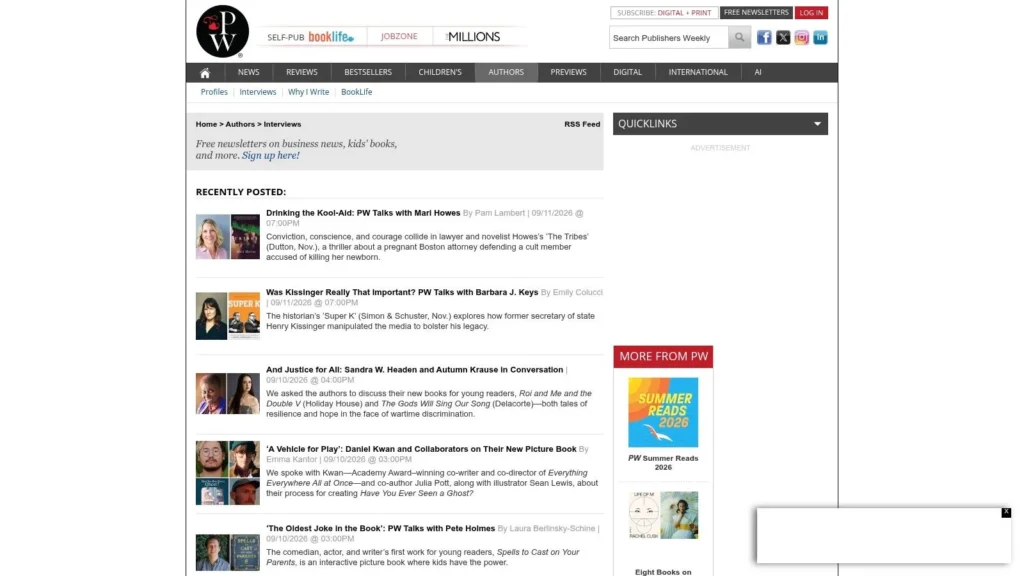
1. Publishers Weekly Author Interviews
Publishers Weekly’s author interview archive is the strongest starting point for breaking publishing context. Its conversations frequently sit close to publication dates and industry developments, so an editor can use them to identify timely angles rather than treating the interview as an isolated profile. Coverage extends across adult books, children’s and young adult titles, and nonfiction, creating a useful view of how different publishing sectors frame authors and releases.
The archive also benefits from its relationship to Publishers Weekly’s broader reviews and industry reporting. That surrounding context helps a reader distinguish a quote about a book’s subject, a comment about the publishing process, and a statement that belongs to a larger market or cultural conversation. The publication’s established role in U.S. publishing gives contributors a credible reference point when they need to support a news-oriented article.
What to extract
Look for a sentence that explains why the book matters now, not merely what it contains. Record the interview title, author, publication context, exact wording of the quote, and the link to the original page before drafting. If you’re writing for prospective contributors, connect the interview to how to become a published author only when the discussion illuminates publishing practice, submission, or career development.
The limitation is editorial framing. A trade publication may emphasize the book’s place in publishing more than the author’s detailed creative method, and some readers may need explanations for industry terminology.
Best use: Cite Publishers Weekly for timely publishing context, release-linked statements, and quotes that explain an author’s position within the book trade.
For publishers seeking a more targeted promotional workflow, a targeting engine for publishers can sit alongside editorial research, but it shouldn’t replace the interview’s actual substance.
2. Literary Hub In Conversation
Literary Hub’s In Conversation archive is built for literary conversation, especially when a contributor needs more than a launch announcement. Its Q&As and dialogues often connect an author’s work to criticism, culture, politics, history, or ideas. The result is a source that can support a reported essay, a book-club discussion, or a feature about how writers interpret their own subjects.
The archive leans toward literary fiction, criticism, and topical nonfiction. That focus is a strength when the assignment requires close attention to language, form, or intellectual context. It’s less dependable as a single discovery source for highly commercial categories such as romance or mass-market science fiction and fantasy, where other archives may offer broader coverage.
How to read the framing
Start with the interviewer’s questions, not the author’s answers. The questions reveal what the editor believes deserves attention: a structural decision, a historical source, an ethical problem, or an interpretive disagreement. That makes the archive valuable for contributors who want to develop sharper prompts of their own.
When citing an interview, link directly to the specific conversation and identify its title rather than linking only to the category page. Pull a short passage that supports a clear editorial point, then explain what the passage reveals. Reproducing several promotional answers without analysis weakens the article, even when the source itself is respected.
A conversation from this archive can also help an author prepare for a more substantial interview by showing how a familiar book-summary prompt can become a question about motive, method, or consequence.
Extract the question architecture. The best material often comes from the connection between a precise question and a specific answer, not from an isolated statement.
For contributors, Literary Hub demonstrates that an interview can function as criticism. The author remains a source, but the interviewer’s framing gives the exchange a larger purpose.
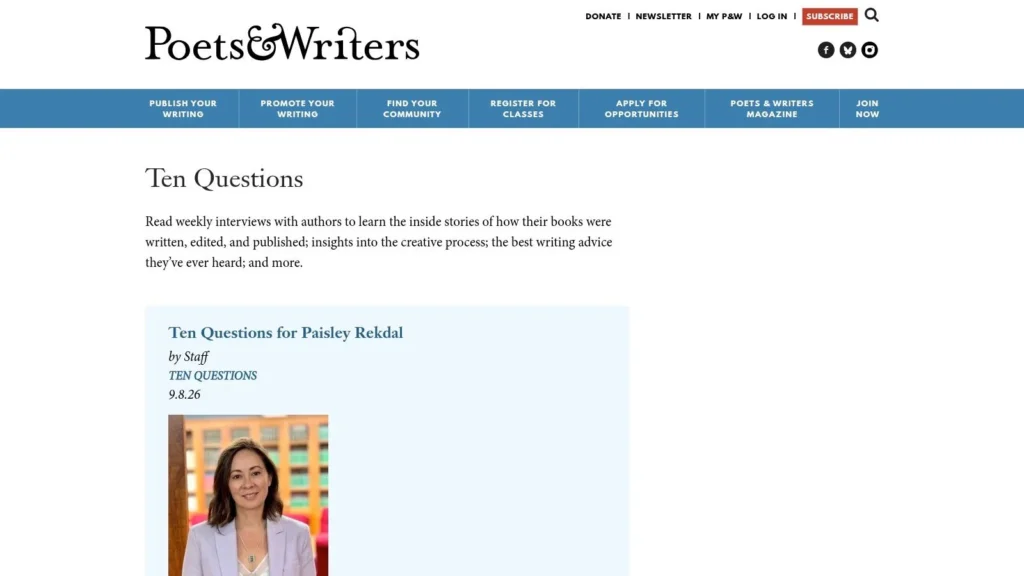
3. Poets & Writers Ten Questions and Interview Archives
Poets & Writers’ Ten Questions archive is the most useful source here for craft study. Its consistent format makes interviews easy to compare, while the author mix brings poets, novelists, essayists, debut writers, and small-press voices into the same research field. Readers can trace recurring concerns such as revision, routine, voice, structure, reading habits, and the practical realities of sustaining a writing life.
The format’s consistency creates a special editorial advantage. Because contributors encounter a recognizable question structure, they can quickly identify which answers contain transferable insight and which are mainly biographical. That makes the archive useful for quote research, writing education, and profiles centered on process rather than publicity.
What prospective contributors can learn
A process-focused interview works best when it asks for a concrete decision. “How do you write?” often produces a broad answer. A question about how the author revised a difficult passage, chose a form, handled research, or responded to an editorial problem is more likely to produce material readers can use.
The archive’s search and tagging structure also supports focused research by genre, identity, and theme. Contributors working on creative writing submissions can use those patterns to develop an interview pitch that names the specific craft question rather than proposing a vague conversation about writing.
This source is less suited to breaking publishing news or celebrity coverage. Its value is more durable. A strong answer can remain useful after the release cycle because it addresses how a writer works and thinks.
Practical rule: Ask for an example of a decision, revision, or constraint. Process becomes informative when the author has something specific to describe.
When linking a passage, preserve enough context for readers to understand the question that produced it. A quote about revision can change meaning when detached from the prompt.
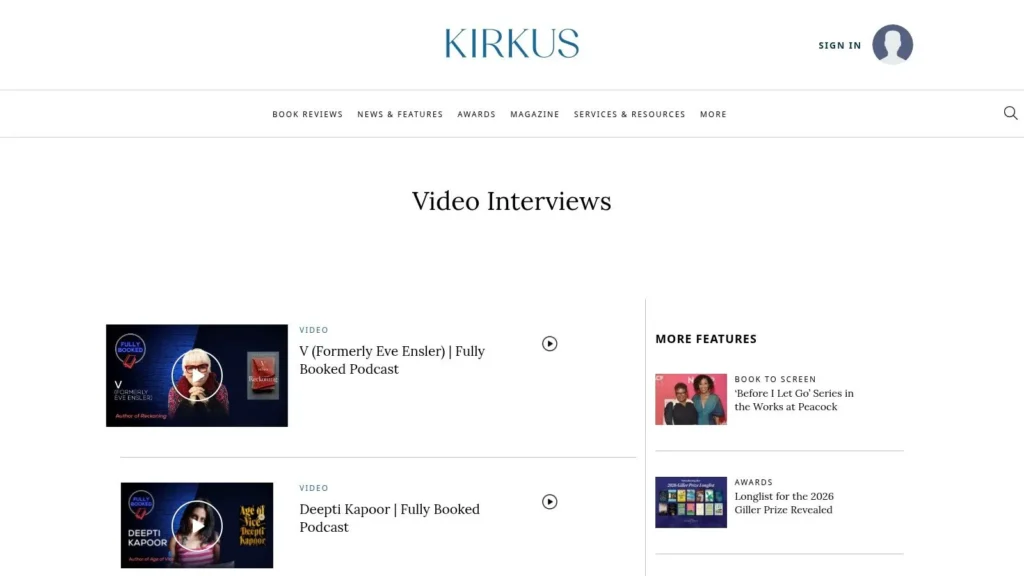
4. Kirkus Reviews Video Interviews
Kirkus Reviews’ video interview archive is the clearest choice for video reference. The conversations are concise and tightly edited, with coverage spanning fiction, nonfiction, children’s books, young adult titles, and graphic literature. Their relationship to Kirkus reviews, features, podcast material, and thematic roundups gives contributors several ways to place a clip inside broader multimedia coverage.
Video supplies information that text alone can’t preserve. A reader can observe pacing, hesitation, expression, and the way an author responds to an unexpected question. Those details shouldn’t be overinterpreted, but they can help a contributor describe the tone of a conversation or choose a short clip that complements an article.
Best editorial applications
Use Kirkus when the story benefits from an embedded reference, a visual introduction to an author, or a concise answer that can orient readers before deeper analysis. Cite the exact video page, identify the author and conversation, and describe the clip accurately. Don’t present a visual impression as evidence of personality or intent.
The format’s main limitation is depth. Short editing leaves less room for an extended discussion of research, revision, or controversy. For those subjects, pair the video with a text-based literary or craft archive, then make the distinction clear.
Contributors can also study the editing. Notice how quickly the interview establishes the book, how questions move from premise to process, and which answers receive visual emphasis. Those choices show how a host converts a longer conversation into accessible material. Anyone producing their own video can use that observation alongside this practical guide on editing videos for YouTube.
Video is evidence of delivery, not permission to infer motive. Quote what the author says, describe what the clip shows, and keep interpretation proportionate.
5. Barnes & Noble Poured Over
Barnes & Noble’s Poured Over author interview podcast is the strongest source for audio discovery. The series presents in-depth conversations with authors across literary and commercial categories, often supported by companion posts, show notes, and links. That combination gives a contributor both the texture of an audio exchange and a practical route back to the book, author, and episode context.
The retail setting shapes the archive. Barnes & Noble’s hosts approach books through a bookseller’s understanding of reader interest, so conversations may spend more time on premise, audience, and the qualities that make a title appealing. That perspective is useful when a story needs to understand how a book is presented to readers, but it can place less emphasis on the most technical parts of craft.
How to work from audio
Listen for an answer that changes in tone or becomes more detailed after a follow-up. Audio can reveal when a host has moved beyond prepared publicity language, although contributors should still quote only from a verified transcript or carefully checked recording. If a transcript isn’t available, note the episode title, speaker, and relevant time marker while taking notes, then verify the wording before publication.
The series is also useful for studying host curation. A good audio interview doesn’t ask the author to summarize the book. It establishes a reason to listen, creates room for narrative, and uses follow-up questions to clarify what the first answer leaves unresolved.
For teams planning a recording, a creative collaboration space for book podcasts may help with production logistics, but editorial preparation still determines whether the finished conversation is useful.
Audio rewards attention to sequence. The meaning of an answer often depends on the question that came immediately before it.
Because retail-facing conversations can foreground marketability, contributors should add interpretation. Explain what the author’s answer reveals about audience, theme, or method instead of repeating the episode description.
6. Book Riot Interviews and First Edition
Book Riot’s interview archive is the best choice for broad reader appeal. Its coverage moves across mystery, science fiction and fantasy, romance, comics, and other categories, with an approachable voice that makes author conversations accessible beyond literary-specialist audiences. The accompanying First Edition podcast adds another route into new releases and reading trends.
This source is especially useful for finding niche and independent authors who may not appear in more trade-focused or prestige literary archives. It also reflects how readers often encounter books, through questions about emotional experience, genre expectations, character, accessibility, and the pleasure of reading.
What to take from the archive
Use Book Riot to identify the language readers use when they talk about a book. A contributor can extract a question that explains the reading experience rather than relying on publication boilerplate. That might mean asking what kind of reader the author hopes to reach, which convention the book embraces or challenges, or what emotional response the author wants to make possible.
The archive’s breadth is also its limitation. Editorial depth and interview length vary, so each piece needs individual evaluation. A short Q&A may offer a strong discovery angle but not enough material for a deep craft feature. Link to the exact interview, identify whether the insight came from an article or the First Edition podcast, and avoid treating every answer as equally authoritative.
Readers who want approachable commentary can use the archive for recommendations and context. Contributors can use it as a prompt bank for questions that sound natural rather than academic.
Broad appeal comes from specificity, not simplification. A clear question about genre, character, or reader experience can welcome newcomers without flattening the author’s work.
Book Riot works best when paired with analysis. Summarize the relevant answer, connect it to the book’s premise or audience, and explain why the exchange matters to readers who haven’t encountered the author before.
7. Los Angeles Times Book Club
The Los Angeles Times Book Club is the strongest source for live event coverage. Its program combines author conversations, event previews, related interviews, and recorded material, giving contributors an opportunity to report on both the discussion and the occasion surrounding it. The archive is particularly useful for high-profile lineups, local literary culture, and timely book news.
A live conversation creates a different kind of source from an edited Q&A. Audience questions can expose what readers want clarified, while the event format may produce spontaneous comparisons, stories, or responses that wouldn’t appear in a prepared promotional exchange. Contributors should distinguish between the author’s formal answer, an audience question, and the host’s framing when taking notes.
How to cite an event
Record the program name, author, date or event context as displayed on the source page, exact quote, and direct link. If the event is ticketed, registration-based, or subject to access restrictions, don’t imply that every reader can view the full recording. A recap can still cite an available preview or related article, but the wording should match what readers can verify.
Some coverage may carry a regional emphasis or sit behind registration or a paywall. That doesn’t make it unusable. It means the contributor should provide enough context and avoid building the entire article around material that readers can’t independently access.
The event archive also teaches contributors how to create news from a conversation. A recap needs a hook, not a chronological transcript. Focus on a revealing answer, a timely theme, or a connection between the author’s remarks and the audience’s concerns.
A live interview is an event and a source. Report both, but don’t confuse atmosphere with evidence.
For maxijournal.com contributors, this format offers a model for event-driven coverage that combines verified excerpts with interpretation instead of reproducing promotional copy.
Author Interview Outlets, 7-Point Comparison
| Outlet | Implementation complexity | Resource requirements | Expected outcomes | Ideal use cases | Key advantages |
|---|---|---|---|---|---|
| Publishers Weekly, Author Interviews | Low, straightforward to find and cite | Low, web access; occasional paywall | Timely industry quotes and pub-day hooks | Breaking-news coverage; pull quotes for new releases | High editorial standards and trade credibility |
| Literary Hub, In Conversation | Medium, longform requires curation | Low, web access; longer reads | Deep craft and idea-driven insights | Culture/ideas features; craft-focused profiles | Thoughtful editing and longform depth |
| Poets & Writers, Ten Questions & Archives | Low, structured format makes extraction easy | Low, web access and archive search | Evergreen craft quotes and process perspectives | How-to, craft pieces, teaching and mentorship content | Consistent Q&A format; strong poetry/literary focus |
| Kirkus Reviews, Video Interviews | Medium, need to embed/use video clips | Moderate, video embeds, playback; file handling | Short, quotable audiovisual soundbites | Multimedia stories, embeds, quick author reactions | Video-ready content; recognized review brand |
| Barnes & Noble, Poured Over (Podcast) | Medium, audio-first requires listening or transcription | Moderate, podcast players; possible transcript needs | In-depth conversations with retail context | Audio pulls; retail-facing momentum and listener insight | Regular cadence; retail perspective and host curation |
| Book Riot, Interviews (+ First Edition) | Low, accessible, reader-friendly content | Low, web/podcast access; social assets | Mainstream-appeal quotes and discovery leads | Social-driven coverage; reader recommendations; niche discovery | Approachable voice; strong shareability and discovery |
| Los Angeles Times, L.A. Times Book Club | Medium, event content may need access or archiving | Moderate, event attendance or archive access; possible paywall | Event-driven coverage and high-profile author material | Event recaps, regional literary perspective, high-profile interviews | High-profile lineups; live events and timely hooks |
Turn Interview Browsing Into Better Coverage
The fastest way to improve author-interview research is to assign each source a job. Begin with Publishers Weekly or the Los Angeles Times Book Club when you need a timely hook, a release-related angle, or an event recap. Turn to Literary Hub and Poets & Writers for craft, ideas, revision, and literary context. Use Kirkus Reviews for visual reference, Barnes & Noble’s Poured Over for audio discovery, and Book Riot for broad reader appeal and genre discovery.
Before drafting, create a source record with six fields:
- Source title: Capture the exact interview, episode, or event name.
- Author and context: Note the book, publication setting, podcast, or live program.
- Exact quote: Preserve the wording and enough surrounding context to prevent distortion.
- Direct link: Link to the original page, not a generic homepage or search result.
- Editorial angle: State whether the passage supports craft, news, audience, controversy, research, or interpretation.
- Contributor use: Explain how the source can inform a pitch, question, recap, or reported feature.
This discipline matters because the interview format has become a durable part of literary and scholarly media. One review notes that Publishers Weekly’s digital archive contains about 5,000 author profiles and interviews, while another source describes Statistical Science as having published interviews for roughly 20 years and produced around 100 by the time of that review in its discussion of the interview form. The archive is large enough that selection and framing matter as much as discovery.
Prospective contributors should pitch a clear subject, explain why the conversation matters now, and propose questions that move beyond biography and book summary. Ask about creative process, research methods, interpretation, or a meaningful constraint. If the topic involves controversy, give the author a fair opportunity to answer and separate verified fact from personal response.
Before recording or publishing, get explicit permission where required, preserve the source context, and reserve time for synthesis. Interview-driven workflows benefit from planning repurposable outputs in advance and setting aside 30 to 60 minutes after the interview for synthesis and note-taking, as Author Media’s research-marketing guidance explains. That post-interview work is where a conversation becomes an accurate article, clip, quote card, newsletter item, or follow-up pitch.
The audience also matters. Australia Reads found that author media interviews were “very likely” or “most likely” to influence buying decisions for 60% of engaged readers, compared with 33% of general readers, according to the cited discussion of that finding. The practical lesson is not that interviews persuade everyone. It’s that contributors should identify the reader segment, format, and question angle before claiming that an interview drives discovery or purchase.
For maxijournal.com, an interview works best when the contributor adds reporting and interpretation. Use the source to explain something readers couldn’t learn from a jacket description alone, then invite them into the wider conversation through a carefully linked, accessible piece.
Maxi Journal publishes approachable writing across books, arts, technology, health, business, entertainment, and other subjects, including coverage built from thoughtful author conversations. Visit the site to explore current articles and consider pitching a focused interview or analysis that gives readers a specific reason to keep reading.
Discover more from Maxi Journal
Subscribe to get the latest posts sent to your email.