A detector score can’t prove that media is authentic. It only reports how closely a file resembles patterns the system has learned to associate with manipulation. That distinction matters because the original FaceForensics++ benchmark recorded detector accuracy of 99.03% on raw material, falling to 95.42% with high-quality compression and 80.49% with low-quality compression. A separate evaluation in the same study produced lower results under a different testing protocol. The lesson isn’t that benchmark scores are useless. It’s that a score without context can mislead an editor, investigator, or moderation team.
This comparison evaluates each tool by the verification job it supports, not by a generic feature checklist. The relevant questions are which modalities it covers, whether it works in real time or batch mode, how it explains results, how it deploys, whether pricing is visible, and how it responds to unfamiliar manipulation methods.
Classifier-based tools inspect pixels, frames, waveforms, or other media signals and return a probability or risk score. Provenance technologies take a different approach. Watermarks such as SynthID and standards such as C2PA Content Credentials try to establish where content came from or whether it carries a verifiable production history. They don’t replace classifiers, and a missing watermark doesn’t prove that media is authentic. Simple Unmark’s guide to AI watermarks and AI detectors explains this distinction clearly.
Journalists and researchers should preserve the original file, record every conversion or upload, inspect metadata and provenance, compare more than one signal, and seek independent corroboration. The ten tools below are useful in different parts of that process.
1. Reality Defender

Reality Defender is designed for organizations that need multimodal deepfake detection across images, audio, and video. Its delivery model includes an API, SDKs, and a SaaS dashboard, so a security team can connect detection to an existing workflow while investigators retain a review interface.
The platform uses an ensemble of detection methods rather than depending on one classifier. Its product materials describe frame-level scoring and explanations, which can help reviewers identify where a video generated concern instead of treating the entire file as equally suspicious. Continuous model updates are also positioned as a response to changing manipulation techniques.
That makes Reality Defender a logical fit for enterprise fraud prevention, call centers, brand protection, and media verification. Its public integration path and documented free testing tier lower the barrier for an initial technical trial. Marketplace availability may also simplify procurement for organizations already buying cloud services.
What reviewers should test
The enterprise orientation is also the main limitation for smaller teams. Detailed pricing isn’t publicly listed, and quote-based terms make cost comparison harder. An ensemble doesn’t eliminate distribution shift. NIST recommends testing systems on newer manipulation methods and on media affected by blur and compression, rather than accepting a single vendor benchmark.
Practical rule: Use Reality Defender to prioritize investigation or trigger a review path. Don’t turn its score into an automatic rejection decision until it has been tested on the formats, compression history, and generators your organization actually receives.
2. Hive Moderation

Hive Moderation approaches deepfake detection as part of a broader content-moderation pipeline. Its dedicated models cover images, audio, and video, with video analyzed frame by frame. Teams can work through an API or dashboard, which supports both automated intake and human triage.
The strongest reason to consider Hive is workflow breadth. A platform already classifying content for moderation can add AI-generated and manipulated-media signals without introducing a separate review environment. That matters to marketplaces, social products, and publishing systems where a deepfake score is only one input among many safety or policy signals.
Hive also publishes usage pricing, which gives teams a clearer starting point for cost forecasting than quote-only products. The tradeoff is that per-frame video processing can become expensive for long recordings. A sensible implementation should sample or prioritize relevant segments where the editorial or moderation policy allows it, rather than sending every second of every video through the most expensive path.
Where Hive fits best
Hive is better suited to high-volume screening than to courtroom-style forensic attribution. Detection quality can vary by generator, subject, and content domain, so teams should test ordinary user uploads rather than relying only on clean internal examples.
Its output should route content into actions such as allow, review, or hold. It shouldn’t independently determine whether a journalist’s source is truthful, whether a person committed misconduct, or whether a disputed recording is admissible evidence.
3. Resemble Detect
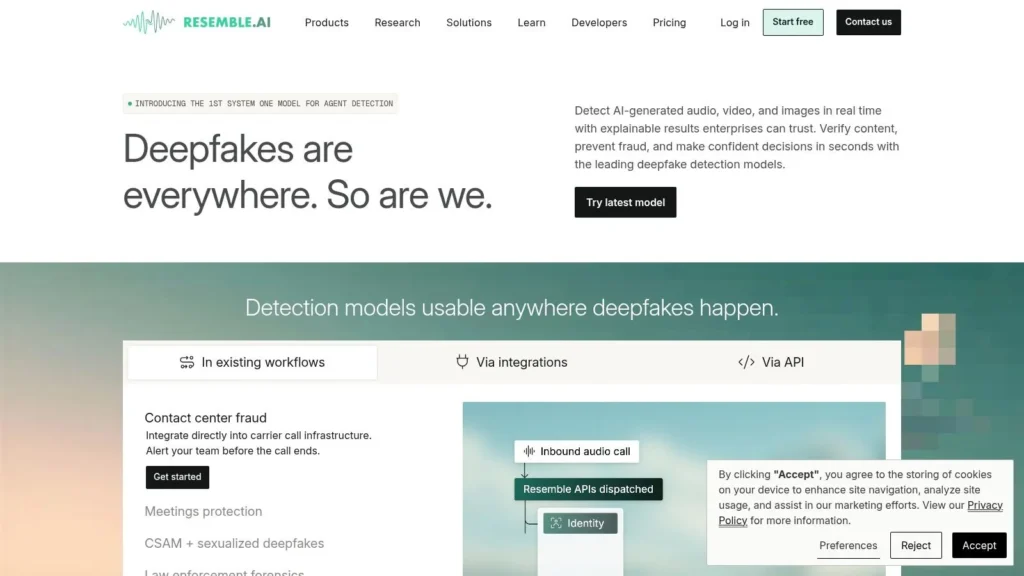
Resemble Detect covers audio, images, and video, with particular emphasis on cloned voices and communication scenarios. It supports real-time and batch modes, offers developer documentation, and can provide explanatory detection output. Its ability to check watermarks, including SynthID when present, gives it a provenance-oriented signal alongside statistical detection.
That combination changes how the tool should be interpreted. A classifier may identify characteristics associated with synthetic audio, while a watermark check may indicate that content originated from a participating generation system. The two outputs answer different questions. A positive watermark finding can be strong evidence about origin, but the absence of a watermark doesn’t establish authenticity.
Resemble’s focus on voice makes it relevant to meeting security, telecom workflows, voice-AI teams, and fraud investigations involving impersonation. Integrations with communication partners may help teams place checks closer to the live interaction instead of waiting for a recording to be uploaded.
A cautious procurement position
Public granular pricing for detection may not always be available, and enterprise or partner terms can apply. Claims and benchmark results also need independent validation under the buyer’s own conditions. Test background noise, call compression, multiple speakers, short clips, and unfamiliar voices before treating the system as a reliable gate.
The tool is most useful when paired with a known-channel callback or identity check. A voice score can tell a reviewer that the audio deserves scrutiny, but it can’t confirm that the caller is authorized to make a request.
4. Pindrop

Pindrop is primarily a voice-security system, not a general-purpose media-forensics workstation. Its Pulse and Protect suite is designed for contact centers and virtual meetings, with real-time voice-clone and deepfake detection, liveness and spoofing checks, and call-risk scoring.
That focus matters. A newsroom verifying an uploaded interview has a different requirement from a bank assessing a caller during an active interaction. Pindrop’s value lies in combining voice signals with authentication and fraud analytics so an organization can decide whether to continue, escalate, or add verification during the call.
Enterprise integrations and marketplace availability can support formal procurement. The product’s long track record in voice security is relevant for organizations with established telephony operations, but it also means the platform may be more extensive than a small editorial team needs.
The modality boundary
Pindrop is strongest on audio. Video and image coverage depends on meeting integrations rather than functioning as a standalone visual-forensics service. Teams looking for frame-level investigation of a social-media clip will need another tool.
Pricing is aimed at larger enterprise deployments and may be unsuitable for small teams. That isn’t a flaw in the detection approach, but it should prevent buyers from comparing Pindrop directly with a free upload service. For live voice risk, the right comparison is against other voice-security systems, not image classifiers.
5. Sensity AI
Sensity AI is an API-first platform for image, video, and audio forensics. Its single REST API, signed upload flows, and asynchronous processing are suited to teams that need to process media at scale while retaining a structured record of submissions and results.
The platform offers SaaS and on-premises deployment options. That flexibility is important for regulated environments, investigative units, and organizations that can’t send sensitive evidence to an external processing environment without reviewing data-residency and retention requirements.
Sensity’s investigative orientation is more important than a broad modality label. Explainability and chain-of-custody-friendly processing can help a reviewer document how a file entered the system, which processing step occurred, and what result the detector returned. That documentation still isn’t the same as proof of authenticity, but it creates a more defensible review trail.
Best use in an investigation
Sensity’s likely users include investigators, platforms, and enterprises conducting media-intelligence or authenticity work. Pricing isn’t publicly listed and generally requires an enterprise conversation. Buyers should request results on recompressed, resized, screen-recorded, and cross-generator content, then compare false-positive behavior with the organization’s tolerance for mistaken accusations.
The main operational risk is model drift. New generators can change the signals a detector sees, so deployment should include scheduled re-evaluation rather than a one-time acceptance test.
6. Google SynthID

Google SynthID belongs to a different category from most entries on this list. It is primarily a watermark detection and provenance signal, designed to identify content generated by Google AI models and partners that adopt SynthID.
The watermark is intended to be imperceptible while remaining detectable through supported verification tools. SynthID covers images and audio, with video support expanding, and Google provides a public verification route as well as an enterprise path through Google Cloud.
That makes SynthID valuable when the question is, “Does this content carry a supported generation watermark?” It isn’t a universal classifier that can assess arbitrary media from every generator. A file without a SynthID watermark may be authentic, generated by another system, edited after creation, or stripped of its signal during distribution.
Use it as an origin check
A positive result can add meaningful evidence to a verification file, especially when the content is claimed to come from a Google generation system. It shouldn’t be used as a universal real-or-fake verdict.
Enterprise API pricing isn’t broadly published, which makes direct cost comparisons difficult. Teams should also document whether a verification result was obtained from the original file or a platform-recompressed copy. Provenance signals are strongest when their history is preserved from creation through review.
7. Truepic
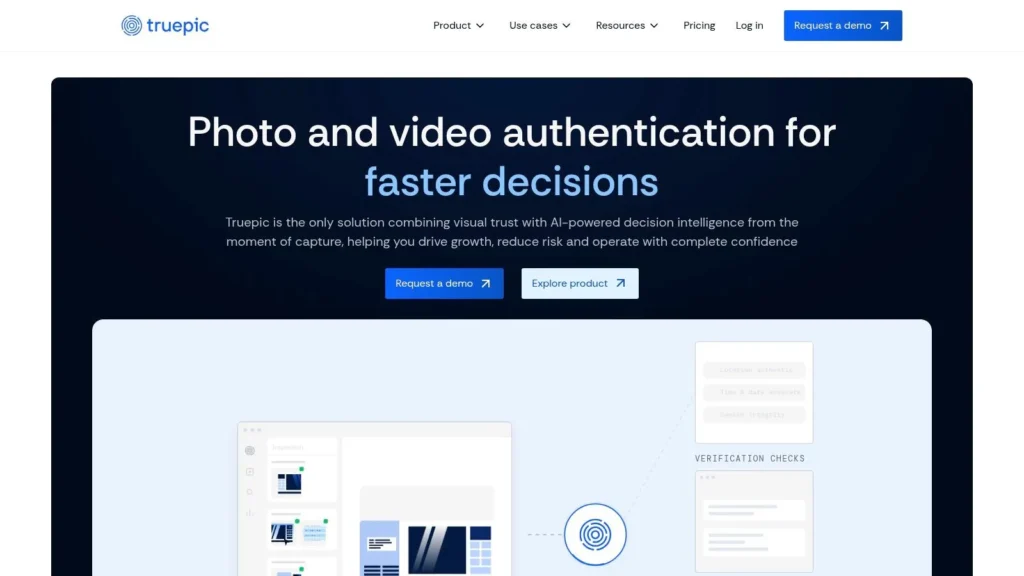
Truepic focuses on authenticity at capture, using device attestation and C2PA Content Credentials to create cryptographically signed media. Its capture SDK can sign content on the device, while its APIs validate credentials and run authenticity checks on media received later.
This is not the same job as a pixel classifier. A classifier asks whether the content contains patterns associated with manipulation. Truepic’s provenance workflow asks whether the file carries a verifiable record connecting capture, device, and subsequent changes. That distinction can improve auditability and support a clearer chain of custody when organizations control the capture process.
The approach fits journalism, insurance, e-commerce identity workflows, and public-sector use cases where the organization can establish a trusted capture path. It is less powerful for a viral clip downloaded from an unknown account, because provenance is most useful when credentials were created before the file began circulating.
Provenance is strongest before publication
C2PA credentials can support Maxijournal’s source-verification workflow by giving editors a structured authenticity signal to review alongside the source’s identity, location, and independent evidence.
Truepic isn’t a general pixel-based deepfake classifier. Pricing typically comes through enterprise or partner arrangements, and teams should ask how credentials survive editing, export, platform upload, and other transformations. A missing credential should trigger further checking, not an automatic fake label.
8. Deep Media
Deep Media’s DeepID is oriented toward voice and video detection, threat monitoring, and media intelligence. Its API and enterprise dashboards target organizations handling disinformation, impersonation, and public-sector risk at scale.
The product’s positioning makes it different from a newsroom upload utility. A national-security or threat-intelligence team may need to track recurring impersonation patterns and monitor a wider information environment, while an editor may need a defensible assessment of one disputed recording. Deep Media is more naturally evaluated against the first requirement.
Usage-based licensing can align with API workloads, but much of the product detail is handled through enterprise sales. That lowers price visibility and makes an independent test especially important before a critical deployment.
Require current external testing
A buyer should ask for modality-specific results, test conditions, supported input formats, retention terms, and evidence about unfamiliar generators. Public datasets and a GitHub presence can help researchers understand the surrounding ecosystem, but they don’t substitute for a current evaluation of the production service.
Deep Media is best treated as a threat-intelligence component. Its output can identify content that deserves investigation or help connect related incidents. It shouldn’t be the sole basis for declaring a video authentic, false, or intentionally deceptive.
9. AI or Not Optic
AI or Not Optic is built for teams that want a developer-friendly, multimodal detection layer. Its tools cover images, audio and voice, video, AI music, and AI-written text, with synchronous REST endpoints, SDKs, a dashboard, and limited or zero data-retention options.
The product fits quick integration, KYC checks, editorial screening, and platform workflows where an application needs a rapid classification signal. Pay-as-you-go options can make experimentation easier, while enterprise plans and integrations support larger deployments.
Its breadth is useful, but modality coverage shouldn’t be mistaken for equal reliability across every medium. A video result, a voice result, and an image result may come from different models with different weaknesses. Product teams should store the modality, model version, confidence, input characteristics, and decision taken rather than saving only a single “AI” label.
Classification isn’t provenance
Optic provides a classification-style result, not a cryptographic record of where media was created. That makes it complementary to provenance checks, not a replacement for them. Teams building a review system may also benefit from understanding what machine learning means in this context, particularly when explaining uncertainty to nontechnical editors or compliance staff.
Public price granularity varies by feature, and some enterprise accuracy claims need independent validation. Test unseen models, ordinary compression, low-light footage, and short audio samples before connecting the result to an irreversible user or publishing decision.
10. DeepFake-o-Meter
DeepFake-o-Meter is a free academic web service from the University at Buffalo Media Forensics Lab. It accepts images, video, and audio, then runs submissions through multiple open-source research detectors and returns comparative scores.
Its most valuable feature isn’t a supposedly definitive answer. It’s detector variance. If different models produce sharply different results, that disagreement tells a journalist or researcher that the media needs closer examination. Agreement can increase confidence in a screening judgment, but it still doesn’t overcome poor source quality, compression, or an unfamiliar manipulation method.
A second opinion, not an SLA
The service is useful for newsroom spot checks, teaching, and comparative research. It isn’t an enterprise-supported product with guaranteed speed, retention terms, or an organizational service-level agreement. Users handling sensitive material should review the platform’s current data-handling conditions before uploading it.
Research detectors can also lag behind in-the-wild or adversarial media. The result requires expert interpretation, which is why it pairs well with Maxijournal’s approach to AI ethics and governance, where the question isn’t only whether a model returns a high score, but how an organization should act under uncertainty.
Top 10 Deepfake Detection Tools, Feature Comparison
| Product | Modalities | Target audience / use cases | Integration & deployment | Pricing & cost model | Unique selling point |
|---|---|---|---|---|---|
| Reality Defender (RD) | Image, audio, video; frame-level scoring | Enterprises: fraud prevention, brand/media verification, call centers | Public API, SDKs, SaaS dashboard; cloud marketplace availability | Enterprise quotes; documented free testing tier | Ensemble of detectors with continuous updates; enterprise security focus |
| Hive Moderation – AI & Deepfake Detection | Image, video (per-frame), audio | High-volume platforms and moderation teams | API + web dashboard; built to scale | Transparent per‑unit, self-serve pricing | Part of a broader moderation suite; predictable cost forecasting |
| Resemble Detect (Resemble AI) | Audio, image, video; real-time & batch; watermark checks | Telecoms, meetings, voice-fraud detection, contact centers | APIs; telecom/meeting integrations, dev docs | Enterprise/partner quotes (public granularity limited) | Strong voice-cloning detection and SynthID/watermark decoding |
| Pindrop (Pulse/Protect) | Primarily audio (voice) | Contact centers, fraud/risk teams, enterprises | Real-time call integrations; conferencing integrations; marketplaces | Enterprise-focused pricing (typically high) | Established voice-security vendor; liveness, spoofing & risk scoring |
| Sensity AI | Image, video, audio (forensic-grade) | Investigators, platforms, regulated enterprises | Single REST API; SaaS + on‑prem options; chain-of-custody workflows | Enterprise quotes | Forensic explainability and deploy options for regulated workflows |
| Google SynthID (Detection) | Images, audio; video expanding (watermark-based) | Organizations using Google AI or seeking provenance signals | Public verification portal; Google Cloud enterprise API | Pricing not broadly published | High-reliability provenance when SynthID watermark is present; Google-backed |
| Truepic (Vision/Lens; C2PA) | Capture-level image/video provenance & verification | Journalism, insurance, KYC, compliance, public sector | Capture SDK that signs media; validation APIs; standards-based (C2PA) | Enterprise/partner quotes | Cryptographic, tamper-evident Content Credentials for auditability |
| Deep Media (DeepID) | Voice and video detection | Mis/disinformation monitoring, national security, public sector | API + dashboards for threat monitoring; developer resources | Usage-based licensing / enterprise sales | Focus on media intelligence and public-sector scale use cases |
| AI or Not (Optic) – Multimodal API | Images, audio/voice, video, text | Product teams, KYC flows, editorial checks, platforms | Synchronous REST, SDKs, dashboard; limited/zero retention options | Pay-as-you-go + enterprise plans (public detail varies) | Fast to trial; single vendor multi‑modal signals and privacy options |
| DeepFake-o-Meter (Univ. at Buffalo) | Images, video, audio via many research detectors | Journalists, researchers, editors, educators | Public web upload service that returns comparative model scores | Free to use | Academic, transparent comparative baseline for detector variance and education |
Build a Verification Workflow, Not a Verdict
The right tool depends on the event being verified. Voice-security systems such as Pindrop belong in live calls and contact-center workflows, where liveness, spoofing, identity, and call-risk signals can support an intervention during the interaction. Multimodal APIs such as Reality Defender, Hive, Resemble Detect, Sensity AI, and AI or Not fit product pipelines that need image, audio, or video screening at ingestion or review.
Provenance technologies solve a different problem. SynthID can identify supported watermark-bearing content, while Truepic can establish a cryptographically signed capture history when an organization controls the capture path. Neither tool can certify arbitrary internet media, and neither should be interpreted as a universal authenticity verdict.
Comparative research tools such as DeepFake-o-Meter are valuable when a journalist, researcher, or editor wants to observe disagreement between detectors. That disagreement is evidence about uncertainty, not evidence that one model is wrong. NIST’s evaluation guidance supports this broader approach by emphasizing distribution shift, ROC curves, AUC, false-alarm trade-offs, and testing on altered and compressed files. Its OpenMFC also uses operational measures such as AUC and Correct Detection Rate at a defined false-alarm rate, while DeepfakeBench brings 34 detectors and 10 datasets into a standardized comparison environment, as described by NIST’s forensic evaluation program.
A practical newsroom or research workflow should include:
- Preserve the original: Save the file as received, record its hash where appropriate, and keep later exports separate from the original.
- Document processing: Record downloads, conversions, screenshots, cropping, transcription, and every detector submission.
- Review provenance: Inspect C2PA credentials, watermarks, metadata, source history, and platform transformations.
- Compare detectors: Use more than one classifier, preferably across different model families and modalities.
- Separate evidence types: Keep classifier scores, provenance signals, source testimony, metadata, and independent corroboration in distinct fields.
- Protect privacy: Check retention, deletion, regional processing, on-premises options, and whether sensitive faces or voices are used for model improvement.
- Use human review: Route ambiguous or high-consequence results to a trained reviewer instead of applying an automatic rejection.
- Set documented thresholds: Define what happens at low, medium, and high confidence, and account for the cost of false accusations and missed fakes.
- Retest continuously: Evaluate new generators and ordinary transformations such as recompression, resizing, screen recording, and low-quality capture.
This layered approach is becoming an operational requirement, not merely a technical preference. The EU AI Act’s transparency obligations for deepfakes and other AI-generated or manipulated content are scheduled to apply on 2 August 2026, including disclosure duties for deployers and machine-readable markings for relevant AI systems, according to the European Commission’s explanation of the rules. Compliance will require more than purchasing a classifier. Organizations need labeling, provenance, documentation, review, and escalation procedures.
Adoption is growing, but deployment is still incomplete. A 2026 survey of 713 fraud professionals found that 25% of organizations were already using AI or machine learning in anti-fraud programs, compared with 18% in 2024, while 28% expected to adopt by 2028. The same survey found that 77% had seen deepfake social engineering increase and 72% had seen deepfake digital injection increase, as reported by SAS in its coverage of the ACFE anti-fraud technology study. Those figures indicate rising exposure, not proof that one vendor or classifier solves the problem.
The most useful conclusion is therefore contrarian but practical. A tool that performs impressively on a curated benchmark may still be unsuitable for authenticating a compressed viral clip. A lower score from several independent signals, combined with provenance and corroboration, may be more useful than a single impressive number.
That is the standard Maxijournal should apply when evaluating technology stories. As an independent publication, it can distinguish product capability from vendor claims, report uncertainty directly, and connect technical results to the editorial decisions readers make. That same discipline supports broader strategies for handling misinformation in social care and public-facing communication, where a false positive can harm trust just as a missed fake can.
Maxijournal.com publishes approachable reporting and commentary on science, technology, business, health, arts, education, and other subjects where evidence matters. Visit maxijournal.com for independent technology stories, practical explainers, and opportunities for readers and contributors to engage with the publication.
Discover more from Maxi Journal
Subscribe to get the latest posts sent to your email.