So, when is the next ice age? If you were to ask this question based purely on Earth’s natural history, the answer would point to a cosmic clock that had the next glacial period kicking off in about 10,000 to 50,000 years. But human activity has completely upended that ancient timeline, potentially delaying or even canceling the next big freeze.
The Surprisingly Simple Answer to the Next Ice Age
For millions of years, Earth’s climate has danced to a predictable, cyclical rhythm. This natural pulse, driven by subtle shifts in our planet’s orbit around the sun, created a reliable pattern of long, cold glacial periods (ice ages) followed by shorter, warm interglacials, like the Holocene Epoch we’re in right now.
You can think of it as a planetary symphony. Each tiny wobble and tilt of our world contributed to a grand, long-term climate composition. Because this clockwork was so regular, predicting the next ice age was mostly a matter of understanding these cosmic beats. Following that predictable score, scientists had a clear answer: our current warmth was due to end, and the initial cooling that signals a new ice age was just over the horizon.
Earth’s Natural Glacial Schedule
For hundreds of thousands of years, our planet has swung through these dramatic climate shifts, with massive ice sheets periodically grinding across entire continents. In-depth research analyzing a million years of data from ice sheets and deep ocean temperatures showed the next glacial period was naturally slated to start in about 10,000 years. The study found an incredible link between the start of ice ages and changes in Earth’s axial tilt, which seems to be the main trigger. You can explore the full findings of these planetary rhythms and their connection to past climate shifts.
This long-term, predictable pattern is governed by what we call Milankovitch cycles. These are three key orbital changes that work in concert over immense timescales:
- Glacials: These are the long, cold chapters lasting around 100,000 years. During these periods, colossal ice sheets expand from the poles to cover huge parts of North America, Europe, and Asia.
- Interglacials: These are the shorter, warmer intervals, like our current Holocene. They typically last between 10,000 and 30,000 years and represent a temporary retreat of the ice before the cycle begins again.
A New Conductor Enters the Orchestra
But a powerful new instrument has just joined the orchestra—human-driven carbon emissions. This new influence is playing so loudly it’s starting to drown out the original, natural score. The staggering amount of greenhouse gases we’ve pumped into the atmosphere acts as a potent warming agent, overwhelming the subtle cooling cues from Earth’s orbit.
The result is a profound disruption of a system that has operated for eons. We have effectively seized the planetary thermostat, turning it up to a level that is now strong enough to counteract the natural forces that would otherwise be guiding us toward the next glacial period. The question is no longer just when is the next ice age, but if it will happen at all in the foreseeable future.
To really grasp how much we’ve altered this timeline, it helps to compare the natural schedule with different projections based on our carbon output. The differences are stark.
Natural vs Human-Influenced Ice Age Timelines
| Scenario | Predicted Onset of Next Glacial Period | Key Driver |
|---|---|---|
| Natural Conditions (No Humans) | In approx. 10,000 – 50,000 years | Subtle shifts in Earth’s orbit (Milankovitch cycles) |
| Low-Emissions Scenario | Delayed by at least 50,000 years | Moderate atmospheric CO2 levels (around 400-500 ppm) |
| High-Emissions Scenario | Potentially skipped entirely for 500,000 years or more | High atmospheric CO2 levels (above 700 ppm) |
As the table shows, even in our best-case scenarios, we’ve already pushed the next ice age far into the future. In the worst-case scenarios, we may have broken the cycle completely for a timeframe longer than modern humans have existed.
Understanding Earth’s Cosmic Climate Pacemaker
So, how does our planet know when it’s time to start an ice age? The trigger isn’t found on Earth at all, but in the slow, rhythmic dance our planet performs as it orbits the sun. These predictable orbital shifts are known as Milankovitch cycles, and for millions of years, they’ve acted as Earth’s natural climate clock.
Think of it like a cosmic metronome, setting a very slow but powerful beat that dictates when glacial periods begin and end. These cycles subtly change the amount of solar energy—what scientists call insolation—that hits the Northern Hemisphere. This is the key, because this is where the massive continental ice sheets are born.
The Three Rhythms of Earth’s Orbit
The Milankovitch theory isn’t about one single change, but three separate orbital movements that overlap. Each operates on its own massive timescale, and when they line up just right, they create the perfect conditions for ice to either take over or retreat.
Eccentricity (Orbital Shape): This cycle is all about the shape of Earth’s orbit. Over about 100,000 years, our path around the sun shifts from nearly circular to slightly more elliptical (oval-shaped) and back. When the orbit is more elliptical, Earth’s distance from the sun varies more, altering the total solar energy we get throughout the year.
Obliquity (Axial Tilt): This is the tilt of Earth’s axis, the very reason we have seasons. On a 41,000-year cycle, this tilt rocks back and forth between 22.1 and 24.5 degrees. A greater tilt means more extreme seasons—hotter summers and colder winters. But a smaller tilt leads to milder seasons, and that’s crucial for ice growth. Why? Cooler summers mean last winter’s snow doesn’t completely melt away.
Precession (Wobble): Like a spinning top that starts to wobble, Earth’s axis also wobbles slowly in a circle. This 23,000-year cycle changes which direction the axis points. This determines which hemisphere is tilted toward the sun during our closest approach, directly impacting whether northern summers are hot or cool.
When you look at the geologic record, these cycles match up beautifully. The 41,000-year tilt, 23,000-year wobble, and 100,000-year orbital stretch are the undisputed drivers of past ice ages. During the last one, which lasted from about 120,000 to 11,500 years ago, these cycles aligned to cool the Northern Hemisphere, allowing ice sheets to grow so vast that global sea levels plummeted. Learn more about the science behind these glacial cycles and their powerful history.
The Master Switch for an Ice Age
How do these three cosmic rhythms work together to flip the planet into a deep freeze? It all comes down to giving the Northern Hemisphere a long, cool summer.
The secret to starting an ice age isn’t an brutally cold winter. It’s a summer that’s just not warm enough to melt the snow and ice from the previous year. When snow survives the summer, it starts to pile up, year after year, compacting into continent-sized glaciers.
When eccentricity, obliquity, and precession all conspire to reduce summer sunlight up north, they set the stage. The growing ice sheets then kick off a powerful feedback loop. Their bright white surfaces reflect more sunlight back into space, causing even more cooling and helping the ice expand further.
This is how the natural clock works. But as this diagram shows, that clock has been seriously disrupted.
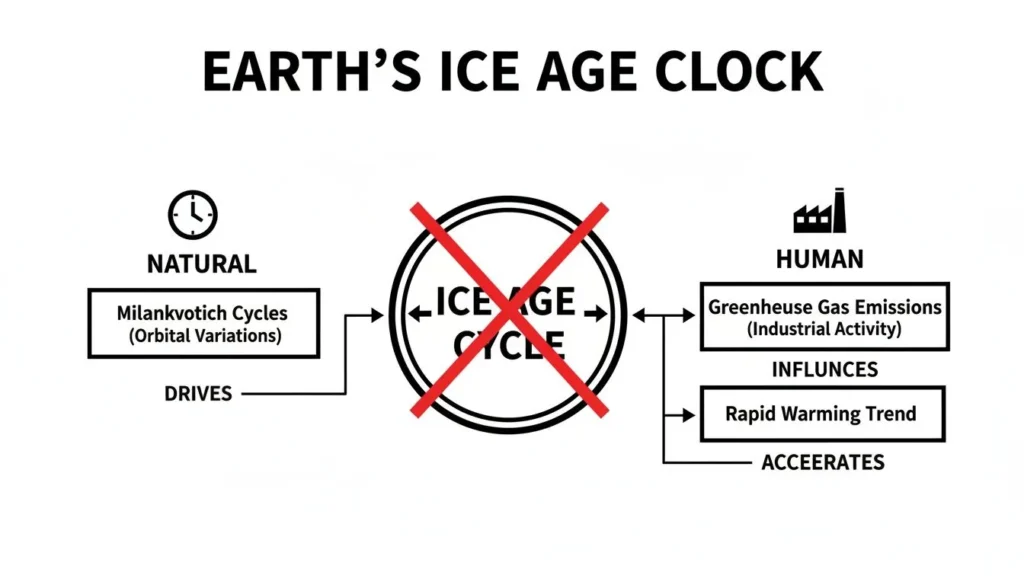
The image perfectly contrasts the slow, methodical beat of natural cycles with the rapid, overwhelming force of human-driven warming. For eons, Milankovitch cycles were the only game in town, making ice ages a predictable part of our planet’s story. Grasping this cosmic pacemaker is the first step to seeing just how dramatically we’ve thrown that ancient rhythm off-kilter.
To figure out why the next ice age might be on hold, we first have to understand how we can possibly know what Earth’s climate was like hundreds of thousands of years ago. It sounds like science fiction, but researchers have become incredible climate detectives, using natural archives to piece together the past with stunning accuracy.
These natural records are called climate proxies. Think of them as the pages in Earth’s massive history book, preserving direct evidence of past conditions. They let us see the planet’s long-term rhythms and confirm the natural schedule of glacial cycles.
Two of the most powerful proxies come from completely different environments: the frozen ice sheets at the poles and the dark, muddy depths of the ocean floor.
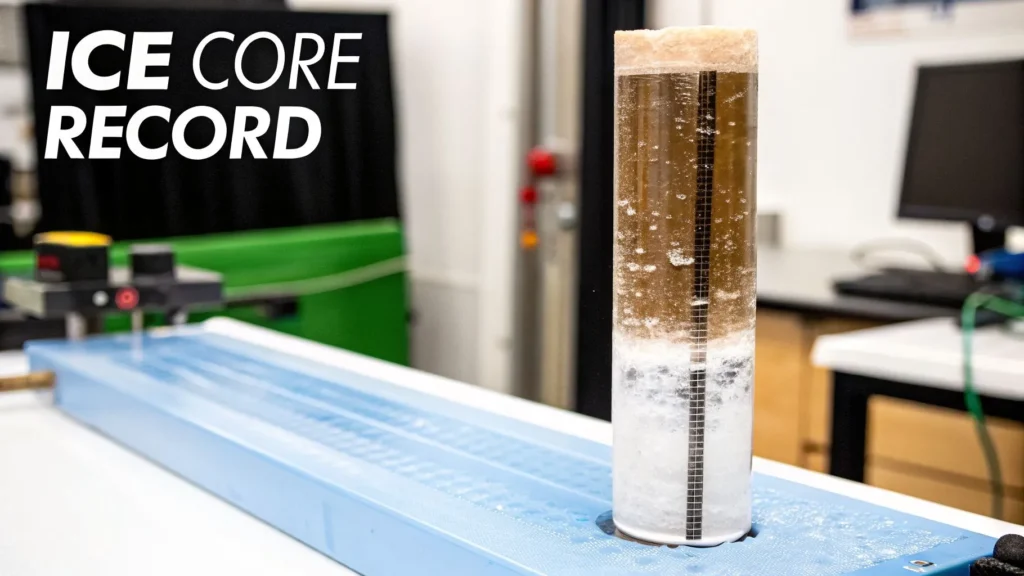
Frozen Libraries of Ancient Air
Imagine a library where the books are massive columns of ice, and each page is a single year’s snowfall. That’s exactly what ice cores drilled from Greenland and Antarctica give us. As snow falls and builds up over millennia, it gets compressed into distinct annual layers, trapping tiny bubbles of the atmosphere.
Those bubbles are perfect little time capsules. By analyzing the air trapped inside, scientists can directly measure the concentration of greenhouse gases like carbon dioxide (CO2) from as far back as 800,000 years ago. The ice itself holds clues, too—studying the specific types of atoms in the frozen water allows researchers to reconstruct past temperatures with incredible precision.
When scientists put all this data together, a powerful story emerges. The records show an almost perfect lockstep between CO2 in the atmosphere and global temperatures. During past ice ages, CO2 levels hovered around 180 parts per million (ppm). During the warm periods in between, they rose to about 280 ppm. This undeniable link is the key to understanding our current climate disruption.
Unlocking Secrets From the Deep Sea
While ice cores tell us about the air, sediment cores from the ocean floor reveal secrets about the water. By drilling deep into the seabed, scientists pull up long cylinders of mud that have slowly settled over millions of years. Inside this mud are the fossilized shells of tiny marine organisms known as foraminifera.
These microscopic shells are chemical treasure chests. The makeup of their shells changes based on the temperature of the water they grew in. Even more telling, the specific oxygen atoms (isotopes) in the shells tell scientists how much water was locked up in the world’s ice sheets at the time.
This means that by analyzing these tiny fossils, we can create a continuous logbook of both past ocean temperatures and the total volume of global ice. It’s an incredibly detailed account of every past ice age.
Weaving the Threads of Evidence Together
What makes the science of paleoclimatology so solid is that these different lines of evidence all tell the same story. They confirm each other.
- Ice Cores: Give us direct evidence of past atmospheric CO2 and air temperature.
- Sediment Cores: Provide a detailed history of ocean temperatures and how much ice existed on the planet.
When you lay these records side-by-side, they align perfectly. The temperature spikes and dips seen in the ice cores match the changes in ocean temperature and ice volume recorded in the deep-sea mud. This powerful consistency gives scientists immense confidence in their reconstructions of Earth’s past.
Most importantly, the timing of these climate shifts perfectly matches the predictable, clockwork-like rhythm of the Milankovitch cycles. The evidence is clear: Earth’s climate has long followed a natural, orbitally-driven schedule. This historical record is the essential baseline we need to measure the dramatic changes happening today and to understand what will—or won’t—trigger the next ice age.
For millions of years, Earth’s climate has followed a predictable rhythm, nudged along by the slow, gentle shifts in our planet’s orbit. But that ancient schedule is now being dramatically overwritten by a new, powerful force: human activity.
This is where the story takes a sharp turn, and we see just how much we’ve altered the planet’s climatic future.
For thousands of years, the concentration of carbon dioxide (CO2) in our atmosphere naturally hovered around 280 parts per million (ppm). This level was the sweet spot for our current warm period, the Holocene, allowing civilizations to rise and thrive.
But in just the last two centuries, that number has shot up. Today, atmospheric CO2 has soared past 420 ppm, a concentration not seen for millions of years. This isn’t a small tweak; it’s a massive intervention in the Earth’s climate system, and it changes all the rules.
The Planetary Thermostat Turned Way Up
Think of the Earth’s climate like a house with a very sensitive thermostat. The Milankovitch cycles have been making tiny, gradual adjustments to that thermostat for eons, slowly dialing the temperature up and down over tens of thousands of years. These were the subtle nudges that guided the planet into and out of ice ages.
In what amounts to a geological blink of an eye, we’ve grabbed that thermostat and cranked it to a setting the planet hasn’t seen in over three million years. We did it by burning massive amounts of fossil fuels, releasing colossal quantities of greenhouse gases like CO2.
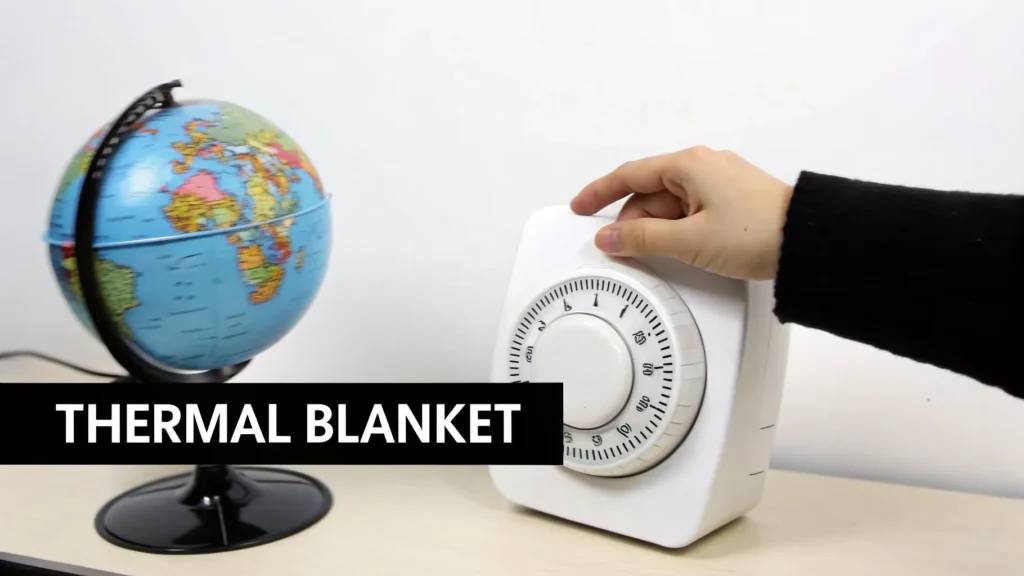
This extra CO2 acts like a thick thermal blanket wrapped around the Earth. Just as a blanket traps your body heat on a cold night, these gases trap heat from the sun that would normally radiate back into space. This powerful warming effect is now completely overwhelming the faint cooling signals from our planet’s orbit.
This “blanket” is the single biggest reason why the natural timeline for the next ice age has been thrown off course. The gentle cooling that should be slowly setting in is being drowned out by this intense, human-generated warmth.
Why This Thermal Blanket Stops an Ice Age
For an ice age to kick off, you need one key ingredient: massive ice sheets have to form and expand across the Northern Hemisphere. This can only happen if summers are cool enough to prevent the previous winter’s snow from melting, allowing it to pile up year after year.
Right now, our orbital position is actually in a phase with less summer sunlight in the north—a condition that would normally, over time, encourage the start of glaciation. But the CO2 blanket we’ve created is now so thick that it’s keeping summer temperatures far too high for this process to even begin.
The extra warmth simply melts any budding ice sheets before they can get a foothold. The natural trigger for an ice age is still present, but the human-caused warming is effectively slamming on the brakes.
This is a fundamental change to our planet’s operating system. If you want a deeper look at the mechanisms involved, you can learn more about what climate change is and how it works on a global scale. Studies show that even if all emissions stopped today, the CO2 we’ve already released will remain in the atmosphere for centuries, continuing to exert its warming influence.
- Natural Cooling Signal: Earth’s current orbital cycle is creating conditions that should, over millennia, lead to cooler northern summers.
- Human Warming Force: The huge increase in atmospheric CO2 traps heat, raising global temperatures and ensuring summers stay warm.
- The Outcome: The human warming force is now far stronger than the natural cooling signal, preventing the year-on-year snow accumulation needed to start an ice age.
The scientific consensus is clear: we have already put enough carbon dioxide into the atmosphere to put off the next ice age for at least 50,000 years. The question of when is the next ice age has shifted from a geological prediction to a human-driven one.
The Future of Ice Ages Postponed or Canceled?
So, we’ve completely thrown a wrench in Earth’s natural climate clock. What does that mean for the great cycle of ice ages? The conversation among scientists is no longer just about when the next ice age will arrive, but if it will happen at all in any future we can imagine.
The answer really boils down to the long-term legacy of our carbon emissions.
Climate models are now overwhelmingly in agreement: we have already pumped enough carbon dioxide into the atmosphere to radically change our planet’s long-term climate path. The warming effect from the CO2 already up there is simply too powerful. It’s strong enough to override the natural cooling signals that would otherwise have tipped us into a new glacial period.
This isn’t just a minor delay. The data suggests we’ve broken the cycle on a timescale that is almost impossible for us to truly wrap our heads around.
The Minimum Delay We’re Already Locked Into
Even if every carbon-emitting activity on Earth stopped this very second, a significant amount of warming is already “baked in.” The CO2 we’ve released will hang around in the atmosphere for hundreds of years, and the oceans will keep releasing the heat they’ve soaked up for even longer.
Working from this reality, scientific models show we’ve already postponed the next ice age by a bare minimum of 50,000 years.
To put that number in perspective, 50,000 years ago, our modern human ancestors were sharing the planet with Neanderthals. It’s a span of time longer than all of recorded history. This delay isn’t a “what if” anymore; it’s our current reality.
Scenarios for an Even Longer Postponement
That 50,000-year delay is the best-case scenario. If global emissions continue on a high path, the effects become even more staggering. The extra warming could push the next ice age off by an incredible 100,000 to 500,000 years.
This effectively means we’re not just skipping one glacial cycle, but potentially several. We’re taking on the role of a geological force, pushing Earth into what some scientists are calling an “extended interglacial” or even a “super-interglacial”—an unnaturally long warm spell.
A world that goes half a million years without an ice age would be, from a geological standpoint, unrecognizable.
- Ice Sheet Stability: The massive ice sheets covering Greenland and Antarctica would face a continuous, unending period of warmth. This raises serious, long-term questions about their stability and how much they’ll contribute to rising sea levels.
- Geological Processes: Ice ages are monumental events. They carve out landscapes, forge new river paths, and move mountains of sediment. Skipping them means removing one of the key tools our planet has used to shape itself for millions of years.
- Evolutionary Trajectories: Life on Earth has evolved to the rhythm of these glacial and interglacial cycles. A permanent break in that pattern could have unpredictable, long-term ripple effects on ecosystems and the path of evolution itself.
Grasping this immense timescale isn’t about creating alarm. It’s about appreciating the sheer magnitude of our influence. The decisions we make in our lifetimes will have consequences that echo for a period longer than our species has known farming. This level of planetary engineering is something you only see in events like the Great Oxygenation Event or a major asteroid impact. If the concept of shaping worlds intrigues you, you might be interested in our article discussing how long it would take to terraform Mars, another grand-scale planetary project.
Why a Postponed Ice Age Matters to Us Today
It’s easy to think of geological time as something abstract, but the fate of a far-future ice age is surprisingly relevant right now. Looking at this massive change gives us a new lens to understand the true scale of our impact on Earth’s most basic systems.
We often hear about climate shifts over thousands of years. It’s another thing entirely to see the consequences playing out in our own lifetimes. The very warming that’s powerful enough to cancel a glacial cycle is also driving tangible effects we simply can’t afford to ignore.
The Immediate Consequences of Long-Term Change
The most direct issue is the stability of our planet’s remaining ice sheets. The enormous ice reserves in Greenland and Antarctica—which should have been the seeds for the next glaciation—are now facing relentless heat.
Their continuous melting is what’s driving modern sea-level rise. This isn’t a problem for some distant generation; it’s happening as we speak, hitting coastal communities all over the world.
The irony is powerful: for decades, pop culture and some media sensationalized the fear of a coming ice age. Yet the overwhelming scientific reality is a warming world of our own creation, where the more immediate threat is not advancing ice, but retreating coastlines.
From New York to Tokyo, major cities are staring down a future shaped by rising waters. This is a direct consequence of the same heat that has thrown the next ice age completely off its schedule. Every inch of sea-level rise increases the risk of flooding, storm surge damage, and saltwater creeping into our freshwater.
A New Geological Epoch
This unprecedented disruption is more than just a delayed climate event. Many scientists believe it signals the beginning of a whole new geological epoch: the Anthropocene.
This proposed epoch isn’t defined by the slow, natural rhythms of the planet. Instead, it’s defined by the permanent and powerful fingerprint of human activity. Our actions have become a geological force in their own right, strong enough to change the course of Earth’s history. Learning about the transition to what is renewable energy is a key step in understanding how we can lessen this impact.
The legacy we’re creating now will be written into the rock strata for millions of years. Future geologists will see a planet that was supposed to cool but instead got hit with a dramatic, human-induced fever spike. The question “when is the next ice age” has been answered with a profound new reality: it’s on a schedule that we, for better or for worse, are now setting.
Frequently Asked Questions About the Next Ice Age
Whenever you’re talking about a timeline that spans thousands of years, a few key questions always pop up. Let’s dig into some of the most common ones that come to mind when we look at the future of Earth’s climate.
Weren’t Scientists Worried About a Coming Ice Age in the 1970s?
This is a classic question, and it’s rooted in a bit of truth. You might have heard about a “global cooling” scare in the 1970s, and yes, some media reports definitely ran with that headline. But the idea was never the scientific consensus.
What really happened was a few research papers explored Earth’s natural cooling cycles. Some news outlets latched onto the most dramatic possibility and sensationalized it. At the exact same time, a much larger and rapidly growing body of research was already pointing to the significant warming we’d see from greenhouse gases. The “coming ice age” story was a media moment, not a widely held scientific view.
It’s a persistent myth. An analysis of the actual climate papers published in the 1970s shows the overwhelming majority already predicted or assumed a warming trend. The idea of a scientific consensus on global cooling has been thoroughly debunked.
Is It Possible for a Mini Ice Age to Happen Soon?
People often use the term “mini ice age” when thinking about something like the Little Ice Age, which chilled parts of the world from roughly 1300 to 1850. But that was a period of regional cooling—mostly in the North Atlantic—not a true, planet-wide ice age.
It’s true that certain natural events, like a massive volcanic eruption or a dip in the sun’s activity, can cause temporary cooling. But these effects only last for a few years or decades, and their impact is small. Scientists are in firm agreement that these natural wobbles are completely overshadowed by the powerful, long-term warming driven by our current CO2 levels. So no, a “mini ice age” isn’t going to swoop in and save the day.
If We Stop All Emissions Today, Will the Ice Age Happen on Schedule?
That’s a great question, but the answer is a hard no. Even if we could magically halt all carbon emissions this very second, the next ice age wouldn’t arrive on its natural schedule. The problem is that the carbon dioxide we’ve already pumped into the atmosphere is incredibly stubborn; it will stick around and keep the planet warm for many centuries.
The scientific consensus here is crystal clear. We have already put enough CO2 into the air to delay the next glacial cycle by at least 50,000 years. That ship has sailed; the window to let the next ice age begin on time has already slammed shut.
At maxijournal.com, we delve into the science that shapes our world, from past climates to future technologies. Explore more articles and join our community of curious readers today!
Discover more from Maxi Journal
Subscribe to get the latest posts sent to your email.